Portable Gas Monitor Calibration: How Often Is It Needed for Safe Confined-Space Work?
Author
Date Published
Reading Time
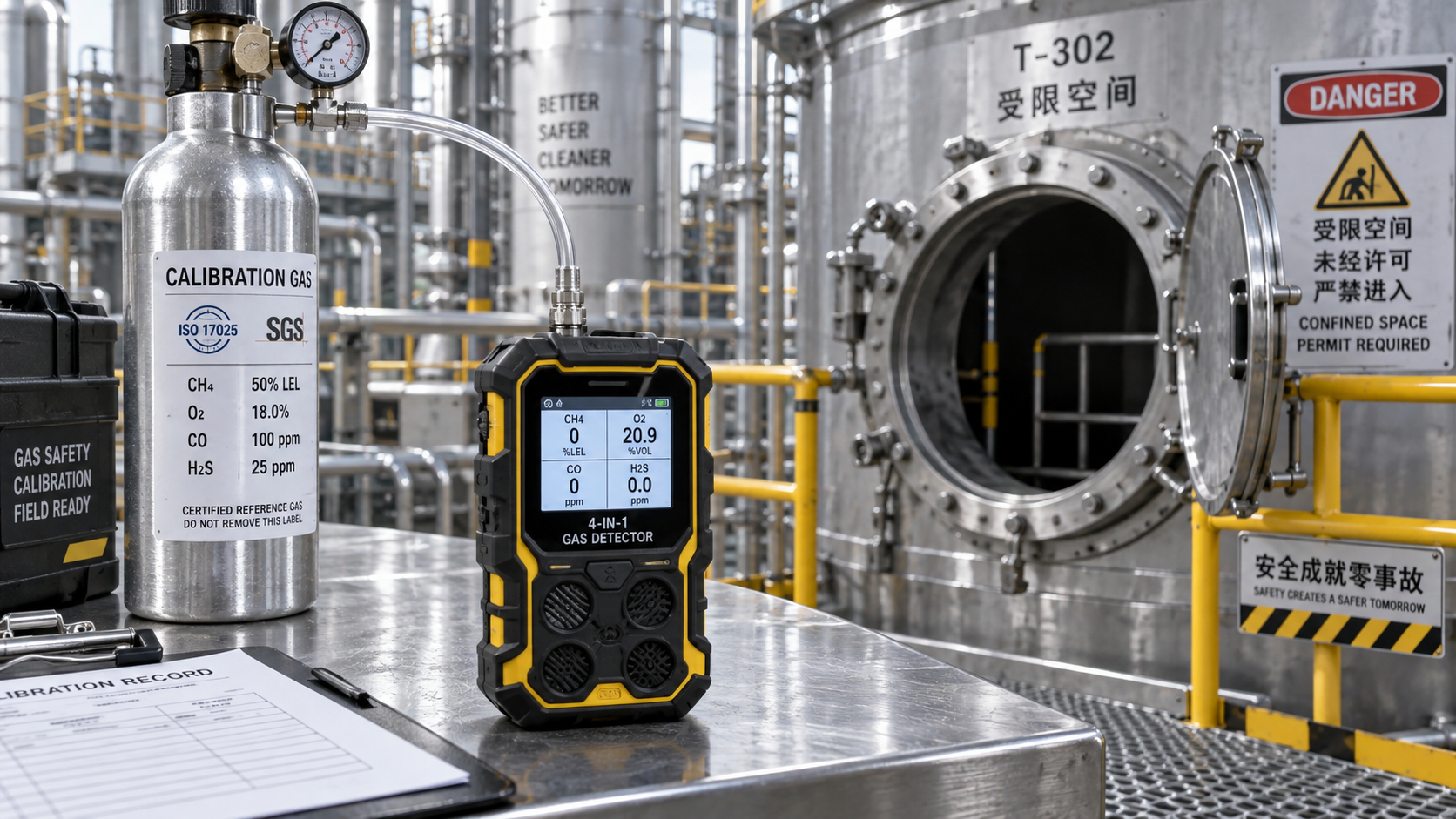
A portable gas monitor used for confined-space entry should receive a full calibration at the interval specified by its manufacturer, with the interval shortened when exposure, handling, environmental conditions, or verification results indicate reduced confidence in sensor response. A bump test before use confirms that the instrument responds to test gas and alarms; it does not establish measurement accuracy across the sensor range. For entry decisions involving oxygen deficiency, flammable vapours, hydrogen sulfide, carbon monoxide, or other identified hazards, that distinction is decisive.
There is no defensible universal interval that applies to every portable monitor. The correct calibration frequency is set by the instrument instructions, the applicable site procedure, and evidence from use. A monitor that is routinely bump-tested, stored correctly, exposed only to clean air, and showing stable results may remain within its stated calibration schedule. The same model used around solvent vapours, silicone-containing products, high humidity, dust, temperature cycling, or corrosive contaminants can require earlier recalibration or sensor assessment.
Calibration and bump testing answer different questions
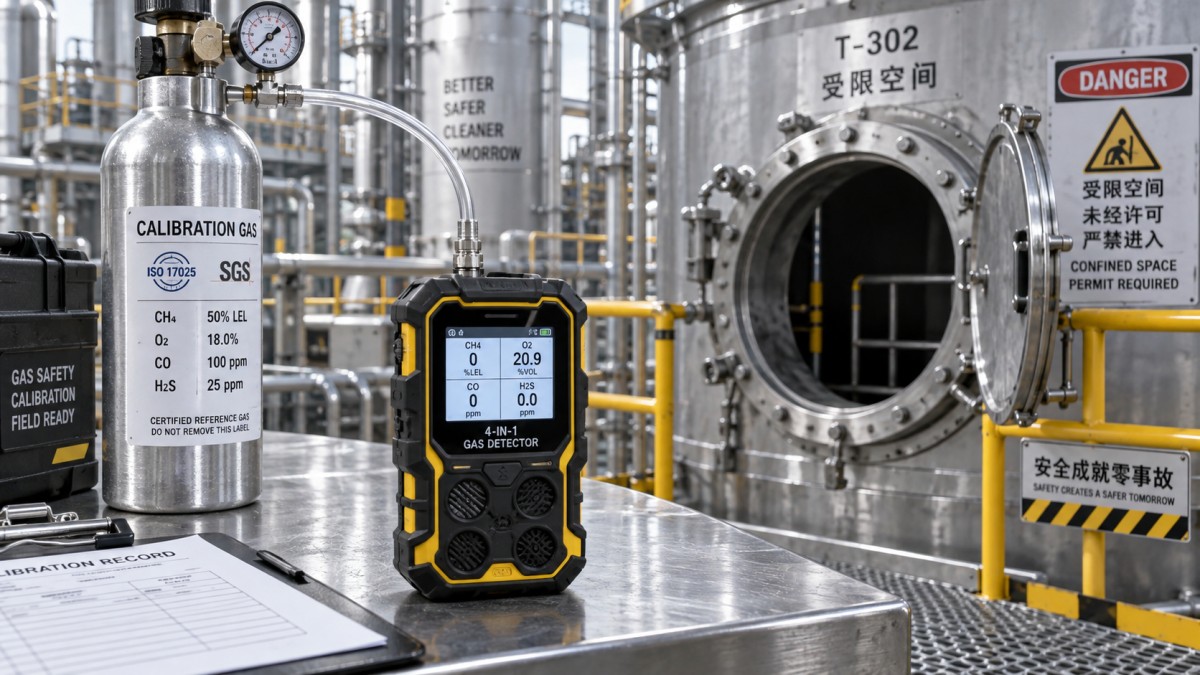
A bump test exposes the monitor to a known test gas concentration sufficient to confirm gas delivery, sensor response, alarm activation, visual indication, audible indication, vibration where fitted, and associated control functions. It is a functional challenge. It answers: Will this device detect gas and alarm?
Full calibration compares the displayed reading with a traceable known concentration and adjusts the instrument response where adjustment is required. Zero adjustment establishes the baseline in suitable clean air or with an approved zero gas. Span calibration then aligns the sensor output to the certified concentration of the applicable calibration gas. It answers: Is this instrument reading concentration accurately enough for the intended decision?
A monitor can pass a bump test while its displayed concentration has drifted beyond acceptable tolerance. This is particularly relevant where a reading is close to an entry limit, a flammability threshold, or an alarm set point. Conversely, a failed bump test is not automatically proof of a failed sensor. An empty cylinder, incorrect regulator, blocked tubing, damaged probe, exhausted pump, poor connection, expired gas, or wrong gas mixture can create the same observed failure. The fault must be isolated before the monitor is returned to service.
Set the interval from the equipment instructions, then apply field triggers
The manufacturer's calibration interval is the starting control because it reflects the sensor design, approved gas mixtures, specified accuracy, and instrument approval conditions. Site rules or contract requirements may impose a more frequent interval. Neither should be relaxed merely because recent bump tests passed.
Beyond the scheduled interval, full calibration or a documented investigation is warranted after a failed functional test, abnormal response time, unexpected zero drift, sensor replacement, firmware work that affects measurement functions, or repair of gas-path components. A monitor should also be assessed after immersion, severe impact, prolonged storage, battery leakage, loss of configuration, or exposure to an atmosphere likely to poison or overload a sensor.
Combustible-gas sensors deserve particular attention. Catalytic bead sensors require oxygen to respond correctly to combustible gas and can be inhibited or poisoned by certain compounds. Silicone vapours, sulfur-containing materials, lead-containing compounds, and some halogenated substances are among contaminants that can affect response, subject to the sensor construction and exposure conditions. A monitor may show a normal zero reading after such exposure while responding weakly or slowly to calibration gas. Infrared combustible sensors avoid some catalytic poisoning mechanisms, but they have their own gas-response characteristics and may not respond to hydrogen or other gases that do not absorb at the relevant infrared wavelengths.
Electrochemical toxic-gas and oxygen sensors also change with age and environment. Temperature, humidity, pressure, cross-sensitivity, and prolonged exposure can alter their output. An oxygen sensor reading that appears plausible at ground level is not proof that it will remain accurate after storage in heat or after a substantial change in ambient pressure. Where the monitor compensates automatically for temperature or pressure, the compensation function does not remove the need for calibration at the required interval.
Confined-space conditions can justify a tighter control cycle
Calibration frequency should reflect the consequence of an incorrect reading, not merely the calendar. A short-duration entry into a well-characterized, clean utility vault and entry into a vessel with residues, cleaning chemicals, inerting history, or process connections do not present the same uncertainty. Where the atmosphere can change rapidly, the monitor is part of a wider control system that includes isolation, ventilation, permit conditions, communication, rescue arrangements, and continuous or repeated atmospheric testing as required by the task.
The gas selection and sensor configuration must match the hazard assessment. A common four-gas monitor may measure oxygen, lower explosive limit, carbon monoxide, and hydrogen sulfide, but it does not automatically detect every toxic gas, vapour, or oxygen-displacing substance relevant to a space. Calibration cannot correct a mismatch between the instrument's sensors and the actual hazards. For example, a low combustible reading does not establish that a nitrogen-purged space is safe, and a normal oxygen reading does not rule out a toxic contaminant outside the installed sensor range.
Sampling method changes the interpretation as well. Diffusion monitors need adequate time for the atmosphere at the sensor inlet to reach the sensing elements. Pumped instruments require a leak-free sampling train, compatible tubing, clean filters, adequate flow, and sufficient stabilization time at each sampling level. A fresh calibration does not compensate for a kinked sample line or a blocked water trap. Before entry, testing at different elevations remains necessary because gases and vapours do not always distribute uniformly, especially in spaces with poor mixing, thermal gradients, residual liquids, or ongoing releases.
Control the calibration gas as carefully as the monitor
Calibration quality depends on the reference gas, delivery system, and method. The cylinder concentration must be suitable for the instrument and sensor, within its stated certification period, and traceable through the supplier documentation required by the site system. Incorrect concentration, incorrect balance gas, incompatible regulator flow, or a mismatched gas mixture can produce a result that looks successful in the docking station while leaving the monitor unsuitable for the intended hazard.
For oxygen channels, the specified zeroing method matters. Ambient air is only an acceptable zero reference when it is known to be clean and within the conditions stated by the instrument instructions. Near vehicle exhaust, process vents, charging areas, solvent use, or other emissions, ambient air can introduce an offset at the start of calibration. The same concern applies to toxic-gas sensors whose baseline is affected by nearby contaminants.
Gas delivery components are not passive accessories. Tubing absorbs or delays certain vapours, moisture can restrict filters, and damaged fittings can dilute the challenge gas with air. When a monitor repeatedly fails calibration but succeeds with a direct connection, the sample train should be investigated before replacing the sensor. When it fails in both arrangements, sensor condition, electronic fault, gas validity, and configuration should be examined in a controlled sequence.
Use calibration records to detect drift, not just prove completion
A useful record links the individual instrument to its serial number or asset identifier, installed sensor types, calibration date and time, person or authorized system performing the work, gas cylinder identity, gas expiry status, test result, adjustment values where available, and any corrective action. The record should also preserve the instrument configuration relevant to entry decisions: alarm set points, measurement units, enabled channels, pump status, and firmware or configuration revision when the local control system tracks them.
Trend review is more valuable than a stack of pass certificates. Repeatedly increasing adjustment on one channel, recurring low-response failures, shortened sensor response, or a pattern linked to a particular location can reveal a developing issue before a failed calibration removes multiple monitors from service. Such patterns can also expose process weaknesses, such as cylinders left in unsuitable storage, contaminated sampling lines, inconsistent docking-station gas delivery, or field instruments being used after an out-of-service event without review.
A calibration certificate alone should not be treated as a release document for confined-space entry. The current status must be visible and unambiguous: calibration within the approved interval, pre-use functional test completed where required, correct sensor configuration, adequate battery condition, and no unresolved damage or fault indication. Entry documentation should identify the monitor used and retain atmospheric readings in a form that can be associated with the entry period.
When a monitor fails, separate the fault from the consequence
A failed bump test, failed calibration, or unexplained reading makes the monitor unavailable for atmospheric acceptance until the condition is resolved under the approved maintenance process. Substituting a personal exposure monitor, using another unit with a different sensor set, or relying on a recent result from outside the space does not restore the missing measurement function.
The practical sequence is to confirm cylinder identity and remaining pressure, inspect regulator and connections, verify the calibration procedure and selected gas profile, check filters and sample path, and repeat only where the equipment instructions permit. If the result remains outside limits, the instrument should be tagged out for calibration, sensor replacement, or service. Repeated adjustment without investigating why the response changed can conceal exposure damage or a failing gas path.
Portable gas monitor calibration is therefore a scheduled metrological control reinforced by condition-based triggers. A valid pre-use bump test supports confidence that alarms will activate; a current full calibration supports confidence in the reading itself. Confined-space work requires both controls to remain connected to the actual hazards, the sampling arrangement, and the documented status of the specific instrument in use.
Technical Specifications
- Portable Gas Monitor Calibration: How Often Is It Needed for Safe Confined-Space Work?Author :Precision Metrology Expert
- Wholesale Borosilicate Lab Glassware: How Buyers Verify Quality, Specs, and Supply ReliabilityAuthor :Precision Metrology Expert
- How to Select Electronic Hotel Key Card Locks for Guest Rooms and Staff AreasAuthor :Safety Compliance Lead
Expert Insights

Chief Security Architect
Dr. Thorne specializes in the intersection of structural engineering and digital resilience. He has advised three G7 governments on industrial infrastructure security.
Related Analysis
- Sep 19, 2026Portable Gas Monitor Calibration: How Often Is It Needed for Safe Confined-Space Work?Author :Precision Metrology Expert
- Sep 18, 2026Wholesale Borosilicate Lab Glassware: How Buyers Verify Quality, Specs, and Supply ReliabilityAuthor :Precision Metrology Expert
- Sep 17, 2026How to Select Electronic Hotel Key Card Locks for Guest Rooms and Staff AreasAuthor :Safety Compliance Lead
Core Sector // 01
Security & Safety
- Portable Gas Monitor Calibration: How Often Is It Needed for Safe Confined-Space Work?Author :Precision Metrology Expert

- What to Check When Sourcing Vibration Meters Wholesale for Industrial MaintenanceAuthor :Precision Metrology Expert

- How to Select Process Control Instruments for Accuracy, Safety, and UptimeAuthor :Precision Metrology Expert

- What Should Standards Compliance Analysis Training Cover Before an Audit?Author :Precision Metrology Expert

- Why Do Pressure Instruments Fail in High-Vibration Sites?Author :Precision Metrology Expert

- Is FM Software Integration Needed for Overseas Instrument Maintenance?Author :Precision Metrology Expert

- What Are the Differences Between Lab and Field Testing Equipment?Author :Precision Metrology Expert

- Is Independent Testing Necessary for Critical Safety Components?Author :Precision Metrology Expert