How to Validate Third-Party Flow Meter Vibration Data for Humid Climates
Author
Date Published
Reading Time
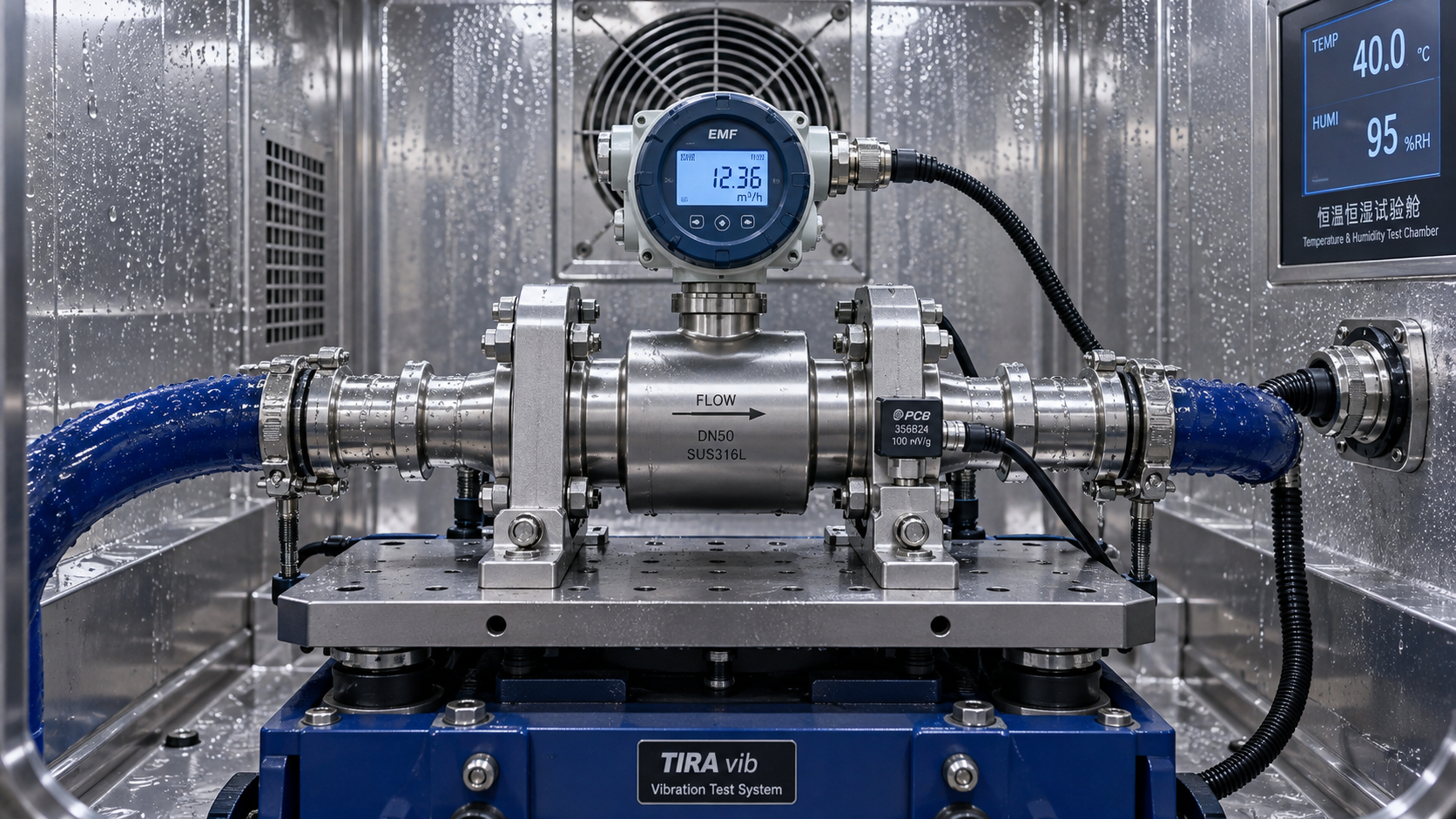
To validate third-party vibration test data for flow meters in humid climates, check whether the evidence supports reliable measurement under the conditions of the intended installation. A pass certificate alone cannot establish this. The report must identify the tested equipment, describe the mechanical and moisture exposure, and show how performance was assessed.
The central distinction is between surviving vibration and maintaining measurement accuracy during vibration. A meter can remain physically intact while its output becomes unstable, its zero shifts, or moisture affects electrical connections. Approval should therefore rest on three linked questions: does the tested configuration match the supplied meter, does the exposure represent the site, and do the results meet defined operating limits?
Define the conditions the evidence must cover
Begin with a short installation profile. Record where the meter will sit, what generates vibration, how it will be supported, and what moisture conditions it will encounter. “Suitable for tropical climates” is too broad to serve as a test requirement.
A sheltered indoor installation with continuously warm equipment presents a different moisture risk from an outdoor meter that cools overnight. Condensation can form when a surface falls below the surrounding air’s dew point. A chilled process line may therefore expose a sensor or connection box to moisture even when ambient humidity appears unremarkable.
Describe vibration in equally practical terms. Pumps, compressors, pipe resonance, and intermittent equipment starts produce different exposures. Where site measurements exist, use their frequency content, direction, and operating duration to guide the comparison. Where they do not, document the expected sources and the basis for the proposed qualification profile.
Separate environmental qualification from other service requirements. Process pressure, fluid compatibility, hazardous-area suitability, and flow accuracy remain separate approval questions. Strong vibration evidence does not answer them.
Check the laboratory and the identity of the tested meter
Laboratory accreditation is useful when its scope covers the activities performed. An accreditation logo on a report does not establish competence for every environmental or measurement test. Review the laboratory’s scope for the relevant vibration methods and humidity testing, and identify any work performed by another laboratory.
The report should have an identifiable issuer, a unique reference, an issue date, and authorized approval. Obtain the complete report, including photographs, result tables, amendments, and referenced procedures. A supplier’s summary may omit limitations that materially change the meaning of “passed.”
Then connect the tested specimen to the equipment being purchased. Relevant details include:
- Model, serial number, meter size, and sensing principle.
- Sensor and transmitter arrangement, including remote or integral mounting.
- Housing, seals, cable glands, connectors, and enclosure accessories.
- Firmware and electronic hardware revisions where they affect measurement or diagnostics.
- Mounting hardware, cable routing, and the condition of the sample before testing.
A report for one member of a product family may support another configuration, but the relationship needs an engineering explanation. A larger housing can have different mechanical responses; a remote transmitter introduces additional cables and connections. Qualification should follow the relevant design features rather than the product-family name.
Check whether seals, coatings, or fasteners changed after testing. Changes do not automatically invalidate the evidence, but they can affect the failure mechanisms the test was intended to address.
Read the vibration profile beyond its headline severity
A useful vibration report describes the exposure well enough to understand what the meter experienced. Look for the excitation type, frequency range, amplitude definition, test duration, axes, sweep or dwell conditions, and monitoring arrangements.
For sinusoidal vibration, the equipment experiences excitation at a defined frequency that may be swept or held. Random vibration distributes excitation across a frequency range and is described using a spectral profile. These methods reveal different behavior; a single headline acceleration cannot make them directly comparable.
Also establish whether amplitude is reported as peak, peak-to-peak, or an averaged measure. Displacement and acceleration describe different aspects of motion, and their relationship depends on frequency. Comparing values without those definitions can produce a misleading assessment of severity.
Duration matters because brief exposure may reveal immediate instability without adequately challenging loosening or fatigue. Direction matters because a meter, bracket, or cable connection may respond differently along different axes. A report covering only one direction needs a stated basis for representing the installation.
Review interruptions and deviations. A stopped test, repaired connection, adjusted fixture, or replaced component may affect the qualification claim. The report should explain what happened and which results apply before and after the intervention.
The fixture can change the result
A rigid laboratory fixture may transmit vibration differently from a pipe span, bracket, or flexible connection in service. Examine mounting photographs and drawings alongside the test profile. Identify the restraint points, orientation, support arrangement, and location of control accelerometers.
The shaker command is not necessarily the motion experienced by every part of the meter. Fixture resonance can amplify or reduce local response. Where this could influence the conclusion, response measurements at relevant locations help demonstrate the exposure actually delivered.
For a remote transmitter, assess both assemblies and the connecting cable. Testing the sensor alone leaves the transmitter mounting and cable interfaces outside that evidence.
Establish what the humidity test actually demonstrated
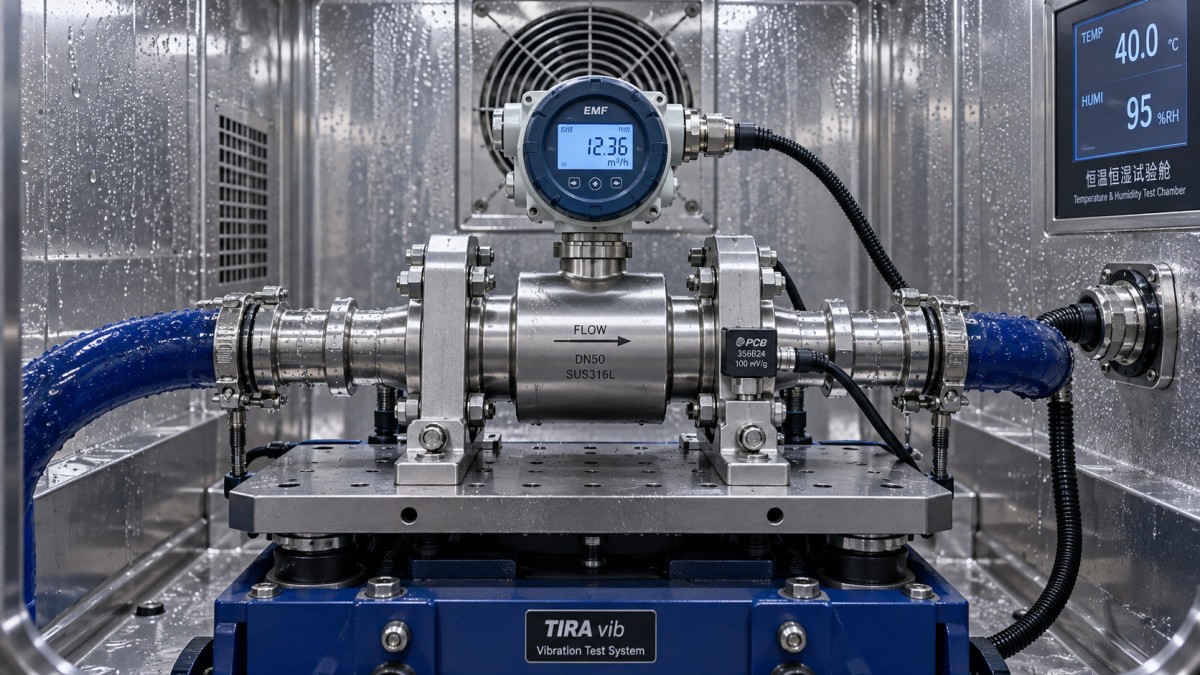
Relative humidity must be read together with temperature, exposure duration, and temperature transitions. A steady warm, humid chamber can assess moisture exposure without reproducing condensation. A cyclic exposure may produce a different challenge as the equipment heats and cools.
Look for recorded chamber conditions rather than only nominal settings. The report should explain whether condensation was intended, how the sample was powered, which connections were fitted, and whether any enclosure openings were sealed differently from the service configuration.
Operating state can affect the result. Powered electronics may keep an enclosure warmer than its surroundings. The same equipment may collect condensation during a shutdown or restart. Conversely, an unpowered test does not demonstrate live measurement performance in humid conditions.
An ingress-protection rating provides evidence about specified ingress tests. It does not, by itself, establish resistance to internal condensation, corrosion, or measurement drift under humidity and vibration. Cable entries and installation workmanship also influence the protection achieved in service.
Keep other environmental exposures distinct. Coastal salt contamination and aggressive washdown chemicals introduce risks that ordinary humidity testing may not address. If those conditions are part of the installation, include their evidence in the qualification review.
Separate tests leave a gap between the stresses
A dry vibration test and a separate humidity test demonstrate performance under those individual exposures. They do not directly establish behavior when moisture and vibration act together. Vibration can disturb interfaces or seals, while moisture can affect insulation and connections.
This gap does not make combined testing necessary for every application. Its significance depends on the likelihood of simultaneous exposure, the design’s vulnerability, and the consequences of measurement failure.
Sequential testing can provide useful evidence when the order reflects a credible service condition. For example, humidity conditioning followed by vibration may challenge equipment after moisture exposure. However, drying or recovery between stages can remove the condition of interest. Record the sequence, transfer time, and recovery period when assessing what the results support.
Require evidence of measurement performance
Inspection after testing can reveal loose hardware, damaged seals, or corrosion. It cannot show whether the flow signal remained usable during exposure. Read the report for functional measurements before, during, and after testing, and identify any period when performance was not monitored.
The appropriate checks depend on the sensing principle. Coriolis meters may be affected by external vibration interacting with their vibrating measurement system. Vortex meters can experience vibration-related signal interference. Electromagnetic and ultrasonic meters have different sensitivities involving installation conditions, signal quality, electrical connections, or acoustic coupling. A qualification plan should address the relevant mechanism.
Zero-flow monitoring can reveal false output or zero instability, but it does not establish accuracy across the operating flow range. Similarly, an electrical simulation may check transmitter behavior without exercising the complete sensor. The report should identify whether actual flow, simulated input, or static conditions were used.
Where flow accuracy is assessed, review the reference system, its calibration traceability, and measurement uncertainty. The laboratory should distinguish changes in the meter from changes in the test loop. Otherwise, fluctuations caused by pumps or unstable reference conditions can be mistaken for meter behavior.
Useful functional evidence may include:
- Error or repeatability at flow conditions relevant to service.
- Zero stability and false output under vibration.
- Signal interruptions, communication faults, and diagnostic events.
- Post-exposure calibration shift and recovery behavior.
- Inspection findings at seals, terminals, fasteners, and cable entries.
Time histories are especially helpful for intermittent problems. An average output can hide short dropouts or spikes that disrupt control or distort totals. Ask for underlying records where the summary conceals behavior relevant to the application.
Apply acceptance criteria that reflect the application
“No visible damage” is a valid mechanical observation, but it is incomplete as a functional acceptance criterion. Define the permitted measurement error, zero shift, output interruption, diagnostic behavior, and physical damage before interpreting the results.
The criteria should reflect how the meter will be used. A transient disturbance acceptable for general indication may be unacceptable in a control loop. A small persistent zero error may have little effect at high flow but become significant during extended low-flow operation.
Measurement uncertainty also belongs in the decision. When a reported result lies close to an acceptance boundary, the report’s decision rule should explain how uncertainty affects conformity. Without that rule, a pass statement may imply more confidence than the measurements support.
Turn the review into a defensible approval
Record each requirement against the supporting report section, the demonstrated result, and any limitation. This makes missing evidence visible and avoids repeated requests for broad statements such as “tropicalized” or “vibration resistant.”
Where the evidence falls short, request a focused response: a configuration comparison, additional functional data, a mounting assessment, or targeted testing. A narrow evidence gap often calls for a specific check rather than repeating an entire qualification program.
Approval can include installation conditions when they are supported by engineering reasoning. These might specify a qualified bracket, transmitter location, cable-entry arrangement, or documented condensation-control measure. Avoid adding vibration isolation casually; changing supports can introduce new resonances and alter the meter’s mechanical environment.
Finally, qualification of tested specimens does not establish the condition of every delivered unit. Keep production configuration control, incoming inspection, and commissioning checks connected to the approved evidence. The final approval should state which meter configuration is covered, which operating conditions are supported, and which installation details must be maintained.
Technical Specifications
Expert Insights

Chief Security Architect
Dr. Thorne specializes in the intersection of structural engineering and digital resilience. He has advised three G7 governments on industrial infrastructure security.
Related Analysis
- Oct 30, 2026Choosing a Lint-Free Wipes Factory: How to Evaluate Quality and CapacityAuthor :Precision Metrology Expert
- Oct 29, 2026Mysteel: Steel Price Composite Index Rises 2.26 Points on October 28Author :
- Oct 29, 2026Choosing a LOTO Device OEM: Quality Checks, Customization, and MOQsAuthor :Safety Compliance Lead
Core Sector // 01
Security & Safety
- Choosing Contact Temperature Instruments: Accuracy, Range, and Response TimeAuthor :Precision Metrology Expert

- How to Validate Third-Party Flow Meter Vibration Data for Humid ClimatesAuthor :Precision Metrology Expert

- Are IEC Standards and ATEX Mandatory for Overseas Pressure Instruments?Author :Precision Metrology Expert

- How to Verify ATEX Pressure Transmitters for Overseas Oil and Gas SitesAuthor :Precision Metrology Expert

- Does Global Industrial Core Provide Better Test Equipment Compliance Data Than Generic Industrial Hubs?Author :Precision Metrology Expert

- Is Global Industrial Core Reliable for Overseas EPC Test Equipment?Author :Precision Metrology Expert

- Choosing a Bluetooth Total Station: Software Compatibility and Connection RangeAuthor :Precision Metrology Expert

- Material Testing Standards: ASTM E8 vs. ISO 6892-1 for Metal Tensile TestsAuthor :Precision Metrology Expert