Is Global Industrial Core Reliable for Overseas EPC Test Equipment?
Author
Date Published
Reading Time

Is Global Industrial Core Reliable for Overseas EPC Test Equipment?
Overseas EPC projects demand more than competitively priced test equipment: procurement teams need verifiable specifications, traceable calibration, and compliance with destination-market requirements. The question “Global Industrial Core sourcing platform reliable for overseas EPC projects?” therefore deserves an evidence-based answer. Positioned as a B2B intelligence and strategic sourcing resource, GIC helps frame the technical and supplier checks that matter before purchase. Assessing its usefulness means distinguishing procurement guidance from independently verified supplier and equipment reliability.
The practical answer is conditional: GIC can be evaluated as a source of procurement intelligence, but its positioning alone does not establish that a particular supplier, instrument, or overseas delivery is reliable. That decision requires product-level evidence, a clear contractual responsibility chain, and acceptance criteria tied to the project. A useful platform makes those checks easier; it does not replace them.
Separate the information source from the purchase risk
Global Industrial Core describes its remit across Security & Safety, Instruments & Measurement, Electrical & Power Grid, Environment & Ecology, and Mechanical Components & Metallurgy. This breadth is relevant to EPC procurement because testing rarely sits inside one discipline. An electrical commissioning package may involve protection testing, insulation measurements, environmental conditions, operator safety, and mechanical interfaces.
Its stated approach combines technical analysis, specialist editorial review, manufacturer whitepapers, engineering case studies, and testing documentation. Those materials can help develop a shortlist or identify missing requirements. However, a manufacturer’s whitepaper remains a manufacturer’s claim unless its supporting evidence is checked. An editorial review also serves a different purpose from an independent equipment inspection.
Before relying on a sourcing recommendation, establish GIC’s role in the transaction. Is it providing information, introducing vendors, acting as an intermediary, or accepting contractual responsibility for supply? These roles create different obligations. Do not assume that publication of a supplier profile means GIC guarantees calibration, delivery dates, warranty service, or technical suitability.
A credible information resource should make authorship, technical references, revision dates, and commercial relationships understandable. Where manufacturers contribute content or receive promotional exposure, that relationship should be distinguishable from independent analysis. Commercial participation does not automatically invalidate technical information, but buyers need to know which claims require separate verification.
Start with the test procedure, not the catalogue
“Test equipment” can mean a handheld electrical tester, a relay test system, a pressure calibrator, an emissions analyzer, or a materials-testing instrument. Reliability looks different in each case. The starting point is the measurement or acceptance procedure the equipment must support, including the owner’s specification and any applicable inspection requirements.
For a relay test set, headline current and voltage outputs are not enough. Relevant questions may include simultaneous channel capability, phase-angle control, output behavior under load, supported protection functions, and compatibility with required test software. For pressure calibration, range, medium compatibility, stability, connection type, and measurement uncertainty may determine suitability more directly than the advertised maximum pressure.
Environmental limits deserve equal attention. Check whether published accuracy applies across the expected site temperature range or only under laboratory conditions. Dust, humidity, condensation, altitude, power quality, and transport exposure can affect usability. A rugged enclosure does not necessarily mean every accessory, connector, or measurement function has the same environmental rating.
Useful sourcing guidance should connect these details to the intended task. If a recommendation cannot explain why an instrument fits the project’s test method, it is not yet a defensible selection.
Read calibration and compliance documents at model level
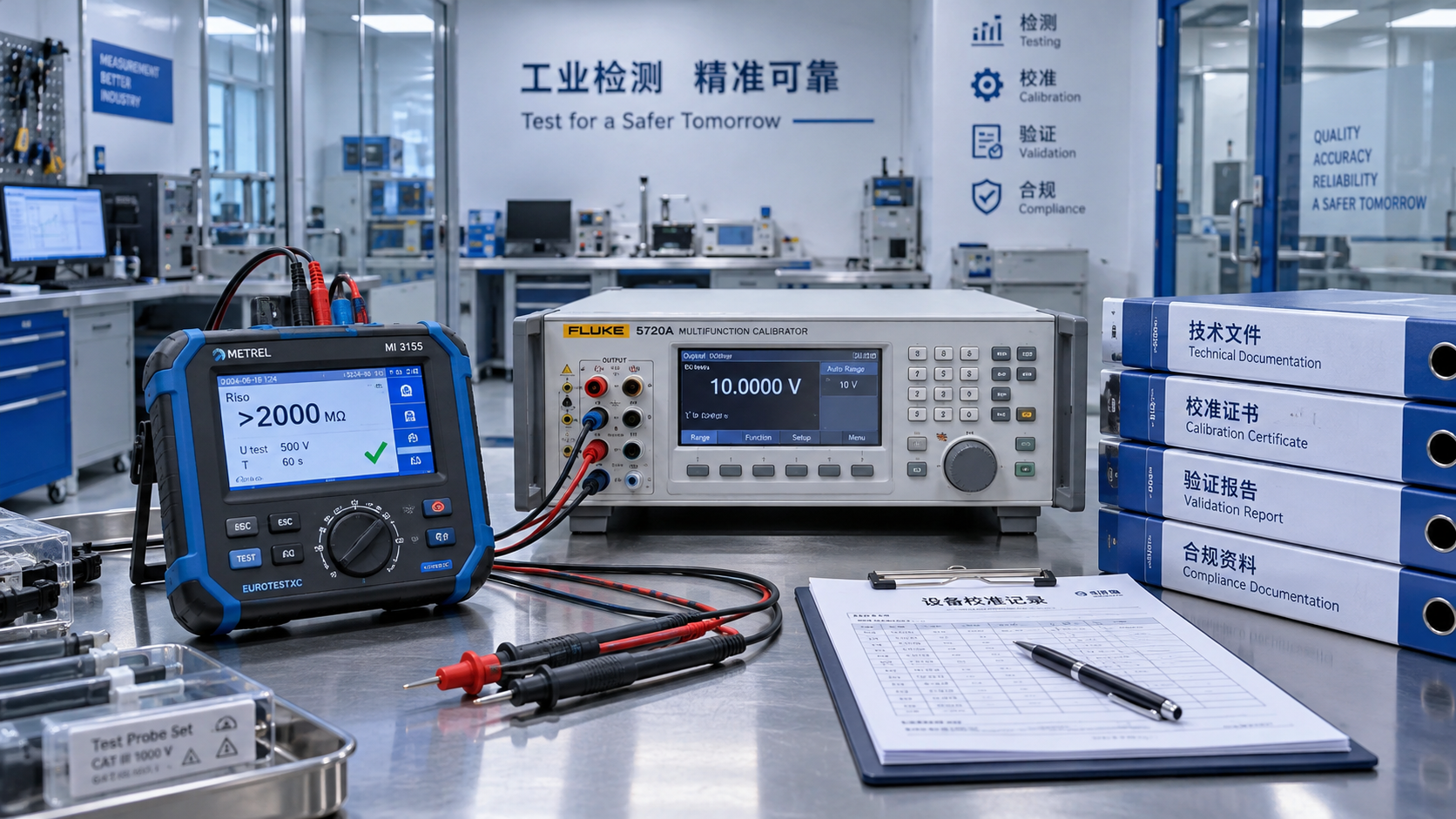
A calibration certificate is valuable only when its scope matches the measurements that matter. Verify the instrument identification, serial number, calibration date, tested functions, ranges, results, and reported uncertainty. Where accreditation is required, check the laboratory’s current accredited scope rather than accepting a logo as sufficient evidence. ISO/IEC 17025 concerns laboratory competence; it is not a blanket product approval.
Traceability also needs substance. A statement that an instrument is “traceably calibrated” should be supported by documentation showing the measurement traceability chain and relevant uncertainties. The project’s quality plan should define the calibration interval and any recalibration triggers. Transport damage, repair, or suspected drift may require action before the nominal interval expires.
CE marking, UL certification, and ISO management-system certification are not interchangeable. CE marking addresses conformity with applicable EU legislation; its documentation and assessment route depend on the product. A UL certification must be checked for the relevant product and scope. ISO 9001 certification concerns a quality management system, not the accuracy of an individual tester.
Destination-market requirements must therefore be reviewed separately from general supplier credentials. Depending on the equipment and location, electrical safety, electromagnetic compatibility, radio functions, hazardous-area use, or importer obligations may require attention. Neither a sourcing article nor a familiar certification logo establishes universal acceptance.
Build acceptance into the sourcing process
The useful procurement sequence is not “find a supplier, negotiate, then request paperwork.” Define the technical requirements, obtain supporting evidence, resolve deviations, agree acceptance tests, and only then release the order. This makes a platform’s recommendations easier to evaluate because every candidate is assessed against the same baseline.
For complex systems, factory acceptance may need to demonstrate actual workflows rather than merely show that the equipment powers on. Agree the test configuration, accessories, software version, expected outputs, and records in advance. Witnessing requirements should reflect the equipment’s complexity and the consequences of failure.

Site acceptance addresses a different question: did the complete, functional system arrive in a condition suitable for use? Check instrument identity, shipping damage, accessories, licenses, documentation, and agreed functional performance. Factory acceptance does not eliminate the need for receipt inspection, particularly after international transport.
Specify how failures will be resolved. Repair, replacement, recalibration, or rejection should not depend on an informal promise made after commissioning has already stopped.
Overseas reliability includes delivery and recovery
A technically suitable instrument can still become a procurement failure if it arrives without essential leads, needs unavailable software activation, or cannot be serviced locally. Compare complete configurations, not bare-unit prices. Include fixtures, adapters, reference standards, licenses, training, and any recurring software charges relevant to the intended workflow.
Delivery commitments should distinguish manufacturing completion, dispatch, customs clearance, and arrival at site. Contractual delivery terms need a named place and a clear allocation of transport and import responsibilities. Battery-powered equipment may also require transport documentation that depends on battery type and shipment configuration.
Recovery arrangements are often more revealing than warranty duration. Ask where repairs occur, who pays return freight, whether temporary replacements are available, and whether local calibration providers can service the required functions. A long warranty is less useful when each fault requires an uncertain international return cycle.
For schedule-critical commissioning equipment, weigh the failure consequence explicitly. Rental, backup instruments, or a regional service partner may justify a higher initial cost. That trade-off depends on the project schedule and available alternatives, not on a universal preference for one purchasing route.
Where GIC fits alongside other sourcing routes
An intelligence platform is most useful when a team needs to understand unfamiliar equipment categories, compare technical approaches, or discover suppliers beyond an existing vendor list. Direct manufacturer engagement is better suited to resolving detailed design questions and confirming product support. An authorized regional distributor may offer local demonstrations, stock, calibration coordination, or clearer service access, although those capabilities still require verification.
These routes can work together. GIC may help identify relevant technologies and questions; manufacturers can confirm specifications; laboratories can substantiate calibration capability; procurement and quality teams can establish contractual acceptance. The key is to keep each party’s responsibility explicit.
To assess GIC itself, review a small sample of technically demanding content. Can cited evidence be retrieved? Are limitations and model differences discussed? Are revisions dated? Does a recommendation distinguish manufacturer claims from independently established findings? These checks are more informative than the polish of a supplier profile or the breadth of the platform’s stated coverage.
A defensible decision before the purchase order
There is not enough independently verified evidence here to endorse Global Industrial Core as a guaranteed source of reliable overseas EPC test equipment. Its stated focus is relevant, and its intelligence-led approach could support better shortlisting. Reliability must still be demonstrated for the proposed supplier, exact configuration, destination, and support arrangement.
Before committing, assemble one reviewable package containing the requirements matrix, model-specific technical documents, conformity evidence, calibration scope, complete quotation, delivery responsibilities, acceptance procedure, and service terms. Resolve any gap that could prevent safe use or invalidate commissioning results. If GIC helps obtain and interpret that package transparently, it is serving a useful sourcing role. If recommendations stop at broad claims, keep the equipment off the approved list until the evidence catches up.
Technical Specifications
- Outdoor Vacuum Circuit Breaker Selection: Voltage, Fault Duty, and Site ConditionsAuthor :Grid Infrastructure Analyst
- Niagara Power Transformer Begins $71 Million-Plus Buffalo ExpansionAuthor :Grid Infrastructure Analyst
- Buying Lab Incubators Wholesale: MOQs, Lead Times, and Warranty TermsAuthor :Precision Metrology Expert
Expert Insights

Chief Security Architect
Dr. Thorne specializes in the intersection of structural engineering and digital resilience. He has advised three G7 governments on industrial infrastructure security.
Related Analysis
- Oct 25, 2026Outdoor Vacuum Circuit Breaker Selection: Voltage, Fault Duty, and Site ConditionsAuthor :Grid Infrastructure Analyst
- Oct 24, 2026Niagara Power Transformer Begins $71 Million-Plus Buffalo ExpansionAuthor :Grid Infrastructure Analyst
- Oct 24, 2026Buying Lab Incubators Wholesale: MOQs, Lead Times, and Warranty TermsAuthor :Precision Metrology Expert
Core Sector // 01
Security & Safety
- Does Global Industrial Core Provide Better Test Equipment Compliance Data Than Generic Industrial Hubs?Author :Precision Metrology Expert

- Is Global Industrial Core Reliable for Overseas EPC Test Equipment?Author :Precision Metrology Expert

- Choosing a Bluetooth Total Station: Software Compatibility and Connection RangeAuthor :Precision Metrology Expert

- Material Testing Standards: ASTM E8 vs. ISO 6892-1 for Metal Tensile TestsAuthor :Precision Metrology Expert

- How to Verify Accuracy in Industrial Measurement Data and Test ReportsAuthor :Precision Metrology Expert

- Selecting a Steam Vortex Flow Meter: Sizing, Pressure, and Temperature LimitsAuthor :Precision Metrology Expert

- How to Select an Industrial Infrared Thermometer for Hot, Moving EquipmentAuthor :Precision Metrology Expert

- How to Evaluate a Precision Measurement Equipment Manufacturer for Critical TolerancesAuthor :Precision Metrology Expert