Are IEC Standards and ATEX Mandatory for Overseas Pressure Instruments?
Author
Date Published
Reading Time

Are IEC Standards and ATEX Mandatory for Overseas Pressure Instruments?
Are IEC and ATEX both mandatory for overseas pressure instrument procurement? Not automatically. The answer depends on the destination market, hazardous-area classification, instrument design, and purchase specification. IEC standards are generally voluntary unless adopted into applicable regulations or made binding by contract. ATEX requirements apply to covered equipment intended for potentially explosive atmospheres in the European Union.
That distinction matters when buying pressure transmitters, switches, and gauges. A transmitter installed on a water-treatment skid in a non-hazardous location does not face the same explosion-protection requirements as one mounted beside a solvent transfer pump. International shipment alone does not make either instrument subject to ATEX.
The useful procurement question is therefore not “Does this supplier have IEC and ATEX?” It is “What evidence does this exact instrument need for this installation, and who will accept it?”
Separate the standard, the certification scheme, and the law
IEC, IECEx, and ATEX are often grouped together in quotations, although they describe different things.
The International Electrotechnical Commission publishes technical standards. For hazardous-area electrical equipment, the IEC 60079 series is particularly relevant. IEC 60079-0 addresses general requirements; other parts cover protection techniques such as flameproof enclosures and intrinsic safety. A claim that a product is “IEC compliant” is incomplete unless the supplier identifies the standards, editions, applicable requirements, and supporting evidence.
IECEx is a separate international conformity-assessment system based on IEC standards. An IECEx Certificate of Conformity can provide independently assessed evidence for explosion-protected equipment. It is not a universal import permit, and its acceptance depends on national rules and the project’s approval requirements.
ATEX, in this procurement context, principally means EU Directive 2014/34/EU, covering equipment and protective systems intended for use in potentially explosive atmospheres. It establishes legal obligations for products within its scope. Directive 1999/92/EC addresses workplace responsibilities, including assessing explosion risks and classifying hazardous areas. Buying compliant equipment does not replace those site obligations.
A supplier may use European standards adopting IEC technical content to support ATEX conformity. However, an IECEx certificate does not replace the ATEX conformity process or the EU Declaration of Conformity. Equally, an ATEX document does not automatically establish approval for every non-European destination.
Destination and installation determine the requirement
For an EU installation, equipment within ATEX scope must meet the applicable requirements before being placed on the market. Equipment outside that scope may still face other legislation. Depending on its design and function, a pressure instrument may need assessment under electromagnetic compatibility, pressure-equipment, or other applicable rules. Neither a CE mark nor an explosion-protection certificate settles every compliance question.
For the United States and Canada, do not assume that an ATEX or IECEx certificate is sufficient. Electrical approval requirements, hazardous-location classifications, and acceptance by the authority having jurisdiction must be checked. Depending on the installation, documentation may need to address Class/Division or Zone requirements and an appropriate certification or approval route.
Other markets may accept IECEx evidence, require national certification, or impose additional registration and marking requirements. The country where the supplier is based is not the deciding factor. The relevant destination is where the equipment will be placed on the market and used.
Contracts add another layer. An EPC specification can require both ATEX and IECEx even when local law does not require both. That may be justified for standardized equipment packages deployed across several markets. It may also be an inherited specification with no clear technical purpose. Resolve the difference before tender evaluation rather than asking suppliers to price an ambiguous requirement.
A mechanical gauge needs a different scope assessment
Do not treat a purely mechanical pressure gauge as if it were an electronic transmitter. Non-electrical equipment can fall within ATEX scope, but the assessment includes whether it has its own potential ignition sources. Being installed in a hazardous area does not, by itself, prove that every passive component requires ATEX conformity.
Ask for a documented scope assessment where the position is unclear. Electrical contacts, monitoring accessories, materials, and intended operating conditions may change the answer. A gauge fitted with a switch should not inherit the assumptions made for the basic mechanical version.
Match the certificate to the actual operating location
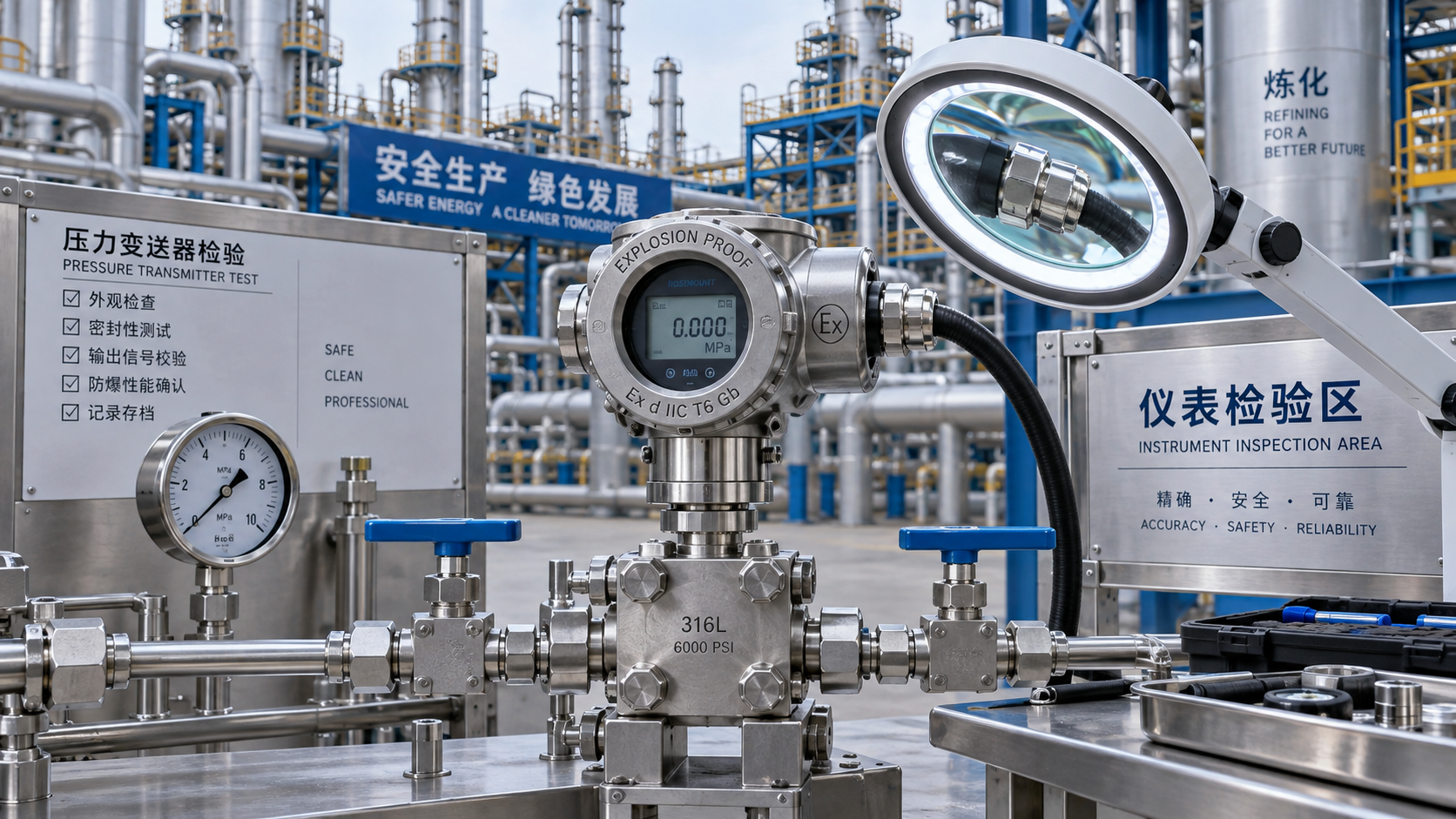
Consider a pressure transmitter installed on a solvent-handling line. “Explosion-proof” in the quotation is not enough. Selection needs the hazardous-area classification, gas or dust characteristics, required protection level, ambient temperature, and relevant process conditions. These inputs should come from the project’s approved hazardous-area documentation, not from a salesperson’s assumption.
Gas Zones 0, 1, and 2 and dust Zones 20, 21, and 22 describe different conditions. Under ATEX, equipment categories provide a basis for selection: Category 1 offers the highest protection level, while Categories 2 and 3 address progressively less demanding circumstances. Gas and dust suitability are distinct. Selection must also account for any site-specific restrictions.
A certificate must support the required gas group or dust group and the applicable temperature marking. Process heat deserves particular attention. A transmitter measuring hot fluid may experience conditions that are not obvious from the weather forecast or instrument-room temperature. The certificate and installation instructions govern permissible limits; do not assume the standard catalogue temperature range remains valid for every certified configuration.
For intrinsic safety, the instrument is only part of the assessment. The associated apparatus, wiring, and permitted electrical parameters must be compatible. Where entity-parameter verification applies, that includes voltage, current, power, capacitance, and inductance, including cable contributions. For flameproof equipment, cable entries, glands, and unused-entry closures also require attention.

This is where a seemingly acceptable purchase can fail: the transmitter has suitable certification, but the supplied accessories or planned installation do not satisfy its conditions. Procurement should review the assembly and installation interface, not just the sensor housing.
Check the ordered configuration—not the product family
A brochure showing ATEX and IECEx logos is an invitation to request evidence, not evidence itself. Certification may cover only particular electronics, housings, outputs, temperature ranges, or option combinations. A supplier can sell certified and uncertified versions under the same product-family name.
Before releasing the purchase order, reconcile these documents:
- The complete model and option code, including the selected explosion-protection version.
- The applicable certificate and schedule, with the ordered configuration within their scope.
- The EU Declaration of Conformity where required, identifying the product and applicable legislation.
- The proposed nameplate, including relevant Ex markings and temperature limits.
- The installation instructions, special conditions of use, and required accessories.
For IECEx equipment, check the certificate against the official IECEx online certificate system, including its status and issue. For ATEX documents involving a notified body, verify the body’s relevant designation through the European Commission’s official information and examine the certificate’s scope. A supplier’s scanned PDF should not be the only verification step.
A certificate number ending in “X” indicates special conditions of use that need review. A “U” suffix identifies a component certificate; it should not be mistaken for approval of a complete instrument ready for standalone installation. These small markings can materially affect acceptance.
Also avoid demanding the same third-party document for every ATEX category. Conformity-assessment procedures differ by equipment type and category, and some permit manufacturer-led assessment. The correct question is whether the legally applicable procedure was followed—not whether every supplier submits an identical certificate pack.
Explosion protection does not prove measurement suitability
An instrument can be appropriately certified for a hazardous area and still be a poor choice for the process. ATEX conformity does not establish the accuracy, response time, corrosion resistance, overload capability, or long-term stability needed by the application.
A pulsating pump discharge, for example, may require attention to pressure spikes and damping. A corrosive process may require different wetted materials or a diaphragm seal. Neither problem is solved by adding another explosion-protection logo to the datasheet. Calibration traceability and performance evidence should be assessed separately.
If the transmitter participates in a safety instrumented function, functional-safety suitability is another distinct review. ATEX or IECEx certification does not establish a Safety Integrity Level claim. That requires appropriate supporting documentation and assessment of the complete safety function.
For Global Industrial Core (GIC), this separation is central to useful industrial sourcing intelligence: market access, explosion protection, measurement performance, and mechanical compatibility are connected, but they are not interchangeable approvals. Keeping them separate helps procurement teams identify exactly what a supplier has demonstrated—and what remains unverified.
Write an acceptance requirement suppliers can actually meet
Replace “IEC and ATEX mandatory” with a requirement tied to the destination and installation. Specify the applicable market requirements, hazardous-area classification, required equipment protection, temperature conditions, process limits, and documentation deliverables. Where IEC standards are contractual requirements, identify the relevant standards and editions rather than writing “all IEC standards.”
Assign responsibility for certificate review before manufacture or shipment. The instrument engineer should confirm application suitability; the electrical or hazardous-area specialist should check protection and installation conditions; procurement should ensure that approved codes and document obligations appear in the order. Delivery inspection should then verify that the nameplate and supplied configuration match that approval.
For primary references, consult Directive 2014/34/EU, Directive 1999/92/EC, and the official IECEx system. Confirm current destination-country requirements with the responsible local authority or qualified compliance specialist.
If a supplier cannot connect the ordered model, its certification scope, and the intended installation, pause the order. Buying both ATEX and IECEx labels without that connection does not remove the compliance risk.
Technical Specifications
Expert Insights

Chief Security Architect
Dr. Thorne specializes in the intersection of structural engineering and digital resilience. He has advised three G7 governments on industrial infrastructure security.
Related Analysis
- Oct 30, 2026Choosing a Lint-Free Wipes Factory: How to Evaluate Quality and CapacityAuthor :Precision Metrology Expert
- Oct 29, 2026Mysteel: Steel Price Composite Index Rises 2.26 Points on October 28Author :
- Oct 29, 2026Choosing a LOTO Device OEM: Quality Checks, Customization, and MOQsAuthor :Safety Compliance Lead
Core Sector // 01
Security & Safety
- Choosing Contact Temperature Instruments: Accuracy, Range, and Response TimeAuthor :Precision Metrology Expert

- How to Validate Third-Party Flow Meter Vibration Data for Humid ClimatesAuthor :Precision Metrology Expert

- Are IEC Standards and ATEX Mandatory for Overseas Pressure Instruments?Author :Precision Metrology Expert

- How to Verify ATEX Pressure Transmitters for Overseas Oil and Gas SitesAuthor :Precision Metrology Expert

- Does Global Industrial Core Provide Better Test Equipment Compliance Data Than Generic Industrial Hubs?Author :Precision Metrology Expert

- Is Global Industrial Core Reliable for Overseas EPC Test Equipment?Author :Precision Metrology Expert

- Choosing a Bluetooth Total Station: Software Compatibility and Connection RangeAuthor :Precision Metrology Expert

- Material Testing Standards: ASTM E8 vs. ISO 6892-1 for Metal Tensile TestsAuthor :Precision Metrology Expert