How to Verify ATEX Pressure Transmitters for Overseas Oil and Gas Sites
Author
Date Published
Reading Time
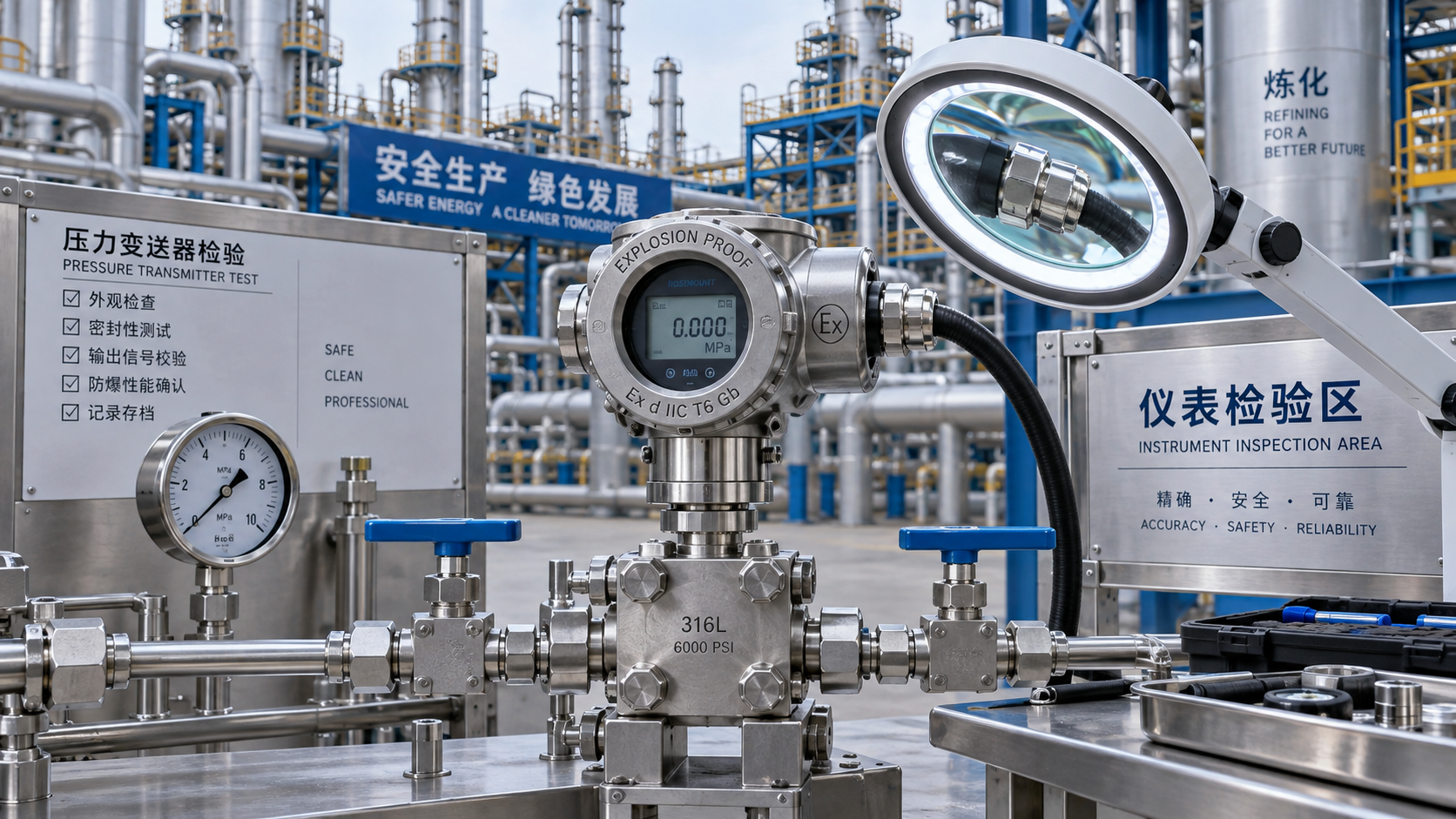
Searching for “ATEX certified pressure transmitters oil gas overseas” is only the starting point for safe international procurement. For EPC contractors and oil and gas operators, verification means matching certification documents and equipment markings to the exact transmitter model, hazardous-area classification, temperature limits, and installation conditions. ATEX conformity alone does not establish acceptance in every destination country.
The difficult decisions often arrive after a supplier has submitted an attractive quotation: an approval covers a different housing, the certificate contains an installation restriction, or the receiving facility requires a national approval that ATEX cannot replace. Discovering these gaps before purchase is manageable. Discovering them during commissioning can leave a critical pressure loop unavailable while everyone waits for replacement equipment.
A sound verification process follows the evidence from the site specification to the certificate, then to the delivered instrument and its installation. Here is how to make that process practical.
Start with the site—not the supplier’s certificate
Before reviewing a transmitter, obtain the approved hazardous-area classification and instrument specification. A supplier cannot establish suitability from “oil and gas application” alone. A refinery compressor skid, offshore wellhead, and pipeline metering station may require different protection concepts, materials, and approvals.
The minimum review basis should identify:
- Destination requirements: country, applicable regulations, operator standards, and the authority responsible for acceptance.
- Hazardous-area designation: gas or dust classification, zone, gas group, and required temperature class or maximum surface temperature.
- Operating envelope: ambient and process temperatures, pressure range, maximum allowable pressure, and credible overpressure conditions.
- Installation arrangement: protection concept, power supply, signal interface, barriers or isolators, cable entries, and mounting location.
- Environmental exposure: salt spray, humidity, vibration, flooding, corrosive chemicals, and washdown conditions.
Where classification drawings or ambient-temperature requirements are unresolved, record that uncertainty as an engineering hold point. Do not let a general-purpose datasheet silently become the project specification.
Read the marking as a set of operating boundaries
An explosion-protection marking is not simply a badge of quality. It describes the conditions under which the equipment can be used. For gas atmospheres, a marking may include the ATEX equipment group and category, an ignition-protection concept, gas group, temperature class, and equipment protection level.
For example, an illustrative marking such as II 1 G Ex ia IIC T4 Ga points to Group II equipment, Category 1 for gas atmospheres, intrinsic safety “ia,” gas group IIC, temperature class T4, and protection level Ga. This example does not establish suitability for any particular transmitter or installation; the certificate and instructions remain decisive.
Do not confuse temperature class with process-temperature capability. A transmitter might tolerate hot process media only with a remote seal, cooling element, or other specified arrangement. Conversely, a suitable pressure connection does not prove that the electronics remain within their certified ambient limits.
Build a traceable ATEX document package
For ATEX certified pressure transmitters intended for overseas oil and gas sites, request documents against the complete order code. A certificate for a product family is useful only when its scope and annexes include the selected configuration.
The package should normally include the applicable EU Declaration of Conformity, relevant ATEX certificates and schedules, installation instructions, ordering-code breakdown, and a legible nameplate sample. Where the conformity-assessment route requires notified-body involvement in production control, obtain evidence of that oversight, such as the applicable quality assurance notification.
ATEX falls under Directive 2014/34/EU. The assessment route depends on the equipment category and type. Not every ATEX product requires the same third-party certification: Category 3 equipment can generally follow an internal production-control route. Buyers should therefore verify the required conformity procedure rather than assume that every legitimate product must have an identical certificate package.
Check authenticity through an independent route
Use the issuing body’s official certificate database where available, or contact it through independently located contact details. Compare the certificate number, manufacturer, product designation, revision, and status with the supplied document. A logo or scanned signature is not sufficient evidence.
For an EU notified body, the European Commission’s NANDO database helps confirm its notified status and scope. It does not, by itself, authenticate a particular product certificate. Likewise, there is no single universal ATEX product database that replaces issuer verification.
Request the full certificate schedule and amendments, not only the cover page. Older standard editions are not automatically grounds for rejection, but they warrant review of the current declaration, certificate status, and manufacturer’s assessment of continued conformity.
Resolve every “X” condition
An “X” suffix on a certificate number indicates specific conditions of use. These may concern electrostatic charging, impact protection, ambient temperatures, cable entries, or other restrictions. Read each condition and assign responsibility for meeting it.
A “U” suffix identifies an Ex component certificate. It is not equivalent to approval of a complete, ready-to-install transmitter. If a supplier relies on a component certificate, request the conformity evidence for the finished equipment.
Match the certified model to the purchased configuration
Pressure transmitter ordering codes can conceal important differences: enclosure material, electrical output, process connection, display, cable gland, sensor construction, and approval option. Two instruments with the same commercial family name may not share the same certified configuration.
Ask the manufacturer to map the offered order code to the certificate scope. Check that the legal manufacturer on the declaration and certificate is consistent with the product identification. For private-label instruments, require a clear documentary explanation of the relationship rather than accepting a visually similar original-equipment model.
At goods receipt, compare the physical nameplate with the purchase specification and approved documentation. Confirm model, serial number, approval marking, ambient limits, and electrical ratings. Where relevant, inspect supplied glands, plugs, and accessories against the certified installation requirements.
A useful procurement rule: prohibit substitutions affecting explosion protection, wetted materials, electrical interfaces, or pressure ratings without written technical approval. “Equivalent model” is not a sufficient change-control description.
Verify the installation circuit, not just the transmitter
A genuine certificate can still accompany an unsuitable installation. Intrinsically safe and flameproof designs illustrate why the surrounding system matters.
For intrinsically safe pressure transmitters
Check the transmitter’s input safety parameters against the barrier or isolator’s output parameters. In a typical entity-parameter assessment, Uo must not exceed Ui, Io must not exceed Ii, and Po must not exceed Pi. Total connected capacitance and inductance—including cable contributions—must remain within the permitted limits.
These comparisons are a starting point, not a complete design method. Combined capacitance and inductance restrictions, multiple sources, grounding arrangements, and manufacturer control drawings can introduce additional requirements. Have a competent hazardous-area engineer validate the circuit against the applicable installation standard and project requirements.
Also verify functional operation. A barrier can satisfy intrinsic-safety limits yet leave insufficient voltage for the transmitter at the required loop current. Check supply voltage, cable resistance, barrier voltage drop, receiver load, and any digital communication requirements.
For flameproof pressure transmitters
Review cable-entry arrangements, approved glands or conduit systems, stopping plugs, thread specifications, and any restrictions on adapters. The flameproof enclosure depends on installation details that prevent an internal explosion from igniting the surrounding atmosphere.
Barrier glands are not universally required for every flameproof installation; the decision depends on the applicable rules, equipment design, cable construction, and certificate conditions. Nor does an IP rating establish explosion protection. Ingress resistance and ignition protection solve different problems.
Confirm what the destination country will accept
ATEX is a European Union regulatory framework. It can be specified on projects elsewhere, but acceptance outside the EU depends on local law, the operator, and the approving authority. Project approval and legal market access are related questions, not interchangeable ones.
ATEX and IECEx share many technical standards, but they are not interchangeable approval systems. A dual-approved transmitter may simplify sourcing without eliminating local obligations. Obtain a written destination-acceptance decision before committing to a large order.
Explosion protection does not prove measurement suitability
Once certification checks are complete, assess whether the transmitter can actually support the process. ATEX conformity does not establish measurement accuracy, corrosion resistance, or suitability for a safety instrumented function.
Review calibrated span, turndown, temperature effects, response time, long-term stability, and overpressure limits. A published accuracy figure may apply under reference conditions or use a different calculation basis from the project specification.
For sour service, assess wetted materials against the applicable service conditions and standards, such as ISO 15156/NACE MR0175 where relevant. Material suitability depends on factors including fluid composition, temperature, stress, and manufacturing condition—not simply a “sour service” label.
If the pressure signal supports a safety instrumented function, request the functional-safety documentation separately. Review the safety manual, failure data, diagnostic assumptions, and proof-test requirements. An ATEX marking does not demonstrate SIL suitability.
Make acceptance a documented decision
Before purchase release, close five gates: site classification match, document authenticity, exact configuration coverage, installation compatibility, and destination acceptance. Keep measurement performance and material compatibility alongside these checks, not behind them.
Hold the order when a certificate amendment is missing, an “X” condition is unresolved, or local acceptance remains uncertain. Reject unsupported approval claims and configurations outside the documented scope. For critical applications, retain the evidence in the project dossier so maintenance teams can verify replacements years later.
For Global Industrial Core’s industrial sourcing audience, the strongest procurement decision is not the transmitter with the longest approval list. It is the one whose documents, configuration, operating limits, and installation requirements form a consistent, auditable chain. That discipline turns a promising quotation into equipment the project can confidently accept—and the site can safely use.
Technical Specifications
- US Commerce Opens Changed Circumstances Review of Mexican Heavy-Walled Rectangular Welded Carbon Steel PipeAuthor :Heavy Industry Strategist
- Selecting Flexible Copper Busbars for Switchgear: Current Rating and Bend RadiusAuthor :Grid Infrastructure Analyst
- Outdoor Vacuum Circuit Breaker Selection: Voltage, Fault Duty, and Site ConditionsAuthor :Grid Infrastructure Analyst
Expert Insights

Chief Security Architect
Dr. Thorne specializes in the intersection of structural engineering and digital resilience. He has advised three G7 governments on industrial infrastructure security.
Related Analysis
- Oct 26, 2026US Commerce Opens Changed Circumstances Review of Mexican Heavy-Walled Rectangular Welded Carbon Steel PipeAuthor :Heavy Industry Strategist
- Oct 26, 2026Selecting Flexible Copper Busbars for Switchgear: Current Rating and Bend RadiusAuthor :Grid Infrastructure Analyst
- Oct 25, 2026Outdoor Vacuum Circuit Breaker Selection: Voltage, Fault Duty, and Site ConditionsAuthor :Grid Infrastructure Analyst
Core Sector // 01
Security & Safety
- How to Verify ATEX Pressure Transmitters for Overseas Oil and Gas SitesAuthor :Precision Metrology Expert

- Does Global Industrial Core Provide Better Test Equipment Compliance Data Than Generic Industrial Hubs?Author :Precision Metrology Expert

- Is Global Industrial Core Reliable for Overseas EPC Test Equipment?Author :Precision Metrology Expert

- Choosing a Bluetooth Total Station: Software Compatibility and Connection RangeAuthor :Precision Metrology Expert

- Material Testing Standards: ASTM E8 vs. ISO 6892-1 for Metal Tensile TestsAuthor :Precision Metrology Expert

- How to Verify Accuracy in Industrial Measurement Data and Test ReportsAuthor :Precision Metrology Expert

- Selecting a Steam Vortex Flow Meter: Sizing, Pressure, and Temperature LimitsAuthor :Precision Metrology Expert

- How to Select an Industrial Infrared Thermometer for Hot, Moving EquipmentAuthor :Precision Metrology Expert