EU Net-Zero Industry Act Takes Effect for Wind Components
Author
Date Published
Reading Time
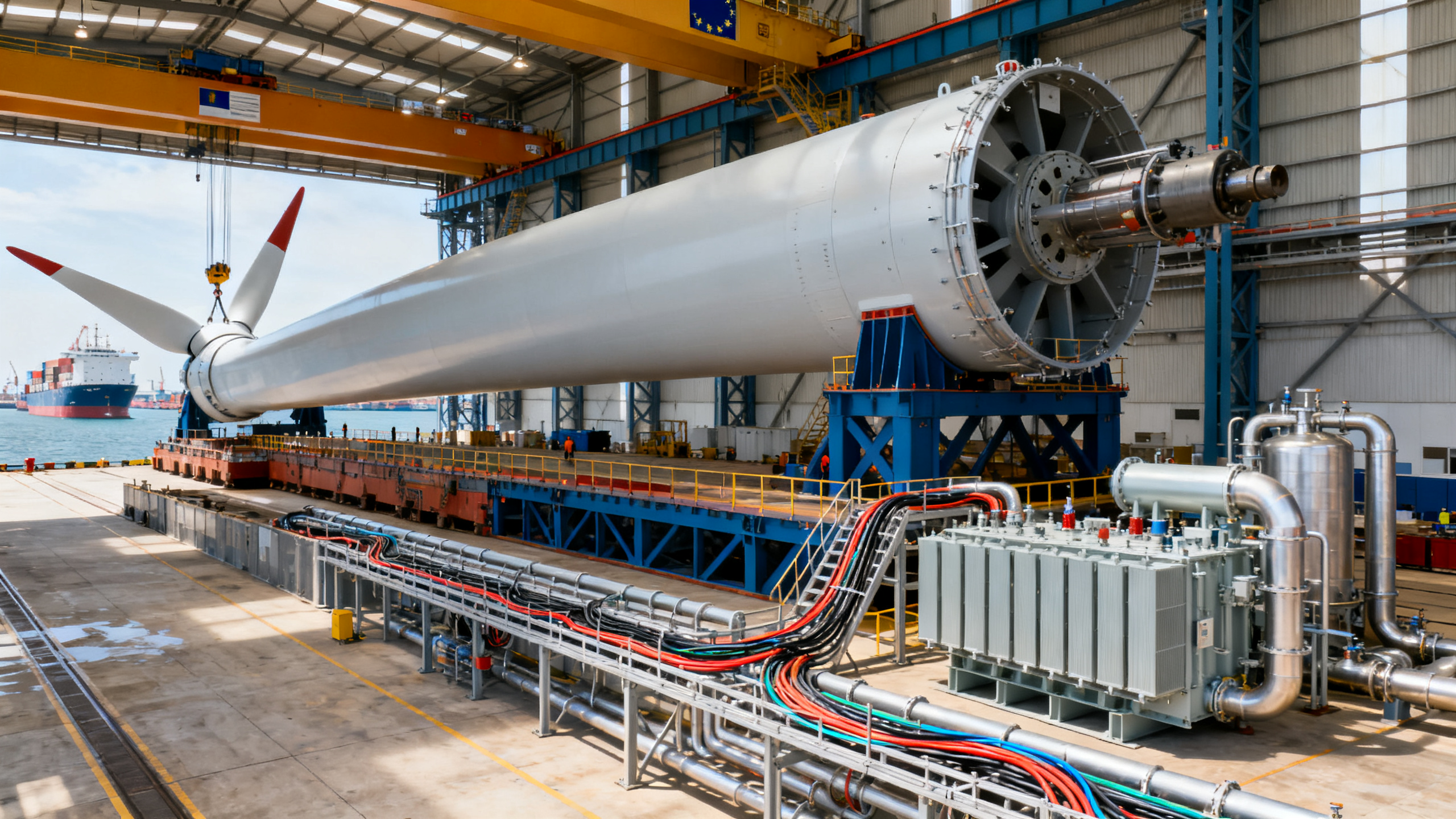
On June 5, 2026, the EU Net-Zero Industry Act formally took effect, turning local content and carbon-footprint disclosure into practical market-entry requirements for key wind-related industrial components such as tower sections and foundation parts. For exporters supplying supporting structural components tied to Transformers & Switchgears, Cables & Wiring, Steel & Metal Profiles, and Industrial Water Treatment projects in the EU market, this is not just a policy update but a compliance and delivery issue that can affect supplier qualification, procurement alignment, and export pathways.
What the rule change now clearly requires
The confirmed facts are limited but material. The EU Net-Zero Industry Act became effective on June 5, 2026. Under the information provided, the law imposes a minimum local content requirement of at least 40% for key industrial components including wind turbine foundations and tower sections, and it also makes full life-cycle carbon-footprint disclosure mandatory for those components.
The information provided further indicates that this change directly affects supplier access to the EU market. Its impact is particularly relevant to major Chinese steel structure and heavy equipment manufacturers in their export compliance routes. The scope described also covers exporters supplying supporting structural parts for Transformers & Switchgears, Cables & Wiring, Steel & Metal Profiles, and Industrial Water Treatment applications.
Where the pressure is likely to appear across the supply chain
Supplier qualification is moving closer to a compliance screen
From an industry perspective, manufacturers and exporters of wind tower and foundation-related components may be affected first at the supplier-approval stage. The reason is straightforward: once local content and life-cycle carbon disclosure become mandatory, qualification is no longer based only on manufacturing capability and delivery record. Companies may need to pay closer attention to whether their bids, technical files, and supply-chain arrangements can demonstrate alignment with the new requirements.
Procurement teams may need earlier documentation checks
For buyers and project procurement teams, the practical impact is likely to fall on sourcing design, tender review, and contract documentation. What deserves closer attention is that a local content threshold and carbon-footprint disclosure requirement can influence how procurement specifications are written, how suppliers are shortlisted, and what supporting documents are requested before award and delivery.
Export execution may become more document-dependent
For export-oriented manufacturers, especially those serving EU-bound industrial support structures, the rule change may affect shipment preparation, customer communication, and contract performance. Analysis shows that documentation linked to origin structure, supply-chain composition, and carbon-footprint disclosure may become more important in demonstrating continued eligibility. This matters not only for primary wind components but also for supporting structures associated with the listed industrial categories.
Service and verification-related businesses may see follow-through demand
Certification-related firms, testing service providers, and supply-chain service companies may also be drawn in through customer requests for supporting evidence, traceability files, and disclosure consistency. The provided information does not define a detailed execution method, so it would be premature to treat any specific review process as settled. Still, the direction of travel is clear enough for these service functions to prepare for more scrutiny around compliance records and technical documentation.
What companies should watch in current practice
Check whether existing export files can support the new thresholds
Companies shipping relevant components to the EU should review whether current bid files, technical submissions, and delivery documentation are sufficient to address both the local content threshold and life-cycle carbon-footprint disclosure. Analysis shows that this is not only a production issue but also a document-readiness issue.
Reassess sourcing and subcontracting arrangements
Where supply chains rely on multiple processing and sourcing links, exporters should pay closer attention to how those arrangements interact with the stated local content requirement of at least 40%. Observably, any mismatch between sourcing practice and qualification expectations could become a commercial issue before it becomes a customs or delivery issue.
Track changes in tender language and customer qualification requests
Because the information provided confirms mandatory requirements but does not provide detailed implementation language, companies should closely monitor how buyers translate the rule into tender files, vendor registration criteria, and technical annexes. What deserves closer attention is the wording customers use when asking for carbon-footprint disclosure and proof tied to local content.
Prepare for closer linkage between compliance and delivery schedules
Exporters serving EU projects should also watch for possible effects on order planning, supplier approval timing, and handover milestones. It is more appropriate to understand this as a compliance-and-delivery coordination issue rather than only a regulatory headline, especially for suppliers of structural parts connected to Transformers & Switchgears, Cables & Wiring, Steel & Metal Profiles, and Industrial Water Treatment projects.
Why this looks like an execution signal, not just a headline
Analysis shows that the most important point in this development is that the rule is already in force as of June 5, 2026. That makes it more than a policy direction. At the same time, the input does not provide detailed implementing guidance, review procedures, or enforcement examples, so it would be inaccurate to claim that market practice is already fully standardized.
It is more appropriate to understand this event as a confirmed rule landing with further execution details still worth watching. For the industry, the immediate takeaway is that market access, procurement language, and export compliance are becoming more tightly connected around local content and carbon accounting. The next stage of attention should focus on how these requirements are reflected in actual supplier screening, tender documents, and project delivery expectations.
How the market should read this development now
In practical terms, this development signals that relevant wind-related and supporting industrial component suppliers to the EU can no longer treat localization and carbon disclosure as secondary topics. The confirmed change is already effective, and its importance lies in supplier access and export compliance rather than abstract policy messaging.
At the current stage, a neutral reading is more suitable: this is a real compliance threshold with direct commercial relevance, but the detailed execution path still needs continued observation through customer requirements, procurement practice, and market feedback. Companies that are exposed to EU-bound projects should therefore read it as an active compliance development rather than a distant regulatory trend.
Basis of this article and items still requiring verification
This article is generated based on the user-provided news title, event date, and event summary. The content reflects the supplied information that the EU Net-Zero Industry Act took effect on June 5, 2026, introduced a local content requirement of at least 40% and mandatory life-cycle carbon-footprint disclosure for key components such as wind turbine foundations and tower sections, and affects supplier access for exporters serving the specified industrial categories.
For developments of this type, commonly relevant source categories may include official announcements, regulatory publications, customs or trade authority information, industry association updates, standard-setting documents, and reporting by established professional media. However, no specific official source link was provided in the input, so the precise official reference chain still needs to be verified on an ongoing basis.
Items that still warrant continued checking include detailed implementation language, certification or verification expectations, the wording used in tender and supplier-qualification documents, industry feedback, and how companies actually execute compliance in export and delivery practice.
Technical Specifications
- How to Select Electronic Hotel Key Card Locks for Guest Rooms and Staff AreasAuthor :Safety Compliance Lead
- How to Select Lab Instruments for Reliable Chemical Analysis WorkflowsAuthor :Precision Metrology Expert
- How to Size a UPS for Server Rooms: Load, Runtime, and Redundancy FactorsAuthor :Grid Infrastructure Analyst
Expert Insights

Chief Security Architect
Dr. Thorne specializes in the intersection of structural engineering and digital resilience. He has advised three G7 governments on industrial infrastructure security.
Related Analysis
- Sep 17, 2026How to Select Electronic Hotel Key Card Locks for Guest Rooms and Staff AreasAuthor :Safety Compliance Lead
- Sep 16, 2026How to Select Lab Instruments for Reliable Chemical Analysis WorkflowsAuthor :Precision Metrology Expert
- Sep 15, 2026How to Size a UPS for Server Rooms: Load, Runtime, and Redundancy FactorsAuthor :Grid Infrastructure Analyst
Core Sector // 01
Security & Safety
- Stainless Steel Welded Tube Applications: Matching Tube Supply to Fabrication NeedsAuthor :Heavy Industry Strategist

- What Maintenance Do Furnace Components Need After 18 Months?Author :Heavy Industry Strategist

- How to Assess Metal Materials for Thermal Cycling in Power BoilersAuthor :Heavy Industry Strategist

- How to Evaluate Aluminum Extrusion Suppliers for Tight-Tolerance Components?Author :Heavy Industry Strategist

- How to Evaluate a Weld Neck Flange Manufacturer for High-Pressure Pipe ProjectsAuthor :Heavy Industry Strategist

- EU REACH Ban Hits Cr(VI)-Coated Steel ImportsAuthor :Heavy Industry Strategist
-Coated Steel Imports")
- How to Evaluate a Heat Sink Aluminum Profile Supplier for Custom Thermal ProjectsAuthor :Heavy Industry Strategist

- Industrial Metal Fabrication Components Price: What Drives Cost and How to Compare QuotesAuthor :Heavy Industry Strategist