How to Select Electronic Hotel Key Card Locks for Guest Rooms and Staff Areas
Author
Date Published
Reading Time
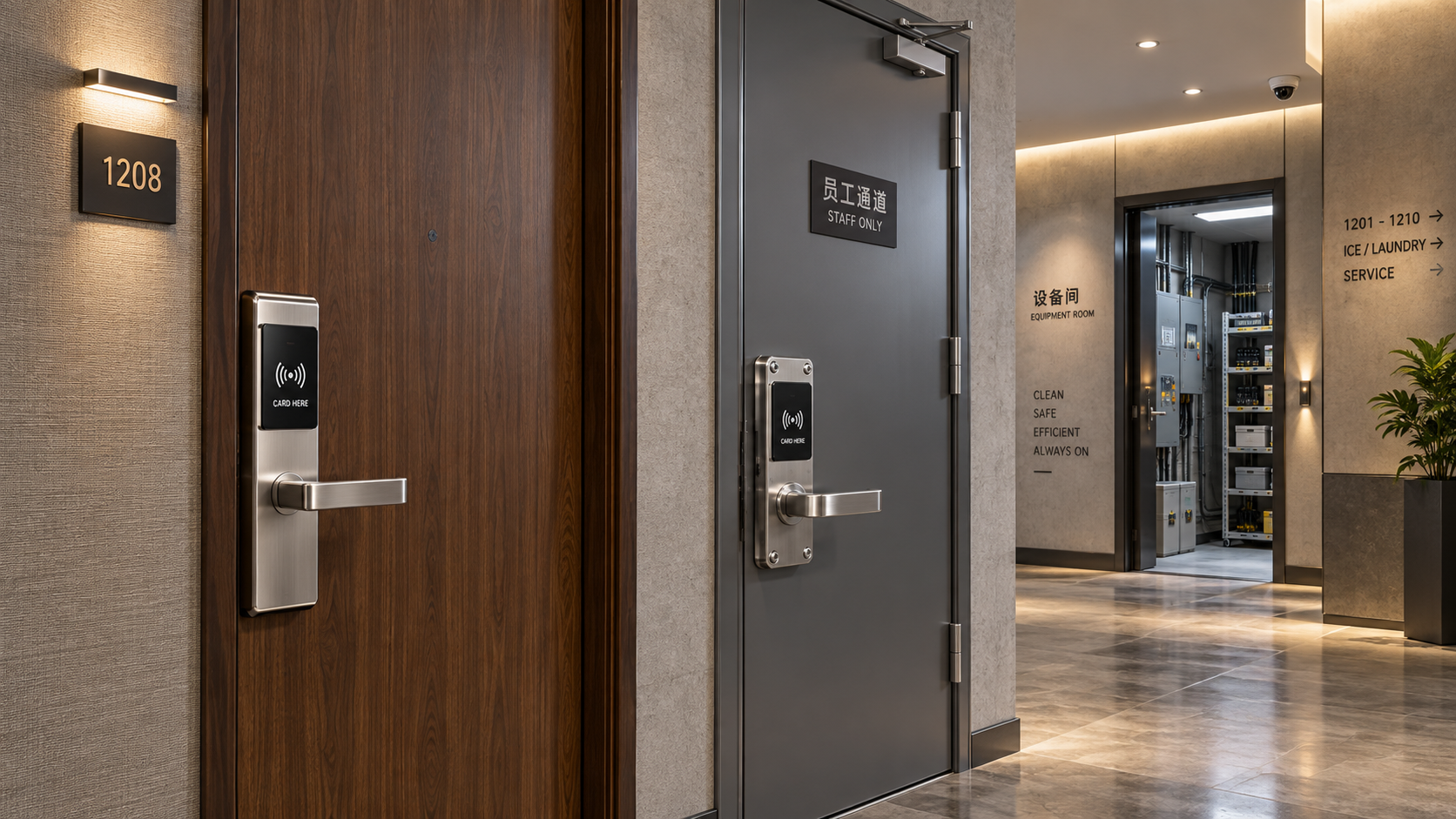
An electronic hotel key card lock should be selected as part of an access-control system, not as a standalone door accessory. The right choice depends on who uses each door, what happens when power or network connectivity is interrupted, how credentials are issued and revoked, and whether the lock can withstand the door’s real traffic level.
Guest rooms, housekeeping closets, plant rooms, offices, loading entrances, and staff-only corridors do not need the same lock specification. Applying one low-cost model across every opening may simplify the initial order, but it often creates avoidable security gaps, maintenance work, and operational restrictions. A better approach is to classify doors by risk and use, then evaluate compatible lock families and management software against that map.
Start with the door and access map
Before comparing brands or credential technologies, create a door schedule that identifies each opening’s purpose, user group, traffic pattern, required audit trail, and emergency function. This prevents a common mistake: choosing locks based only on appearance, card format, or unit price.
Guest-room doors usually need fast, intuitive access, reliable privacy functions, and simple credential replacement at reception. Staff areas require more granular permissions. A maintenance technician may need access to utility rooms and service corridors but not finance offices or guest floors. A manager may need broad access during business hours but should not retain unrestricted access after a role change.
The access map should also identify doors that are part of a fire or emergency egress route. Access control must not interfere with safe exit. The lockset, door hardware, door assembly, and local life-safety requirements need to work together. A credential-controlled entry function is different from locking people in, and that distinction must remain clear throughout the specification.
Choose credential technology based on operations, not fashion
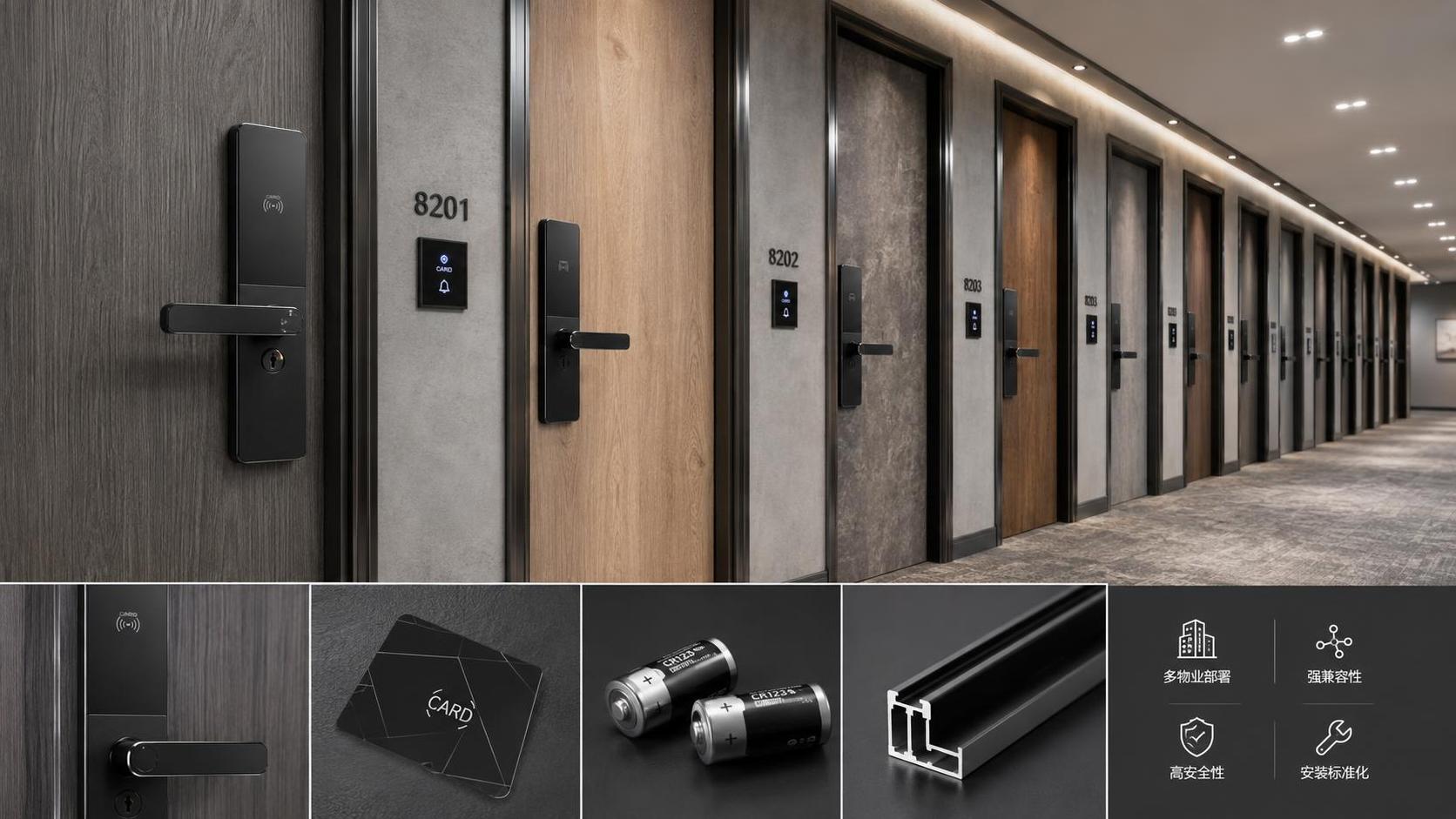
Most electronic hotel key card lock systems use contactless credentials, commonly RFID-based cards, fobs, wristbands, or mobile keys. The best option is the one that fits the property’s check-in process, staff workflows, guest expectations, and security model.
Contactless cards remain practical because they are familiar, fast to issue, and usable by guests who do not want to install an app or use a phone as a room key. They are also useful where front-desk teams must issue replacement credentials quickly. The important question is not simply whether the lock accepts RFID cards. Ask which credential technology it supports, how credentials are encrypted or protected, whether unauthorized duplication risks are addressed, and whether staff and guest credentials can be managed under different rules.
Mobile access can reduce dependence on physical cards and support remote pre-arrival credential delivery. It is most useful when the property already has a reliable digital check-in journey and can support guests who encounter phone battery, device compatibility, or app-access issues. It should complement a clear fallback process rather than eliminate it. A guest who cannot open a room late at night needs a rapid operational solution, not a troubleshooting exercise.
For staff access, named credentials are generally more useful than shared department cards. Shared cards make daily work convenient, but they weaken accountability. When several people use the same credential, the audit trail identifies the card rather than the individual. There may be limited circumstances where shared access is appropriate, but restricted rooms should normally use credentials assigned to specific people and roles.
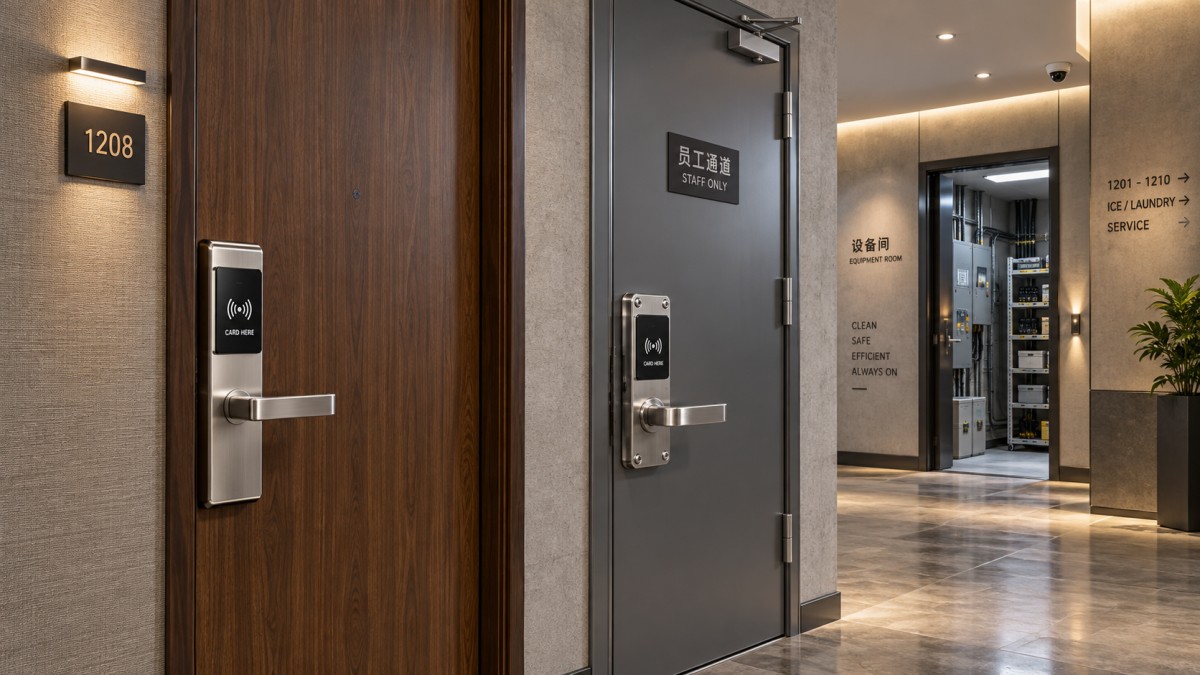
Do not treat offline, online, and wireless locks as interchangeable
The terms used by suppliers can be confusing. A lock may operate locally at the door while still receiving updates through a wireless gateway. Another may require a card to carry updated permissions from the management system to the lock. Both models can be appropriate, but they create different operational responsibilities.
Standalone or offline locks typically store permissions and event information locally. They can be suitable for standard guest rooms and smaller properties because they reduce network infrastructure at each door. However, changes such as cancelled reservations, lost staff cards, or altered access rights may not reach every door immediately. The workflow for updating locks and collecting audit events should be understood before purchase.
Networked locks can provide more immediate status visibility and quicker permission changes. They are often better suited to high-risk staff zones, entrances, or properties that need centralized response to lost credentials. Their value depends on the reliability of the communications architecture, gateway placement, network ownership, cybersecurity controls, and support model. Adding connectivity without defining who monitors and maintains it creates another failure point.
Hybrid systems are common in hospitality environments. Guest-room doors may use an offline or wireless approach while selected back-of-house doors receive more direct control and monitoring. This can be a sensible balance where the risk profile differs across the property.
Ask suppliers to demonstrate what occurs in four situations: a guest card is lost, an employee leaves without returning a credential, a management workstation is unavailable, and a lock battery reaches a low-power condition. The answers reveal more about system suitability than a feature list.
Evaluate the lock body as carefully as the software
A polished escutcheon and a modern credential reader do not indicate whether a lock is mechanically appropriate for the door. The lock body, latch or mortise case, handle return, spindle, strike, door preparation, and closer interaction determine daily reliability.
Confirm the door construction, thickness, handing, backset, existing preparation, frame condition, and fire-door status for every door type. A lock compatible with a timber guest-room door may not suit a metal service door, a narrow-stile glazed opening, or a door with an existing panic device. Retrofitting becomes expensive when drilling templates, strikes, or internal reinforcement are discovered late in the project.
High-use openings need durable components and a design suited to repeated cycles. Service entrances and staff corridors can receive more hard use than many guest rooms, especially where carts, deliveries, cleaning equipment, or shift changes create frequent traffic. Specify the right duty level for the opening rather than assuming that all electronic locks are built for the same conditions.
Battery-powered locks deserve particular attention. Battery replacement is normal maintenance, not a defect, but the system should provide clear low-battery alerts and a manageable replacement routine. Confirm whether alerts appear at the lock, in the management software, or both; whether event data is retained after a battery change; and how authorized staff gain entry when a battery is depleted. Avoid systems that require a specialist visit for routine battery service.
Access rules should match real staff workflows
A secure system can fail operationally when permissions are too broad, too rigid, or difficult to administer. Define access groups before deployment: front desk, housekeeping, engineering, food service, security, supervisors, contractors, and management may each need different combinations of doors and schedules.
Time-based access is especially useful for spaces that do not require continuous entry. A contractor credential can expire after a planned work window. A housekeeping credential can work on assigned floors during the relevant shift. A temporary visitor card can be limited to a meeting area. These rules reduce unnecessary standing access without requiring staff to request manual approval for every routine task.
There should also be a controlled exception process. Emergency responders, designated managers, and authorized security personnel may require override access. That function needs to be limited, recorded, and governed by a clear internal procedure. Selecting a system with a powerful master credential but no meaningful control over its use merely moves risk from the door to the keyholder.
Integrate only where the integration has an operational purpose
An electronic hotel key card lock may connect with a property management system, staff identity system, elevator controller, energy-management platform, or security monitoring platform. Integration can reduce duplicate data entry and improve the speed of credential changes, but it also increases implementation complexity.
Property management system integration is valuable when guest credentials should automatically align with reservation dates, room moves, extensions, and checkout. The integration should handle exceptions cleanly, including early arrivals, late departures, room changes, and manually issued replacement cards. Test these workflows during evaluation rather than accepting a generic statement that two systems are “compatible.”
For staff access, an identity or HR-linked process can reduce the chance that former employees retain active access. The practical question is how quickly a role change becomes a permission change, and who owns that responsibility. If access administration depends on informal email requests or shared administrator accounts, the software connection alone will not solve the governance problem.
Do not require integration for every door simply because it is available. A simple, well-managed standalone lock can be more effective than an over-integrated platform that local teams cannot support.
Security evaluation must include administration and recovery
Cybersecurity is relevant wherever credentials, door events, mobile applications, gateways, or cloud-hosted management tools are involved. A meaningful review goes beyond asking whether the system is “secure.” It examines how administrator accounts are protected, how permissions are assigned, whether access changes are logged, how software and firmware updates are delivered, and whether suppliers define responsibilities for vulnerability response.
Request a clear explanation of data ownership and retention, especially for access-event records that may be sensitive. Establish who can export reports, who can create master-level credentials, and how access is removed when an administrator changes roles. Separate individual accounts are preferable to a shared login because they make administrative actions traceable.
Recovery planning is equally important. The property needs documented procedures for a failed workstation, unavailable internet connection, lost administrator credential, damaged lock, or major staff credential issue. A system that works only under normal conditions is not a complete access-control solution.
Compare total operating cost, not just the installed price
The lowest initial quote may exclude the costs that shape the system’s usefulness over its life: door modifications, credential stock, gateways, software licensing, installation training, replacement batteries, maintenance tools, spare lock bodies, support coverage, and future expansion.
Ask for a quotation structured by door type and system component. It should distinguish guest-room locks, staff-area locks, gateways, software modules, credentials, installation accessories, commissioning, and training. This makes it easier to compare proposals that appear similar but rely on different assumptions.
Availability of replacement parts matters as much as the first installation. Locks will eventually be damaged, doors may be renovated, and a property may add rooms or convert spaces. Confirm the expected support path for spares, credentials, programming devices, and compatible successor products. A proprietary system with weak local service capability can create long delays for a minor hardware failure.
A practical evaluation sequence
- Build a complete door schedule and classify doors by guest use, staff use, sensitivity, traffic, and emergency function.
- Define credential types and access rules before reviewing lock models.
- Decide where immediate remote changes are necessary and where local operation is acceptable.
- Verify mechanical compatibility through a door survey, including fire-door and egress considerations.
- Test real operational scenarios: check-in, room move, lost card, staff offboarding, low battery, and network interruption.
- Review administrator controls, audit records, recovery procedures, and supplier support arrangements.
- Compare lifecycle costs using the same door schedule and scope for every bidder.
The final selection should not be a single lock model chosen for the whole building by default. A consistent platform with different hardware and connectivity levels for guest rooms, service spaces, and restricted areas is often easier to manage and better aligned with risk. The strongest decision is the one that gives guests uncomplicated entry while giving the property clear, controllable access for the doors where operational and security consequences are higher.
Technical Specifications
- How to Select Electronic Hotel Key Card Locks for Guest Rooms and Staff AreasAuthor :Safety Compliance Lead
- How to Select Lab Instruments for Reliable Chemical Analysis WorkflowsAuthor :Precision Metrology Expert
- How to Size a UPS for Server Rooms: Load, Runtime, and Redundancy FactorsAuthor :Grid Infrastructure Analyst
Expert Insights

Chief Security Architect
Dr. Thorne specializes in the intersection of structural engineering and digital resilience. He has advised three G7 governments on industrial infrastructure security.
Related Analysis
- Sep 17, 2026How to Select Electronic Hotel Key Card Locks for Guest Rooms and Staff AreasAuthor :Safety Compliance Lead
- Sep 16, 2026How to Select Lab Instruments for Reliable Chemical Analysis WorkflowsAuthor :Precision Metrology Expert
- Sep 15, 2026How to Size a UPS for Server Rooms: Load, Runtime, and Redundancy FactorsAuthor :Grid Infrastructure Analyst
Core Sector // 01
Security & Safety
- How to Select Electronic Hotel Key Card Locks for Guest Rooms and Staff AreasAuthor :Safety Compliance Lead

- How to Evaluate a Hotel Key Card Lock Supplier for Multi-Property RolloutsAuthor :Safety Compliance Lead

- Pre-Contract Audit Checklist for Verified Production Safety and Environmental ComplianceAuthor :Safety Compliance Lead

- How Can Distributors Build Procurement-Oriented Industrial Content That Drives RFQs?Author :Safety Compliance Lead

- EU Mandates EN 50131-1:2026 for Security SystemsAuthor :Safety Compliance Lead

- EU EN 50131-1:2026 Takes Effect on CCTV ComplianceAuthor :Safety Compliance Lead

- IEC Issues CCTV Interoperability Test StandardAuthor :Safety Compliance Lead

- EN 50131-4:2026 Raises EU Security Compliance BarAuthor :Safety Compliance Lead