Dosing Agitator for Wastewater Treatment: Common Mixing Problems and How to Fix Them
Author
Date Published
Reading Time
Dosing Agitator for Wastewater Treatment: Common Mixing Problems and How to Fix Them
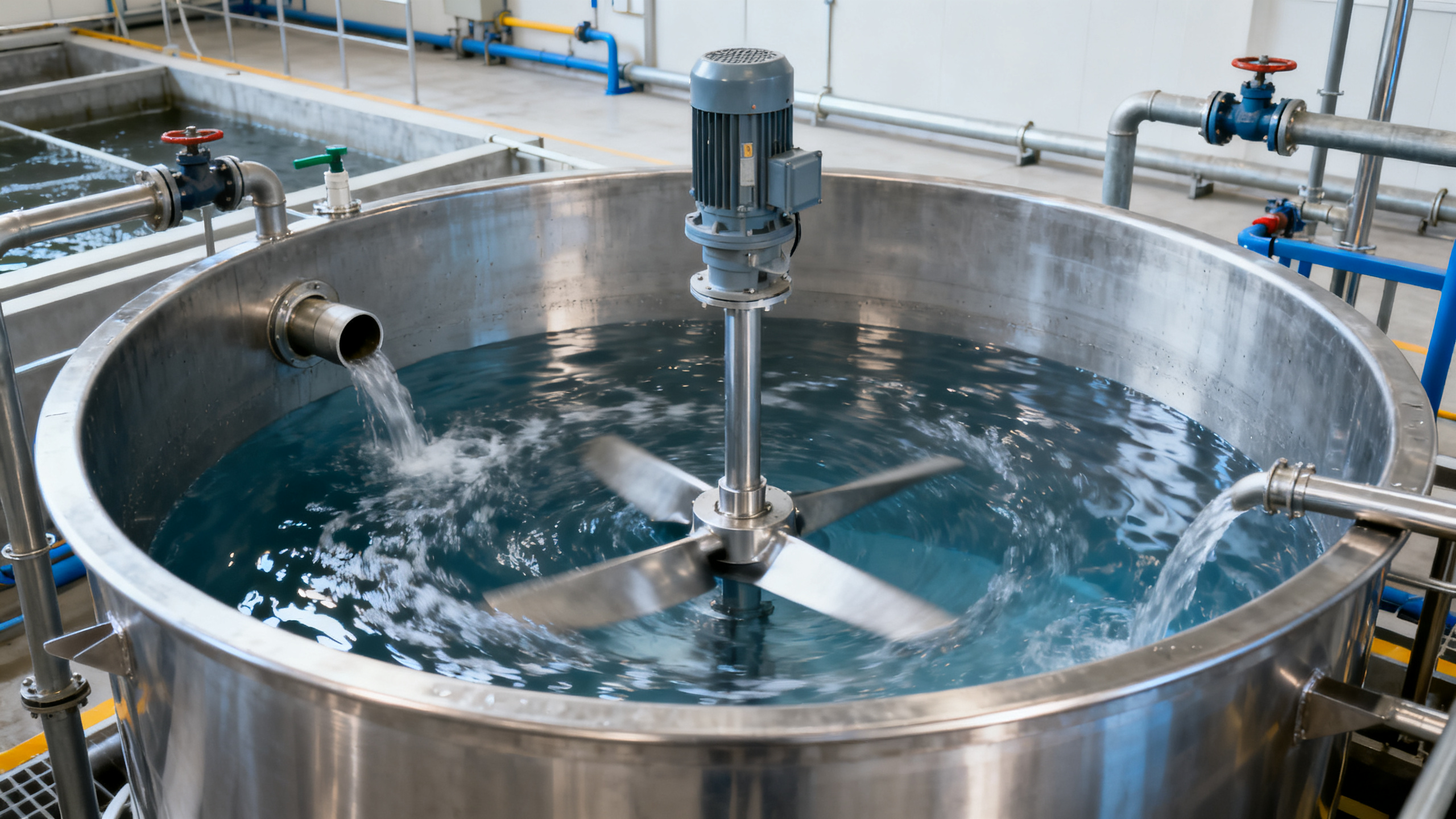
A dosing agitator for wastewater treatment can solve chemical blending issues, but poor mixing, vortexing, dead zones, and uneven dosing still affect daily operations.
If treatment results keep drifting, the root cause is often mechanical, hydraulic, or operational rather than chemical quality alone.
This guide explains the most common problems, why they happen, and what practical fixes usually work on site.
Why Mixing Performance Matters More Than Many Systems Assume
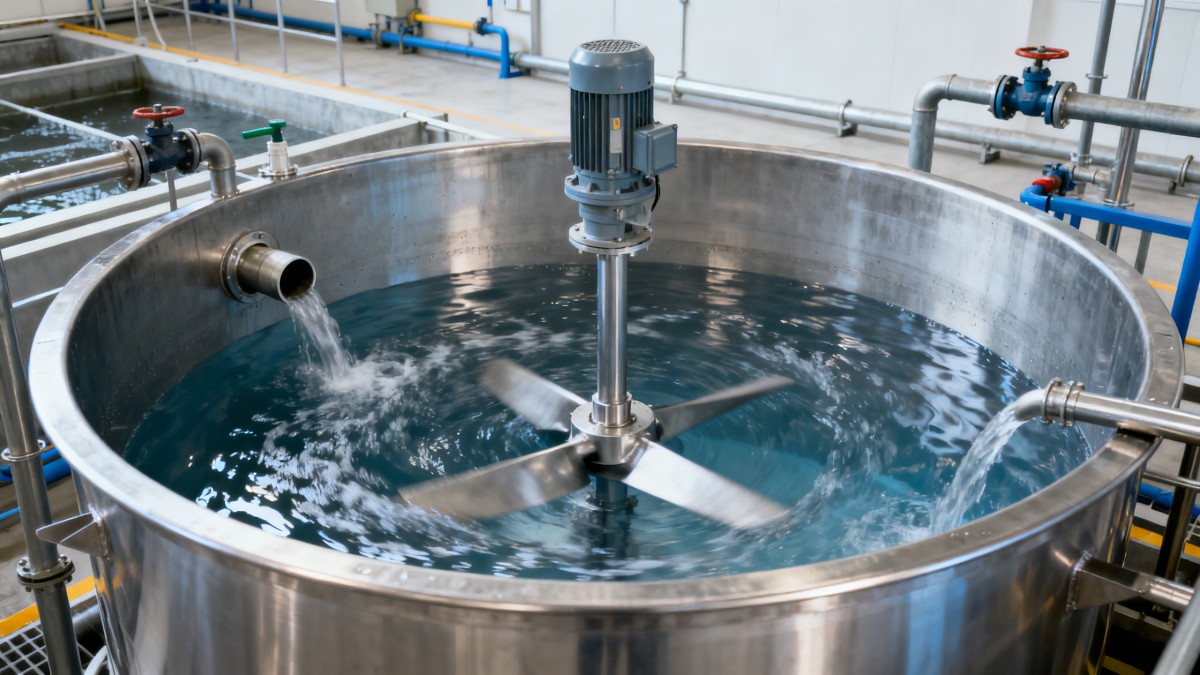
A dosing agitator for wastewater treatment does more than keep liquid moving.
It controls how fast chemicals disperse, how evenly reactions start, and how stable downstream treatment becomes.
When mixing is weak, operators usually see symptoms before they identify the source.
- pH swings after dosing
- Higher coagulant or polymer consumption
- Floc quality changing from batch to batch
- Sedimentation performance dropping without a clear reason
- Premature wear on shafts, seals, and impellers
In practical terms, poor agitation wastes chemicals and narrows process stability.
That also means more operator intervention, more retesting, and more downtime risk.
From a cost angle, the agitator is often a small asset with a very large process impact.
Problem 1: Poor Chemical Dispersion After Dosing
One common issue with a dosing agitator for wastewater treatment is delayed or uneven chemical dispersion.
The chemical enters the tank, but concentration remains high near the inlet and weak elsewhere.
This often shows up as unstable readings, patchy floc formation, or repeated manual correction.
Typical causes
- Dosing point placed too far from the mixing zone
- Impeller speed too low for fluid viscosity or tank volume
- Inlet flow pattern fighting the agitator circulation path
- Chemical feed entering near walls or stagnant corners
What usually fixes it
- Move the dosing point closer to the strongest circulation area.
- Check whether the agitator speed matches actual process demand.
- Review impeller type if the liquid has changed in solids content or viscosity.
- Run a short jar test and compare it with tank behavior.
A dosing agitator for wastewater treatment performs best when feed location and flow pattern work together.
If those two are misaligned, chemical efficiency drops quickly.
Problem 2: Vortexing and Air Entrainment
A visible vortex may look like strong mixing, but it often signals wasted energy.
In a wastewater tank, vortexing can pull air into the liquid and interfere with treatment chemistry.
This becomes more obvious when foam increases or oxidation-sensitive chemicals behave unpredictably.
Why it happens
- Agitator speed is too high for the liquid level
- Impeller is mounted too close to the surface
- Tank lacks baffles or equivalent anti-swirl features
- Round tanks encourage circular flow without enough disruption
Corrective actions
- Reduce speed and observe whether chemical blending remains adequate
- Lower the impeller position if the shaft design allows it
- Install baffles or adjust internals to break rotational flow
- Verify liquid level during normal and low-load operation
For many plants, the best dosing agitator for wastewater treatment is not the fastest one.
It is the one that creates controlled circulation without dragging air into the process.
Problem 3: Dead Zones in the Tank
Dead zones are areas where liquid movement becomes too weak to support consistent blending.
They are especially common in larger tanks, rectangular basins, and systems with changing water levels.
More importantly, dead zones can hide under otherwise acceptable average performance.
Warning signs
- Sludge or solids collecting in corners
- Different pH or turbidity readings at different sampling points
- Chemical residue sticking to walls or internal supports
- Local odor increase from stagnant zones
How to solve dead zones
Start with a simple circulation check using dye, conductivity, or multiple sampling points.
That often reveals whether the dosing agitator for wastewater treatment is undersized or poorly positioned.
Then review these factors:
- Tank geometry and internal obstructions
- Impeller diameter and pumping capacity
- Mounting angle and shaft location
- Seasonal changes in influent solids and viscosity
In some cases, a second mixing point or a different impeller profile is the better answer.
Trying to fix every dead zone with higher speed alone usually increases wear first.
Problem 4: Uneven Dosing During Variable Flow Conditions
Wastewater conditions rarely stay constant for long.
Flow, temperature, solids load, and chemical demand often shift across a single day.
When that happens, a dosing agitator for wastewater treatment can appear inconsistent even if the motor is healthy.
What changes on site
The stronger signal here is variability, not total failure.
A stable setup at one flow condition may struggle badly at another.
That is why operating data should be reviewed together with mixing behavior.
Problem 5: Excessive Wear, Noise, or Power Draw
A dosing agitator for wastewater treatment should not require constant mechanical attention.
When bearings heat up, seals fail early, or power use rises, mixing conditions may be part of the problem.
This is often missed because teams focus only on process chemistry.
Likely reasons
- Impeller loading exceeds original design assumptions
- Shaft misalignment creates vibration under load
- Chemical crystallization or solids buildup changes balance
- Motor sizing leaves little margin for real wastewater conditions
Practical checks
- Trend current draw against solids load and liquid level.
- Inspect the impeller for scaling, erosion, or material loss.
- Measure vibration and compare with past maintenance records.
- Confirm that startup and shutdown routines are not causing shock loads.
When a dosing agitator for wastewater treatment is running outside its real duty point, wear escalates fast.
Fixing the hydraulic mismatch often reduces maintenance more than replacing parts alone.
A Simple Troubleshooting Routine That Works
When mixing problems appear, a structured routine saves time.
It also prevents random adjustments that create new instability.
- Document the symptom clearly: poor floc, pH drift, foam, sludge buildup, or power increase.
- Check process conditions first: flow, level, solids, temperature, and recent chemical changes.
- Observe actual circulation inside the tank instead of relying only on motor status.
- Inspect feed point, impeller position, and any blockage or buildup.
- Adjust one variable at a time and record the effect.
This approach gives a more reliable diagnosis than changing speed and dosage at the same time.
When It Is Time to Upgrade the Agitator
Not every issue can be solved with tuning.
Sometimes the existing dosing agitator for wastewater treatment no longer fits the process it now serves.
That is more likely after production expansion, influent changes, or chemical program updates.
- Frequent retuning is needed to maintain acceptable results
- Chemical consumption keeps rising without better treatment performance
- Mechanical failures repeat after standard maintenance
- Tank coverage remains poor even after repositioning and speed changes
In that situation, review motor power, impeller geometry, materials, sealing, and mounting arrangement together.
A better-matched unit often improves process consistency and lowers total operating cost.
Final Takeaway
A dosing agitator for wastewater treatment affects far more than chemical motion.
It shapes dosing accuracy, treatment stability, equipment life, and chemical cost.
If poor dispersion, vortexing, dead zones, uneven dosing, or rising wear keep appearing, the answer is usually visible in the mixing pattern.
Start with feed location, circulation path, impeller setup, and real operating conditions.
Once those are aligned, wastewater treatment becomes easier to control and much less expensive to stabilize.
Technical Specifications
- How to Select Electronic Hotel Key Card Locks for Guest Rooms and Staff AreasAuthor :Safety Compliance Lead
- How to Select Lab Instruments for Reliable Chemical Analysis WorkflowsAuthor :Precision Metrology Expert
- How to Size a UPS for Server Rooms: Load, Runtime, and Redundancy FactorsAuthor :Grid Infrastructure Analyst
Expert Insights

Chief Security Architect
Dr. Thorne specializes in the intersection of structural engineering and digital resilience. He has advised three G7 governments on industrial infrastructure security.
Related Analysis
- Sep 17, 2026How to Select Electronic Hotel Key Card Locks for Guest Rooms and Staff AreasAuthor :Safety Compliance Lead
- Sep 16, 2026How to Select Lab Instruments for Reliable Chemical Analysis WorkflowsAuthor :Precision Metrology Expert
- Sep 15, 2026How to Size a UPS for Server Rooms: Load, Runtime, and Redundancy FactorsAuthor :Grid Infrastructure Analyst
Core Sector // 01
Security & Safety
- How to Size a Wafer Butterfly Valve for HVAC Chilled-Water and Heating LoopsAuthor :Environmental Engineering Director

- How Pressure Class and Joint Design Affect Long-Term Performance of Ductile Iron Pipes in Drainage InfrastructureAuthor :Environmental Engineering Director

- How Ductile Iron Pipe Joints Affect Installation Reliability and Leak ControlAuthor :Environmental Engineering Director

- How to Size Effluent Treatment Equipment for Variable Industrial Wastewater LoadsAuthor :Environmental Engineering Director

- US Battery Push Raises New Entry Rules for SuppliersAuthor :Environmental Engineering Director

- EU EMC Rule Tightens for Water Treatment ExportsAuthor :Environmental Engineering Director

- EU REACH Restriction Targets PFAS Water Treatment ImportsAuthor :Environmental Engineering Director

- EU Mandates EN 14113:2026 for Water Treatment ExportsAuthor :Environmental Engineering Director