Buying Fiberglass Water Tanks Wholesale: Compare Quotes and Delivery Costs
Author
Date Published
Reading Time
Buying Fiberglass Water Tanks Wholesale: Compare Quotes and Delivery Costs
Buying fiberglass water tanks wholesale requires more than comparing unit prices. Freight charges, unloading requirements, tank specifications, and delivery lead times can significantly change the total landed cost—and the value of a supplier’s quote. A lower price may lose its advantage once oversized transport or site access constraints are factored in.
The practical challenge is making competing offers comparable. One supplier may include fittings and transport protection; another may price only the tank shell. A third may quote delivery to a terminal rather than your facility. Before negotiating a volume discount, establish exactly what must arrive, where responsibility changes hands, and what it will take to put each tank into service.
Define the tank before comparing the price
Fiberglass-reinforced plastic, commonly called FRP or GRP, describes a material system rather than a single tank specification. Resin selection, reinforcement, manufacturing method, structural design, and fittings all affect suitability and price. Equal nominal capacity does not make two tanks interchangeable.
Start with the stored water and operating conditions. Potable water, process water, rainwater, and treated wastewater can require different material documentation and design choices. Include operating temperature, cleaning chemicals, disinfectant exposure, and any other constituents that could affect the laminate or internal surface.
State whether the installation is aboveground or buried, indoors or outdoors, and atmospheric or subject to pressure or vacuum. A tank designed for atmospheric storage should not be assumed suitable for pressure, burial loads, or suction conditions. Wind, seismic exposure, anchoring, and foundation requirements also need project-specific review.
Your request for quotation should establish:
- Quantity, nominal capacity, required usable capacity, and measurement units.
- Maximum installed dimensions and restrictions along the delivery route.
- Water composition, temperature range, installation environment, and design conditions.
- Nozzle sizes, flange standards, connection locations, access openings, vents, drains, and overflow arrangements.
- Required drawings, inspection records, application approvals, and delivery destination.
Usable capacity deserves particular attention. Freeboard, overflow elevation, and the lowest practical outlet level can reduce available storage. Comparing price per nominal gallon or cubic meter can therefore hide a shortfall in working volume.
Ask for evidence that matches the application
For potable-water service, determine which drinking-water-contact requirements apply in the destination market. Where NSF/ANSI/CAN 61 certification is required, verify the listing covers the proposed product and applicable conditions of use. A general claim about “food-grade resin” is not a substitute for the evidence your project requires.
Likewise, an ISO 9001 certificate concerns a quality management system; it does not by itself establish that a particular tank meets your structural or water-contact requirements. Ask suppliers to identify the proposed design standard, its scope, and any deviations. Do not add CE, UL, or other marks to the purchasing specification without confirming their relevance.
Turn supplier offers into a common cost comparison
Keep the original quotations, but evaluate them through a separate comparison sheet. Distinguish confirmed inclusions, exclusions, and unresolved allowances. An empty freight field is not zero freight, and “standard fittings included” is not a sufficiently defined scope.
Define your own comparison boundary. For example, evaluate landed cost through receipt at the site, then show installation and commissioning separately. Include nonrecoverable taxes where applicable and flag recoverable taxes as a cash-flow consideration rather than automatically treating them as a permanent cost.
For international purchases, request the Incoterms® rule, version, and precise named place. An FOB quotation needs separate freight and destination-cost analysis before comparison with a delivered offer. Even a delivered quotation needs checking: delivery, unloading, import clearance, and insurance are not interchangeable responsibilities.
Freight depends on geometry, not just weight
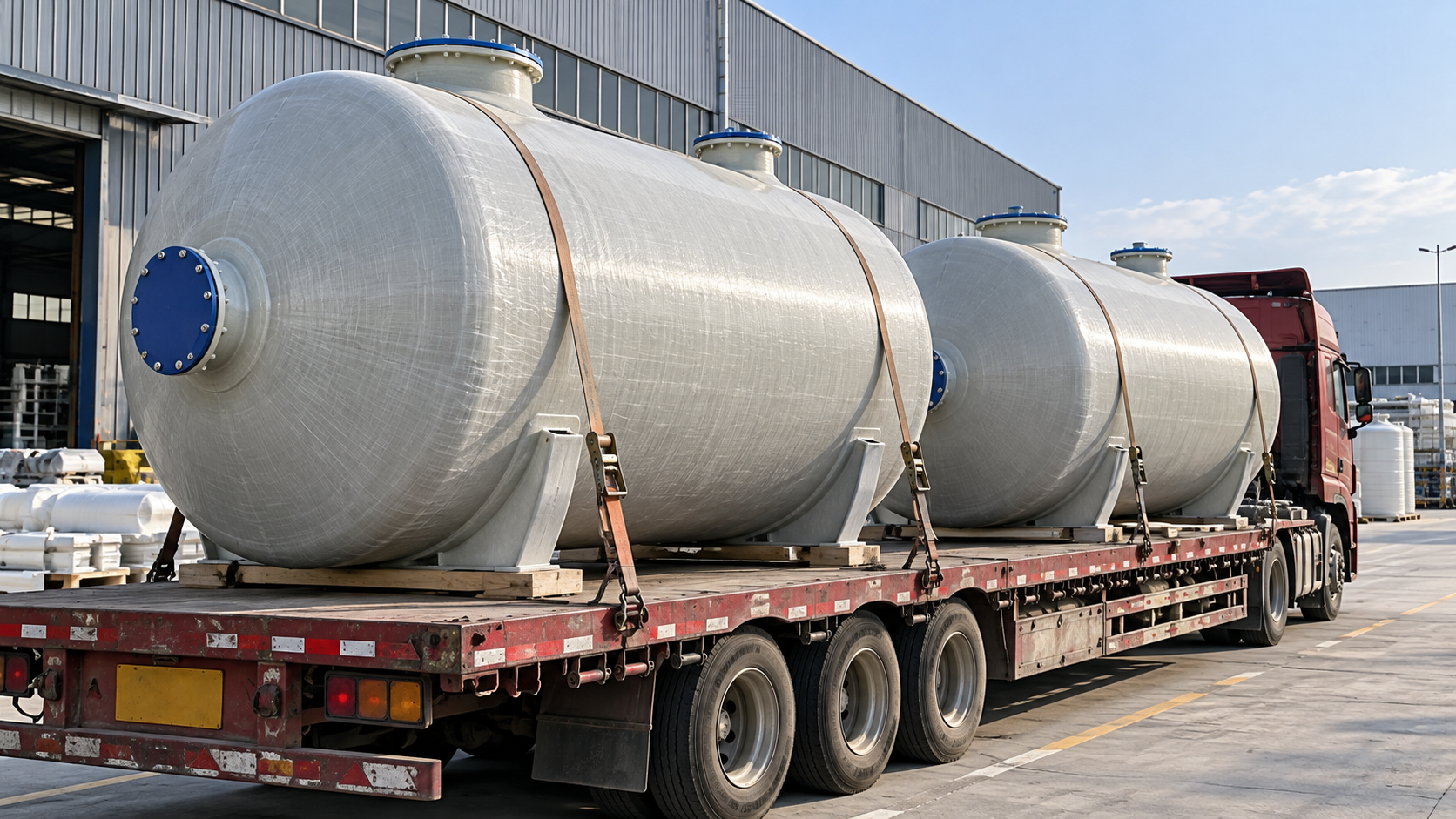
An empty fiberglass tank can occupy substantial vehicle space without being especially heavy. Carrier pricing may reflect dimensions, deck space, route restrictions, and handling requirements rather than weight alone. A modest dimensional change can alter the transport arrangement, although the exact effect depends on the route and local limits.
Request packed shipping dimensions, shipping weight, orientation, support requirements, and the proposed number of loads. These should include cradles, projecting connections, and protective packaging—not simply the dimensions on the tank’s general arrangement drawing.
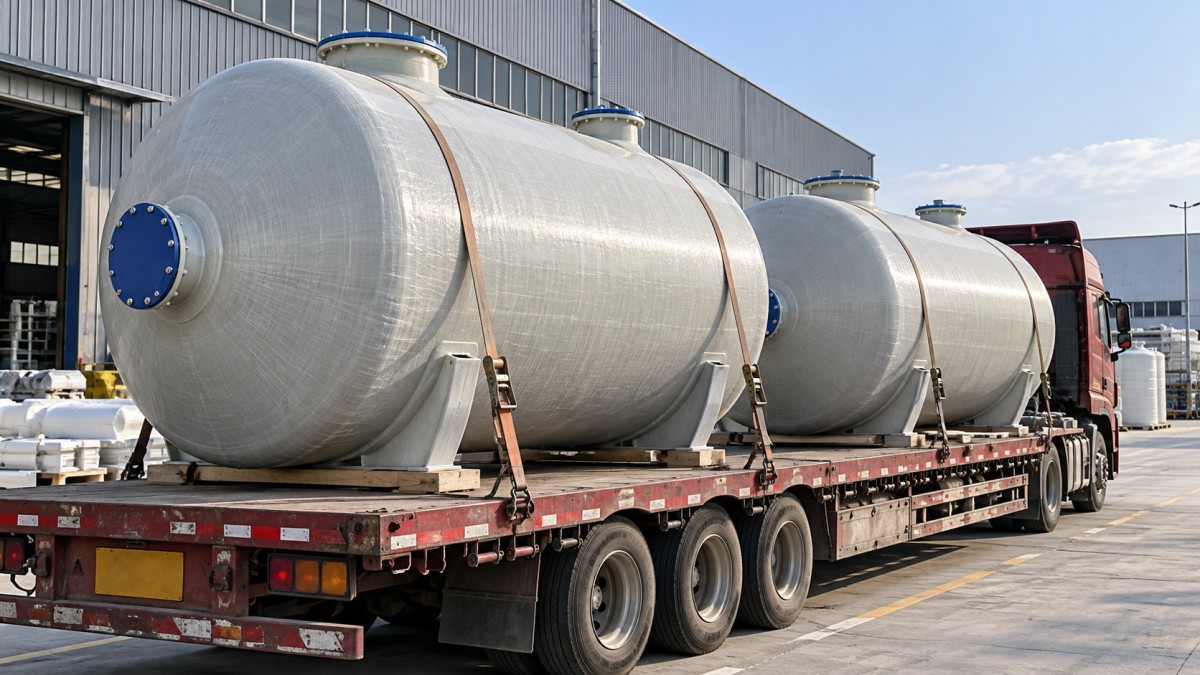
Ask the carrier or logistics provider to assess the actual route. Oversize permits, escorts, bridges, overhead clearances, delivery-hour restrictions, and the final approach to the site can affect feasibility and price. A quotation based only on distance is not enough for a large load.
For overseas shipments, confirm whether the packed tank fits the proposed container and loading arrangement. Equipment availability, special handling, terminal storage, and onward road transport all require checking. Avoid assuming that a tank fitting inside a container also means it can pass through the door and be safely secured.
Sectional tanks or site assembly may be worth evaluating when access is restrictive. However, compare the complete installed scope, including assembly labor, joint sealing, inspection, and testing. Reduced freight does not automatically mean a lower project cost.
Wholesale savings depend on the release schedule
Ordering more tanks can improve manufacturing efficiency when designs are standardized. Freight savings are less predictable: once a vehicle reaches its dimensional limit, another tank may require another load. Ask suppliers to separate the manufacturing discount from any assumed transport consolidation.
Compare one consolidated shipment with scheduled releases against a blanket order. Consolidation may reduce some handling costs, but it can also create storage, preservation, and working-capital burdens. Staged deliveries can suit a phased project better, provided the contract defines price validity, storage charges, release notice, and cancellation terms.
Standardizing fittings and tank configurations across sites may produce a cleaner commercial offer than simply increasing quantity. Still, do not force identical designs onto locations with different water conditions, foundations, or loading requirements.
A delivery date is only useful if the site can receive the tank
Separate manufacturing lead time from drawing approval, inspection, dispatch, transit, customs clearance, and the site delivery appointment. Confirm what starts the quoted lead time: order acceptance, deposit receipt, approved drawings, or another milestone. “Available in six weeks,” for example, is ambiguous unless its starting point and delivery boundary are stated.
Before dispatch, obtain the manufacturer’s handling instructions and confirm the unloading method. Designated lifting points, sling arrangements, and support requirements matter. Tank nozzles should not be treated as lifting points unless expressly designed and approved for that purpose.
Check gate width, turning space, ground bearing conditions, crane access, and any temporary obstructions. The lifting contractor should assess the actual load and working radius. Assign responsibility for failed delivery, vehicle waiting time, redelivery, and storage before these costs become an argument at the gate.
Set a receiving procedure as well. Record packaging condition and visible damage, check accessories against the packing list, and follow contractual notification deadlines. Receipt inspection should not replace the specified installation checks and commissioning tests.
Award on a complete scope, not an attractive subtotal
Use technical suitability as a pass-or-fail gate before ranking commercial offers. Then compare confirmed landed cost, delivery confidence, warranty terms, and the cost of identified exclusions. Keep uncertain allowances visible rather than disguising them inside an apparently precise total.
Warranty wording deserves review: coverage for a replacement tank may not include removal, lifting, freight, or reinstallation. Clarify exclusions involving foundations, unsupported pipework, handling, and operating conditions. Also check whether replacement fittings and repair guidance will remain available.
Global Industrial Core’s focus on foundational industrial systems supports this evidence-led sourcing approach: connect material requirements, engineering documentation, and logistics responsibilities before making a cost judgment. For fiberglass water tanks wholesale, the useful comparison is not simply price per tank, but the cost of receiving a compliant, undamaged tank ready for the agreed installation process.
Before issuing the purchase order, close the remaining gaps in writing: approved configuration, documented exceptions, delivery boundary, unloading responsibility, and schedule milestones. If those items are still uncertain, the lowest quotation is not yet a reliable project price.
Technical Specifications
- Air Handling Unit Supplier Checklist: Performance Data, Lead Times, and SupportAuthor :Environmental Engineering Director
- Buying Fiberglass Water Tanks Wholesale: Compare Quotes and Delivery CostsAuthor :Environmental Engineering Director
- Choosing an XLPE Power Cable Supplier: Test Reports, Traceability, and Lead TimesAuthor :Grid Infrastructure Analyst
Expert Insights

Chief Security Architect
Dr. Thorne specializes in the intersection of structural engineering and digital resilience. He has advised three G7 governments on industrial infrastructure security.
Related Analysis
- Oct 19, 2026Air Handling Unit Supplier Checklist: Performance Data, Lead Times, and SupportAuthor :Environmental Engineering Director
- Oct 18, 2026Buying Fiberglass Water Tanks Wholesale: Compare Quotes and Delivery CostsAuthor :Environmental Engineering Director
- Oct 17, 2026Choosing an XLPE Power Cable Supplier: Test Reports, Traceability, and Lead TimesAuthor :Grid Infrastructure Analyst
Core Sector // 01
Security & Safety
- Buying Fiberglass Water Tanks Wholesale: Compare Quotes and Delivery CostsAuthor :Environmental Engineering Director

- How to Select Industrial pH Meters for Continuous Wastewater Process ControlAuthor :Environmental Engineering Director

- How to Size a Rinse Fill Cap Machine for Your Bottle Format and Target OutputAuthor :Environmental Engineering Director

- How to Size a Heavy-Duty Submersible Sewage Pump for High-Solids Lift StationsAuthor :Environmental Engineering Director

- How to Size a Wafer Butterfly Valve for HVAC Chilled-Water and Heating LoopsAuthor :Environmental Engineering Director

- How Pressure Class and Joint Design Affect Long-Term Performance of Ductile Iron Pipes in Drainage InfrastructureAuthor :Environmental Engineering Director

- How Ductile Iron Pipe Joints Affect Installation Reliability and Leak ControlAuthor :Environmental Engineering Director

- How to Size Effluent Treatment Equipment for Variable Industrial Wastewater LoadsAuthor :Environmental Engineering Director