When Do Weld Neck Flanges Justify the Higher Cost?
For technical evaluators, the real question is not whether weld neck flanges cost more, but whether their performance justifies that premium in critical service.
In high-pressure, high-temperature, cyclic, or hazardous piping systems, flange selection directly affects leakage risk, fatigue life, inspection confidence, and lifecycle cost.
This article examines where weld neck flanges deliver measurable engineering value, when cheaper alternatives may be acceptable, and how procurement teams can align flange choice with safety, compliance, and total cost of ownership.
The short answer: pay more when failure consequences are high

Weld neck flanges justify the higher cost when the joint must behave like an engineered pressure boundary, not merely a detachable connection.
Their value comes from stress distribution, weld integrity, inspection access, and long-term reliability under demanding thermal, mechanical, or process conditions.
For benign low-pressure utilities, a slip-on or threaded flange may satisfy code, budget, and operating requirements without excessive risk.
For steam, hydrocarbons, toxic media, cyclic service, or critical shutdown lines, the weld neck design often becomes the defensible engineering choice.
The cost premium should therefore be evaluated against leakage probability, outage cost, repair accessibility, regulatory exposure, and safety consequences.
Why weld neck flanges perform better in severe service
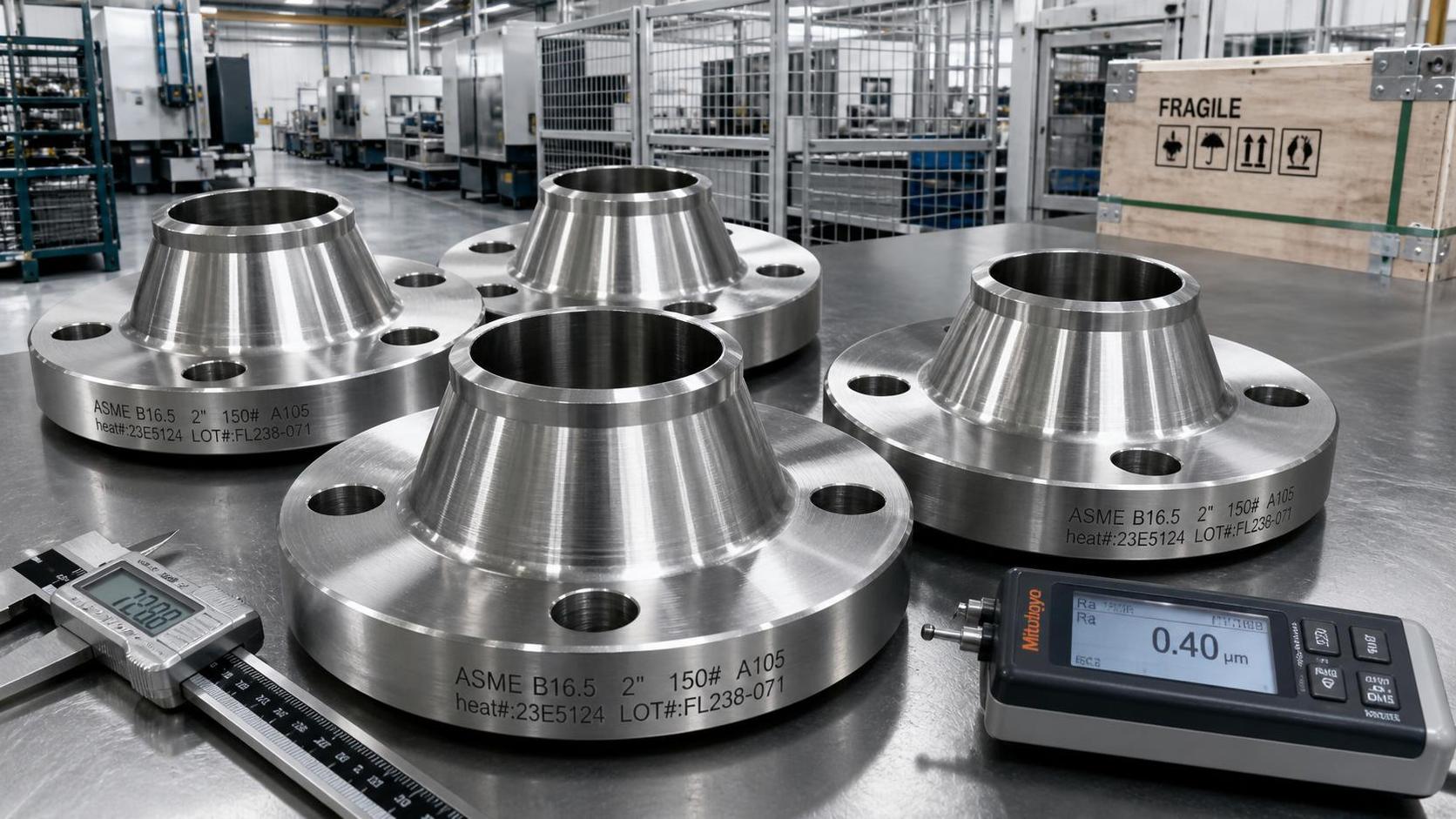
A weld neck flange has a long tapered hub that gradually transfers stress from the flange to the pipe wall.
This geometry reduces abrupt stiffness changes, which are common initiation points for fatigue cracks in vibrating or thermally cycling systems.
The full-penetration butt weld also creates a stronger and more inspectable joint than the fillet welds used on many slip-on flanges.
For evaluators, this matters because joint reliability is rarely determined by flange strength alone, but by flange, weld, pipe, and gasket interaction.
In high-pressure systems, the smoother internal bore alignment can also reduce turbulence, erosion, and localized process disturbance near the connection.
These advantages become most valuable where pressure boundary failure would trigger production loss, environmental release, injury risk, or mandatory reporting.
When pressure and temperature make the premium rational
Higher pressure classes are one of the clearest signals that weld neck flanges deserve serious consideration during technical evaluation.
As pressure rises, bolting loads, gasket seating stress, pipe reactions, and bending moments all become more consequential to joint integrity.
Temperature adds another layer because thermal expansion, creep potential, material derating, and gasket relaxation can reduce available safety margin.
In steam headers, thermal oil loops, refinery units, and high-temperature chemical lines, flange selection should reflect sustained operating severity.
A cheaper flange may meet nominal dimensions, yet still provide less tolerance for misalignment, cycling, and secondary loads over time.
Technical evaluators should compare flange options using design pressure, design temperature, material group, pressure class, and applicable code ratings.
Cyclic loading and vibration often decide the case
Many flange failures are not caused by one overload event, but by repeated small stresses accumulating over years of operation.
Pumps, compressors, reciprocating equipment, pressure pulsation, water hammer, and thermal startups can create fatigue conditions around flange joints.
The tapered hub of weld neck flanges helps reduce stress concentration where the pipe meets the flange body.
This is especially important when piping flexibility analysis shows significant bending moments, nozzle loads, or displacement stress near equipment connections.
Slip-on flanges can perform adequately in stable service, but their fillet-welded configuration is generally less favorable for fatigue resistance.
If the line experiences frequent startups, shutdowns, vibration, or thermal transients, the lifecycle argument for weld neck flanges becomes stronger.
Hazardous fluids change the economics completely
For water or compressed air, a minor leak may be inconvenient, but usually manageable with planned maintenance.
For flammable, toxic, corrosive, or environmentally regulated media, leakage consequences are operational, legal, and reputational, not merely mechanical.
Hydrocarbon service, hydrogen systems, ammonia lines, acid transfer, and high-pressure gas applications often justify conservative flange selection.
In these systems, the incremental price of weld neck flanges is small compared with containment failure, evacuation, remediation, or incident investigation.
Evaluators should also consider whether the flange location is near personnel, ignition sources, confined spaces, public boundaries, or sensitive equipment.
Where exposure risk is high, selecting the more robust and inspectable connection supports both engineering prudence and safety governance.
Inspection confidence is a major hidden advantage
Weld neck flanges support full-penetration butt welds that are well suited to radiographic, ultrasonic, magnetic particle, or dye penetrant inspection.
This inspection advantage matters when project specifications require traceable quality assurance, pressure boundary documentation, or third-party verification.
By contrast, fillet welds on slip-on flanges can be harder to evaluate fully, particularly for root defects or incomplete fusion.
In regulated industries, the ability to demonstrate weld quality may be nearly as important as the physical strength itself.
Technical evaluators should ask whether the project requires NDE records, weld maps, material test reports, pressure test evidence, and code compliance dossiers.
If documentation quality affects acceptance, insurance, commissioning, or audit outcomes, weld neck flanges can reduce uncertainty during approval.
Where cheaper flange types may still be acceptable
Weld neck flanges are not automatically the best choice for every connection, and over-specification can waste capital without improving reliability.
Slip-on flanges may be appropriate for low-pressure water, noncritical utility air, drainage, firewater branches, and moderate service with limited cycling.
Threaded flanges may suit small-bore, low-pressure applications where welding is impractical, though leakage and fatigue limits require caution.
Socket weld flanges can serve compact high-pressure small-bore systems, but crevice corrosion and fatigue concerns should be evaluated.
Lap joint flanges are useful where alignment, frequent dismantling, or expensive alloy wetted parts influence the design decision.
The decision should not be based on flange price alone, but on service severity, maintainability, inspection requirements, and failure consequences.
Cost comparison should include installation and downtime
The purchase price of weld neck flanges is only one component of the true installed and operated cost.
They require pipe beveling, fit-up control, qualified welders, consumables, inspection time, and sometimes more demanding fabrication procedures.
However, those added costs may be offset by fewer leaks, reduced rework, longer service life, and greater commissioning confidence.
For critical plants, one unplanned shutdown can exceed the entire flange cost difference across a piping package.
Evaluators should model total cost of ownership using procurement cost, welding cost, inspection cost, outage risk, repair accessibility, and spare availability.
The premium is easiest to justify when maintenance access is poor, shutdown windows are expensive, or process interruption affects multiple units.
Standards and specifications that influence the decision
Common references include ASME B16.5, ASME B16.47, ASME B31.3, ASME B31.1, EN 1092, and project-specific piping classes.
These standards define dimensional, pressure-temperature, material, and design expectations, but they do not replace engineering judgment.
A flange may be standard-compliant yet still unsuitable for a severe fatigue environment, poor alignment condition, or hazardous service.
Procurement teams should verify pressure class, facing type, bore schedule, material grade, heat treatment, marking, and certification requirements.
They should also confirm compatibility with gaskets, bolts, corrosion allowance, pipe wall thickness, and the applicable piping material specification.
For global sourcing, traceability to recognized standards and reliable material test reports are essential to avoid dimensional or metallurgical surprises.
Material selection can be as important as flange style
A weld neck design cannot compensate for the wrong metallurgy, especially in corrosive, sour, cryogenic, or high-temperature environments.
Carbon steel, low-temperature carbon steel, stainless steel, duplex, alloy steel, and nickel alloys each serve different service conditions.
Evaluators should review corrosion mechanisms, chloride exposure, sulfide stress cracking, hydrogen attack, thermal oxidation, and galvanic compatibility.
For sour service, relevant NACE or ISO requirements may influence both material selection and hardness control.
For cryogenic applications, impact testing and low-temperature toughness become critical, particularly where brittle fracture risk exists.
The final judgment should pair flange geometry with verified material suitability, not treat weld neck flanges as a universal solution.
A practical decision framework for technical evaluators
Start by classifying the service according to pressure, temperature, fluid hazard, cyclic duty, vibration, corrosion, and accessibility.
Next, identify the consequence of leakage or rupture, including personnel exposure, environmental release, production loss, and repair complexity.
Then review code requirements, owner specifications, piping class rules, inspection expectations, and any previous failure history in similar services.
If multiple risk factors are present, weld neck flanges should move from optional upgrade to preferred baseline.
If service is stable, nonhazardous, low-pressure, and easily maintainable, alternative flange types may deliver adequate value.
This structured approach helps procurement defend decisions with risk logic rather than relying on habit, preference, or lowest initial price.
Procurement questions that prevent costly mistakes
Before issuing a purchase order, confirm whether the flange bore matches the pipe schedule and whether special bore machining is required.
Check facing requirements, such as raised face, flat face, ring-type joint, or special finishes for selected gasket technology.
Verify material certificates, heat numbers, dimensional tolerances, pressure class markings, origin requirements, and any positive material identification needs.
Ask whether the supplier can provide inspection reports, NDE records, hydrotest documentation, and compliance with project documentation packages.
For alloy or high-pressure service, confirm manufacturing route, heat treatment, mechanical testing, and supplementary requirements before fabrication begins.
These checks help ensure weld neck flanges deliver the expected performance instead of becoming expensive components with uncertain pedigree.
Common mistakes when judging the cost premium
One frequent mistake is comparing flange unit prices without including welding, inspection, maintenance, leakage risk, and downtime exposure.
Another is selecting weld neck flanges everywhere, even in low-risk systems where the added complexity provides little operational benefit.
Some teams also overlook pipe schedule compatibility, causing bore mismatch, flow disturbance, or field modification during installation.
Others focus on flange class while ignoring gasket selection, bolt quality, tightening procedure, and surface finish.
A robust flange cannot overcome poor assembly practice, damaged gasket faces, incorrect torque, or uncontrolled pipe alignment.
The best evaluation treats the flanged joint as a system, not as a single catalog item.
Conclusion: justify weld neck flanges with risk, not habit
Weld neck flanges justify their higher cost when the application demands superior stress distribution, fatigue resistance, weld integrity, and inspection confidence.
They are especially valuable in high-pressure, high-temperature, cyclic, hazardous, regulated, or difficult-to-maintain piping systems.
Cheaper alternatives can still be appropriate for low-risk utilities, stable operation, and accessible service where failure consequences are limited.
For technical evaluators, the most defensible decision comes from balancing code compliance, operating severity, lifecycle cost, and consequence of failure.
When leakage is unacceptable and reliability must be proven, weld neck flanges are not simply more expensive; they are often the safer investment.