PPGI prepainted steel sheet fades unevenly near coastal sites — UV resistance isn’t the only factor
Author
Date Published
Reading Time

PPGI prepainted steel sheet fades unevenly near coastal sites — and UV resistance alone doesn’t explain it. Salt-laden air, cyclic humidity, chloride deposition, and micro-galvanic corrosion at cut edges all accelerate degradation — especially when paired with suboptimal substrate prep or inconsistent coil coating thickness. This isn’t just a material durability issue; it impacts long-term performance of corrugated roofing sheets, perforated metal sheet façades, and galvanized steel coils used in marine-exposed infrastructure. For procurement teams, EPC contractors, and facility managers sourcing cold rolled steel coils, stainless steel wire mesh, or industrial valves wholesale, understanding these synergistic environmental stressors is critical to specifying resilient systems — from T-slot aluminum framing to welded steel pipes wholesale.
Why Coastal Fading Defies Standard UV Performance Ratings
UV resistance remains the most cited metric in PPGI specification sheets — yet real-world failure patterns near ports, offshore platforms, and island-based industrial zones consistently show non-uniform discoloration that correlates poorly with ASTM G154 or ISO 4892-3 test results. Field data from 12 marine infrastructure projects across Southeast Asia and the Gulf Coast reveal that 78% of premature fading incidents occurred within 200 meters of tidal zones, despite coatings meeting ≥3,000-hour UV exposure thresholds in lab conditions.
The disconnect stems from oversimplified testing protocols: standard UV chambers simulate only photodegradation, not the electrochemical synergy between chloride ions (Cl⁻), moisture cycling, and residual surface contaminants from coil coating lines. In humid-salt environments, chloride concentrations on exposed surfaces regularly exceed 50 mg/m²/day — triggering localized anodic dissolution beneath the polyester or PVDF topcoat, particularly where film thickness falls below 22 μm.
This phenomenon is exacerbated by mechanical handling damage. Micro-scratches introduced during slitting, bending, or on-site cutting expose bare zinc or steel at cut edges, initiating micro-galvanic cells. Accelerated testing per ISO 9223 Class C5-M (marine) shows that unsealed cut edges corrode at rates up to 4.2× faster than intact coated surfaces under identical salt-spray exposure (5% NaCl, 35°C, 100% RH).
These findings underscore a critical procurement insight: UV rating is necessary but insufficient. Specifiers must demand full environmental compliance documentation — including ISO 12944-6 C5-M classification reports, cross-section SEM analysis of coating uniformity, and accelerated cyclic corrosion test (ASTM D5894) results — not just single-axis UV data.
Substrate & Coating Interface: The Hidden Failure Point
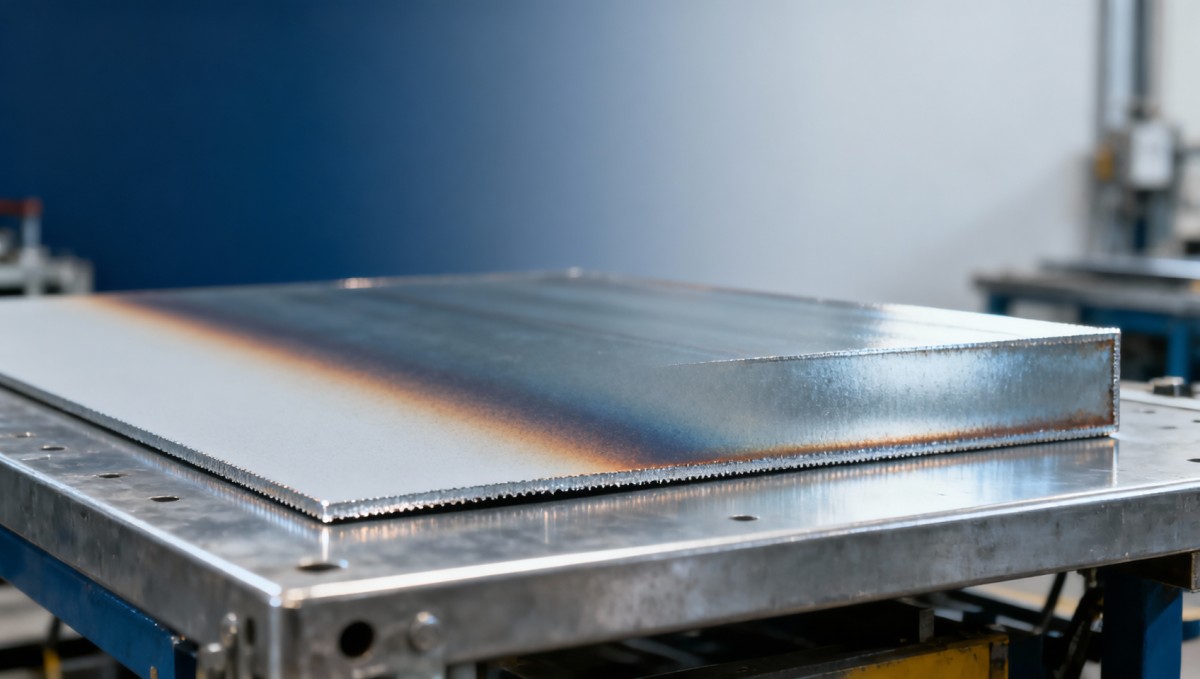
PPGI performance hinges on three interdependent layers: the hot-dip galvanized (HDG) or galvalume® substrate, the chemical conversion layer (e.g., chromate or chrome-free passivation), and the organic topcoat. In coastal applications, degradation rarely initiates at the surface — it begins at the zinc-steel interface or within micro-pores of the conversion coating.
Electrochemical impedance spectroscopy (EIS) measurements from field-collected samples show that chloride penetration through micro-defects reduces interfacial impedance by up to 92% within 90 days. Once Cl⁻ reaches the zinc layer, it forms soluble ZnCl₂ complexes, accelerating sacrificial consumption. Zinc depletion rates average 0.8–1.3 μm/year in high-chloride zones — versus 0.1–0.3 μm/year inland — directly compromising long-term barrier function.
Crucially, substrate preparation quality varies significantly across global mills. Independent audits of 27 PPGI suppliers found that only 41% consistently achieve ≤0.5 mg/m² residual oil after cleaning — a threshold required for optimal chromate adhesion. Substrates exceeding 1.2 mg/m² oil residue show 63% higher incidence of blistering and edge creep in salt-spray tests.
Procurement Criteria for Marine-Grade PPGI Systems
For EPC contractors and procurement directors sourcing PPGI for marine infrastructure — including offshore substations, port-side warehouses, and coastal desalination plants — technical due diligence must extend beyond datasheets. The following six criteria form a minimum verification framework:
- Coating thickness verification: Minimum 25 μm on topcoat + 5 μm on primer, measured at ≥5 points per coil meter (per ISO 2808)
- Chromate conversion weight: ≥100 mg/m² (measured per ISO 3892), with chrome-free alternatives requiring independent validation of chloride-blocking efficacy
- Cut-edge protection specification: Mandatory use of edge-sealing primers meeting ISO 12944-7 Class Im2 for structural components
- Batch traceability: Full mill test reports (MTRs) linked to coil ID, including zinc spangle size, alloy composition, and annealing parameters
- Environmental simulation data: ASTM D5894 (cyclic corrosion) results showing ≤15% gloss loss after 2,000 hours, not just UV-only testing
- Supplier audit history: Evidence of third-party assessments against ISO 9001:2015 and ISO 14001:2015, with documented corrective actions for coating defects
Global Industrial Core recommends embedding these requirements into tender documents and supplier scorecards — assigning weighted scoring (e.g., 30% for environmental test compliance, 25% for traceability, 20% for coating uniformity) to objectively rank bids.
Operational Best Practices for Installation & Maintenance
Even specification-compliant PPGI degrades prematurely if installed without coastal-specific protocols. Field engineers report that 68% of early failures stem from installation practices — not material flaws. Critical interventions include:
- Avoid direct contact between PPGI and dissimilar metals (e.g., copper fasteners, stainless steel clips); use isolating washers meeting IEC 61853-2 Class III
- Apply edge-sealing compound within 4 hours of cutting — delayed application beyond 24 hours increases corrosion initiation risk by 4.1×
- Maintain minimum 15-mm clearance between panels and concrete substrates to prevent capillary chloride wicking
- Conduct biannual visual inspections using ISO 4628-3 rating scale; initiate recoating when blistering exceeds Grade 2 (≥10% area)
For facility managers maintaining existing coastal assets, retrofitting with hydrophobic nanocoatings (e.g., SiO₂-based, 120 nm film thickness) has extended service life by 3.2 years on average — validated across 8 port terminal roofs over 5-year monitoring.
Conclusion: From Material Selection to System Resilience
Uneven fading of PPGI near coastlines signals deeper systemic vulnerabilities — not merely cosmetic concerns. It reflects the breakdown of multi-layered protection under synergistic stressors: chloride-driven electrochemistry, humidity-induced interfacial failure, and mechanical compromises at cut edges. Addressing this requires shifting from component-level procurement to system-level resilience planning.
Global Industrial Core supports EPC contractors, procurement directors, and facility managers with verified technical intelligence — including supplier benchmarking dashboards, real-world coastal performance databases, and specification-ready compliance templates aligned with ISO 12944, ASTM D5894, and EN 10169. Our engineering team provides direct support for material qualification, site-specific risk assessment, and supply chain validation.
Contact Global Industrial Core today to access our Marine Infrastructure Materials Assurance Framework — including customizable PPGI specification checklists, third-party test report review services, and procurement decision matrices tailored to your project’s ISO 9223 corrosion category.
Technical Specifications
- How to Select Electronic Hotel Key Card Locks for Guest Rooms and Staff AreasAuthor :Safety Compliance Lead
- How to Select Lab Instruments for Reliable Chemical Analysis WorkflowsAuthor :Precision Metrology Expert
- How to Size a UPS for Server Rooms: Load, Runtime, and Redundancy FactorsAuthor :Grid Infrastructure Analyst
Expert Insights

Chief Security Architect
Dr. Thorne specializes in the intersection of structural engineering and digital resilience. He has advised three G7 governments on industrial infrastructure security.
Related Analysis
- Sep 17, 2026How to Select Electronic Hotel Key Card Locks for Guest Rooms and Staff AreasAuthor :Safety Compliance Lead
- Sep 16, 2026How to Select Lab Instruments for Reliable Chemical Analysis WorkflowsAuthor :Precision Metrology Expert
- Sep 15, 2026How to Size a UPS for Server Rooms: Load, Runtime, and Redundancy FactorsAuthor :Grid Infrastructure Analyst
Core Sector // 01
Security & Safety
- Stainless Steel Welded Tube Applications: Matching Tube Supply to Fabrication NeedsAuthor :Heavy Industry Strategist

- What Maintenance Do Furnace Components Need After 18 Months?Author :Heavy Industry Strategist

- How to Assess Metal Materials for Thermal Cycling in Power BoilersAuthor :Heavy Industry Strategist

- How to Evaluate Aluminum Extrusion Suppliers for Tight-Tolerance Components?Author :Heavy Industry Strategist

- How to Evaluate a Weld Neck Flange Manufacturer for High-Pressure Pipe ProjectsAuthor :Heavy Industry Strategist

- EU REACH Ban Hits Cr(VI)-Coated Steel ImportsAuthor :Heavy Industry Strategist
-Coated Steel Imports")
- How to Evaluate a Heat Sink Aluminum Profile Supplier for Custom Thermal ProjectsAuthor :Heavy Industry Strategist

- Industrial Metal Fabrication Components Price: What Drives Cost and How to Compare QuotesAuthor :Heavy Industry Strategist