EPDM Rubber Extrusion Explained: Profiles, Tolerances, and Common Industrial Uses
Author
Date Published
Reading Time
Why does EPDM rubber extrusion matter in industrial sealing and protection?
EPDM rubber extrusion sits behind many parts people rarely notice until failure happens.
It is widely used to seal gaps, cushion vibration, insulate edges, and protect assemblies from weather, dust, moisture, and ozone exposure.
In practical terms, an EPDM profile is a shaped rubber section pushed through a die, then cured into a stable form.
That simple process supports complex industrial needs across electrical enclosures, HVAC systems, transport equipment, doors, glazing, and mechanical housings.
The reason EPDM rubber extrusion remains popular is not cost alone.
Its value comes from balanced performance under UV, rain, heat cycling, and outdoor aging, where many general-purpose rubbers degrade faster.
This is why technical platforms such as Global Industrial Core often treat material selection as a system reliability issue, not just a component choice.
When a seal profile fails, the downstream effect may involve corrosion, electrical risk, energy loss, contamination, or premature maintenance.
What exactly is EPDM rubber extrusion, and how are the profiles made?
A common question is whether EPDM rubber extrusion refers to the material, the shape, or the manufacturing method.
The answer is all three working together.
EPDM stands for ethylene propylene diene monomer, a synthetic rubber known for weather resistance and stable outdoor performance.
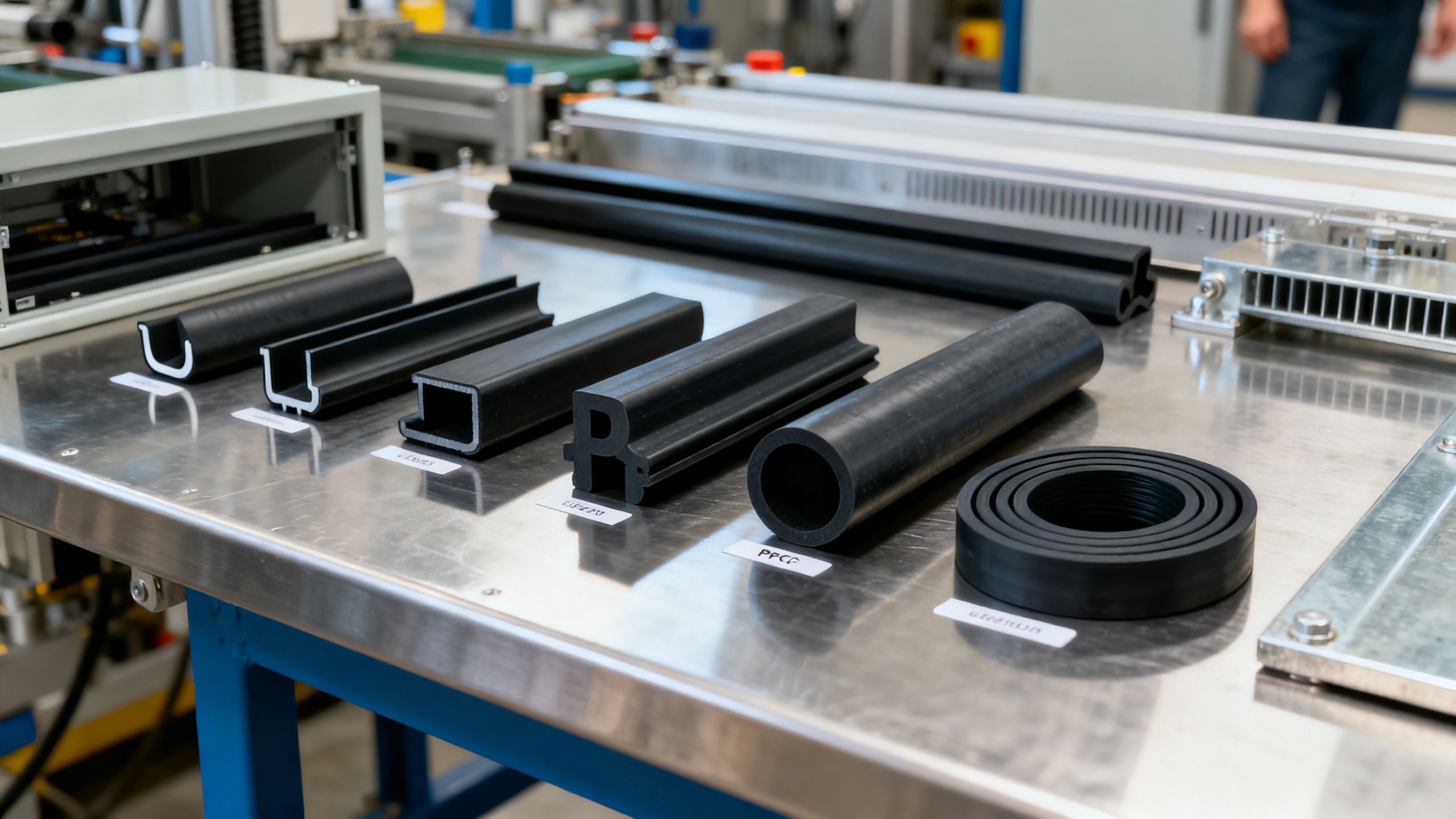
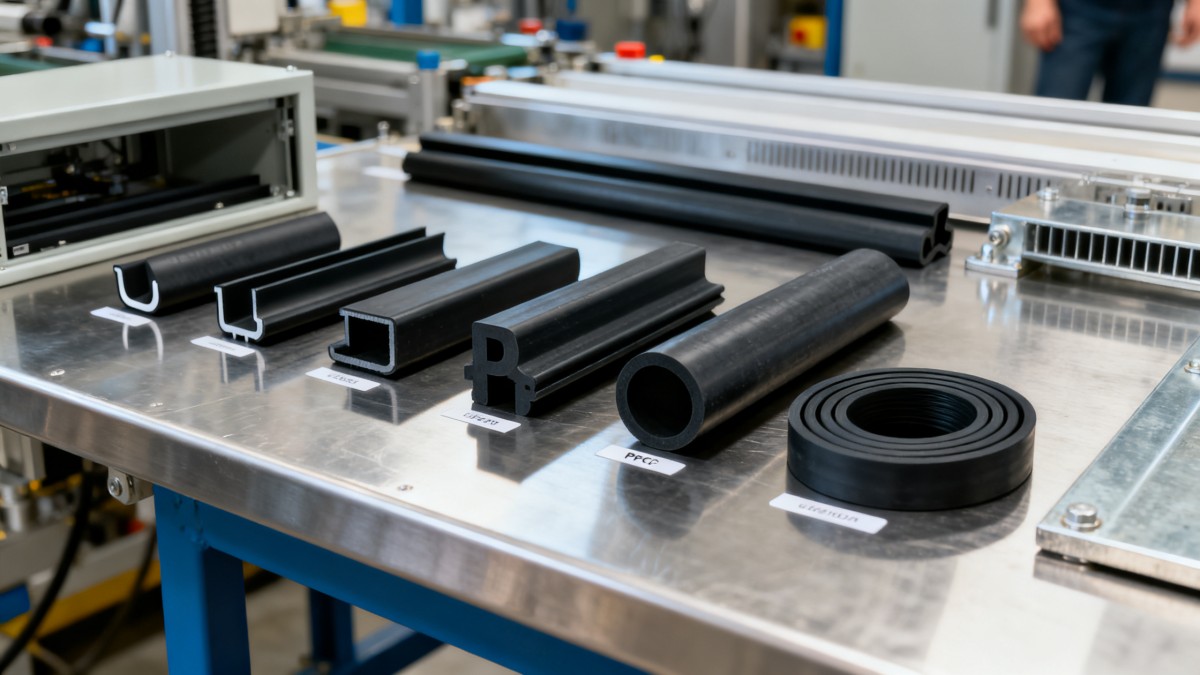
Extrusion is the process that forms the compound into continuous profiles such as U-channels, D-seals, P-seals, tubing, cords, or custom cross-sections.
The process usually follows a predictable sequence, although compound design and curing methods vary by application.
- Raw EPDM compound is mixed with fillers, curing agents, and performance additives.
- The compound is fed through an extrusion die shaped to the target profile.
- The extruded section is cured with heat to lock in geometry and elasticity.
- The profile is cooled, cut, spliced, coiled, or finished for installation.
What matters here is that profile performance depends on both the polymer recipe and the dimensional stability after curing.
A strong material can still perform poorly if the profile shape is inconsistent or compression behavior is not matched to the joint design.
Which EPDM profiles are most common, and where do they usually fit best?
Not every EPDM rubber extrusion is designed for the same sealing task.
Shape selection usually depends on movement, compression range, mounting method, and whether the profile must seal air, water, dust, or vibration.
Some shapes are widely recognized because they solve recurring industrial problems with simple installation.
In actual projects, the better question is rarely “Which profile is standard?”
It is usually “Which cross-section still seals after thermal movement, tolerance stack-up, and repeated opening cycles?”
That shift in thinking helps avoid overspecifying shape while underspecifying service conditions.
How much do tolerances really affect EPDM rubber extrusion performance?
More than many first-time buyers expect.
With EPDM rubber extrusion, a profile may look correct on paper yet fail in the field because the final dimensions drift outside usable limits.
Tolerance affects sealing force, fit inside grooves, corner joining, and long-run assembly consistency.
Rubber is also different from machined metal.
It flexes, shrinks during curing, and responds to temperature, density, and compound variation.
That is why dimensional targets must be realistic and linked to function.
The most important tolerance factors usually include:
- Wall thickness variation in hollow or bulb profiles
- Overall width and height after cure
- Cut length consistency for framed assemblies
- Hardness range and compression recovery
- Splice accuracy for rings or closed-loop seals
A useful rule is to define critical-to-function dimensions before asking for tight tolerances everywhere.
That keeps the specification focused and often improves manufacturability.
Where infrastructure reliability matters, GIC-style evaluation tends to link tolerances with failure mode, inspection method, and actual service stress.
Where is EPDM rubber extrusion most commonly used across industry?
EPDM rubber extrusion appears in more sectors than many people assume because sealing problems repeat across different equipment types.
The material is especially common where outdoor exposure, moisture control, and moderate heat resistance matter more than oil resistance.
Typical industrial uses include:
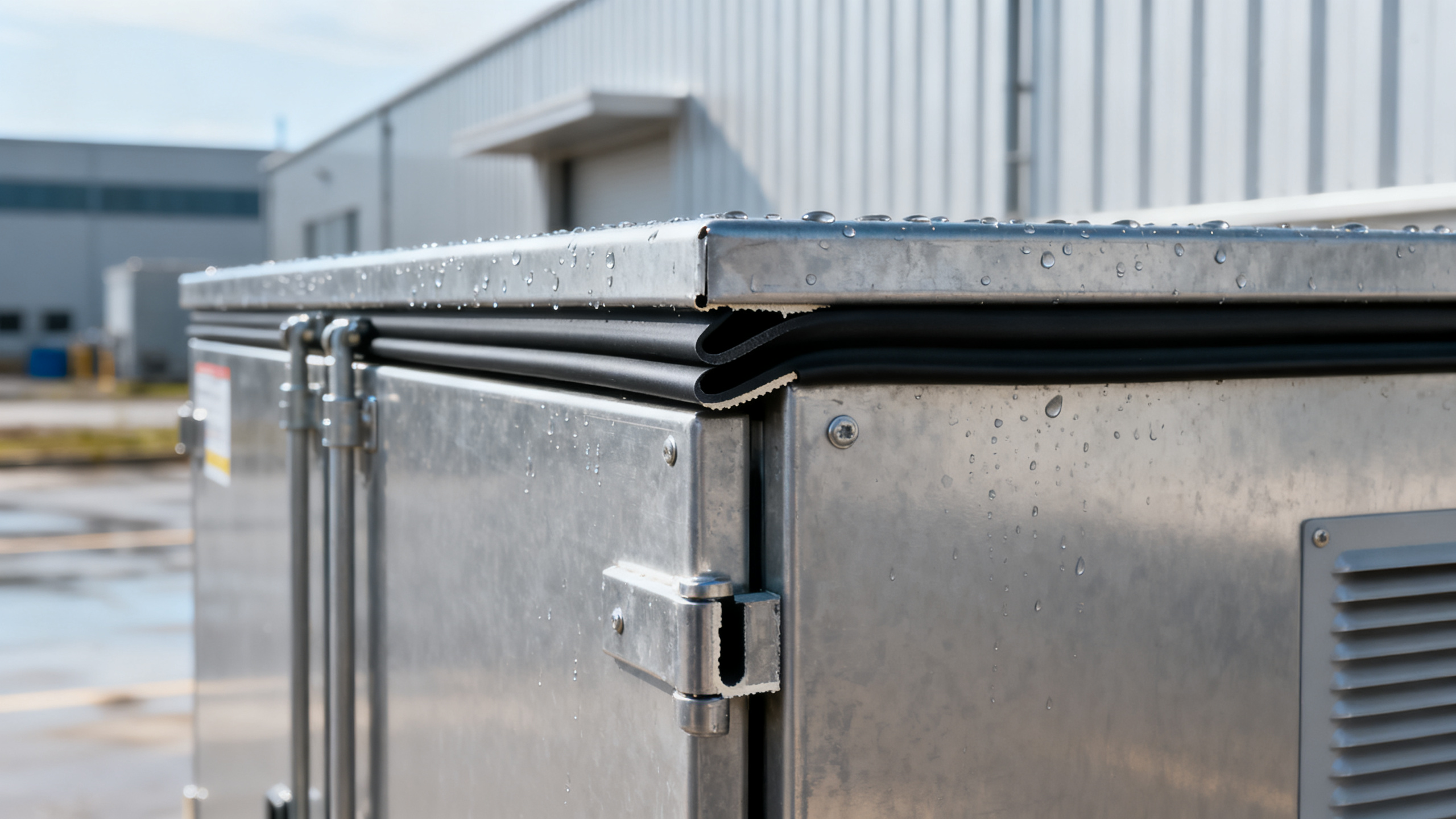
- Electrical cabinets and control panels needing dust and water ingress sealing
- HVAC housings, ducts, and access sections exposed to condensation and thermal cycling
- Building facades, glazing systems, and expansion joints facing UV and rain
- Rail, commercial vehicles, and equipment doors requiring weatherstripping
- Industrial machinery covers and edge trims needing cushioning and isolation
One point often missed is chemical exposure.
EPDM handles water, steam, and weather very well, but it is not the best choice for oils, fuels, and many hydrocarbons.
So when a profile sits near lubricants or petrochemical media, material confirmation becomes essential.
What should you compare before choosing an EPDM rubber extrusion?
This is where selection usually becomes more practical.
Instead of asking only for a quote, it helps to compare the working conditions that define long-term fit.
A short comparison checklist often reveals whether a standard profile works or a custom EPDM rubber extrusion is worth the extra lead time.
If technical documentation is available, compare compound grade, hardness, density, compression set, UV resistance, and any CE, UL, or ISO-related test relevance.
Those details are often more useful than a generic claim of “industrial quality.”
What are the most common mistakes and how can they be avoided?
Most EPDM rubber extrusion issues do not come from the material being poor.
They come from mismatch between environment, profile design, and installation assumptions.
Three mistakes appear again and again.
- Selecting EPDM for oil-heavy areas without checking media compatibility
- Using nominal dimensions without accounting for closure force and tolerance stack-up
- Treating custom profiles as simple drawings rather than tested functional parts
A better approach is to review the full service picture.
That includes weather exposure, compression rate, mounting geometry, inspection criteria, and replacement interval.
For higher-risk installations, prototype evaluation is usually worth the extra time.
A short test under realistic temperature, compression, and exposure conditions can prevent expensive field corrections later.
So how should EPDM rubber extrusion be evaluated before moving forward?
The clearest way to evaluate EPDM rubber extrusion is to connect profile design with operating reality.
Look at the environment first, then the sealing function, then the dimensions that actually control performance.
If the application depends on weather resistance, ozone stability, and durable compression behavior, EPDM is often a strong candidate.
If the part faces oils or aggressive hydrocarbons, a comparison with other elastomers is the safer next step.
Before final selection, it helps to document profile shape, tolerance priorities, curing expectations, installation method, and required compliance signals.
That creates a more reliable basis for technical review, supplier comparison, and lifecycle judgment.
In other words, choosing the right EPDM rubber extrusion is less about finding a generic seal and more about defining where performance cannot fail.
Technical Specifications
- How to Select Electronic Hotel Key Card Locks for Guest Rooms and Staff AreasAuthor :Safety Compliance Lead
- How to Select Lab Instruments for Reliable Chemical Analysis WorkflowsAuthor :Precision Metrology Expert
- How to Size a UPS for Server Rooms: Load, Runtime, and Redundancy FactorsAuthor :Grid Infrastructure Analyst
Expert Insights

Chief Security Architect
Dr. Thorne specializes in the intersection of structural engineering and digital resilience. He has advised three G7 governments on industrial infrastructure security.
Related Analysis
- Sep 17, 2026How to Select Electronic Hotel Key Card Locks for Guest Rooms and Staff AreasAuthor :Safety Compliance Lead
- Sep 16, 2026How to Select Lab Instruments for Reliable Chemical Analysis WorkflowsAuthor :Precision Metrology Expert
- Sep 15, 2026How to Size a UPS for Server Rooms: Load, Runtime, and Redundancy FactorsAuthor :Grid Infrastructure Analyst
Core Sector // 01
Security & Safety
- Selecting Low-Friction Pneumatic Seals for High-Cycle, Low-Pressure CylindersAuthor :Heavy Industry Strategist

- Selecting Spherical Roller Bearings for Mining: Load, Contamination, and Service LifeAuthor :Heavy Industry Strategist

- Do Deep Groove Ball Bearings Need Special Seals in Coastal Humidity?Author :Heavy Industry Strategist

- How to Select Anti Vibration Rubber Shock Absorbers for Machinery and EquipmentAuthor :Heavy Industry Strategist

- When to Specify Induction Hardened Slewing Ring Bearings for Heavy-Duty EquipmentAuthor :Heavy Industry Strategist

- How to Evaluate Weather Resistant EPDM Extrusion for Outdoor Sealing ApplicationsAuthor :Heavy Industry Strategist

- Bearing and Seal Lead Times Stretch to 22 WeeksAuthor :Heavy Industry Strategist

- Angular Contact Ball Bearings Explained: Contact Angle, Load Capacity, and Common UsesAuthor :Heavy Industry Strategist