EU Updates EN 61000-6-4:2026 for Industrial EMC
Author
Date Published
Reading Time

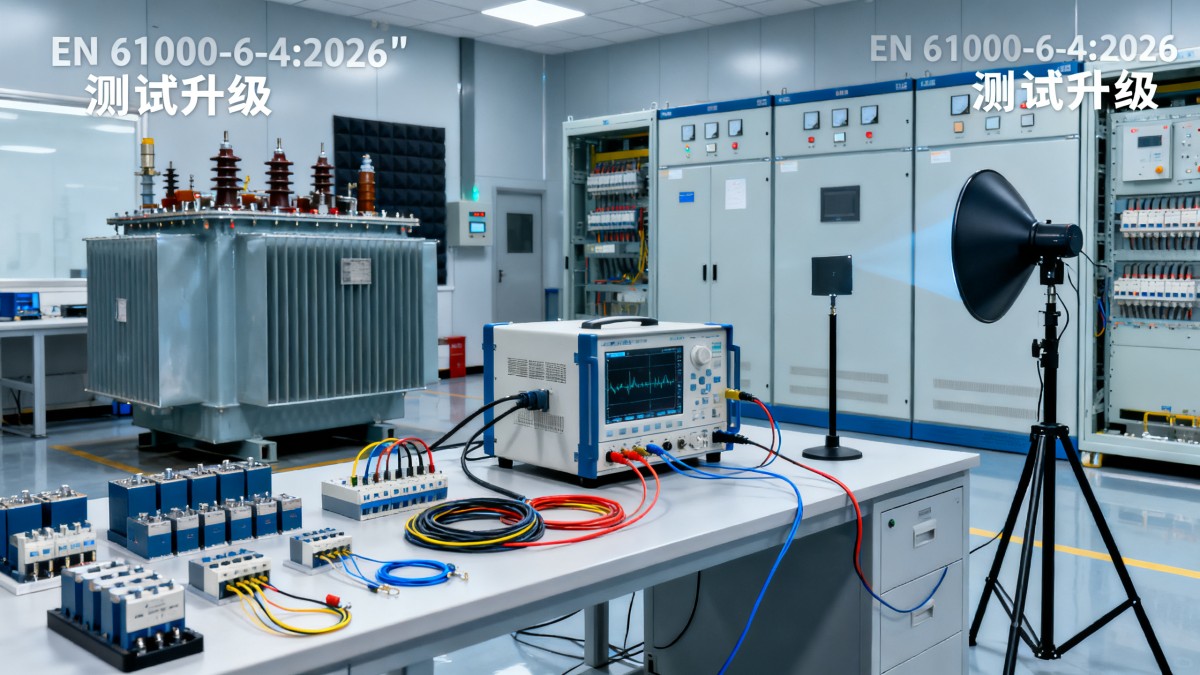
On July 27, 2026, the Official Journal of the European Union (OJEU) published the revised harmonized standard EN 61000-6-4:2026, replacing the 2019 edition for EMC emission testing of electrical and electronic equipment used in industrial environments. For exporters and manufacturers involved in transformers and switchgears, breakers and relays, cables and wiring, and related industrial equipment, this matters because the update changes the testing scope and points ahead to the standard’s expected role in supporting CE presumption of conformity from January 28, 2027.
What the revised standard formally changes
According to the information provided, EN 61000-6-4:2026 was published in the OJEU on July 27, 2026 as a revised harmonized standard and replaces the 2019 version. It is mandatory for EMC emission testing of electrical and electronic equipment intended for industrial environments. The scope of affected export-oriented industrial products includes categories such as transformers and switchgears, breakers and relays, and cables and wiring.
The revision expands the applicable frequency range for radiated emission limits to 6 GHz. It also adds testing requirements for broadband power amplifiers and digital power modules. Based on the provided summary, the revised standard is expected to become a basis for presumption of CE conformity from January 28, 2027.
Where the immediate pressure may appear in the supply chain
Export manufacturers may face a narrower compliance margin
From an industry perspective, manufacturers shipping industrial electrical and electronic equipment into the EU may be affected first because EMC emission testing is directly tied to product access and technical documentation. The most immediate impact is likely to appear in product verification, test planning, and model-by-model assessment for equipment that falls within the industrial environment scope.
What deserves closer attention is whether existing test evidence prepared under the 2019 edition remains sufficient for future shipments once EN 61000-6-4:2026 becomes the expected conformity reference.
Component and module suppliers may see higher documentation expectations
Suppliers of parts used in industrial equipment, especially where broadband power amplifiers or digital power modules are involved, may come under greater scrutiny from their downstream customers. The likely effect is not only technical testing itself, but also the quality and completeness of supporting compliance materials used in procurement, qualification, and project delivery.
Observably, the pressure here may concentrate on upstream communication: suppliers may be asked for clearer EMC-related product data, updated declarations, or testing support aligned with the revised standard.
Testing and certification service workflows may need adjustment
Service providers involved in EMC testing, conformity support, or export compliance may also be affected because the revised standard changes the applicable frequency range and adds product-specific test requirements for certain modules. The business impact may show up in test scheduling, retest decisions, and the interpretation of which product configurations require additional review.
For companies relying on external labs or compliance partners, the practical issue is whether project timelines and evidence packages still align with customer delivery commitments.
What companies should review now
Check which product families fall within the revised testing scope
Companies should first identify which exported industrial product lines are currently assessed against EN 61000-6-4 and whether those lines include transformers and switchgears, breakers and relays, cables and wiring, or related equipment used in industrial environments. This is a practical starting point for deciding where technical files and test plans may need review.
Separate confirmed rule text from expected market practice
Analysis shows that one important distinction is between the published revision itself and the business consequences that follow as January 28, 2027 approaches. The provided information states that the revised standard is expected to become a basis for CE presumption of conformity from that date. Companies should therefore track how customers, notified compliance partners, and internal teams interpret this transition in actual shipment and acceptance workflows.
Review exposure tied to broadband power amplifiers and digital power modules
Because the new requirements explicitly add testing for broadband power amplifiers and digital power modules, businesses using these elements should review where they appear in products, assemblies, or custom configurations. The key issue is not only whether the end product is affected, but whether supplier materials and test records are ready for technical review.
Prepare for timing, documentation, and customer communication
What deserves closer attention is the operational side of compliance. If retesting, document updates, or supplier clarification becomes necessary, procurement, engineering, quality, and sales teams may all need aligned messaging. In practice, that means checking lead times for test arrangements, the status of compliance files, and how to explain transition timing to EU-facing customers or buyers.
Why this reads as more than a routine standards update
This section is analysis. It is more appropriate to understand this as both a near-term compliance change and a longer-term signal about the direction of industrial EMC expectations in the EU. The confirmed facts are limited to the revised standard, the expanded radiated emission frequency range to 6 GHz, the added testing requirements for broadband power amplifiers and digital power modules, and the expected CE conformity relevance date.
Observably, the broader significance comes from where those changes land: industrial equipment exporters, module suppliers, and compliance service chains may all need to revisit assumptions built around the 2019 edition. At the same time, this should not be overstated as a fully settled market outcome, because the practical effect still depends on how companies, customers, and compliance processes adapt during the transition period.
How the market may best interpret the development
In summary, the publication of EN 61000-6-4:2026 signals a concrete upgrade in EMC emission testing expectations for industrial electrical and electronic equipment entering the EU framework. The strongest immediate relevance is for businesses whose products already sit inside industrial-environment EMC testing pathways and for those involving broadband power amplifiers or digital power modules.
At this stage, it is more appropriate to understand the development as a confirmed regulatory-reference change with practical preparation implications, rather than as a complete statement of downstream commercial impact. The standard revision is real, the transition timing is visible, and the business consequences will depend on how quickly affected companies map products, update evidence, and align communication across the supply chain.
Basis of this article and points to keep verifying
This article is based on the user-provided news title, event date, and event summary regarding the OJEU publication of EN 61000-6-4:2026 on July 27, 2026. For this type of update, relevant source categories typically include official notices, company compliance communications, industry association updates, authoritative media coverage, and standardization documents.
No specific official source link was provided in the input, so the exact official reference link still needs to be continuously verified. Follow-up attention should remain on any later official wording, transition-related clarification, and market-side implementation practices connected to the expected use of this standard for CE presumption of conformity from January 28, 2027.
Technical Specifications
- How to Select Electronic Hotel Key Card Locks for Guest Rooms and Staff AreasAuthor :Safety Compliance Lead
- How to Select Lab Instruments for Reliable Chemical Analysis WorkflowsAuthor :Precision Metrology Expert
- How to Size a UPS for Server Rooms: Load, Runtime, and Redundancy FactorsAuthor :Grid Infrastructure Analyst
Expert Insights

Chief Security Architect
Dr. Thorne specializes in the intersection of structural engineering and digital resilience. He has advised three G7 governments on industrial infrastructure security.
Related Analysis
- Sep 17, 2026How to Select Electronic Hotel Key Card Locks for Guest Rooms and Staff AreasAuthor :Safety Compliance Lead
- Sep 16, 2026How to Select Lab Instruments for Reliable Chemical Analysis WorkflowsAuthor :Precision Metrology Expert
- Sep 15, 2026How to Size a UPS for Server Rooms: Load, Runtime, and Redundancy FactorsAuthor :Grid Infrastructure Analyst
Core Sector // 01
Security & Safety
- How to Size a UPS for Server Rooms: Load, Runtime, and Redundancy FactorsAuthor :Grid Infrastructure Analyst

- How to Choose a Step-Down Transformer for a Control Panel: Key Sizing FactorsAuthor :Grid Infrastructure Analyst

- How Often Should Overseas Power Systems Undergo Safety Inspections?Author :Grid Infrastructure Analyst

- How to Choose Panels for Extreme-Cold Industrial Sites?Author :Grid Infrastructure Analyst

- What Should a Cross-Border EPC Equipment Procurement Reference Include?Author :Grid Infrastructure Analyst

- How to Compare Low-Voltage Equipment for Panel IntegrationAuthor :Grid Infrastructure Analyst

- IEC-Compliant Power Infrastructure: Key Design and Verification RequirementsAuthor :Grid Infrastructure Analyst

- Updated EN 61000-6-4:2026 Raises EMC Compliance Bar for EU-Bound Industrial EquipmentAuthor :Grid Infrastructure Analyst