When to Specify Induction Hardened Slewing Ring Bearings for Heavy-Duty Equipment
Author
Date Published
Reading Time
When to Specify Induction Hardened Slewing Ring Bearings for Heavy-Duty Equipment
For technical evaluators specifying components for cranes, excavators, stackers, and other high-load systems, choosing the right bearing surface treatment can directly affect uptime, safety, and lifecycle cost. This guide explains when slewing ring bearings induction hardened designs become the preferred option, especially in applications facing shock loads, repeated rotation, abrasive environments, and strict reliability requirements.
The short version is this: you do not specify induction hardening because it sounds premium. You specify it when the raceway surface is going to take repeated contact stress, local overloads, contamination risk, or duty cycles that would punish a through-hardened or untreated alternative in a less predictable way. In heavy equipment, that decision usually shows up later as fewer shutdowns, steadier backlash, and less ugly wear when the machine ages.
Start with the duty pattern, not the catalog headline
A common purchasing mistake is to begin with diameter, bolt circle, and price, then treat surface hardening as an optional upgrade. For slewing applications, that order is backwards. The first screening question is how the bearing actually lives in service.
- Does the upper structure reverse direction frequently rather than rotate smoothly in one direction?
- Will the machine see impact loading from bucket strikes, swinging loads, grab operation, rail irregularities, or emergency stops?
- Is the bearing expected to sit under high static load for long periods and then move under load?
- Will dust, fines, scale, slurry, or salt contamination be difficult to control?
- Is service access limited enough that premature wear becomes a major operating risk?
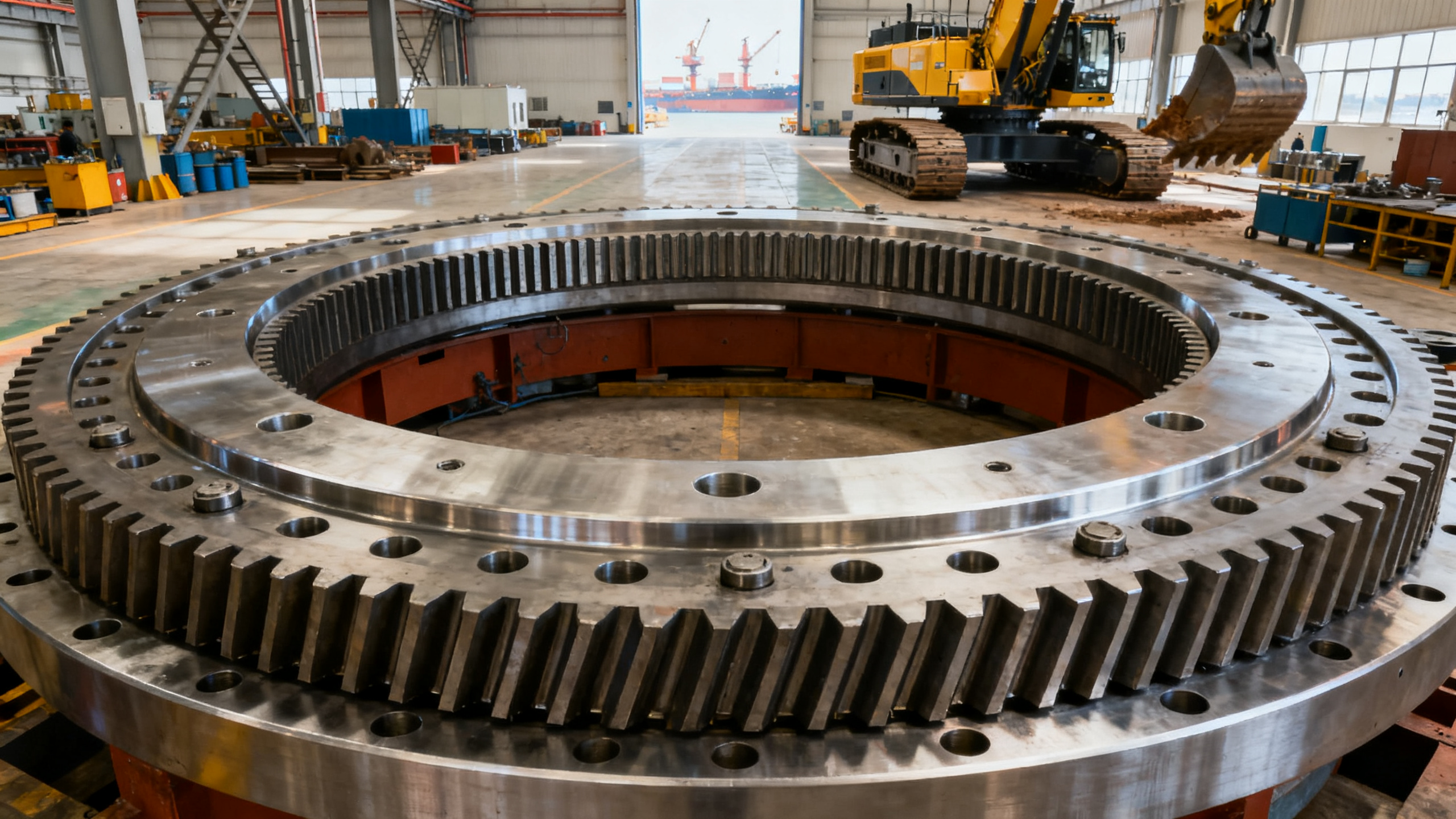
If several of those are true, slewing ring bearings induction hardened designs should move from “possible” to “seriously evaluate.” The hard raceway improves resistance to rolling contact fatigue and wear where the balls or rollers repeatedly load the same zones. That matters more than people expect on machines that oscillate through short arcs rather than completing full rotations.
Where induction hardening usually earns its keep
In practice, the best candidates are not just “heavy” machines. They are machines with concentrated stress histories.
Excavators are a classic example. Swing bearings often spend much of their life moving back and forth through a limited range with shock loads from digging and travel over rough ground. Material handlers and stackers can be similar, especially when they pause under load and resume motion repeatedly. Large access platforms, ladle turrets, port handling equipment, and some offshore deck systems also fall into this bucket, though the corrosion side of the specification needs separate attention.
On the other hand, if the machine has light loads, clean conditions, low duty, and easy replacement access, induction hardening may not be the deciding feature. That is why the evaluation should stay tied to operating reality rather than a blanket rule.
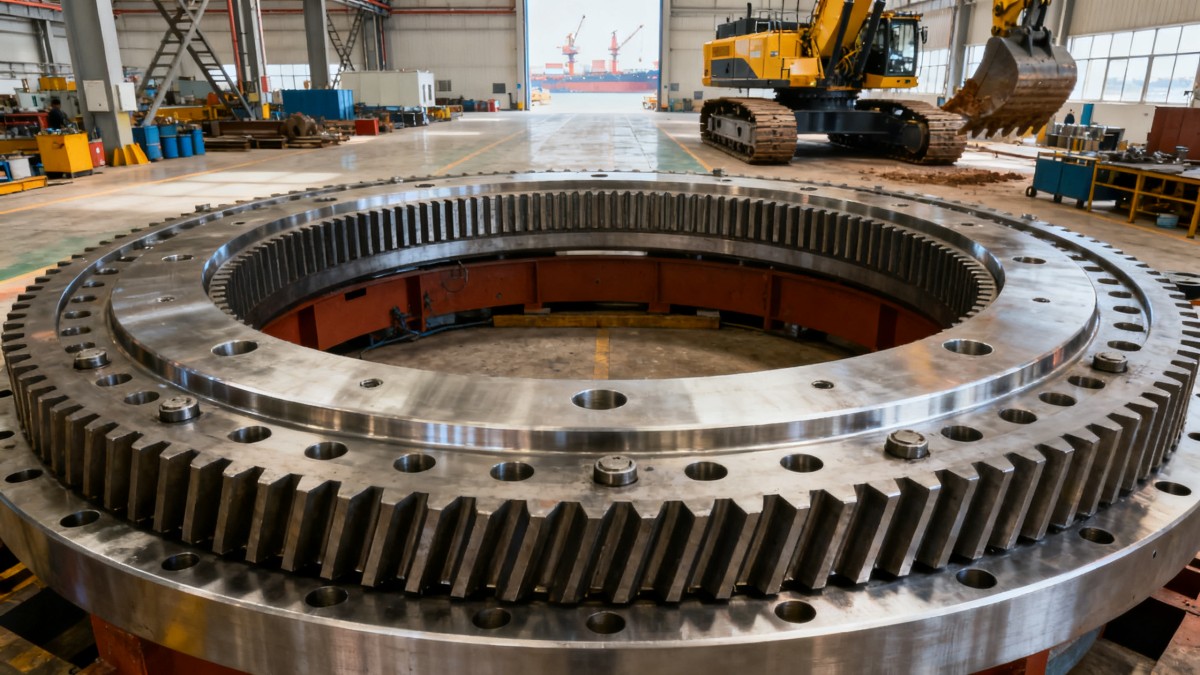
Checklist points that usually separate a necessary spec from an unnecessary one
Look at load reversals, not just maximum load. Many bearing failures are driven less by the single peak load on a datasheet and more by repetitive load cycling, overturning moment changes, and edge loading. If the application sees frequent reversal or oscillation under significant moment load, an induction hardened raceway is often justified.
Check whether the machine operates in a partial-rotation pattern. Short-stroke rotation means the rolling elements revisit the same track segments again and again. That raises the value of a hardened running surface because wear is localized rather than spread around the full circumference.
Ask what happens if backlash grows earlier than expected. In some machines, a bit of extra play is inconvenient. In others, it becomes a safety, positioning, or structural problem. For lifting and precise material placement, preserving raceway condition is not just a maintenance concern.
Do not separate the bearing from the lubrication reality. If relubrication intervals are likely to slip, or access points are awkward, the bearing needs more forgiveness. Induction hardening does not fix poor lubrication, but it can improve durability when real-world maintenance is less perfect than the manual assumes.
Check contamination exposure honestly. Quarry dust, metallic fines, cement particles, and marine contaminants accelerate wear. Seal design, grease choice, and shielding still matter, but a hardened raceway gives you a better starting position when fine abrasive ingress is difficult to eliminate.
Review the consequence of unplanned replacement. On some equipment, bearing replacement is a workshop event. On others, it means crane support, structural disassembly, alignment work, and extended downtime. The higher the replacement burden, the more reasonable it becomes to specify the more durable raceway treatment up front.
Questions to put back to the supplier before you release the spec
This is where technical evaluation usually improves fast. Instead of asking, “Is this bearing induction hardened?”, ask for information that affects the decision.
- Which surfaces are induction hardened: raceway only, gear teeth, or both?
- What hardness range is specified by the manufacturer, and under which internal or customer standard is it verified?
- What is the effective hardening depth or case depth terminology used in their documentation? Suppliers may describe this differently, so it needs careful reading.
- How are transition zones managed, especially near soft spots or raceway joints where applicable? This area deserves attention because poor treatment control can create trouble.
- What fatigue life method is used for sizing, and what duty assumptions sit behind it?
- Which material certificates, inspection reports, or traceability documents are available at order stage versus only after production?
If the supplier cannot explain those points clearly, the bearing may still be acceptable, but the evaluation is not finished. For global projects, buyers often also need alignment with broader quality systems such as ISO 9001 at the manufacturer level, while product-level compliance depends on the equipment and market. Do not assume CE, UL, or similar marks apply to a slewing ring bearing as a standalone component in the same way they apply to finished equipment; that must be checked case by case.
A quick comparison that helps during vendor review
Mistakes that show up later in service
One mistake is assuming raceway hardening alone defines bearing life. It does not. Mounting surface flatness, bolt preload, lubrication practice, seal effectiveness, and actual moment load distribution can erase the benefit of a good heat-treatment decision.
Another is copying a legacy spec from a lighter machine generation. Equipment often gains attachment weight, reach, hydraulic force, or duty hours over time. The bearing spec should be revalidated when the operating envelope changes, even if the interface dimensions stay the same.
There is also a recurring procurement issue: comparing suppliers on nominal dimensions while the life basis, hardness verification method, and inspection scope are not aligned. That turns price comparison into guesswork. When you request quotations, define the duty cycle, load spectrum if available, environmental conditions, lubrication expectations, and documentation package. Otherwise, “equivalent” offers may not be equivalent at all.
What a practical release decision looks like
A reasonable decision path is usually straightforward. If the equipment combines high overturning moment, repeated oscillation, shock loading, abrasive contamination risk, or expensive replacement logistics, specify slewing ring bearings induction hardened and make the supplier document the heat-treatment scope and life assumptions. If the duty is mild and service is simple, confirm the life calculation first before paying for features you may not use.
For technical evaluators, that is the real cutoff: not whether induction hardening sounds advanced, but whether the application has the kind of contact stress history that justifies it. When it does, treating it as optional usually costs more later.
Before final release, ask for the manufacturer’s bearing calculation basis, hardness and material documentation, installation requirements, and maintenance recommendations. If any of those remain unclear, mark them 【待核实】 in the approval file and close the gap before purchase order issue. That extra step is usually cheaper than explaining early raceway damage after commissioning.
Technical Specifications
- How to Select Electronic Hotel Key Card Locks for Guest Rooms and Staff AreasAuthor :Safety Compliance Lead
- How to Select Lab Instruments for Reliable Chemical Analysis WorkflowsAuthor :Precision Metrology Expert
- How to Size a UPS for Server Rooms: Load, Runtime, and Redundancy FactorsAuthor :Grid Infrastructure Analyst
Expert Insights

Chief Security Architect
Dr. Thorne specializes in the intersection of structural engineering and digital resilience. He has advised three G7 governments on industrial infrastructure security.
Related Analysis
- Sep 17, 2026How to Select Electronic Hotel Key Card Locks for Guest Rooms and Staff AreasAuthor :Safety Compliance Lead
- Sep 16, 2026How to Select Lab Instruments for Reliable Chemical Analysis WorkflowsAuthor :Precision Metrology Expert
- Sep 15, 2026How to Size a UPS for Server Rooms: Load, Runtime, and Redundancy FactorsAuthor :Grid Infrastructure Analyst
Core Sector // 01
Security & Safety
- Selecting Low-Friction Pneumatic Seals for High-Cycle, Low-Pressure CylindersAuthor :Heavy Industry Strategist

- Selecting Spherical Roller Bearings for Mining: Load, Contamination, and Service LifeAuthor :Heavy Industry Strategist

- Do Deep Groove Ball Bearings Need Special Seals in Coastal Humidity?Author :Heavy Industry Strategist

- How to Select Anti Vibration Rubber Shock Absorbers for Machinery and EquipmentAuthor :Heavy Industry Strategist

- When to Specify Induction Hardened Slewing Ring Bearings for Heavy-Duty EquipmentAuthor :Heavy Industry Strategist

- How to Evaluate Weather Resistant EPDM Extrusion for Outdoor Sealing ApplicationsAuthor :Heavy Industry Strategist

- Bearing and Seal Lead Times Stretch to 22 WeeksAuthor :Heavy Industry Strategist

- Angular Contact Ball Bearings Explained: Contact Angle, Load Capacity, and Common UsesAuthor :Heavy Industry Strategist