How to Evaluate Bulk Wastewater Treatment Chemicals for Cost, Compliance, and Performance
Author
Date Published
Reading Time
How to Evaluate Bulk Wastewater Treatment Chemicals for Cost, Compliance, and Performance
Choosing bulk wastewater treatment chemicals is not just a pricing exercise. A cheap coagulant, flocculant, biocide, pH adjuster, or defoamer can become expensive very quickly if it drives up dosage, creates more sludge, slows throughput, or causes a compliance problem. Procurement teams usually feel this pressure from both sides: operations wants stable treatment performance, while finance wants a lower delivered cost. The right decision sits in the middle, and it usually comes from better evaluation discipline rather than harder negotiation.
When you are comparing bulk wastewater treatment chemicals, the useful question is not “Which supplier has the lowest unit price?” It is “Which option gives us predictable compliance and treatment efficiency at the lowest total cost of ownership?” That shift changes what you check, what you ask for, and what you put into your bid comparison sheet.
This checklist is written from a buyer’s point of view, but it assumes you are working closely with plant operations, EHS, and sometimes engineering. That is how these purchases should be handled. Wastewater chemistry is one of those categories where the invoice price tells only part of the story.
Start with the wastewater itself, not the product brochure
A surprising number of chemical evaluations start with whatever product a supplier is trying to move. That is backwards. Before you compare offers, pin down the actual wastewater conditions the chemical has to handle. At minimum, procurement should ask operations for the current treatment profile: flow variability, pH range, suspended solids, COD or BOD where relevant, oils and grease, metals, nutrient load, salinity, temperature swings, and whether the plant sees batch discharges or mostly stable continuous flow.
If the wastewater changes by production shift, season, raw material source, or cleaning cycle, capture that too. A chemical that performs well on a stable sample can fail in a real plant with variable influent. This matters especially when buying in bulk, because once inventory is on site, switching out a poor-fit formulation is slow and expensive.
A practical buying note: ask suppliers to state clearly which wastewater types their recommendation is based on, and what assumptions they made. If those assumptions are vague, the offer is weaker than it looks.
Check performance on dosage efficiency, not just treatment outcome
Two chemicals can both achieve target effluent quality and still have very different economics. One may need a much higher dose. Another may require tighter control or more operator intervention. For buyers, dosage efficiency is where cost starts to separate.
When you review supplier proposals, ask for recommended dosing ranges tied to your treatment objective: solids removal, phosphorus reduction, color removal, emulsion breaking, pH correction, odor control, or sludge dewatering. If you only compare price per drum, tote, or ton, you are comparing packaging, not treatment value.
The useful metric is usually cost per cubic meter treated, cost per kilogram of contaminant removed, or cost to achieve the discharge target under normal operating conditions. The exact format depends on the process, but the principle is the same.
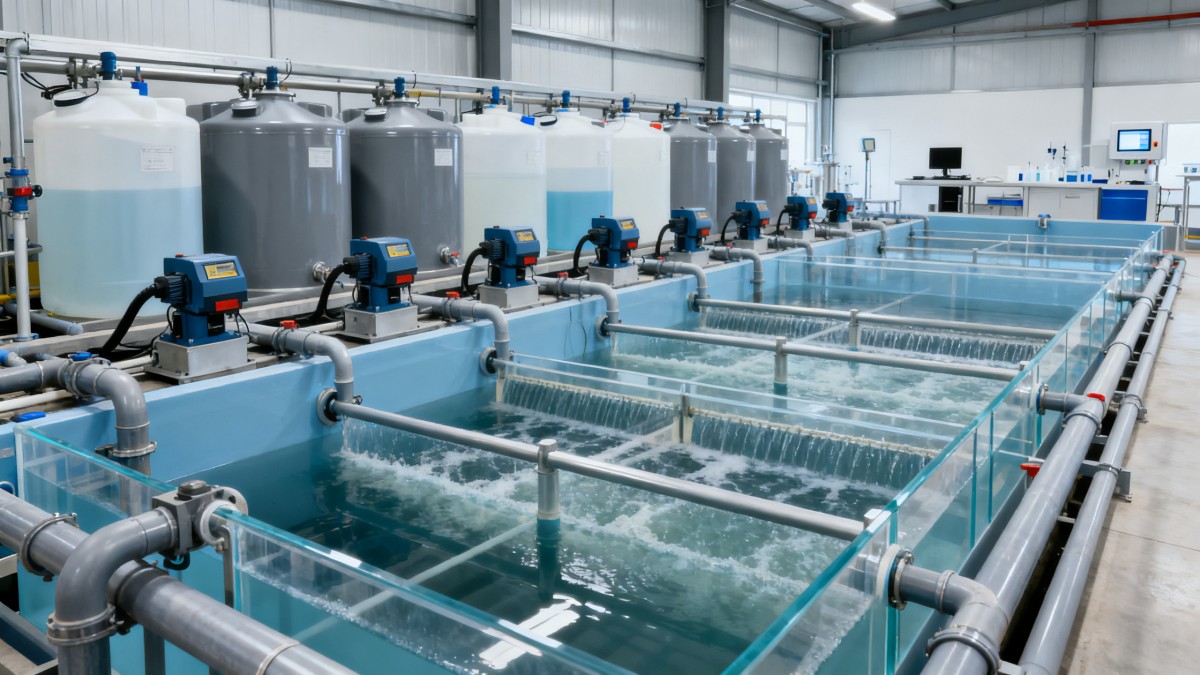
For coagulants and flocculants, do not stop at jar test visuals. Ask whether the supplier can document settling speed, sludge volume impact, and any known sensitivity to pH or conductivity changes. For pH control chemicals, ask how the recommendation affects scaling, corrosion, and handling risk. For biological treatment support chemicals, verify compatibility with the biological system rather than assuming a general-purpose product will behave well.
Look hard at sludge impact because it often hides the real cost
This is one of the most common purchasing misses. A lower-cost chemical can increase sludge generation enough to wipe out any savings. Disposal, dewatering, hauling, and handling costs can move fast, especially where disposal routes are tightly regulated or transport is expensive.
Ask specifically whether the treatment program changes sludge volume, solids content, filterability, or dewatering performance. If the supplier cannot speak to that, the evaluation is incomplete. In many plants, sludge management is where the “cheap” option becomes the most expensive one over a quarter or full contract term.
This is also where operations experience matters. Plant teams usually know which chemicals create sticky sludge, unstable floc, or carryover into downstream equipment. Procurement should pull that knowledge into the bid review, not treat it as an afterthought.
Do not treat compliance paperwork as a formality
For industrial buyers, documentation quality is part of product quality. At minimum, you should expect a current Safety Data Sheet, Technical Data Sheet, recommended storage and handling conditions, and product composition disclosures to the extent required for safe use and local compliance review. Exact disclosure limits vary by jurisdiction and product category, so where something appears incomplete, mark it for verification rather than guessing.
If your site operates under permit constraints, check whether the recommended chemistry introduces compliance exposure. Examples include added salts, residual metals, quaternary compounds, nutrient loading, or byproducts that could affect discharge limits or downstream biological activity. The supplier should be able to discuss foreseeable impacts, but the final review belongs with your environmental team.
Be careful with broad claims like “eco-friendly,” “non-hazardous,” or “fully compliant.” Those phrases are not a substitute for documentation, and in some cases they are marketing language with very little procurement value.
Match the chemical to your equipment and storage reality
A product can be technically effective and still be the wrong purchase if your site cannot store, meter, or transfer it reliably. Before awarding a bulk supply contract, confirm tank compatibility, pumpability, viscosity at expected temperatures, dilution requirements, shelf life, freeze sensitivity where relevant, and any special materials-of-construction issues.
This matters a lot for polymer products, concentrated alkalis and acids, oxidizers, and any chemical that stratifies or degrades in storage. A formulation that requires heated storage or constant agitation may be perfectly reasonable at one plant and a bad fit at another. Buyers should ask a simple operational question: can we use this consistently with the equipment and labor discipline we actually have?
If a supplier recommendation assumes new dosing skids, upgraded transfer pumps, secondary containment changes, or revised PPE practice, put those costs into the sourcing model. Otherwise the procurement case is understated.
Compare landed cost, not quoted cost
Bulk chemicals are heavily affected by logistics. Freight, delivery frequency, packaging format, unloading method, minimum order quantity, and supplier distance can change the economics more than buyers expect. A competitive ex-works quote may lose once you account for delivered pricing and inventory burden.
Put these items in your commercial comparison:
- Delivered price by packaging mode: bulk tanker, IBC, drum, or other site-approved format
- Typical lead time and emergency replenishment capability
- Minimum order quantity and whether it forces excess inventory
- Any return, cleaning, or disposal obligations for containers
- Price adjustment formula if the contract uses feedstock-linked or index-linked mechanisms
- Supplier willingness to hold safety stock or reserve capacity
For multi-site buyers, ask whether the supplier can support consistent product quality across regions. A low price in one geography does not help much if another facility receives a different formulation or unstable delivery service.
Treat supplier technical support as part of the offer
In wastewater chemicals, service quality can be worth more than a small price concession. That is especially true during startup, process changes, upset conditions, or seasonal variation. A supplier that can help troubleshoot dosage drift, upstream contamination changes, or biological inhibition is materially different from one that only ships product.
You do not need vague promises of “excellent support.” Ask concrete questions. Who provides technical service? How quickly can they respond on site or remotely? Will they support trial protocols and data review? Can they help optimize consumption after award, or does support end once the PO is issued?
For critical facilities, response capability should be part of vendor scoring. A missed discharge limit costs more than most negotiated unit-price savings.
Use trials, but keep them controlled
Pilot testing and plant trials are often necessary, but they need clear rules. Otherwise every supplier claims success from a different test condition. Define the trial period, influent conditions where possible, target metrics, dosage boundaries, operator responsibilities, and acceptance criteria before the trial starts.
Good trial metrics usually include more than one output. Effluent quality matters, but also track dose stability, sludge behavior, ease of handling, operator feedback, and any maintenance or corrosion concerns noticed during the trial. If conditions changed materially during testing, note that in the comparison. Do not let a short successful run under unusually easy conditions drive a long-term contract decision.
Watch for procurement shortcuts that usually backfire
A few patterns show up repeatedly in chemical sourcing reviews.
- Awarding based on price per unit without normalizing dosage.
- Approving a product before EHS and operations have reviewed handling and discharge implications.
- Assuming one successful site trial means the product will work the same way at every facility.
- Ignoring supply continuity and focusing only on first-order savings.
- Treating supplier paperwork gaps as minor admin issues instead of risk signals.
These are not abstract mistakes. They are the kind that produce emergency buys, off-spec discharge events, and long internal discussions about why a “cost-saving” decision increased operating pain.
A practical shortlist test for buyers
Before you finalize a supplier for bulk wastewater treatment chemicals, run this quick filter. Can they show a technically plausible fit for your wastewater? Can they support the product with usable documentation? Does the delivered and dosed cost still work after you account for sludge, storage, and service? Can your site handle the product safely with existing systems or a clearly priced upgrade path? And if the process drifts, will the supplier help recover performance quickly?
If you do not have confident answers to those points, you probably do not have a purchasing decision yet. You have a quote.
For procurement teams at EPC firms, industrial plants, and multi-site operators, that distinction matters. The strongest buys in this category usually come from a disciplined side-by-side review of chemistry fit, operational burden, compliance confidence, and full delivered cost. That takes more work upfront, but it is usually the cheapest way to buy.
Technical Specifications
- How to Select Electronic Hotel Key Card Locks for Guest Rooms and Staff AreasAuthor :Safety Compliance Lead
- How to Select Lab Instruments for Reliable Chemical Analysis WorkflowsAuthor :Precision Metrology Expert
- How to Size a UPS for Server Rooms: Load, Runtime, and Redundancy FactorsAuthor :Grid Infrastructure Analyst
Expert Insights

Chief Security Architect
Dr. Thorne specializes in the intersection of structural engineering and digital resilience. He has advised three G7 governments on industrial infrastructure security.
Related Analysis
- Sep 17, 2026How to Select Electronic Hotel Key Card Locks for Guest Rooms and Staff AreasAuthor :Safety Compliance Lead
- Sep 16, 2026How to Select Lab Instruments for Reliable Chemical Analysis WorkflowsAuthor :Precision Metrology Expert
- Sep 15, 2026How to Size a UPS for Server Rooms: Load, Runtime, and Redundancy FactorsAuthor :Grid Infrastructure Analyst
Core Sector // 01
Security & Safety
- How to Size a Wafer Butterfly Valve for HVAC Chilled-Water and Heating LoopsAuthor :Environmental Engineering Director

- How Pressure Class and Joint Design Affect Long-Term Performance of Ductile Iron Pipes in Drainage InfrastructureAuthor :Environmental Engineering Director

- How Ductile Iron Pipe Joints Affect Installation Reliability and Leak ControlAuthor :Environmental Engineering Director

- How to Size Effluent Treatment Equipment for Variable Industrial Wastewater LoadsAuthor :Environmental Engineering Director

- US Battery Push Raises New Entry Rules for SuppliersAuthor :Environmental Engineering Director

- EU EMC Rule Tightens for Water Treatment ExportsAuthor :Environmental Engineering Director

- EU REACH Restriction Targets PFAS Water Treatment ImportsAuthor :Environmental Engineering Director

- EU Mandates EN 14113:2026 for Water Treatment ExportsAuthor :Environmental Engineering Director