EU REACH Restriction Targets PFAS Water Treatment Imports
Author
Date Published
Reading Time
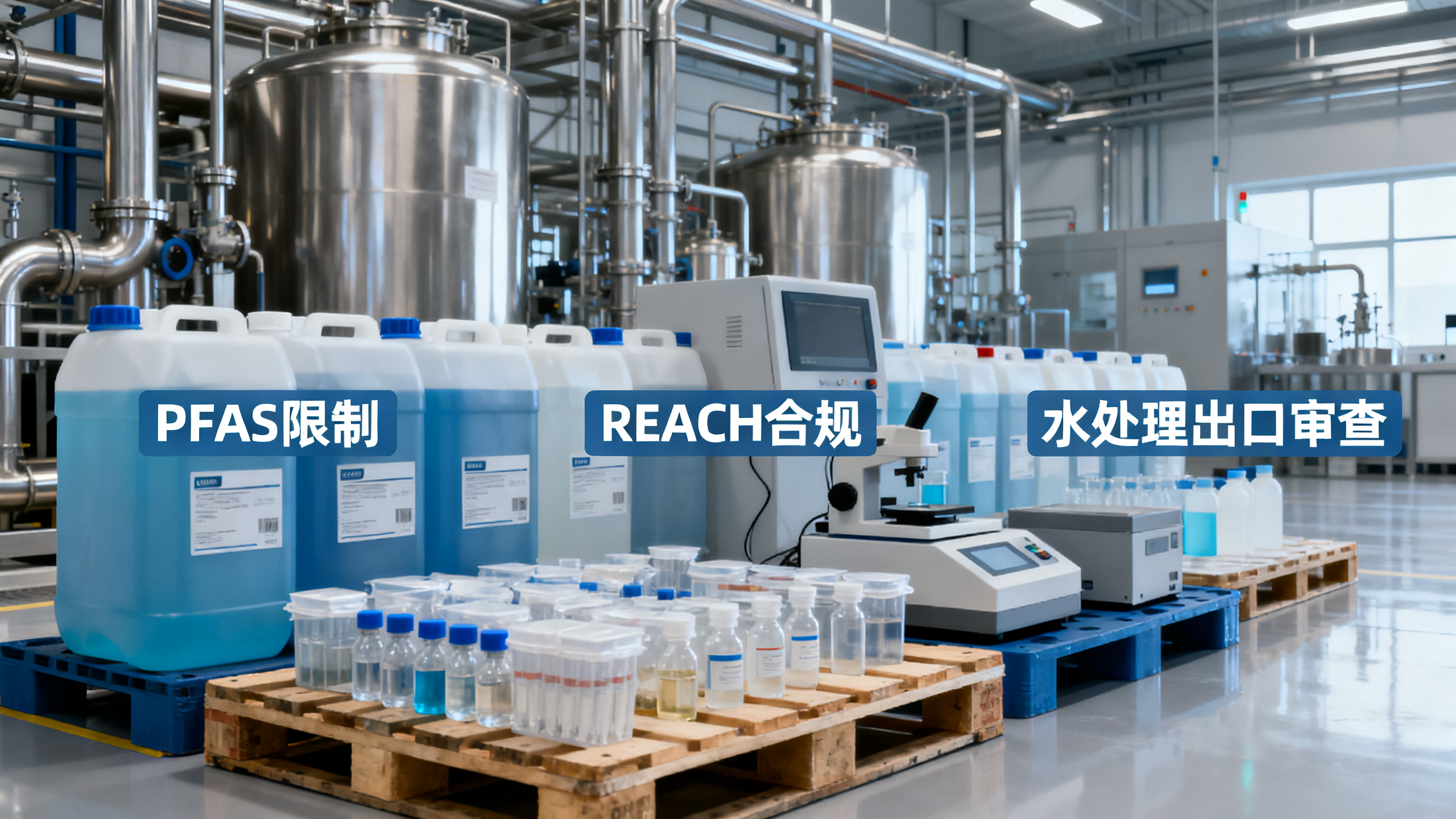
On August 9, 2026, the European Commission released Regulation (EU) 2026/1342, adding PFAS substances to the REACH Annex XVII restriction list and setting a ban from November 1, 2026 on industrial water treatment chemicals containing PFAS from entering the EU market. For exporters, buyers, compliance teams, and certification-related service providers involved in Industrial Water Treatment, this is a rule change with direct implications for market access, qualification status, and delivery planning rather than a routine regulatory update.
What the new restriction formally covers
The confirmed facts are limited but clear. The measure was issued by the European Commission on August 9, 2026 under Regulation (EU) 2026/1342. It brings PFAS compounds into the REACH Annex XVII restriction list and expressly prohibits industrial water treatment chemicals containing PFAS from being placed into the EU market after the transition period ends on November 1, 2026.
The event summary specifically identifies industrial water treatment agents such as flocculants, scale inhibitors, and disinfection auxiliaries within the affected product scope. The restriction is directly linked to export compliance in the Industrial Water Treatment category and affects the supply qualification and certification pathway for leading Chinese water treatment chemical manufacturers serving the EU market.
Where the disruption is most likely to appear
Export supply eligibility moves to the front of the transaction
For exporters of industrial water treatment chemicals, the immediate issue is whether existing products destined for the EU involve PFAS and whether those products can continue to be offered within the transition window. From an industry perspective, the practical impact is likely to appear first in product screening, customer declarations, technical document review, and shipment planning tied to the November 1, 2026 deadline.
Procurement teams will need to revisit product acceptance criteria
Buyers and sourcing teams that procure flocculants, scale inhibitors, or disinfection auxiliaries for EU delivery may need to reassess supplier qualification standards and product acceptance conditions. Analysis shows that procurement decisions may increasingly depend on whether suppliers can support compliance reviews with consistent technical documentation, substance disclosure, and updated supply qualifications aligned with the new restriction.
Certification and testing-related work may become more time-sensitive
For certification-related companies and testing service providers, the restriction points to a higher compliance workload around document checks, product composition review, and support materials used in market access or customer approval processes. What deserves closer attention is not only the restricted substance issue itself, but also whether existing qualification files, customer-facing specifications, and compliance statements remain usable under the revised rule environment.
Delivery and contract execution may face tighter controls
Supply chain service providers, distributors, and contract managers may also be affected where deliveries, acceptance terms, or after-sales responsibilities depend on continued EU market eligibility. Observably, the rule change can influence order timing, shipment scheduling, and document handover at the point where compliance status becomes a condition for import or customer acceptance.
What companies should be checking now
Review product portfolios against the restricted scope
Companies supplying industrial water treatment chemicals into the EU market should first identify whether any product lines fall within the PFAS-related restriction described in the regulation summary. This is particularly relevant for products such as flocculants, scale inhibitors, and disinfection auxiliaries named in the provided event description.
Check whether compliance files still support EU supply
Analysis shows that firms should examine whether current compliance files, technical dossiers, product specifications, and customer submission materials are still fit for EU-facing transactions under the new Annex XVII restriction. Because the input does not provide detailed enforcement mechanics, this should be treated as a precautionary compliance review rather than as evidence of a finalized execution outcome.
Watch for changes in qualification and tender language
Exporters and suppliers should pay close attention to changes in customer qualification criteria, certification expectations, tender documentation, and procurement wording connected to PFAS restrictions. It is more appropriate to understand this as an area requiring continued monitoring, since the provided information confirms the rule change and transition deadline but does not define every downstream implementation detail.
Align delivery timing with the transition period
The transition period ending on November 1, 2026 is a concrete operational marker. Companies involved in sales, production planning, and cross-border delivery should review orders and shipment schedules that may intersect with this date, while also checking whether supporting documents and supplier status remain acceptable for EU market entry during the transition phase.
Why this reads as an execution signal
Observably, this development is more than a policy discussion because it names a regulation, a restriction mechanism under REACH Annex XVII, a defined product direction, and a transition end date. At the same time, it should not be overstated as a fully settled market outcome in every operational detail, because the provided information does not include the full enforcement language, interpretive guidance, or customer-side implementation practices.
From an industry perspective, the update is best read as an execution signal with immediate compliance relevance. It tells market participants that PFAS content in industrial water treatment chemicals is no longer a distant regulatory topic for EU-bound trade, but a near-term condition that can affect qualification pathways, documentation readiness, and commercial continuity.
How the market is likely to frame this development
The industry significance of this event lies in the fact that a defined REACH restriction now intersects directly with Industrial Water Treatment exports and supplier qualification into the EU market. Analysis shows that the most rational reading at this stage is neither to treat it as a routine notice nor to assume every practical consequence is already settled. It is better understood as a landed rule change with immediate compliance implications and a continuing need to watch how procurement standards, certification practice, and delivery requirements respond in execution.
Basis of this article and what still needs verification
This article is generated from the user-provided news title, event date, and event summary. For events of this type, relevant source categories usually include official regulatory notices, releases from supervisory authorities, customs or trade administration information, industry association updates, standard-setting documents, and reporting by established professional media.
No specific official source link was provided in the input, so the underlying official publication path still needs to be checked on an ongoing basis. Further verification should focus on detailed policy wording, certification and compliance interpretation, changes in tender or purchasing documents, market feedback, and how affected companies implement the rule in practice.
Technical Specifications
- Air Handling Unit Supplier Checklist: Performance Data, Lead Times, and SupportAuthor :Environmental Engineering Director
- Buying Fiberglass Water Tanks Wholesale: Compare Quotes and Delivery CostsAuthor :Environmental Engineering Director
- Choosing an XLPE Power Cable Supplier: Test Reports, Traceability, and Lead TimesAuthor :Grid Infrastructure Analyst
Expert Insights

Chief Security Architect
Dr. Thorne specializes in the intersection of structural engineering and digital resilience. He has advised three G7 governments on industrial infrastructure security.
Related Analysis
- Oct 19, 2026Air Handling Unit Supplier Checklist: Performance Data, Lead Times, and SupportAuthor :Environmental Engineering Director
- Oct 18, 2026Buying Fiberglass Water Tanks Wholesale: Compare Quotes and Delivery CostsAuthor :Environmental Engineering Director
- Oct 17, 2026Choosing an XLPE Power Cable Supplier: Test Reports, Traceability, and Lead TimesAuthor :Grid Infrastructure Analyst
Core Sector // 01
Security & Safety
- Buying Fiberglass Water Tanks Wholesale: Compare Quotes and Delivery CostsAuthor :Environmental Engineering Director

- How to Select Industrial pH Meters for Continuous Wastewater Process ControlAuthor :Environmental Engineering Director

- How to Size a Rinse Fill Cap Machine for Your Bottle Format and Target OutputAuthor :Environmental Engineering Director

- How to Size a Heavy-Duty Submersible Sewage Pump for High-Solids Lift StationsAuthor :Environmental Engineering Director

- How to Size a Wafer Butterfly Valve for HVAC Chilled-Water and Heating LoopsAuthor :Environmental Engineering Director

- How Pressure Class and Joint Design Affect Long-Term Performance of Ductile Iron Pipes in Drainage InfrastructureAuthor :Environmental Engineering Director

- How Ductile Iron Pipe Joints Affect Installation Reliability and Leak ControlAuthor :Environmental Engineering Director

- How to Size Effluent Treatment Equipment for Variable Industrial Wastewater LoadsAuthor :Environmental Engineering Director