Air Handling Unit Supplier Checklist: Performance Data, Lead Times, and Support
Author
Date Published
Reading Time
Air Handling Unit Supplier Checklist: Performance Data, Lead Times, and Support
Choosing an air handling unit supplier involves more than comparing quoted prices. Incomplete performance data, uncertain lead times, and weak after-sales support can turn a competitive bid into project delays and operational risk. The challenge is making suppliers price the same duty, disclose the same exclusions, and accept clear delivery and performance obligations.
A lower-priced AHU may be the right purchase. But not if its fan selection ignores filter loading, its delivery promise excludes controls, or its warranty requires a technician who cannot reach the site. This checklist focuses on the evidence worth requesting before an order—and the gaps worth resolving before comparing costs.
Make the RFQ specific enough to expose differences
Suppliers cannot produce comparable selections from airflow and cooling capacity alone. Issue a common equipment schedule covering design airflow, outdoor-air quantity, external static pressure, site elevation, electrical supply, entering-air conditions, required leaving-air conditions, and available heating or cooling media. Include operating hours and anticipated part-load conditions where known.
Describe the installation constraints just as clearly. A replacement unit going into an existing plantroom may need split sections, restricted lifting weights, or an unusual access arrangement. An outdoor unit needs weather protection appropriate to its location. Corrosive intake air, process contaminants, or hygiene requirements can change material selection and maintenance provisions.
Require a separate deviations schedule. “Complies with specification” is not a substitute for identifying a different filter arrangement, reduced access space, or excluded controls package. Undisclosed assumptions are where apparently comparable quotations begin to diverge.
Read the performance selection, not just the headline capacity
Airflow and pressure must describe the same operating point
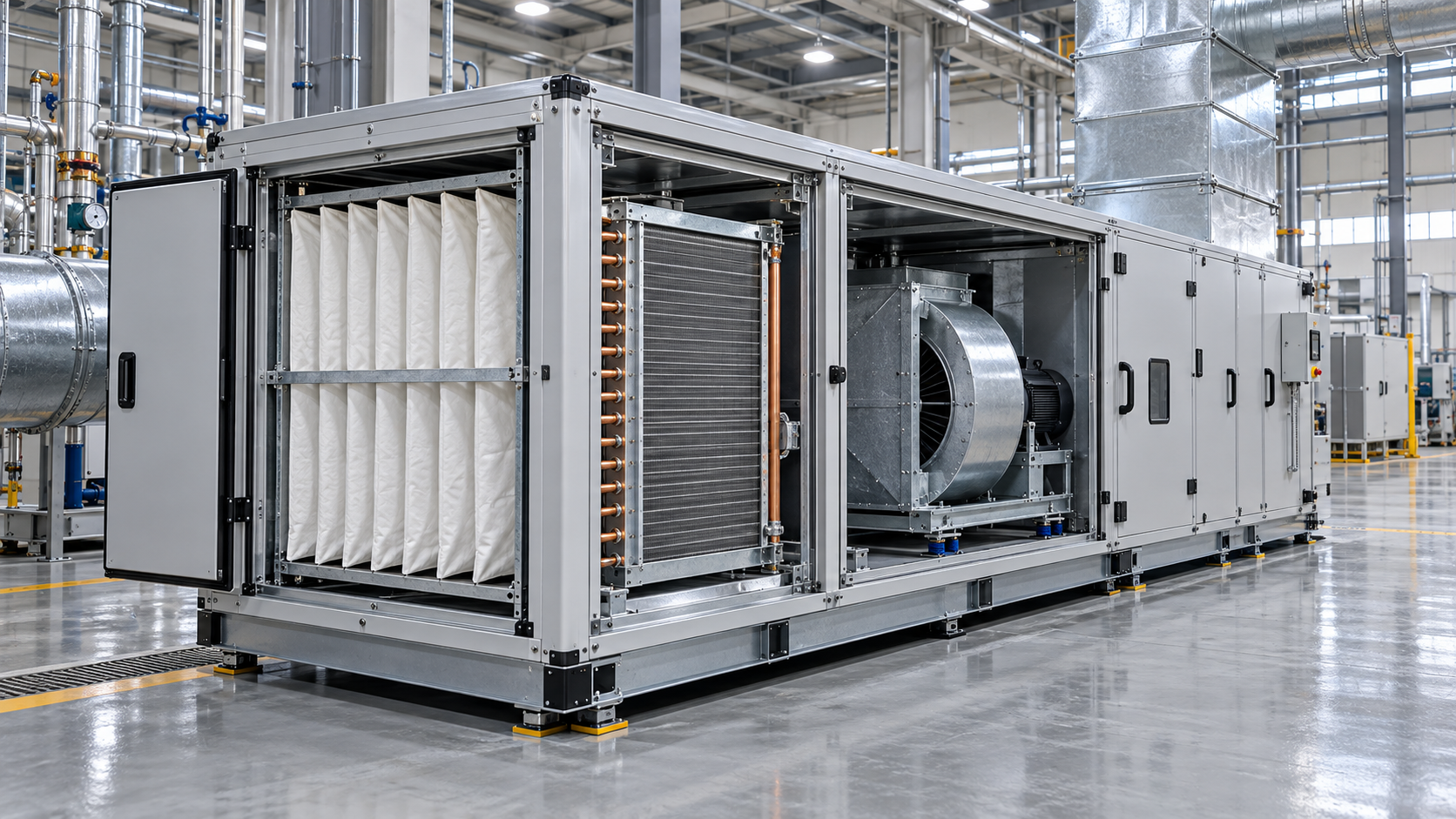
Ask for the selected fan operating point and its supporting curve or selection output. The submission should identify airflow, pressure basis, fan speed, absorbed power, motor rating, and control method. Confirm whether pressure figures are static or total, and whether they refer to the fan or the complete unit.
External static pressure covers resistance outside the AHU. Internal components—including coils, filters, heat recovery devices, and dampers—also consume pressure. If one supplier includes these losses and another leaves them for someone else to calculate, their power figures are not directly comparable.
Filter condition matters. Request the clean-filter duty and the agreed loaded-filter condition, together with the control response. A fan that meets design airflow only with clean filters may not maintain duty through the intended maintenance interval. Equally, excessive pressure allowance can increase equipment cost and complicate efficient operation. The allowance needs a stated basis, not simply a generous margin.
Check coils against actual design conditions
Cooling capacity depends on entering-air temperature and humidity, airflow, fluid temperatures, fluid flow, and fluid composition. Ask for total and sensible capacity, leaving-air conditions, air-side pressure drop, and fluid-side pressure drop at the specified duty. Glycol concentration, where applicable, must be reflected in the selection.
For humidity-sensitive applications, a capacity figure alone is insufficient. Review moisture removal, condensate drainage, and whether the proposed control arrangement can maintain the required conditions at part load. A selection that works at peak cooling may behave differently during mild, humid weather.
Sound data deserve similar scrutiny. Sound power is not the same as sound pressure at an occupied location. Request data relevant to duct-borne and casing-radiated noise, with the operating point identified. Any acoustic treatment should be included in the pressure-loss assessment.
Compare energy costs without pretending to predict the building
Motor efficiency is useful information, but it does not establish AHU energy performance. Fan efficiency, internal resistance, drive losses, control strategy, and operating schedule all affect electricity consumption. Ask each supplier to report electrical input using the same measurement boundary and duty conditions.
For a constant operating condition, estimated fan electricity cost is input power in kilowatts multiplied by annual operating hours and the electricity tariff. Variable-duty systems need a load profile rather than a single full-load calculation. Keep these estimates separate from heating, cooling, and heat-recovery effects unless a consistent system model is available.
There are practical trade-offs. A larger casing may reduce face velocity and pressure losses, but increase purchase cost and consume valuable plantroom space. Heat recovery can reduce thermal demand while adding fan resistance and maintenance requirements. Ask for alternatives with their assumptions exposed, rather than accepting a universal “high-efficiency” label.
Verify what certification actually covers
A certificate is useful only when its scope matches the offered equipment. Confirm the manufacturer, product range, applicable standard, validity, and whether the selected configuration falls within the certified scope. Independently certified ratings, laboratory test reports, and manufacturer declarations provide different forms of evidence; they should not be treated as interchangeable.
Where specified, EN 1886 provides a basis for assessing AHU mechanical characteristics such as casing strength, leakage, and thermal properties. EN 13053 addresses ratings and performance for air handling units, components, and sections. Request the relevant classifications and supporting documentation, not merely a statement that the unit was “designed to” a standard.
Market requirements also differ. CE marking is not a universal third-party quality certificate; ISO 9001 certification concerns a quality management system rather than proof of a particular unit’s performance. UL certification or listing, where required, must be checked against the relevant product and scope. Have the project’s responsible engineer confirm applicable requirements before making them contractual acceptance conditions.
Turn the lead time into a delivery plan
“Delivery in twelve weeks” leaves too much unresolved. Does the clock start at purchase order, deposit receipt, approved drawings, or final technical release? Does delivery mean ready at the factory, handed to a carrier, or unloaded at site?
Ask the supplier to break its commitment into identifiable milestones:
- Technical submittal issue, review period, and approval deadline.
- Release of long-lead fans, coils, drives, and control components.
- Manufacturing completion and any agreed factory testing.
- Document release, packing, and shipment readiness.
- Transport, customs responsibilities, and site delivery arrangements.
The useful question is not simply whether the supplier has factory capacity. It is which components constrain this order and whether their availability has been confirmed. An AHU can be mechanically complete yet unusable because a drive, actuator, or control panel is missing.
Tie the schedule to site readiness. Section dimensions, lifting points, shipping weights, reassembly work, and storage conditions should be settled before dispatch. For replacement projects, establish whether the equipment can pass through the actual access route—not just fit within the final plantroom footprint.
Define support before it becomes an urgent service call
A service office somewhere in the country is not the same as support available at the installation. Ask who performs startup, whether they are directly employed or subcontracted, what their visit includes, and how additional attendance is charged.
Controls integration is a frequent boundary issue. Supplying a compatible communication protocol does not necessarily include point mapping, sequence programming, graphics, or building-management-system commissioning. Allocate those tasks explicitly. Also confirm access credentials, software licensing, and whether local technicians can replace or configure components without proprietary tools.
Review warranty coverage for parts, labor, travel, freight, and removal or reinstallation. Establish when coverage begins and what happens if startup is delayed after delivery. For critical equipment, request spare-part identification, expected availability, and an escalation route. A promised response time should distinguish acknowledgement from remote diagnosis and on-site attendance.
Maintenance access is part of supportability. Confirm filter withdrawal space, coil cleaning access, drain-pan access, and a workable fan or motor replacement route. A compact unit that cannot be serviced safely is not necessarily the economical choice.
Normalize the commercial comparison before awarding
Global Industrial Core’s sourcing focus connects mechanical equipment with electrical infrastructure, measurement, and operational safety. An AHU purchase crosses those same boundaries. Its evaluated cost should include the interfaces needed to make it work, not just the factory quotation.
Before award, attach the agreed selection, deviations, delivery milestones, and acceptance plan to the purchase order. Specify which checks occur at the factory and which require installed-system testing; factory inspection alone cannot establish performance in the completed duct system.
If an air handling unit supplier cannot explain its pressure basis, commit to a defined delivery milestone, or identify who supports startup, keep that issue open. Resolve it in writing before release—not after the unit is on site and the commissioning window is closing.
Technical Specifications
- Air Handling Unit Supplier Checklist: Performance Data, Lead Times, and SupportAuthor :Environmental Engineering Director
- Buying Fiberglass Water Tanks Wholesale: Compare Quotes and Delivery CostsAuthor :Environmental Engineering Director
- Choosing an XLPE Power Cable Supplier: Test Reports, Traceability, and Lead TimesAuthor :Grid Infrastructure Analyst
Expert Insights

Chief Security Architect
Dr. Thorne specializes in the intersection of structural engineering and digital resilience. He has advised three G7 governments on industrial infrastructure security.
Related Analysis
- Oct 19, 2026Air Handling Unit Supplier Checklist: Performance Data, Lead Times, and SupportAuthor :Environmental Engineering Director
- Oct 18, 2026Buying Fiberglass Water Tanks Wholesale: Compare Quotes and Delivery CostsAuthor :Environmental Engineering Director
- Oct 17, 2026Choosing an XLPE Power Cable Supplier: Test Reports, Traceability, and Lead TimesAuthor :Grid Infrastructure Analyst
Core Sector // 01
Security & Safety
- Air Handling Unit Supplier Checklist: Performance Data, Lead Times, and SupportAuthor :Environmental Engineering Director

- How to Select Industrial Emission Control Systems for High-Dust Manufacturing LinesAuthor :Environmental Engineering Director

- Environmental Technologies for Heavy Industry: Choosing Cleaner Production SolutionsAuthor :Environmental Engineering Director

- Selecting Air Compliance Equipment for Dust, Fumes, and VOC ControlAuthor :Environmental Engineering Director

- EU Rule Tightens EN 1822-2 for Industrial Air PurifiersAuthor :Environmental Engineering Director

- EU Eco-Design Rules Tighten for Air PurifiersAuthor :Environmental Engineering Director

- Low-Maintenance Dust and Fume Control Systems: Best Options for Welding ShopsAuthor :Environmental Engineering Director

- EPA Sets VOC Labeling Rule for Air PurifiersAuthor :Environmental Engineering Director