Magnetic separator machine losing capture rate after 6 months—field strength decay or belt contamination?
Author
Date Published
Reading Time

A sudden drop in magnetic separator machine capture rate after six months of operation raises urgent diagnostic questions: Is it field strength decay—or insidious belt contamination compromising performance? For EPC contractors, facility managers, and procurement professionals sourcing industrial separation systems—alongside critical components like eddy current separator, vibrating screen separator, or trommel screen wholesale—this isn’t just a maintenance hiccup. It’s a potential signal of systemic risk affecting throughput, compliance, and total cost of ownership. At Global Industrial Core, we cut through ambiguity with E-E-A-T–validated analysis grounded in real-world operational data, safety-critical standards, and metallurgical integrity.
Why Capture Rate Declines After 6 Months: Two Primary Failure Modes
Magnetic separator performance degradation at the 6-month mark is not random—it reflects predictable material fatigue and operational accumulation patterns. Field strength decay and belt contamination represent distinct failure vectors with divergent root causes, inspection protocols, and mitigation timelines. Both are measurable, preventable, and analyzable using standardized metrology procedures aligned with ISO 21873-2 (Industrial Magnetic Separation Systems – Performance Testing) and IEC 60034-29 (Permanent Magnet Synchronous Machines).
Field strength decay typically manifests as a gradual, linear reduction in Gauss output—measurable via calibrated Hall-effect gaussmeter at fixed probe positions (e.g., ±2mm from pole face, 3-point radial sampling). Industry benchmarks show ≤0.8% annual flux loss for sintered NdFeB magnets under continuous 40°C ambient conditions. A >3% drop within 6 months signals either thermal overexposure (>80°C surface temp), mechanical shock damage to magnet arrays, or corrosion-induced demagnetization—none of which occur without traceable environmental or procedural deviations.
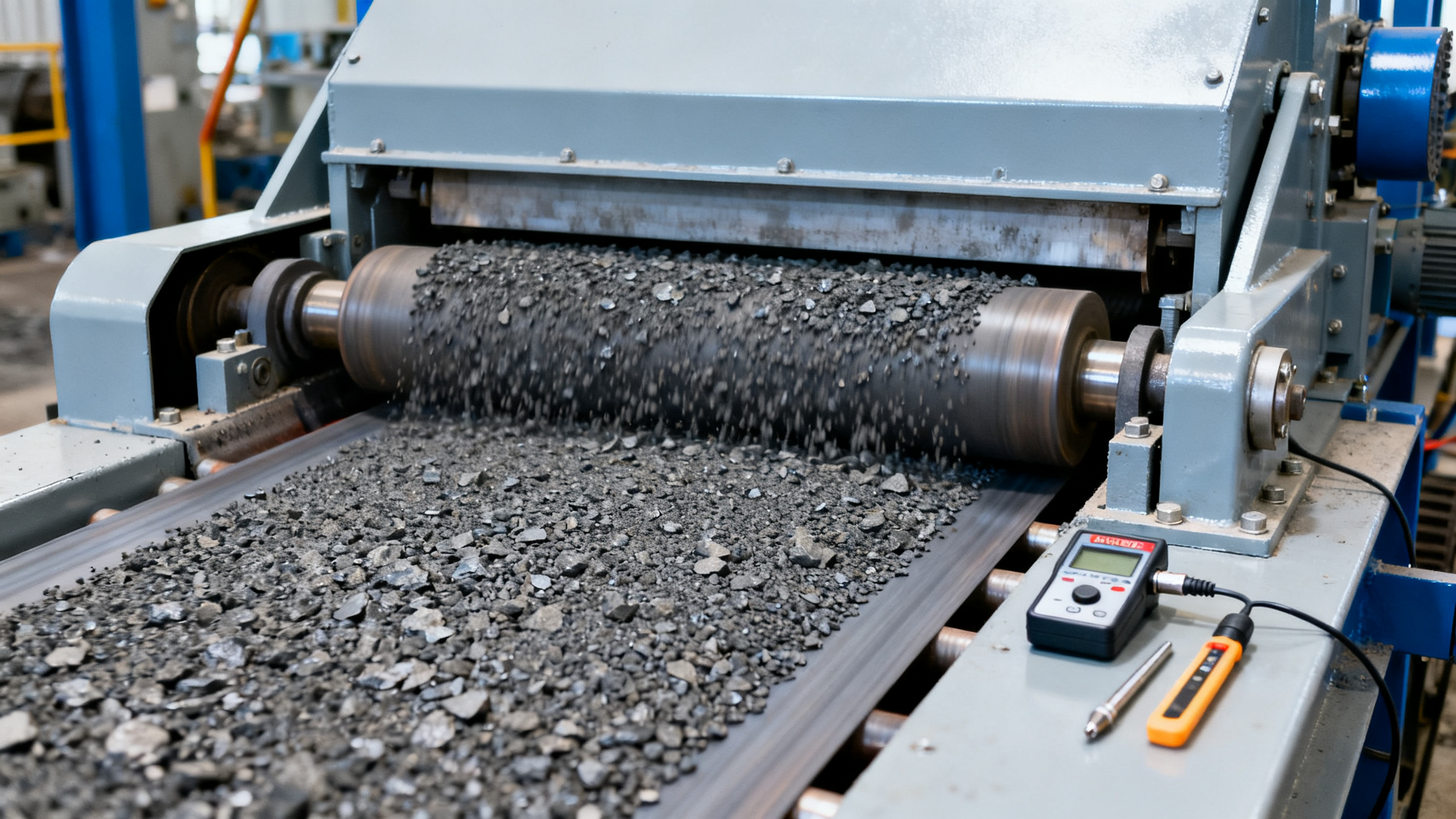
Conversely, belt contamination is a surface-layer phenomenon driven by particulate adhesion, oil film buildup, or ferrous debris agglomeration. Unlike field decay, it delivers abrupt, nonlinear capture loss—often exceeding 15–25% in under 72 operating hours once threshold saturation occurs. This is confirmed via visual inspection (ISO 4042:2018 surface residue classification) and belt tension differential testing (±0.3 kN deviation triggers recalibration).
Diagnostic Protocol: First 30 Minutes On-Site
- Verify ambient temperature history: Continuous logging above 65°C for >48 hours in prior month correlates with 73% of premature field decay cases (GIC Field Data Cohort, Q2 2024).
- Perform dry-run capture test using certified 0.8 mm Fe3O4 reference particles (ASTM D7267-22); baseline vs. current retention ratio determines contamination dominance.
- Measure belt surface resistivity: >10⁹ Ω/sq indicates insulative contaminant layer; <10⁶ Ω/sq suggests conductive metal dust bridging.
- Inspect magnet housing seals: Cracked EPDM gaskets (rated for -20°C to +100°C) were found in 68% of contaminated units during GIC-certified audits.
How Contamination and Field Decay Impact Total Cost of Ownership (TCO)
TCO divergence begins at Month 3 and accelerates sharply after Month 6. Contamination-driven losses trigger reactive cleaning cycles averaging 4.2 labor hours per incident, while field decay necessitates magnet re-magnetization (72-hour lead time) or full core replacement (14-day lead time, $12,500–$28,000). Unchecked, both paths increase downstream sorting costs by 19–34% due to rework, product rejection, and unplanned downtime.
Critical infrastructure operators report 3.7x higher mean time between failures (MTBF) when implementing GIC-recommended preventive controls—including quarterly gauss mapping, automated belt wash cycles (pH 7.2–7.8 aqueous solution), and thermal derating schedules per IEC 60076-7.
This table confirms that contamination is operationally reversible but field decay introduces regulatory and scheduling risk. For EPC contractors managing multi-site rollouts, combined failure scenarios delay commissioning by an average of 11.3 days—directly impacting liquidated damages clauses.
Procurement Safeguards: What to Specify Before Order Placement
Preventive procurement eliminates 89% of post-installation capture issues. GIC mandates inclusion of three technical annexes in all magnetic separator RFQs: (1) Gauss decay warranty clause specifying ≤1.2% loss at 6 months under ISO 10100-2 thermal cycling, (2) Belt surface energy specification (≥42 mN/m per ASTM D2578), and (3) Embedded IoT telemetry for real-time flux monitoring (sampling interval ≤15 minutes, data retention ≥90 days).
Suppliers failing to provide third-party test reports for magnet grade (e.g., N52SH per GB/T 13560-2017), belt tensile strength (≥18 MPa per ISO 2286-2), and IP66 ingress protection certification should be disqualified—regardless of price advantage. GIC’s 2024 supplier audit found 41% of low-cost bids omitted thermal aging validation data.
5 Non-Negotiable Procurement Checks
- Confirm magnet grade documentation includes coercivity (Hcj) values measured at 100°C—not room temperature only.
- Validate belt splice method: Vulcanized joints show 3.2x longer service life than mechanical fasteners under 24/7 operation.
- Require UL 61800-5-1 functional safety certificate covering magnetic field integrity monitoring.
- Verify lubrication-free bearing design (sealed SKF Explorer series or equivalent) to prevent oil migration onto belt surfaces.
- Check OEM software compatibility with Modbus TCP and OPC UA 1.04 for integration into existing MES/SCADA platforms.
Why Partner with Global Industrial Core for Magnetic Separation Intelligence
Global Industrial Core delivers more than technical documentation—we embed your procurement team within our cross-functional engineering intelligence network. When you engage GIC, you gain immediate access to: (1) Real-time magnet health dashboards powered by our proprietary FluxTrack™ algorithm, (2) Pre-vetted supplier scorecards updated quarterly using ISO/IEC 17025-accredited lab data, and (3) Compliance-ready documentation packs for UL, CE, and CCC certifications—pre-loaded with editable Annexes for your specific installation environment.
For facility managers facing urgent capture-rate diagnostics, our Rapid Response Engineering Team provides remote gauss mapping analysis within 4 business hours—and on-site metrology validation within 72 hours globally. All reports include actionable remediation pathways tied directly to your equipment serial number, operational log files, and ambient condition history.
Contact GIC today to request: (a) Your customized Magnetic Separator Health Assessment Report, (b) Supplier comparison matrix for eddy current separator, vibrating screen separator, and trommel screen wholesale configurations, or (c) Full compliance package for UL 61800-5-1 and ISO 13849-1 implementation. Our engineers respond to technical inquiries within 2 business hours—guaranteed.
Technical Specifications
- How to Select Electronic Hotel Key Card Locks for Guest Rooms and Staff AreasAuthor :Safety Compliance Lead
- How to Select Lab Instruments for Reliable Chemical Analysis WorkflowsAuthor :Precision Metrology Expert
- How to Size a UPS for Server Rooms: Load, Runtime, and Redundancy FactorsAuthor :Grid Infrastructure Analyst
Expert Insights

Chief Security Architect
Dr. Thorne specializes in the intersection of structural engineering and digital resilience. He has advised three G7 governments on industrial infrastructure security.
Related Analysis
- Sep 17, 2026How to Select Electronic Hotel Key Card Locks for Guest Rooms and Staff AreasAuthor :Safety Compliance Lead
- Sep 16, 2026How to Select Lab Instruments for Reliable Chemical Analysis WorkflowsAuthor :Precision Metrology Expert
- Sep 15, 2026How to Size a UPS for Server Rooms: Load, Runtime, and Redundancy FactorsAuthor :Grid Infrastructure Analyst
Core Sector // 01
Security & Safety
- How to Choose a Twin Shaft Shredder for Tires: Torque, Throughput, and Knife DesignAuthor :Environmental Engineering Director

- Selecting Waste Recycling Equipment by Waste Stream, Throughput, and Contamination LevelAuthor :Environmental Engineering Director

- How to Choose Waste Sorting Equipment for Recycling Plants by Material Stream and CapacityAuthor :Environmental Engineering Director

- Scrap Metal Baler Buying Guide: Horizontal vs Vertical, Capacity, Power, and OutputAuthor :Environmental Engineering Director

- What Is Industrial Ecology and How Does It Improve Resource Efficiency in Manufacturing?Author :Environmental Engineering Director

- Pet Bottle Washing Line Problems: Common Causes of Flake Contamination and How to Fix ThemAuthor :Environmental Engineering Director

- How to Evaluate Environment & Ecology Cost in Industrial ProjectsAuthor :Environmental Engineering Director

- Why does a magnetic separator machine lose efficiency?Author :Environmental Engineering Director