Electrical & Power Quotations Can Look Complete but Miss Cable Scope
Author
Date Published
Reading Time

An Electrical & Power quotation may look complete on the surface, yet still leave one of the most expensive and schedule-sensitive scopes unclear: cables. For project managers and EPC leads, this is rarely a minor paperwork issue.
When cable responsibility is undefined, the result is often variation claims, delayed installation, mismatched interfaces, and unexpected compliance exposure. The quotation may include switchgear, transformers, panels, and protection systems, but still fail to state who supplies, sizes, routes, tests, terminates, or certifies the cable package.
In practical terms, that means a seemingly competitive Electrical & Power quotation can become more expensive than a higher-priced but better-defined offer. The real risk is not the missing line item alone. It is the chain reaction across procurement, construction sequencing, inspection, energization, and handover.
For industrial projects, the right question is not whether the quote lists cables somewhere. It is whether cable scope is fully allocated, technically aligned, and commercially closed. If not, project cost and accountability remain open.
Why cable scope is often the hidden gap in an Electrical & Power quotation
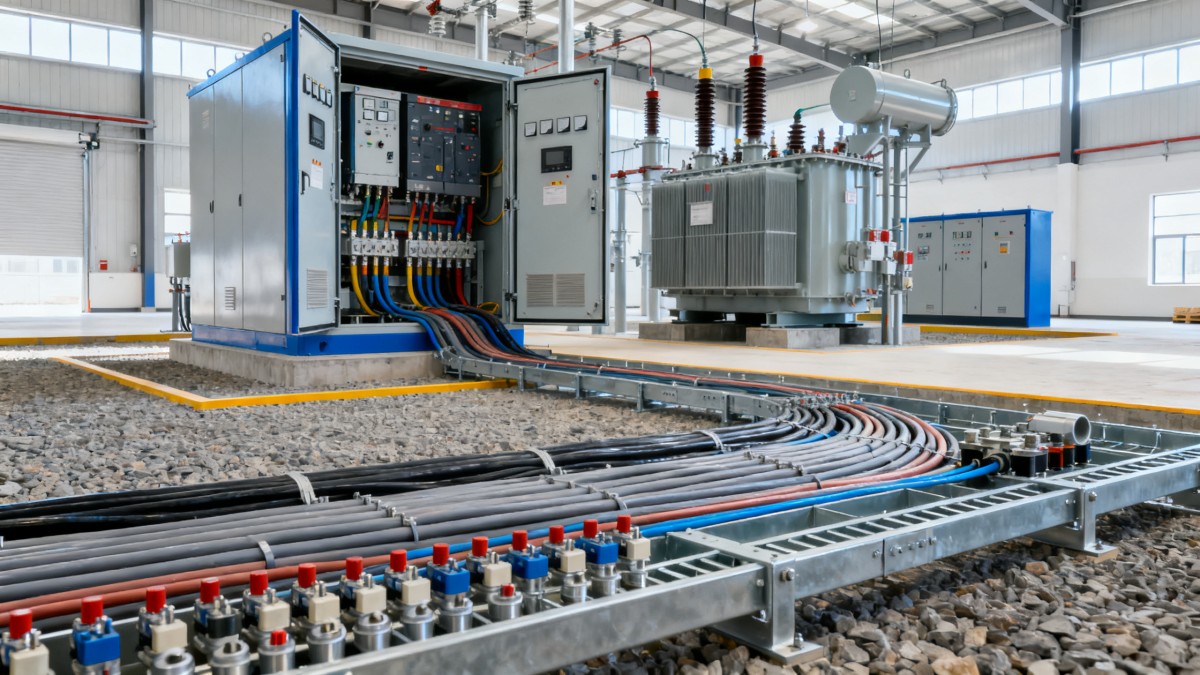
Many quotations are built around major equipment supply. Vendors naturally focus on the assets they manufacture or assemble, such as switchboards, UPS systems, transformers, MCCs, or protection relays. Cable infrastructure then sits in a grey zone between package supplier, EPC contractor, and electrical installer.
This grey zone exists because cable scope crosses disciplines. It affects electrical design, civil routing, tray loading, gland selection, earthing, testing, fire stopping, hazardous area requirements, and commissioning. If the quotation only defines equipment boundaries, these related cable obligations can remain unstated.
Another reason is commercial presentation. A quote can look technically thorough because it contains datasheets, single-line references, panel schedules, exclusions, and standards lists. Yet none of that automatically confirms whether the supplier includes power cables, control cables, fiber, terminations, lugs, glands, pulling support, or testing responsibilities.
For project leaders, this matters because cable omissions are rarely discovered at bid summary stage. They usually surface later, when detailed engineering starts, tray routes are finalized, or site installation asks for exact quantities and interface ownership.
What project managers actually need to verify before award
The core search intent behind an Electrical & Power quotation review is straightforward: decision-makers want to know whether the quote is truly complete, where hidden risk sits, and how to avoid downstream cost and schedule damage.
Most project managers are not looking for a generic explanation of cable types. They want a fast way to identify missing responsibility, challenge ambiguous wording, compare vendors fairly, and prevent post-award disputes.
The highest-value review points are usually these: who supplies cables, who sizes them, who confirms route lengths, who provides glands and lugs, who performs termination, who conducts testing, and who owns compliance evidence at handover.
If those points are not explicitly stated, the quotation is not commercially closed, even if the technical package appears substantial. That is the practical judgment that protects project outcomes.
Where cable scope is most commonly missed
The first common gap is supply boundary wording. A vendor may state “equipment interconnection by others” or “field cabling excluded” without clarifying whether that means all incoming and outgoing power cables, only final connections, or only site installation labor.
The second gap is cable accessories. Even when cable supply is included, the quotation may exclude glands, lugs, ferrules, markers, cleats, junction boxes, sealing materials, or fire-stop systems. These items are small compared with transformers or switchgear, but they strongly affect installation readiness.
The third gap is engineering responsibility. Some suppliers provide a conceptual cable schedule, while final sizing, derating, voltage-drop calculation, short-circuit withstand checks, and tray fill coordination are left to the EPC team. If not recognized early, this creates redesign effort and approval delays.
The fourth gap is testing and documentation. Quotations often mention FAT for equipment, but remain silent on cable continuity testing, insulation resistance testing, hi-pot testing where applicable, tagging records, as-built updates, and turnover dossiers.
The fifth gap is interface scope between packages. For example, a generator vendor, transformer vendor, switchgear vendor, and automation vendor may each assume that inter-package cabling belongs to another contractor. Those assumptions create the most expensive blind spots.
How incomplete cable scope turns into budget overruns and delays
When cable scope is unclear, procurement loses cost visibility first. The award decision may favor a low headline price, but later require separate cable purchase, accessories, installation subcontracting, tray reinforcement, or expedited logistics. The original comparison becomes misleading.
Schedule risk follows quickly. Cable quantities cannot be ordered confidently until routing, termination points, segregation rules, and voltage classes are settled. If those decisions are delayed, site work slows down and critical equipment may sit installed but not connected.
Construction productivity also suffers. Unclear scope leads to waiting time, rework, and field engineering queries. Installers may discover that gland plates do not match actual cable diameters, bending radius has not been considered, or cable tags conflict with the approved drawings.
Compliance risk is the last and often most serious consequence. Improper cable selection or undefined testing responsibility can affect CE, UL, IEC, ISO-aligned project requirements, fire performance, hazardous area integrity, and final energization acceptance.
For large industrial facilities, these are not isolated technical defects. They are management failures caused by incomplete commercial and engineering alignment at the quotation stage.
How to read an Electrical & Power quotation beyond the equipment list
A strong review starts with the battery limits. Project teams should ask where the supplier’s responsibility begins and ends physically, electrically, and contractually. “Up to equipment terminals” is not enough unless every external cable responsibility is assigned elsewhere.
Then review the bill of materials against the single-line diagram and layout drawings. If the system requires feeders, marshalling, control loops, network links, earthing conductors, or heat-trace power supplies, the quotation should show how those connections are delivered.
Next, inspect exclusions carefully. Many hidden risks are not buried in technical schedules but placed plainly in exclusions pages. The problem is that teams often read exclusions only for major equipment omissions, not for supporting cable scope.
Also compare technical notes with commercial assumptions. A supplier may state compliance with project standards while excluding the exact cable accessories or testing tasks needed to achieve those standards in field conditions. That disconnect must be resolved before award.
Finally, verify documentation deliverables. A complete quotation should not only mention physical supply but also cable-related calculation sheets, schedules, routing references where relevant, termination details, test procedures, and turnover records.
A practical checklist for identifying cable scope gaps
Project managers can simplify review by using a structured checklist. First, confirm whether the quotation includes all cable categories: HV, MV, LV power, control, instrumentation, communication, fiber, earthing, and bonding where relevant to the package.
Second, confirm whether included means supply only, install only, terminate only, or complete supply-and-install. Those are very different commercial positions and should never be left implied.
Third, verify accessories and consumables. Ask specifically about glands, lugs, termination kits, cable cleats, trays or tray interfaces, supports, tags, ferrules, sealing compounds, and fire barrier materials.
Fourth, review design accountability. Who owns cable sizing, route length validation, derating calculations, short-circuit checks, EMC segregation, voltage-drop limits, and spare capacity policy? If there are split responsibilities, document them clearly.
Fifth, confirm testing and certification. Who performs continuity tests, insulation resistance tests, functional loop checks, and final records? Who signs the turnover documents? Who carries the liability if testing criteria are not met?
Sixth, test every interface with a simple question: if this cable is missing on site, whose contract requires them to provide it? If the answer is uncertain, the quotation still contains exposure.
Questions to send vendors before you finalize bid evaluation
One effective way to de-risk procurement is to issue focused clarification questions rather than broad requests for “more detail.” Specific questions produce usable responses and reduce room for later interpretation.
Ask whether all incoming and outgoing cables are included, and if not, identify exact endpoints. Ask whether inter-panel, panel-to-field, and package-to-package cabling are included. Ask whether terminations at both ends are part of the supply scope.
Request a line-by-line list of included accessories. Require the vendor to state assumptions on cable lengths, route conditions, ambient temperature, installation method, and standards used for sizing.
Ask who is responsible for final cable schedule issue, testing procedures, redline updates, and as-built submission. Also ask for all exclusions to be consolidated in one section to prevent scattered ambiguity across the quotation.
For high-value projects, require a responsibility matrix. It is often the fastest way to expose scope gaps that are hard to detect in narrative text alone.
What a well-defined quotation should look like
A reliable Electrical & Power quotation does more than present a price and equipment list. It clearly states cable inclusions, exclusions, quantity basis, engineering assumptions, installation boundaries, accessory coverage, and testing deliverables.
It should also align with project documents. The quotation should reference the relevant drawings, specifications, standards, and revision levels used to define cable scope. This reduces the risk of suppliers pricing against outdated assumptions.
Commercially, a strong quotation makes comparison possible. When each bidder defines cable responsibility in the same structure, project teams can compare total installed value rather than headline equipment cost alone.
Operationally, a complete quotation improves execution. Procurement can release orders earlier, construction teams can plan installation with fewer surprises, and commissioning can proceed with clearer accountability.
Why this matters even more for EPC and industrial infrastructure projects
In industrial infrastructure, cable scope is not a minor balance item. Cable networks physically connect the power architecture, control systems, safety logic, and operational resilience of the facility. Missing scope therefore affects both cost and functionality.
EPC environments also involve multiple subcontractors, package vendors, compliance obligations, and milestone-linked payment structures. In that setting, ambiguity is expensive because every unresolved interface becomes a coordination issue with contractual consequences.
For project leaders managing uptime, safety, and budget pressure, the smartest approach is simple: treat cable scope review as a core award criterion, not an afterthought under electrical installation. That mindset prevents many avoidable claims later.
Conclusion: a quotation is only complete when cable responsibility is closed
An Electrical & Power quotation can absolutely look complete while still missing essential cable scope. For project managers and EPC leads, the real test is not document volume or equipment detail. It is whether supply, design, installation, accessories, testing, and interface ownership are explicitly assigned.
If cable scope remains vague, the quotation still carries open cost, open schedule risk, and open compliance exposure. That makes it incomplete from a project control standpoint, even if it appears technically polished.
The practical takeaway is clear. Before award, push beyond the equipment list, challenge exclusions, map interfaces, and force written clarity on every cable-related responsibility. Doing that early protects budget accuracy, installation readiness, and final system accountability.
In complex industrial procurement, the most valuable quotation is not the one that looks the fullest. It is the one that leaves the least room for doubt.
Technical Specifications
- How to Select Electronic Hotel Key Card Locks for Guest Rooms and Staff AreasAuthor :Safety Compliance Lead
- How to Select Lab Instruments for Reliable Chemical Analysis WorkflowsAuthor :Precision Metrology Expert
- How to Size a UPS for Server Rooms: Load, Runtime, and Redundancy FactorsAuthor :Grid Infrastructure Analyst
Expert Insights

Chief Security Architect
Dr. Thorne specializes in the intersection of structural engineering and digital resilience. He has advised three G7 governments on industrial infrastructure security.
Related Analysis
- Sep 17, 2026How to Select Electronic Hotel Key Card Locks for Guest Rooms and Staff AreasAuthor :Safety Compliance Lead
- Sep 16, 2026How to Select Lab Instruments for Reliable Chemical Analysis WorkflowsAuthor :Precision Metrology Expert
- Sep 15, 2026How to Size a UPS for Server Rooms: Load, Runtime, and Redundancy FactorsAuthor :Grid Infrastructure Analyst
Core Sector // 01
Security & Safety
- Selecting PTFE Insulated Hookup Wire for High-Temperature Control PanelsAuthor :Grid Infrastructure Analyst

- How Contractors Can Evaluate EPC Sourcing Solutions for Cost, Lead Time, and RiskAuthor :Grid Infrastructure Analyst

- What Drives Silicone Cable Bulk Price in Industrial Orders?Author :Grid Infrastructure Analyst

- EN 61000-6-4:2026 Takes Effect for EU-Bound ControlsAuthor :Grid Infrastructure Analyst

- How to Choose Low Smoke Cables and Wiring for Safer Commercial Buildings?Author :Grid Infrastructure Analyst

- Medium Voltage Armored Cable Selection Guide: Voltage Rating, Armor Type, and InstallationAuthor :Grid Infrastructure Analyst

- EU Publishes EN IEC 61000-6-4:2026 for Industrial EMCAuthor :Grid Infrastructure Analyst

- Choosing an XLPE Power Cable Manufacturer: 7 Checks for Voltage Class and ComplianceAuthor :Grid Infrastructure Analyst