Electrical Insulation Materials for Cable Joints: How to Select for Voltage, Heat, and Moisture
Author
Date Published
Reading Time
Electrical Insulation Materials for Cable Joints: How to Select for Voltage, Heat, and Moisture
Selecting the right electrical insulation materials for cable joints is not a routine purchasing task. It directly affects joint integrity, outage risk, personnel safety, and long-term compliance.
For power distribution assets, the joint is often the most vulnerable point in the cable system. A strong conductor connection can still fail if insulation selection is weak.
That is why electrical insulation materials for cable joints must be matched to voltage class, thermal load, installation conditions, and moisture exposure.
In practice, many failures come from a simple mismatch. The material may pass a lab test, yet underperform in a wet trench, a hot tunnel, or a heavily loaded plant.
This guide explains how to evaluate electrical insulation materials for cable joints using technical and standard-based criteria that support reliable field decisions.
Why Cable Joint Insulation Fails in Real Operating Conditions
A cable joint rarely fails because of one issue alone. Most breakdowns happen when electrical, thermal, and environmental stresses build together over time.
Voltage stress can create partial discharge, especially where the insulation interface is uneven. Heat then accelerates aging, and moisture lowers dielectric performance.
More importantly, poor material compatibility can introduce voids, shrinkage, or surface tracking. These are common warning signs before a joint failure occurs.
For quality and safety review, the goal is not simply to choose an insulating product. The goal is to control the failure path before the joint enters service.
Three stress factors that matter most
- Electrical stress: dielectric strength, impulse resistance, and field distribution.
- Thermal stress: continuous operating temperature, overload tolerance, and aging stability.
- Environmental stress: water ingress, chemicals, UV exposure, and contamination.
Any review of electrical insulation materials for cable joints should start with these three conditions, because they drive most lifecycle performance issues.
Core Material Options for Electrical Insulation Materials for Cable Joints
Not all insulation systems perform the same way. Selection depends on cable design, installation method, maintenance access, and expected service life.
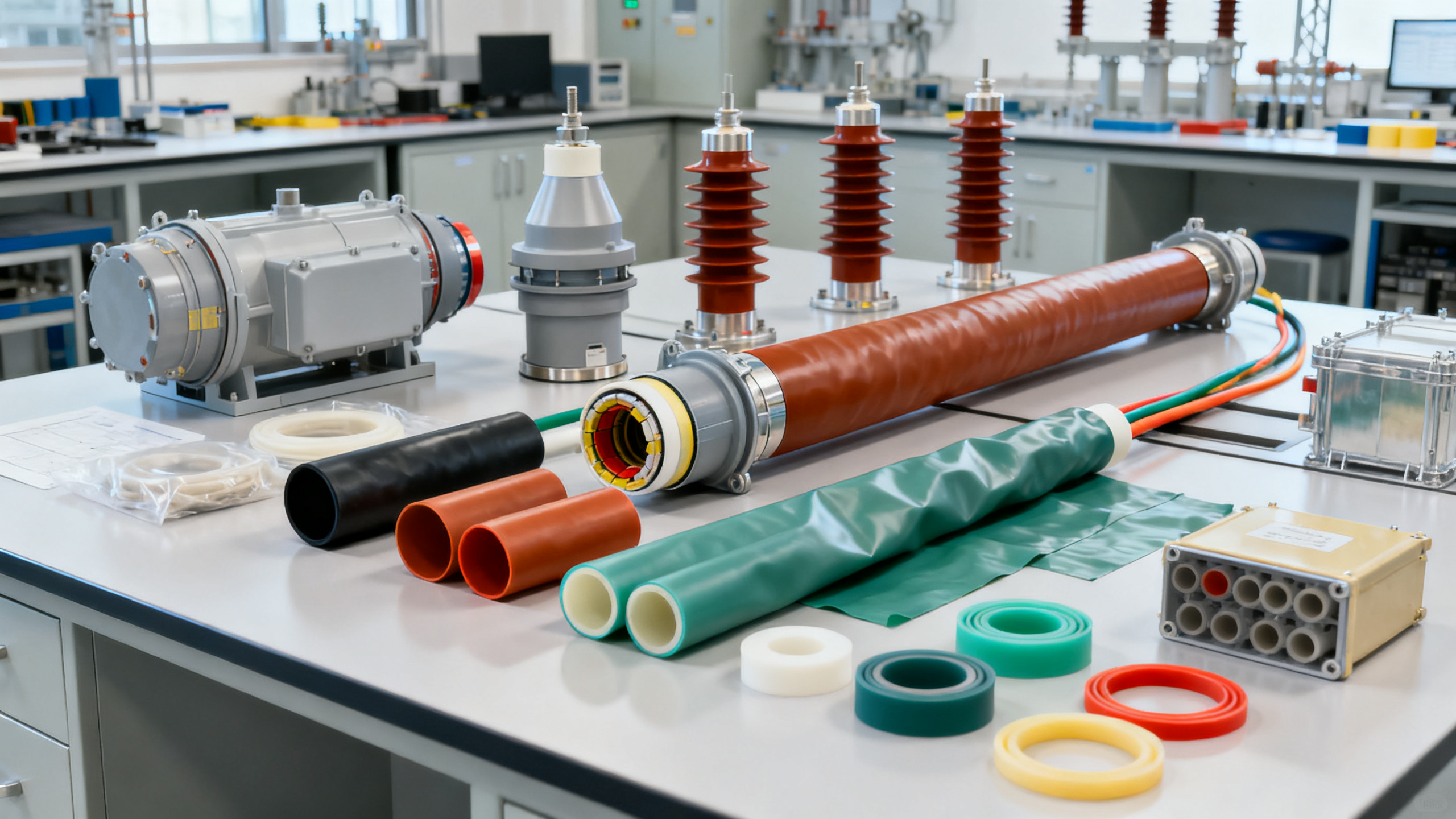
The most common electrical insulation materials for cable joints include heat-shrink polymers, cold-shrink elastomers, rubber compounds, resin systems, and silicone-based materials.
Heat-shrink materials
Heat-shrink systems are widely used because they are compact and cost-efficient. They work well when installation quality is controlled carefully.
Their main risk is installation variability. Uneven heating can create weak sealing areas or incomplete recovery around the joint body.
Cold-shrink elastomers
Cold-shrink products offer more consistent pressure and faster field installation. They are useful where open flame or heat tools are restricted.
For damp environments, they often provide better sealing consistency. Still, storage conditions and shelf life must be checked before deployment.
Resin and cast systems
Resin-based joint insulation is common in demanding underground or submerged conditions. It can create strong encapsulation and solid moisture barriers.
However, cure control is critical. Mixing errors, trapped air, or poor curing can undermine the full benefit of the system.
Silicone and EPDM-based systems
These materials offer strong elasticity, thermal stability, and interface performance. They are often used in medium-voltage and higher reliability applications.
When comparing electrical insulation materials for cable joints, silicone and EPDM options usually score well where temperature cycling is frequent.
How to Select by Voltage Class
Voltage is the first filter. A low-voltage joint and a medium-voltage joint do not face the same electric field behavior.
At higher voltage levels, insulation thickness alone is not enough. Stress control, interface uniformity, and partial discharge resistance become essential.
Low-voltage systems
For low-voltage applications, focus on dielectric adequacy, moisture sealing, mechanical strength, and chemical resistance. Many failures here are environmental, not purely electrical.
Medium-voltage systems
For medium-voltage cables, the selection of electrical insulation materials for cable joints must include stress grading components and validated joint design data.
Look for tested performance under AC withstand, partial discharge, thermal cycling, and impulse conditions. Generic insulation claims are not enough at this level.
A practical voltage checklist
- Rated system voltage and maximum operating voltage.
- Type of cable insulation, such as XLPE, EPR, or PVC.
- Need for stress control tubing or molded components.
- Test evidence under IEC, IEEE, UL, or equivalent standards.
How to Select by Heat and Thermal Aging
Heat is one of the fastest ways to shorten insulation life. Joint materials must survive both continuous temperature and overload events.
This is especially important in confined spaces, industrial plants, solar farms, and high-current feeder routes where hotspots are more likely.
When reviewing electrical insulation materials for cable joints, pay attention to thermal class, softening behavior, shrink-back risk, and resistance to repeated temperature cycling.
Questions worth asking suppliers
- What is the maximum continuous conductor temperature?
- Has the joint passed thermal cycling under load?
- How does the material behave after years of heat exposure?
- Is there data on brittleness, cracking, or seal degradation?
A material that looks acceptable at room temperature can become unreliable after long exposure to elevated heat. That distinction matters in approval decisions.
How to Select by Moisture, Contamination, and Site Exposure
Moisture ingress is a common cause of cable joint degradation. Once water enters, dielectric performance, corrosion resistance, and insulation stability can deteriorate quickly.
This is why electrical insulation materials for cable joints should be reviewed alongside sealing design, not as a separate material choice.
Underground ducts, coastal facilities, wastewater plants, and outdoor substations all increase exposure to water, dirt, salts, and chemicals.
What to verify in wet or dirty environments
- Seal integrity under standing water or humidity.
- Resistance to tracking and surface contamination.
- Compatibility with metallic shields and corrosion controls.
- Performance after mechanical movement or vibration.
In field conditions, interface sealing often decides whether electrical insulation materials for cable joints perform well over ten years or fail much earlier.
Standards and Test Evidence That Support Selection
Technical selection should be backed by standards, not only brochures. Compliance evidence helps reduce ambiguity during specification, audit, and incident review.
Relevant frameworks may include IEC, IEEE, UL, CE, and ISO-linked quality controls, depending on the market and project requirements.
For electrical insulation materials for cable joints, test records are often more useful than generic declarations because they show actual joint system performance.
Key evidence to request
A Practical Selection Framework for Safer Decisions
A workable selection process should be simple enough for procurement review, yet technical enough to prevent hidden risk.
Start with the cable type and voltage class. Then assess heat profile, moisture exposure, installation method, and required certification evidence.
Next, compare electrical insulation materials for cable joints at the system level. Do not evaluate the insulating sleeve, seal, and stress control parts separately.
Finally, review installer competence. Even strong materials can fail if the jointing process is inconsistent or poorly supervised.
Selection steps
- Define voltage, load, fault level, and operating temperature.
- Map site conditions, including water, chemicals, UV, and movement.
- Check cable insulation compatibility and joint design fit.
- Verify standards, test reports, and manufacturing quality controls.
- Assess installation repeatability and inspection requirements.
This approach keeps the decision grounded in operating reality, not just product claims. It also makes audit trails easier to defend later.
Final Takeaway
Choosing electrical insulation materials for cable joints is really about managing failure risk before energization. Voltage, heat, and moisture should be treated as linked decision factors.
The strongest selections usually come from combining material properties, joint system testing, field conditions, and standards evidence into one review process.
For industrial infrastructure, that discipline supports safer operations, fewer joint failures, and more reliable power continuity across the asset lifecycle.
When the next project or replacement cycle begins, use this framework to compare electrical insulation materials for cable joints with clear technical priorities and documented acceptance criteria.
Technical Specifications
- Air Handling Unit Supplier Checklist: Performance Data, Lead Times, and SupportAuthor :Environmental Engineering Director
- Buying Fiberglass Water Tanks Wholesale: Compare Quotes and Delivery CostsAuthor :Environmental Engineering Director
- Choosing an XLPE Power Cable Supplier: Test Reports, Traceability, and Lead TimesAuthor :Grid Infrastructure Analyst
Expert Insights

Chief Security Architect
Dr. Thorne specializes in the intersection of structural engineering and digital resilience. He has advised three G7 governments on industrial infrastructure security.
Related Analysis
- Oct 19, 2026Air Handling Unit Supplier Checklist: Performance Data, Lead Times, and SupportAuthor :Environmental Engineering Director
- Oct 18, 2026Buying Fiberglass Water Tanks Wholesale: Compare Quotes and Delivery CostsAuthor :Environmental Engineering Director
- Oct 17, 2026Choosing an XLPE Power Cable Supplier: Test Reports, Traceability, and Lead TimesAuthor :Grid Infrastructure Analyst
Core Sector // 01
Security & Safety
- Choosing an XLPE Power Cable Supplier: Test Reports, Traceability, and Lead TimesAuthor :Grid Infrastructure Analyst

- How to Select XLPO Insulated Solar Cable for UV, Heat, and High-Voltage PV SystemsAuthor :Grid Infrastructure Analyst

- Selecting PTFE Insulated Hookup Wire for High-Temperature Control PanelsAuthor :Grid Infrastructure Analyst

- How Contractors Can Evaluate EPC Sourcing Solutions for Cost, Lead Time, and RiskAuthor :Grid Infrastructure Analyst

- What Drives Silicone Cable Bulk Price in Industrial Orders?Author :Grid Infrastructure Analyst

- EN 61000-6-4:2026 Takes Effect for EU-Bound ControlsAuthor :Grid Infrastructure Analyst

- How to Choose Low Smoke Cables and Wiring for Safer Commercial Buildings?Author :Grid Infrastructure Analyst

- Medium Voltage Armored Cable Selection Guide: Voltage Rating, Armor Type, and InstallationAuthor :Grid Infrastructure Analyst