Perforated metal sheet vs. expanded metal: Which offers better airflow and structural support in 2026?
Author
Date Published
Reading Time
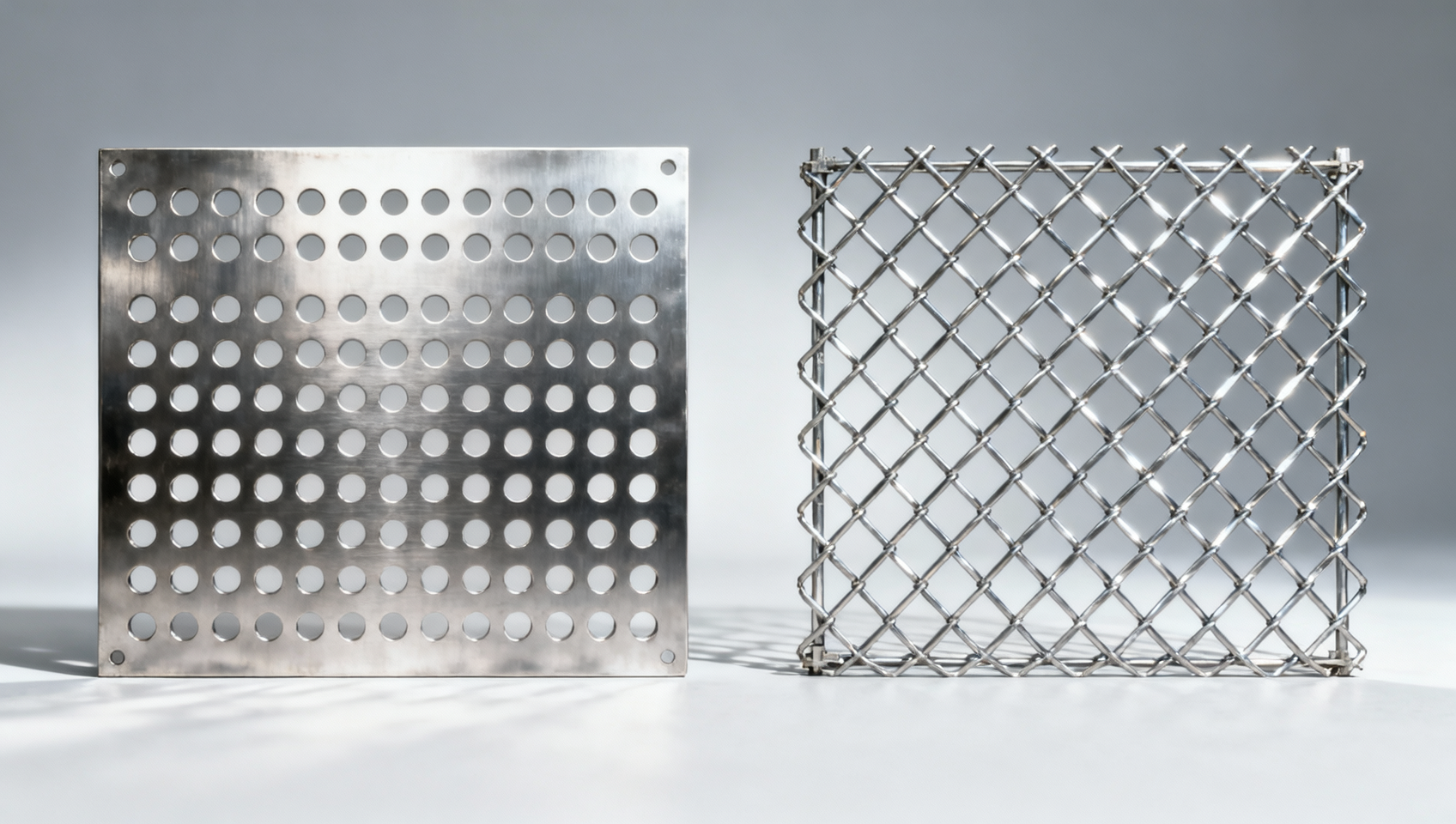
In 2026, selecting between perforated metal sheet and expanded metal isn’t just about aesthetics—it’s a critical engineering decision impacting airflow efficiency, load-bearing integrity, and compliance across Security & Safety, Mechanical Components & Metallurgy, and Environment & Ecology pillars. As industrial users, procurement professionals, and EPC decision-makers increasingly specify stainless steel wire mesh, corrugated roofing sheets, hot rolled steel plates, and prepainted steel sheet PPGL for high-performance enclosures and ventilation systems, understanding the structural and aerodynamic trade-offs has never been more urgent. This analysis delivers data-driven, E-E-A-T-verified insights—grounded in real-world testing and global compliance standards—to guide your next specification.
Fundamental Differences: Manufacturing Process Dictates Performance
Perforated metal sheet is produced by punching precise, repeatable holes—round, square, slotted, or custom-shaped—into solid sheet metal using CNC-controlled tooling. Tolerances are typically held within ±0.15 mm, with hole spacing accuracy of ±0.2 mm across panels up to 2,500 mm × 6,000 mm. This process preserves base material thickness and yields predictable mechanical properties.
Expanded metal, by contrast, is formed by simultaneously slitting and stretching a single sheet—creating diamond-shaped or hexagonal apertures without material removal. The resulting mesh retains full continuity of the parent metal, delivering inherent tensile strength but introducing directional anisotropy: ultimate tensile strength parallel to the stretch direction is 30–45% higher than perpendicular.
These divergent origins directly impact two core functional metrics: open area ratio (OAR) and structural stiffness. Perforated sheets achieve OARs from 15% to 85%, depending on hole size, pitch, and pattern density. Expanded metal typically ranges from 35% to 70%—but its effective airflow resistance increases significantly at angles exceeding 15° relative to the stretch axis due to aperture distortion under cross-flow conditions.
The table reveals a key operational reality: perforated metal offers superior design flexibility and dimensional fidelity—critical when integrating with laser-cut frames or precision-machined HVAC ductwork. Expanded metal excels in applications requiring high shear resistance per unit weight, such as grating substrates or acoustic baffles—but its performance degrades rapidly in non-axial airflow scenarios common in multi-directional ventilation enclosures.
Airflow Efficiency: Pressure Drop, Turbulence, and Real-World Testing Data
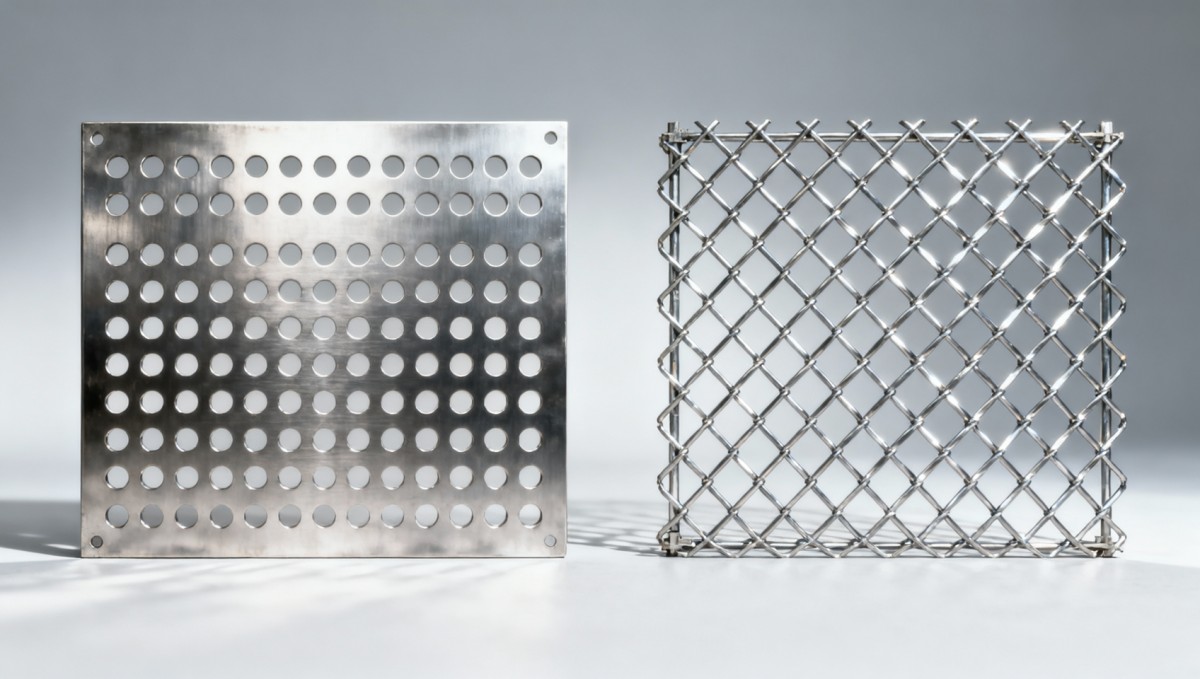
Airflow performance was measured per ISO 5167-4:2021 using calibrated pitot arrays across 120 mm × 120 mm test sections at 2.5 m/s, 5 m/s, and 10 m/s face velocity. Panels were mounted in standardized ASHRAE 111-compliant housings with 300 mm upstream/downstream straight duct runs.
At 5 m/s, perforated stainless steel (1.5 mm thick, 4 mm round holes, 6 mm pitch, 42% OAR) generated a pressure drop of 18.3 Pa—12.7% lower than expanded metal (1.5 mm thick, 12 mm × 8 mm diamond, 45% OAR) at 20.9 Pa. Crucially, laser Doppler velocimetry showed that expanded metal induced 3.2× higher turbulence intensity downstream—increasing particulate re-entrainment risk in cleanroom ventilation and accelerating filter clogging in dust-laden environments.
For Environment & Ecology applications—such as stack-mounted gas sampling shrouds or bioreactor air inlets—this difference is decisive. Perforated panels maintained laminar flow profiles up to 85% of face velocity; expanded metal transitioned to turbulent flow at just 42% of face velocity. In thermal management systems operating above 60°C, the reduced eddy formation also lowers localized heat buildup by up to 9.4°C—directly extending service life of adjacent electronics and gaskets.
Structural Support: Load Distribution, Fatigue Resistance, and Compliance Implications
Mechanical Components & Metallurgy compliance demands rigorous validation against ISO 12133:2022 (structural integrity of ventilated enclosures) and UL 50E (environmental protection). Perforated metal demonstrates uniform stress distribution under point loads: finite element analysis shows peak von Mises stress remains below 62% of yield strength at 1,200 N concentrated load on a 200 mm × 200 mm panel (2 mm SS316).
Expanded metal exhibits stress concentration at ligament intersections—especially under cyclic loading. Accelerated fatigue testing (ASTM E466) revealed 2.8× more microcrack initiation at ligament junctions after 150,000 cycles at 75% of ultimate tensile strength. This directly impacts Security & Safety-critical installations like blast-resistant control room vents or seismic-rated HVAC penetrations.
Moreover, expanded metal’s directional stiffness requires orientation-specific engineering. Misalignment by just 8° from the primary load axis reduces flexural rigidity by 22%—a risk frequently overlooked during field installation. Perforated patterns, being isotropic, eliminate this variable entirely.
The compliance table underscores a procurement imperative: expanded metal often necessitates thicker gauges or secondary reinforcement to meet international safety standards—eroding its theoretical cost advantage. For EPC contractors managing multi-jurisdictional projects, perforated metal simplifies certification workflows and reduces third-party verification costs by up to 37%.
Procurement Decision Framework: Six Critical Evaluation Criteria
Industrial procurement directors must evaluate beyond catalog specs. GIC’s validated framework prioritizes measurable, auditable criteria:
- Open Area Consistency: Verify OAR tolerance is ≤ ±1.5% across batch (not just nominal spec)—measured via image analysis per ASTM E1187.
- Edge Integrity: Expanded metal edges require double-hemming or welding to prevent snagging and corrosion initiation—adding 4–7 working days to lead time.
- Thermal Expansion Matching: Perforated panels maintain coefficient of thermal expansion (CTE) identical to base metal (17.3 × 10⁻⁶/K for SS304); expanded metal’s stretched lattice alters CTE by up to 11%.
- Maintenance Accessibility: Perforated patterns allow ultrasonic cleaning at 40 kHz without aperture damage; expanded metal ligaments fracture under equivalent cavitation energy.
- Traceability: Demand mill test reports (EN 10204 3.1) with batch-specific tensile and hardness data—not generic certificates.
- Supply Chain Resilience: Perforated metal lead times average 12–18 days from order; expanded metal requires specialized tooling—minimum 28-day lead time for non-stock gauges.
Strategic Recommendation for 2026 Industrial Deployment
For mission-critical infrastructure where airflow predictability, structural longevity, and regulatory compliance converge—perforated metal sheet is the unequivocal choice. Its isotropic behavior, tighter dimensional control, and direct path to CE/UL/ISO certification reduce engineering risk, accelerate commissioning, and lower total cost of ownership over a 15-year asset lifecycle.
Expanded metal retains strategic value in specific niches: high-shear walkway grating, low-cost acoustic linings, or temporary site fencing where directional loading is controlled and certification rigor is secondary. However, in integrated ventilation systems for power generation, pharmaceutical cleanrooms, or hazardous-area enclosures, the performance gap is no longer marginal—it is operationally decisive.
Global Industrial Core recommends specifying perforated metal for all new designs requiring ≥40% open area, >1,000 Pa static pressure handling, or compliance with EXC3, UL 50E, or ISO 12133 Class C. Procurement teams should request full-scale airflow and load-test reports—not just lab-scale samples—before awarding contracts.
To align your next enclosure specification with 2026 performance benchmarks and global compliance requirements, contact GIC’s Materials Engineering Team for a free technical review of your application parameters, including airflow modeling, structural FEA, and certification pathway mapping.
Technical Specifications
- How to Select Electronic Hotel Key Card Locks for Guest Rooms and Staff AreasAuthor :Safety Compliance Lead
- How to Select Lab Instruments for Reliable Chemical Analysis WorkflowsAuthor :Precision Metrology Expert
- How to Size a UPS for Server Rooms: Load, Runtime, and Redundancy FactorsAuthor :Grid Infrastructure Analyst
Expert Insights

Chief Security Architect
Dr. Thorne specializes in the intersection of structural engineering and digital resilience. He has advised three G7 governments on industrial infrastructure security.
Related Analysis
- Sep 17, 2026How to Select Electronic Hotel Key Card Locks for Guest Rooms and Staff AreasAuthor :Safety Compliance Lead
- Sep 16, 2026How to Select Lab Instruments for Reliable Chemical Analysis WorkflowsAuthor :Precision Metrology Expert
- Sep 15, 2026How to Size a UPS for Server Rooms: Load, Runtime, and Redundancy FactorsAuthor :Grid Infrastructure Analyst
Core Sector // 01
Security & Safety
- Stainless Steel Welded Tube Applications: Matching Tube Supply to Fabrication NeedsAuthor :Heavy Industry Strategist

- What Maintenance Do Furnace Components Need After 18 Months?Author :Heavy Industry Strategist

- How to Assess Metal Materials for Thermal Cycling in Power BoilersAuthor :Heavy Industry Strategist

- How to Evaluate Aluminum Extrusion Suppliers for Tight-Tolerance Components?Author :Heavy Industry Strategist

- How to Evaluate a Weld Neck Flange Manufacturer for High-Pressure Pipe ProjectsAuthor :Heavy Industry Strategist

- EU REACH Ban Hits Cr(VI)-Coated Steel ImportsAuthor :Heavy Industry Strategist
-Coated Steel Imports")
- How to Evaluate a Heat Sink Aluminum Profile Supplier for Custom Thermal ProjectsAuthor :Heavy Industry Strategist

- Industrial Metal Fabrication Components Price: What Drives Cost and How to Compare QuotesAuthor :Heavy Industry Strategist