Zhejiang Cloud Warehousing Upgraded to Smart Fulfillment
Author
Date Published
Reading Time

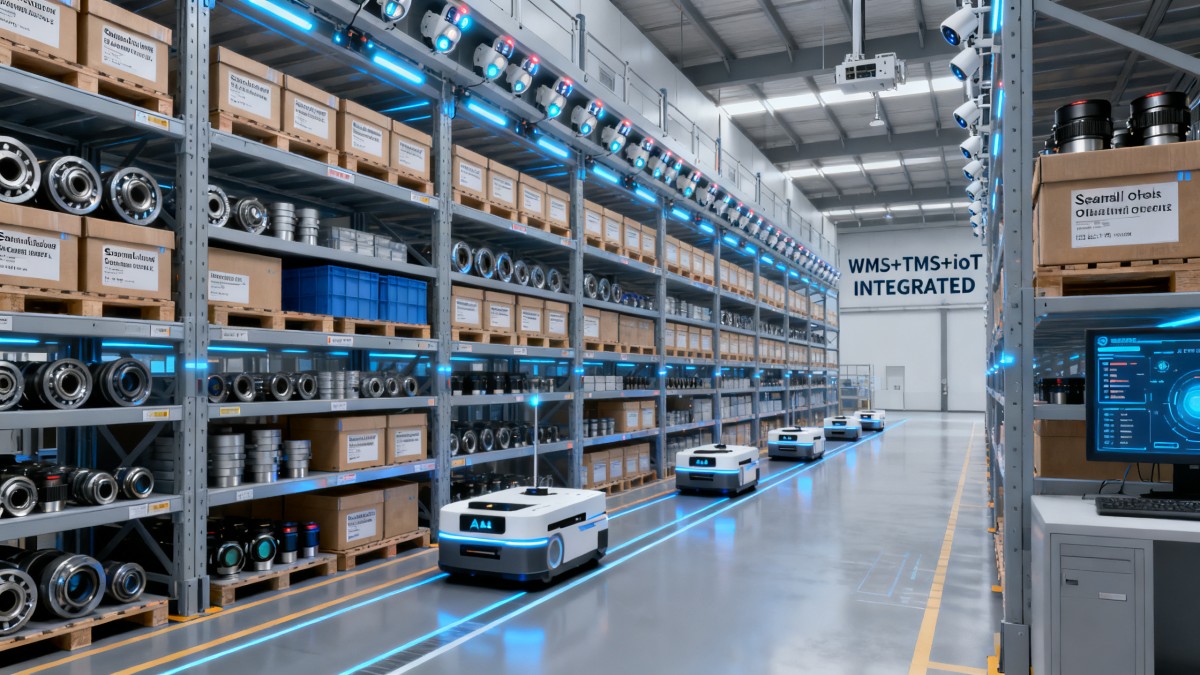
On May 16, 2026, Zhejiang’s cloud warehousing sector formally transitioned to an intelligent fulfillment model — marking a structural shift in cross-border industrial goods logistics. This upgrade directly impacts the industrial components, precision manufacturing, and B2B export sectors, driven by standardized integration of WMS, TMS, and IoT across mainstream third-party托管 providers.
Event Overview
According to the Zhejiang Cloud Warehousing Industry Assessment Report released on May 16, 2026, leading托管 service providers in the province have achieved full-chain digital integration of Warehouse Management Systems (WMS), Transportation Management Systems (TMS), and Internet-of-Things (IoT) infrastructure. The upgraded system supports climate-controlled sorting (constant temperature/humidity), full serial-number traceability, and direct B2B shipment to overseas warehouses — specifically for high-value industrial items including bearings, sealing components, and optical lenses. Average fulfillment time from hub warehouses in Hangzhou and Ningbo to North America and Europe has shortened to 4.2 days; reverse logistics response for returns now occurs within 72 hours.
Industries Affected
Direct Exporting Enterprises
These enterprises — especially SMEs exporting industrial parts to EU/US markets — face reduced lead-time pressure and improved order visibility. Impact manifests in lower buffer inventory requirements, tighter delivery commitments to overseas buyers, and enhanced ability to support just-in-time procurement contracts. However, dependency on integrated cloud warehousing raises operational continuity risks if platform-level outages or compliance gaps emerge.
Raw Material Procurement Firms
Firms sourcing critical subcomponents (e.g., precision-machined alloys or specialty elastomers) for downstream assembly benefit from real-time stock status and lot-level environmental history. This enables more accurate quality assurance documentation and faster customs clearance for regulated shipments. Yet, increased data transparency also intensifies audit exposure — particularly around origin tracing and storage condition logs.
Contract Manufacturing & OEMs
OEMs relying on distributed production networks see improved synchronization between component receipt, kitting, and final assembly scheduling. The 4.2-day transatlantic fulfillment window allows tighter alignment with overseas customer demand signals. Still, the shift demands internal ERP upgrades to match real-time WMS/TMS event feeds — otherwise, visibility gains remain siloed at the logistics layer.
Logistics & Supply Chain Service Providers
Third-party logistics (3PL) and value-added warehousing (VAW) providers must now demonstrate interoperability with unified WMS+TMS+IoT stacks — not just technical compatibility, but certified data governance (e.g., ISO 27001-aligned audit trails for serial numbers). Providers lacking API-native integration risk marginalization in RFPs issued by multinationals prioritizing end-to-end traceability.
Key Considerations & Recommended Actions
Validate Data Interoperability Protocols
Exporters and manufacturers should verify whether their ERP or PLM systems can ingest structured event data (e.g., temperature deviation alerts, bin-level scan timestamps) from Zhejiang cloud platforms — not just receive shipping confirmations.
Review Contractual SLAs for Environmental Compliance
Contracts with托管 providers must explicitly define acceptable humidity/temperature ranges per product category, incident reporting timelines, and liability allocation for condition-related failures — especially for optics or bearing assemblies sensitive to micro-condensation.
Map Reverse Logistics Triggers
Given the new 72-hour return response benchmark, enterprises need to clarify upstream triggers (e.g., buyer-initiated return request vs. carrier-reported damage) and align internal QA re-inspection cycles accordingly — avoiding bottlenecks that undermine the promised speed.
Editorial Perspective / Industry Observation
Observably, this is less a technological milestone than a regulatory-adjacent inflection point: the convergence of customs modernization (e.g., China’s Cross-Border E-Commerce Integrated Service Platform mandates), rising EU MDR/CE traceability expectations, and private-sector investment in industrial IoT has coalesced into de facto operational standards. Analysis shows that firms treating ‘intelligent fulfillment’ as merely faster shipping underestimate its implications for quality governance, audit readiness, and multi-tier supplier coordination. From an industry perspective, the real bottleneck moving forward lies not in hardware deployment — but in harmonizing data semantics across ERP, MES, and cloud logistics layers.
Conclusion
This upgrade signifies a maturing phase in China’s industrial logistics infrastructure — one where speed, traceability, and environmental integrity are no longer competitive differentiators, but baseline operational thresholds. A rational reading suggests that competitiveness will increasingly hinge on how seamlessly enterprises embed these capabilities into their own planning, compliance, and risk management frameworks — rather than outsourcing them as discrete services.
Source Attribution
Primary source: Zhejiang Cloud Warehousing Industry Assessment Report, issued May 16, 2026, by Zhejiang Provincial Department of Commerce and Zhejiang Intelligent Logistics Innovation Alliance. Note: Implementation timelines for non-hub locations (e.g., Jiaxing, Shaoxing) and cross-province interoperability with Guangdong/Fujian cloud nodes remain under observation.
Technical Specifications
- How to Select Electronic Hotel Key Card Locks for Guest Rooms and Staff AreasAuthor :Safety Compliance Lead
- How to Select Lab Instruments for Reliable Chemical Analysis WorkflowsAuthor :Precision Metrology Expert
- How to Size a UPS for Server Rooms: Load, Runtime, and Redundancy FactorsAuthor :Grid Infrastructure Analyst
Expert Insights

Chief Security Architect
Dr. Thorne specializes in the intersection of structural engineering and digital resilience. He has advised three G7 governments on industrial infrastructure security.
Related Analysis
- Sep 17, 2026How to Select Electronic Hotel Key Card Locks for Guest Rooms and Staff AreasAuthor :Safety Compliance Lead
- Sep 16, 2026How to Select Lab Instruments for Reliable Chemical Analysis WorkflowsAuthor :Precision Metrology Expert
- Sep 15, 2026How to Size a UPS for Server Rooms: Load, Runtime, and Redundancy FactorsAuthor :Grid Infrastructure Analyst
Core Sector // 01
Security & Safety
- Selecting Low-Friction Pneumatic Seals for High-Cycle, Low-Pressure CylindersAuthor :Heavy Industry Strategist

- Selecting Spherical Roller Bearings for Mining: Load, Contamination, and Service LifeAuthor :Heavy Industry Strategist

- Do Deep Groove Ball Bearings Need Special Seals in Coastal Humidity?Author :Heavy Industry Strategist

- How to Select Anti Vibration Rubber Shock Absorbers for Machinery and EquipmentAuthor :Heavy Industry Strategist

- When to Specify Induction Hardened Slewing Ring Bearings for Heavy-Duty EquipmentAuthor :Heavy Industry Strategist

- How to Evaluate Weather Resistant EPDM Extrusion for Outdoor Sealing ApplicationsAuthor :Heavy Industry Strategist

- Bearing and Seal Lead Times Stretch to 22 WeeksAuthor :Heavy Industry Strategist

- Angular Contact Ball Bearings Explained: Contact Angle, Load Capacity, and Common UsesAuthor :Heavy Industry Strategist