17 National Associations Release Domestic Trade Transaction Guidelines (Trial)
Author
Date Published
Reading Time
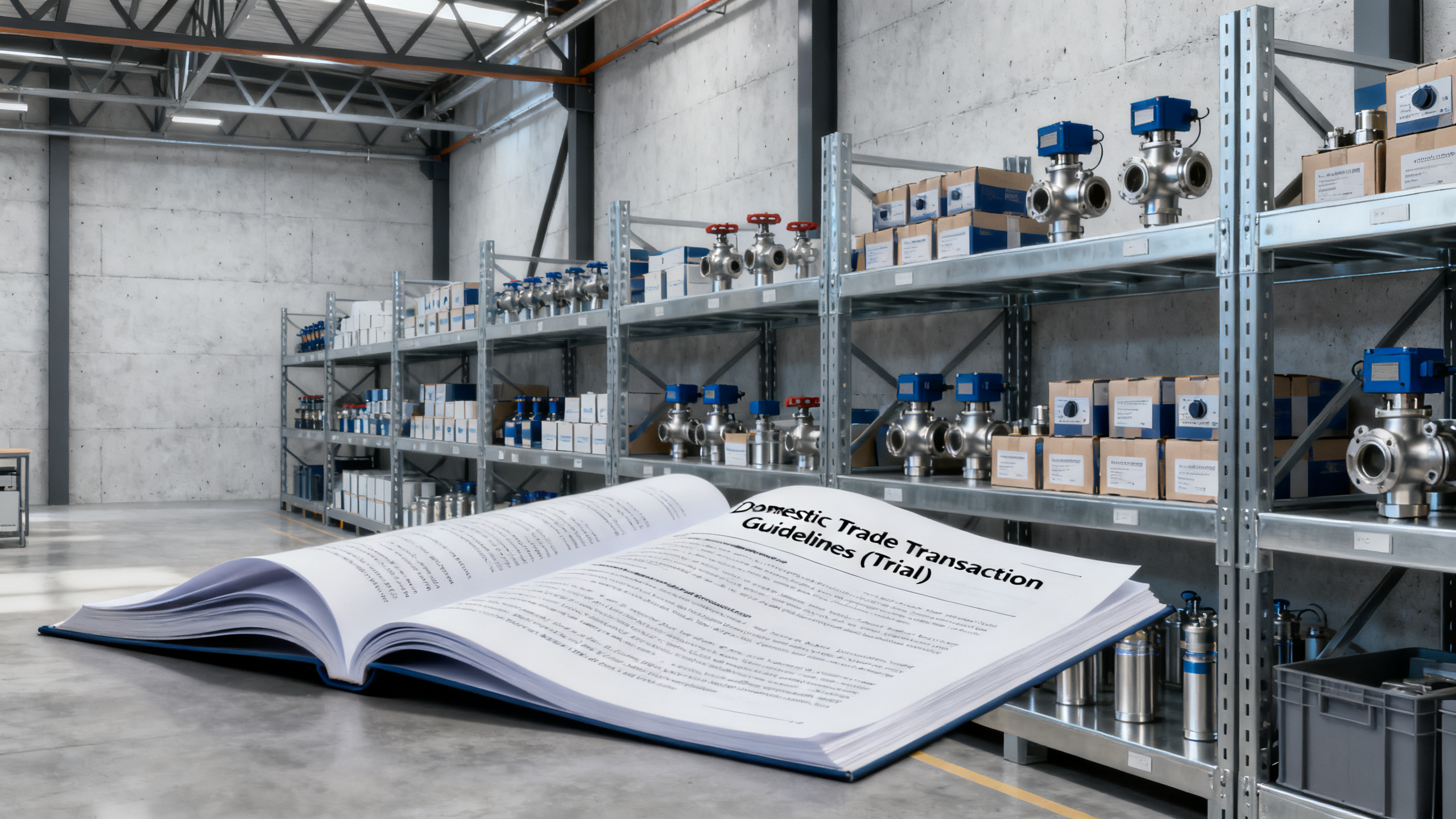
On May 8, 2026, 17 national trade associations jointly issued the Domestic Trade Transaction Guidelines (Trial), under guidance from China’s Ministry of Commerce and four other departments. The Guidelines systematically address contract execution, quality acceptance, dispute resolution, and green-low-carbon clauses across domestic trade processes — with implications extending to export-oriented sectors including fire & rescue equipment and air purifiers & dust control systems, where ESG compliance is increasingly scrutinized by EU and US buyers.
Event Overview
On May 8, 2026, 17 national-level industry associations jointly released the Domestic Trade Transaction Guidelines (Trial). This initiative was conducted under the guidance of the Ministry of Commerce, the State Administration for Market Regulation, the National Development and Reform Commission, the Ministry of Ecology and Environment, and the All-China Federation of Supply and Marketing Cooperatives. The Guidelines aim to standardize domestic trade practices across key stages: contract signing, quality inspection and acceptance, dispute resolution mechanisms, and inclusion of green and low-carbon provisions. The document is explicitly labeled as ‘trial’ and applies to domestic transactions within China.
Industries Affected
Direct Trading Enterprises
These enterprises engage in B2B domestic sales and procurement. They are directly affected because the Guidelines introduce mandatory procedural expectations — especially around contract terms, third-party testing acceptance, and documented quality traceability. Non-compliance may impair transaction efficiency or raise audit risk in cross-border supply chain reviews.
Manufacturers of Fire & Rescue Equipment and Air Purifiers & Dust Control Systems
Though the Guidelines apply domestically, their provisions on quality traceability, ESG-related disclosures, and recognition of third-party test reports are being referenced by European and U.S. procurement teams during supplier sustainability assessments. For exporters in these categories, domestic operational alignment with the Guidelines may now serve as indirect evidence of ESG readiness — particularly where formal international certifications are pending or fragmented.
Supply Chain Service Providers (e.g., logistics, inspection, certification agencies)
Third-party testing and verification services are explicitly cited in the Guidelines as acceptable inputs for quality acceptance. This may increase demand for accredited domestic testing labs and auditors familiar with both Chinese regulatory frameworks and internationally aligned ESG disclosure formats. However, no new accreditation requirements are introduced — only recognition of existing qualified providers.
What Relevant Enterprises or Practitioners Should Focus On and How to Respond
Monitor official follow-up communications and sector-specific implementation notices
The Guidelines are labeled ‘trial’, indicating potential revisions or phased rollout. Enterprises should track announcements from the issuing associations and the five guiding departments — especially any pilot programs, interpretation documents, or model contract templates expected later in 2026.
Assess exposure through high-ESG-scrutiny export categories
Fire & rescue equipment and air purifiers & dust control systems are explicitly noted in the source information as subject to overseas ESG evaluation influenced by these Guidelines. Companies exporting these products should review whether current domestic contracts, quality records, and environmental documentation align with the Guidelines’ structure — not for legal enforcement, but as preparatory alignment with buyer expectations.
Distinguish between policy signal and operational requirement
The Guidelines do not carry the force of law or regulation. Their immediate effect is normative, not binding. Enterprises should avoid over-investing in full-scale internal process overhauls at this stage; instead, prioritize gap-mapping between existing documentation practices (e.g., contract clauses, test report retention, carbon-related disclosures) and the Guidelines’ recommended frameworks.
Update internal procurement and supplier communication protocols
Where domestic suppliers are part of export-bound supply chains, consider incorporating relevant Guideline-aligned language into procurement terms — especially around traceability documentation and acceptance of third-party test results. This supports consistency across tiers and reduces friction during foreign buyer audits.
Editorial Perspective / Industry Observation
Observably, the release functions primarily as a signaling mechanism — reflecting institutional attention to domestic trade standardization and its growing interface with global ESG expectations. Analysis shows it is not yet an enforcement tool, nor does it introduce new legal obligations. Rather, it codifies emerging best practices and creates a reference point for both domestic coordination and international credibility-building. From an industry perspective, its significance lies less in immediate compliance pressure and more in its role as a diagnostic lens: revealing how domestic operational rigor is increasingly interpreted abroad as proxy evidence of ESG governance capacity. Continued observation is warranted as pilot implementations or buyer feedback may shape its de facto influence beyond the trial phase.
In summary, the Domestic Trade Transaction Guidelines (Trial) represents a formal articulation of process expectations for domestic trade — with secondary resonance for exporters whose supply chain transparency and sustainability practices face external scrutiny. It is best understood not as a regulatory mandate, but as an early indicator of convergence between domestic commercial standards and international ESG assessment criteria — one that merits measured attention, not urgent overhaul.
Source: Official joint announcement by 17 national trade associations, issued May 8, 2026, under guidance of the Ministry of Commerce, State Administration for Market Regulation, National Development and Reform Commission, Ministry of Ecology and Environment, and All-China Federation of Supply and Marketing Cooperatives.
Note: The trial nature of the Guidelines and their application scope remain subject to further clarification. Ongoing developments — including sector-specific interpretations, pilot outcomes, or integration into export-related guidance — require continued monitoring.
Technical Specifications
- How to Select Electronic Hotel Key Card Locks for Guest Rooms and Staff AreasAuthor :Safety Compliance Lead
- How to Select Lab Instruments for Reliable Chemical Analysis WorkflowsAuthor :Precision Metrology Expert
- How to Size a UPS for Server Rooms: Load, Runtime, and Redundancy FactorsAuthor :Grid Infrastructure Analyst
Expert Insights

Chief Security Architect
Dr. Thorne specializes in the intersection of structural engineering and digital resilience. He has advised three G7 governments on industrial infrastructure security.
Related Analysis
- Sep 17, 2026How to Select Electronic Hotel Key Card Locks for Guest Rooms and Staff AreasAuthor :Safety Compliance Lead
- Sep 16, 2026How to Select Lab Instruments for Reliable Chemical Analysis WorkflowsAuthor :Precision Metrology Expert
- Sep 15, 2026How to Size a UPS for Server Rooms: Load, Runtime, and Redundancy FactorsAuthor :Grid Infrastructure Analyst
Core Sector // 01
Security & Safety
- Steel Rescue Tripods Wholesale: Key Load Ratings, Standards, and Buying MistakesAuthor :Safety Compliance Lead

- India Lifts Duty on Fire Rescue Imports to 22%Author :Safety Compliance Lead

- IEC 62061 Amendment 2 Targets Fire & Rescue ControllersAuthor :Safety Compliance Lead

- IEC 62819-2:2026 Sets New Cybersecurity CheckpointAuthor :Safety Compliance Lead

- When to Use a Quick Deployment Oil Boom for Spill Control in Ports and Inland WatersAuthor :Safety Compliance Lead

- Saudi SASO Adds Cybersecurity Annex to Fire Equipment CertificationAuthor :Safety Compliance Lead

- CBP Pre-Arrival Portal Raises Import Checks for Fire EquipmentAuthor :Safety Compliance Lead

- UAE Sets Cybersecurity Gate for Fire Control PanelsAuthor :Safety Compliance Lead