Choosing a Lint-Free Wipes Factory: How to Evaluate Quality and Capacity
Author
Date Published
Reading Time
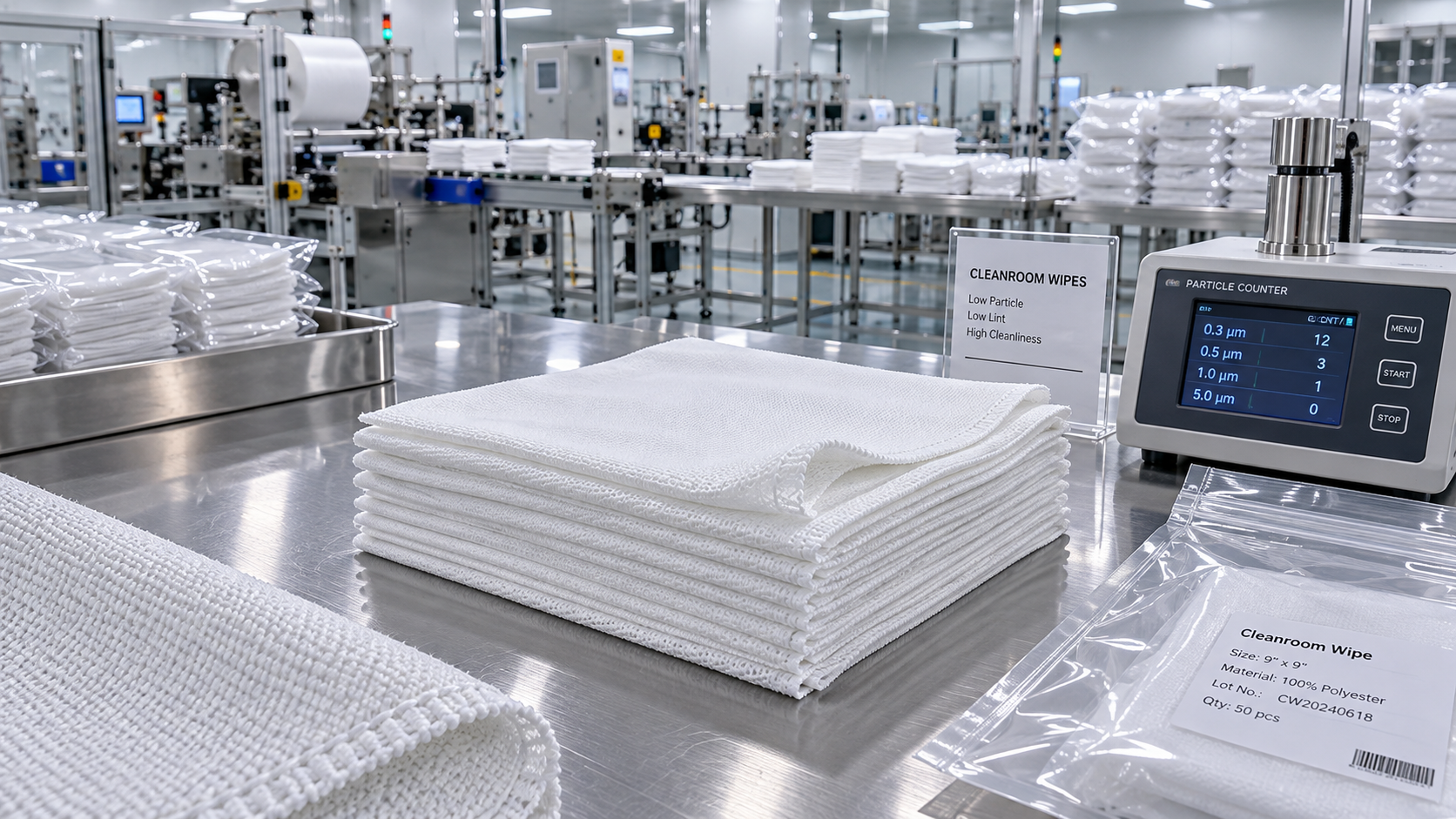
Choosing a lint free wipes factory involves more than comparing prices and product specifications. Inconsistent particle shedding, inadequate documentation, or limited production capacity can disrupt operations and increase supply risk.
This guide explains how to assess wipe materials, cleanliness testing, quality controls, certifications, and manufacturing capacity, and identifies the evidence needed for a confident sourcing decision.
The strongest supplier is not necessarily the one advertising the cleanest wipe or the largest factory. It is the one that can consistently meet your application requirements at your purchasing volumes.
Start With the Contamination Risk, Not the Product Name
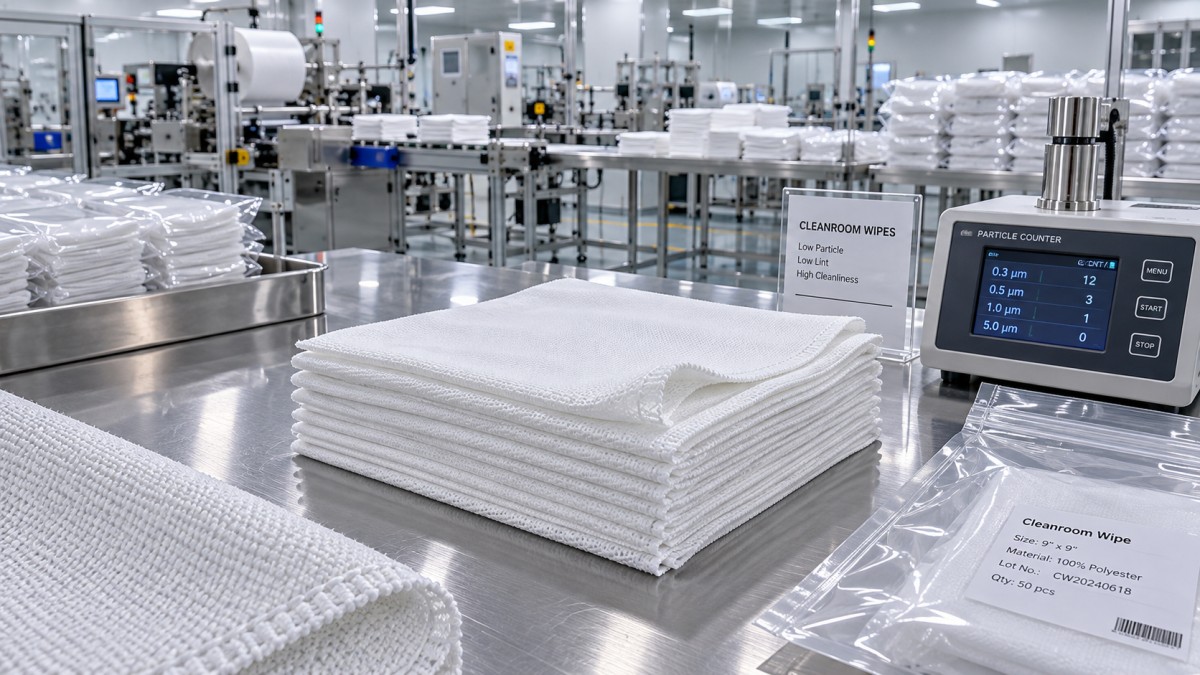
“Lint free” describes a desired performance characteristic, not a universal guarantee that a wipe releases no particles. Define acceptable contamination using a test method and application-specific limits.
A maintenance team wiping external equipment housings has different needs from a facility cleaning optical surfaces, electronic assemblies, or controlled manufacturing equipment. One specification rarely covers every use.
Document the surface, process environment, cleaning solvent, expected abrasion, and consequences of contamination. Include any downstream inspection or rework costs that make inconsistent wipes especially expensive.
For controlled environments, identify the relevant cleanroom classification and internal contamination limits. A cleanroom classification describes the environment; it does not by itself certify a wipe as suitable.
Translate these requirements into a procurement specification covering material, dimensions, packaging, testing, acceptance criteria, and delivery volumes. Send the same specification to every candidate factory.
Which Wipe Material and Construction Fit Your Process?
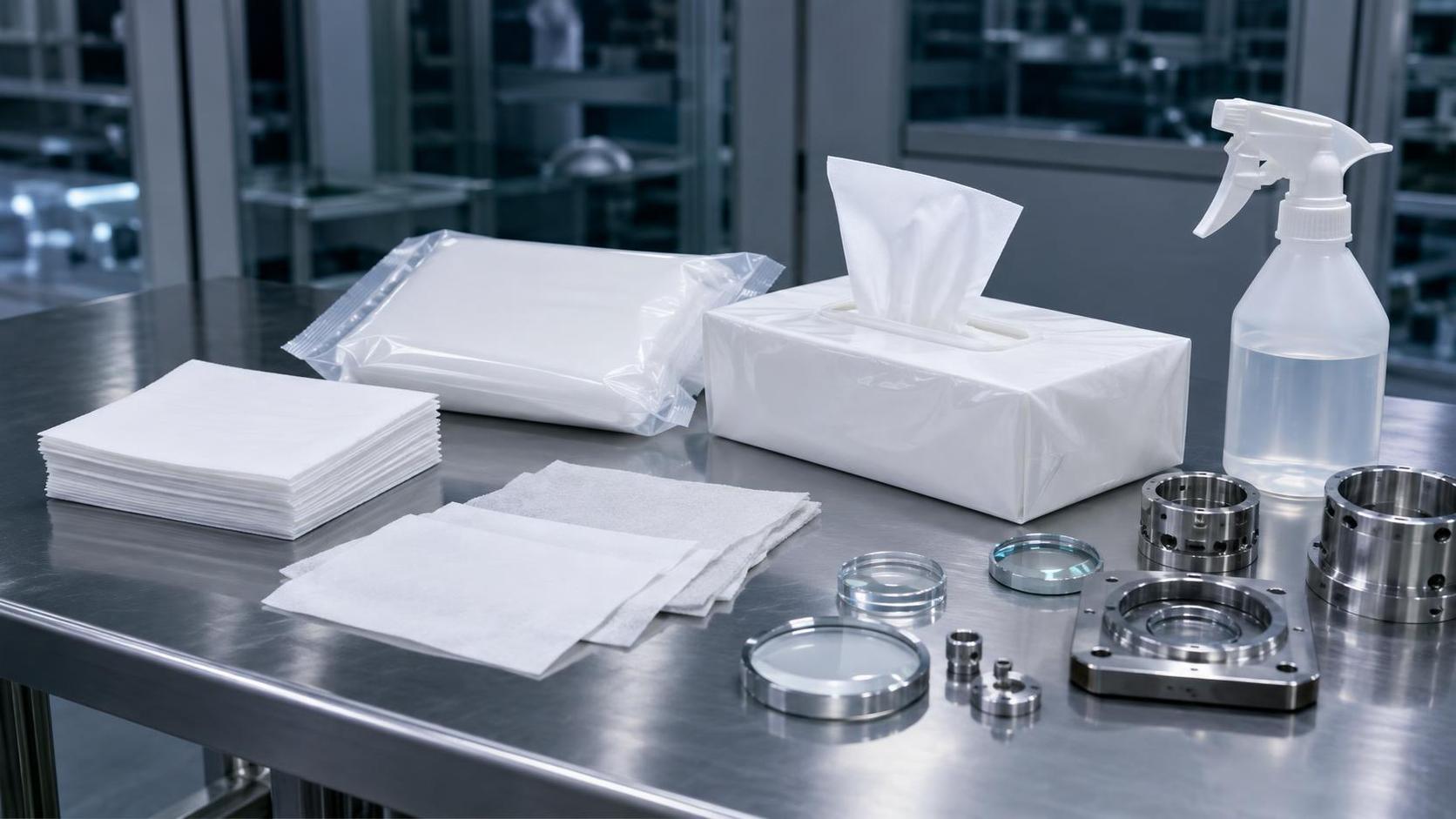
Polyester knitted wipes are often selected for controlled environments because their continuous filaments and construction can limit particle generation. Actual performance still depends on processing and edge treatment.
Polyester-cellulose nonwovens can offer useful absorbency and cost efficiency for general industrial cleaning. However, their particle and fiber release should be checked against the intended process.
Polypropylene and other synthetic nonwovens may suit particular chemical or absorbency requirements. Ask for compatibility evidence rather than assuming that all synthetic wipes behave alike.
Consider both absorbency and liquid release. A wipe that holds plenty of solvent may still perform poorly if it leaves streaks or transfers excess liquid onto sensitive surfaces.
Edge finishing matters because cut edges can release fibers during wiping. Heat-sealed or laser-sealed edges may reduce shedding, but compare tested products rather than relying on terminology alone.
Specify wipe size, basis weight, texture, and folding configuration. These affect coverage, operator handling, dispensing, and consumption, which can change the effective cost per cleaning task.
For solvent use, confirm compatibility with the actual chemical, concentration, exposure time, and surface. Request information on extractables and residue where deposits could interfere with production.
How Should You Verify Cleanliness and Consistency?
Ask the factory for recent test reports covering particle release, fiber shedding, ionic contamination, and nonvolatile residue where relevant. Not every application requires all four measurements.
Each report should identify the product, lot, test date, method, sample preparation, results, and reporting units. A certificate stating only “low particles” is insufficient for comparison.
Particle results are meaningful only alongside the method used to extract and count particles. Compare suppliers using the same method, size thresholds, units, and sampling conditions.
For example, counts reported per wipe cannot be directly compared with counts per square meter without a valid conversion and compatible test procedures. Ask suppliers to clarify discrepancies.
Standards such as IEST-RP-CC004 address evaluating wiping materials used in cleanrooms and controlled environments. Confirm the applicable edition and agreed test procedures before writing acceptance limits.
Request data from multiple production lots, not only a single favorable report. Lot-to-lot variation can reveal whether a factory controls its process or relies on occasional inspection.
Check whether testing is performed internally or by an independent laboratory. For critical measurements, establish the laboratory’s competence, equipment calibration, and any relevant accreditation scope.
A third-party result is useful evidence, but it does not prove every subsequent shipment conforms. Require lot identification and agree on when new testing or certificates are necessary.
Run incoming checks or periodic verification proportionate to the risk. For high-consequence applications, retain samples from approved lots and investigate meaningful shifts before releasing material.
What Should a Factory Audit Cover?
A factory audit should follow the product from incoming material through conversion, washing where applicable, drying, inspection, packaging, storage, and dispatch. Map subcontracted steps as well.
First establish whether the supplier manufactures the quoted wipe or acts as a distributor. Both can be useful partners, but you need visibility into the actual production site.
Review controls for incoming fabric and raw materials, including supplier approval, lot identification, and change notification. A new substrate source can alter performance without changing the product name.
Examine how the factory prevents cross-contamination between products and production areas. Ask about housekeeping, personnel practices, equipment maintenance, and the segregation of rejected material.
If wipes are washed, request information on water quality, filtration, monitoring, and corrective action. If they are not washed, evaluate the alternative controls used to manage contamination.
Inspect packaging conditions and materials. Double packaging may support controlled transfer into cleaner areas, but its value depends on bag integrity, handling procedures, and your facility’s entry protocol.
Traceability should link finished cartons to production lots and relevant records. Test the system by asking the supplier to trace a sample lot back to its materials and processing history.
Finally, review nonconformance handling: who can stop a shipment, how affected lots are contained, and how corrective actions are verified. Request an anonymized example where confidentiality permits.
Which Certifications and Documents Actually Matter?
ISO 9001 certification can provide evidence of a documented quality management system, but it does not establish that a particular wipe meets your cleanliness limits.
Verify the certificate’s scope, production site, validity, and issuing body. A certificate held by a sales office or parent company may not cover the factory making your order.
For controlled-environment claims, ask which operations occur in classified areas and request relevant monitoring or qualification records. A claim that a factory is “cleanroom certified” needs context.
Request a product specification, safety data where applicable, test reports, packaging details, and a certificate of analysis or conformance if required by your purchasing agreement.
CE marking and UL certification are not blanket requirements for ordinary industrial wipes. Determine whether a specific product, chemical formulation, or destination market creates an applicable obligation.
Claims about chemical restrictions, food contact, or sterilization should be supported by evidence relevant to the exact product and market. Do not transfer compliance claims between product variants.
For prewetted wipes, review the formulation, container compatibility, shelf life, transport classification, and local labeling requirements. Confirm that the supplier can provide documentation for each destination.
Can the Factory Meet Your Volume and Delivery Requirements?
Installed machine capacity is not the same as available capacity for your product. Ask for normal output, current utilization, planned maintenance, and realistic lead times for the specified configuration.
Identify constraints at every stage, including fabric sourcing, cutting, washing, packaging, testing, and freight. The slowest shared operation may determine the actual delivery commitment.
Provide a forecast with baseline demand, seasonal peaks, and expected order frequency. Ask the factory to explain how it would handle both a routine order and a demand surge.
Confirm minimum order quantities, batch sizes, replenishment intervals, and finished-goods storage arrangements. A low quoted price may require inventory levels that outweigh the apparent saving.
For critical operations, assess backup equipment, alternative raw material sources, and recovery plans for power loss or transport interruption. Require approval before any substitute material is introduced.
Ask for historical on-time delivery performance and the definition behind the metric. A shipment dispatched on schedule may still arrive late if the measure excludes transit.
Agree on lead times from purchase order acceptance to delivery, including testing and export documentation. Specify escalation contacts and notification deadlines for capacity shortages or delays.
How Should Procurement Compare Samples, Prices, and Risk?
Use a staged evaluation: screen documents, test samples, audit shortlisted suppliers, and run a controlled production trial. Record results against the same criteria for every candidate.
Request samples from representative production lots and confirm they match the proposed commercial product. A hand-selected laboratory sample should not be the sole basis for approval.
During trials, involve operators and quality staff. Measure practical outcomes such as wipe consumption, cleaning time, residue, particle-related defects, and compatibility with existing dispensers.
Compare total landed cost rather than unit price alone. Include freight, duties, inspection, storage, waste, minimum order commitments, and the expected cost of process disruption.
For example, a cheaper wipe may require more sheets per task or generate additional rework. Use observed trial consumption and defect data to calculate the relevant difference.
Score suppliers against weighted criteria such as technical performance, quality control, capacity, delivery reliability, and commercial terms. Set mandatory pass criteria before applying weighted scores.
For a high-risk application, a supplier that fails a required particle limit should not be rescued by a low price. Investigate the failure or remove the product from consideration.
Where continuity matters, qualify a second source against the same specification. Verify interchangeability through testing and trials; two products with similar descriptions may perform differently.
What Should Be Written Into the Supply Agreement?
Attach the approved specification, product identification, test methods, acceptance limits, packaging requirements, and revision level. Define which documents must accompany each shipment or production lot.
Set rules for changes to raw materials, manufacturing sites, processes, packaging, and subcontractors. Require advance notification and requalification when a change could affect performance.
Define inspection rights, complaint response times, lot containment, replacement arrangements, and responsibility for nonconforming goods. Make traceability and record-retention periods explicit.
Include forecast assumptions, agreed lead times, delivery terms, and escalation procedures. Where appropriate, specify safety stock or reserved capacity and clarify who pays for it.
Review performance after implementation using agreed indicators, including conformity, delivery reliability, complaints, and corrective-action closure. Reassess the supplier when demand or process sensitivity changes.
Make the Final Sourcing Decision
Choose a lint free wipes factory by matching demonstrated product performance to your contamination risk, then verifying that its controls and capacity support repeatable supply.
Approve the supplier only after representative testing, documentation review, and a practical capacity assessment. Put the resulting limits and change controls into the purchase agreement.
The best decision balances cleanliness, operational fit, supply continuity, and total cost. That balance gives procurement a defensible basis for selection and a measurable standard for future reviews.
Technical Specifications
Expert Insights

Chief Security Architect
Dr. Thorne specializes in the intersection of structural engineering and digital resilience. He has advised three G7 governments on industrial infrastructure security.
Related Analysis
- Oct 30, 2026Choosing a Lint-Free Wipes Factory: How to Evaluate Quality and CapacityAuthor :Precision Metrology Expert
- Oct 29, 2026Mysteel: Steel Price Composite Index Rises 2.26 Points on October 28Author :
- Oct 29, 2026Choosing a LOTO Device OEM: Quality Checks, Customization, and MOQsAuthor :Safety Compliance Lead
Core Sector // 01
Security & Safety
- Choosing a Lint-Free Wipes Factory: How to Evaluate Quality and CapacityAuthor :Precision Metrology Expert

- Buying Lab Incubators Wholesale: MOQs, Lead Times, and Warranty TermsAuthor :Precision Metrology Expert

- Choosing a 5-Part Hematology Analyzer: Throughput, Sample Volume, and QCAuthor :Precision Metrology Expert

- Wholesale Borosilicate Lab Glassware: How Buyers Verify Quality, Specs, and Supply ReliabilityAuthor :Precision Metrology Expert

- How to Select Lab Instruments for Reliable Chemical Analysis WorkflowsAuthor :Precision Metrology Expert

- Buying Lint-Free Wipes in Bulk: How to Match Material and Packaging to Cleanroom UseAuthor :Precision Metrology Expert

- How to Choose a Class II Biosafety Cabinet Supplier for Compliant Lab ProcurementAuthor :Precision Metrology Expert

- Wholesale Binocular Microscopes: Comparing Specifications, MOQs, and QC RiskAuthor :Precision Metrology Expert