Material Testing Standards: ASTM E8 vs. ISO 6892-1 for Metal Tensile Tests
Author
Date Published
Reading Time
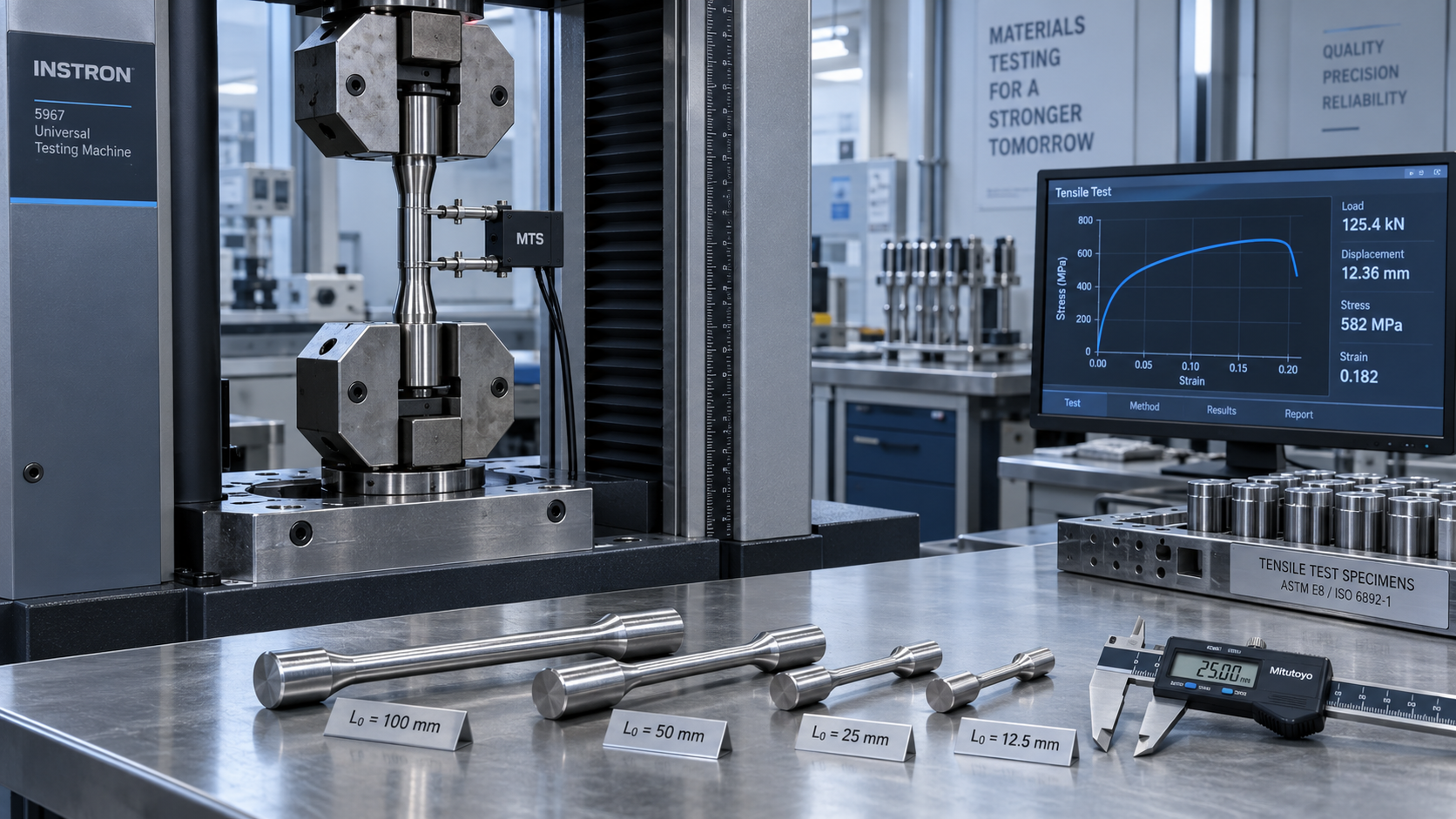
A supplier’s tensile test report looks reassuring: yield strength exceeds the purchase specification, tensile strength sits comfortably within range, and elongation passes. Then the evaluator notices a discrepancy. The purchase order specifies ASTM E8/E8M, but the laboratory tested to ISO 6892-1. Can the results still be accepted?
The answer depends on more than the reported numbers. Material testing standards govern specimen geometry, loading rate, strain measurement, property determination, and reporting. Differences in those details can affect both comparability and contractual acceptance. ASTM E8/E8M and ISO 6892-1 address room-temperature tensile testing of metals, but neither a shared purpose nor similar strength values makes them automatically interchangeable.
For technical evaluators reviewing structural steel, machined components, forgings, or other industrial materials, the practical task is to establish what was tested, how it was tested, and whether that evidence satisfies the governing requirement.
Two standards with the same objective—not identical procedures
ASTM E8/E8M, Standard Test Methods for Tension Testing of Metallic Materials, and ISO 6892-1, Metallic materials—Tensile testing—Part 1: Method of test at room temperature, describe how to obtain tensile properties under controlled conditions. Typical outputs include yield or proof strength, tensile strength, elongation after fracture, and reduction of area where applicable.
Neither standard, by itself, establishes the acceptance limits for a particular alloy or component. Those limits normally come from a material specification, product standard, engineering drawing, regulatory requirement, or purchase agreement. Product-specific requirements may also govern sampling location, specimen orientation, preparation, and retesting.
Use the edition invoked by the contract or governing specification. A report that simply states “ASTM E8” or “ISO 6892” leaves avoidable uncertainty about the applicable requirements.
Why specimen geometry can change the comparison
The specimen is not merely a convenient piece of metal that fits the grips. Its original cross-sectional area determines the engineering stress calculation, while its gauge length strongly influences the reported elongation after fracture.
Gauge length is especially important for elongation
For common standard round specimens, ASTM E8 uses a gauge length of four times the specimen diameter, while ASTM E8M uses five times the diameter. This distinction does not describe every specimen permitted by either method; flat and other specimen configurations have their own requirements.
ISO proportional specimens commonly use an original gauge length of L0 = 5.65√S0, where S0 is the original cross-sectional area. For a circular cross-section, this corresponds approximately to five times the diameter. ISO also accommodates non-proportional specimens under specified conditions.
These details explain why two elongation percentages may not be directly comparable. During a tensile test, deformation becomes localized near the neck before fracture. Changing the gauge length changes how that localized extension contributes to the overall percentage. A shorter gauge length can therefore produce a higher reported elongation without demonstrating a genuinely more ductile material.
Converting inches to millimetres does not establish equivalence. Nor should an evaluator apply an informal elongation correction. Any conversion needs an applicable technical basis and authorization under the governing requirements.
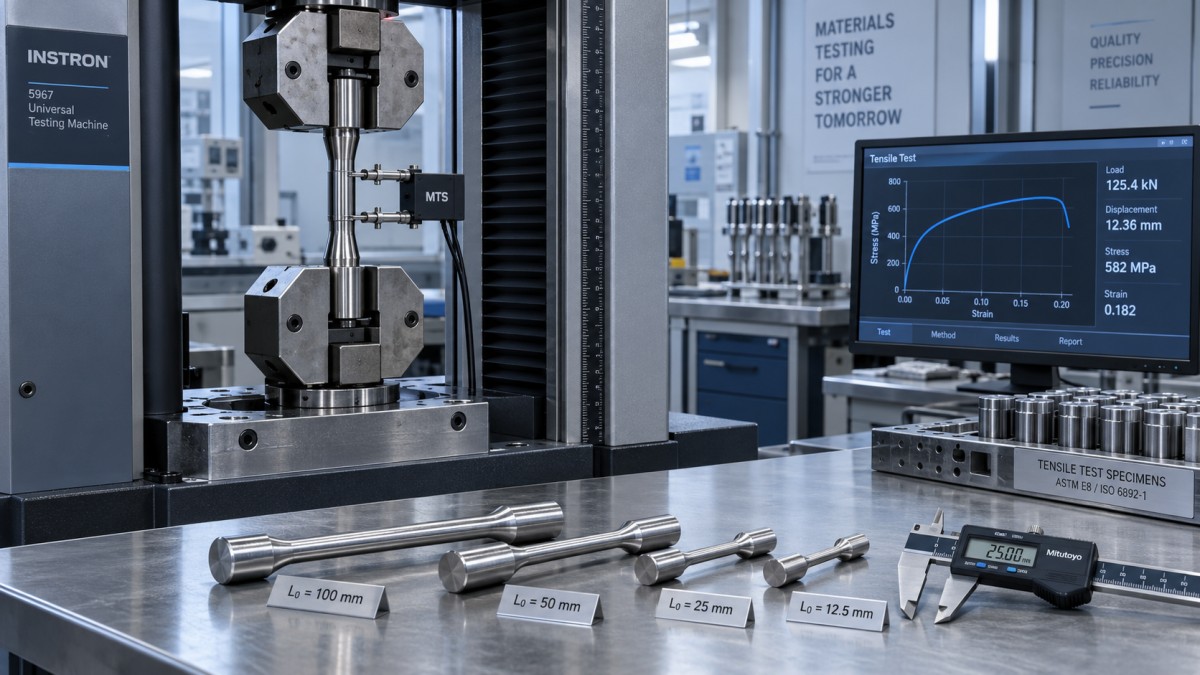
Sampling and preparation deserve equal attention
Even geometrically similar specimens can represent different material conditions. A longitudinal specimen and a transverse specimen may respond differently in rolled products. A specimen from the surface of a thick section may not represent its centre. Machining damage, excessive preparation heat, poor alignment, or unsuitable gripping can also compromise the result.
For critical procurement, trace specimen identity back to the heat or lot, sampling location, orientation, product thickness, and heat-treatment condition. A standards-compliant test cannot compensate for an unrepresentative sample.
Test speed: the difference hidden behind a passing result
Metal tensile properties can depend on deformation rate. Yield and proof strength are particularly sensitive for some materials, making rate control a substantive technical requirement rather than a machine-setting detail.
ISO 6892-1 distinguishes two principal approaches:
- Method A: testing based on strain rate. Its approaches include extensometer-feedback control and control using an estimated strain rate over the specimen’s parallel length, subject to the standard’s requirements.
- Method B: testing based on stress rate in the relevant elastic portion, with further requirements governing subsequent stages of the test.
ASTM E8/E8M also specifies testing-speed requirements and permits different control approaches within defined conditions. The permitted choices and applicable limits must be checked against the invoked edition and the property being determined. It would be misleading to characterize ASTM testing as exclusively crosshead-controlled or ISO testing as exclusively closed-loop strain-controlled.
A crosshead speed is not necessarily the specimen’s strain rate. Machine compliance, grip movement, specimen dimensions, and load-train behaviour influence the relationship. That is why a report listing only “5 mm/min,” without explaining the specimen and control stage, may provide insufficient evidence for a meaningful comparison.
When investigating disagreement between laboratories, ask for the control mode, target rates, transitions between test stages, and available recorded data. Two laboratories may use the same nominal standard yet follow different permitted options that deserve closer review near an acceptance threshold.
Compare the property definition—not just the number
A column labelled “yield strength” can conceal different determination methods. Some metals exhibit a distinct yield phenomenon; others require a proof or offset determination because there is no clear yield point.
Under ISO terminology, upper yield strength, lower yield strength, and proof strength of plastic extension are distinct properties. For example, Rp0.2 denotes proof strength at 0.2% plastic extension. ASTM reporting may identify an offset yield strength determined using a specified offset. These measurements may serve similar engineering purposes, but their equivalence must be established from the definitions and procedures used.
Check whether the acceptance requirement calls for an upper yield value, a lower yield value, a specified offset, or another determination. Do not accept a higher reported number simply because its label sounds interchangeable.
Also distinguish elongation after fracture from extension measured during testing. Total extension at maximum force, plastic extension at maximum force, and elongation after fracture describe different aspects of material behaviour. They are not substitute names for one ductility measurement.
Measurement quality supports the comparison
Force verification and extensometer performance are central to trustworthy results. Relevant supporting standards include ASTM E4 for force verification, ASTM E83 for extensometer verification and classification, ISO 7500-1 for force-measuring systems, and ISO 9513 for extensometer calibration.
The applicable equipment class and verification requirements depend on the test method, property, and governing requirements. Ask whether the extensometer covered the required measurement range and whether its verification was valid when the test occurred. This matters particularly when small strain-measurement errors can shift a proof-strength determination.
Can an ISO result satisfy an ASTM requirement?
Sometimes, but not by assumption. A technically defensible substitution requires both procedural evaluation and authority to accept the deviation.
Consider a purchase specification that explicitly requires ASTM E8/E8M. A supplier submits an ISO 6892-1 report with acceptable strength values and a proportional specimen whose dimensions resemble an ASTM specimen. That similarity is useful evidence, but it does not resolve differences in rate control, property determination, reporting, or product-specific requirements.
The evaluator should establish whether:
- The governing specification permits an alternative method or contains an equivalence provision.
- The specimen geometry, sampling, preparation, and condition satisfy the required basis.
- The loading rates, measurement systems, and property definitions are compatible.
- Any differences could materially affect acceptance, especially for marginal results.
- The purchaser, design authority, or other authorized party has approved the substitution where required.
If the evidence is incomplete, requesting additional laboratory records may resolve the issue. Retesting to the specified method may be more appropriate when a mandatory requirement was missed or equivalence cannot be demonstrated.
A result can be technically credible yet contractually unacceptable. Conversely, a report bearing the requested standard designation can still be inadequate if the underlying procedure or sampling was wrong.
A practical review sequence for supplier reports
For EPC contractors, facility engineering teams, and industrial procurement evaluators, report review works best as a traceability check rather than a quick comparison against minimum strength.
- Start with the acceptance document. Identify the material grade, product specification, invoked editions, supplementary requirements, and any approved deviations.
- Confirm material identity. Match the report to the supplied heat, lot, component, and processing condition.
- Verify the specimen basis. Review specimen type, dimensions, original gauge length, sampling location, and orientation.
- Check the method details. Establish the test standard, applicable control approach, test temperature, and determination method for each required property.
- Assess the laboratory evidence. Review equipment verification and, where specified, laboratory accreditation and its relevant scope.
- Resolve anomalies. Examine unusual fracture locations, recorded deviations, retests, or unexplained differences between specimens.
Not every supporting detail must appear on the face of every test report. Some may be held in laboratory records. The key is whether the information required by the standard and contract is reported, and whether additional evidence is accessible when acceptance depends on it.
Accreditation is not product certification
ISO/IEC 17025 accreditation provides evidence of laboratory competence for activities within the laboratory’s accredited scope. It does not automatically mean that every test the laboratory performs is accredited, that ASTM and ISO procedures are interchangeable, or that the tested product is certified.
Similarly, a material test certificate containing tensile results is not, by itself, proof of compliance with every applicable safety, design, or market-access requirement. Technical evaluators should keep laboratory competence, test-method conformity, material acceptance, and product certification as separate questions.
Check the actual accreditation scope, including the relevant test activity and any limitations, rather than relying solely on an accreditation logo.
Specify the evidence before the material arrives
The most effective way to avoid an ASTM-versus-ISO dispute is to define the testing basis before ordering. State the required standard and edition, governing product specification, sampling requirements, required properties, and report deliverables. Where a particular control method or specimen basis is essential, make that requirement explicit and technically consistent with the applicable standards.
Allowing either standard can be reasonable for global sourcing, but the contract should explain how results will be assessed and how deviations will be approved. “ASTM or equivalent” leaves too much unresolved unless equivalence has a defined evaluation process.
For Global Industrial Core’s technical audience, the central procurement lesson is straightforward: material testing standards create a framework for defensible evidence, not a shortcut around engineering judgment. ASTM E8/E8M and ISO 6892-1 can both support reliable tensile testing. Acceptance depends on connecting the reported result to the correct specimen, procedure, property definition, and contractual requirement—not simply finding a passing number.
Technical Specifications
- Air Handling Unit Supplier Checklist: Performance Data, Lead Times, and SupportAuthor :Environmental Engineering Director
- Buying Fiberglass Water Tanks Wholesale: Compare Quotes and Delivery CostsAuthor :Environmental Engineering Director
- Choosing an XLPE Power Cable Supplier: Test Reports, Traceability, and Lead TimesAuthor :Grid Infrastructure Analyst
Expert Insights

Chief Security Architect
Dr. Thorne specializes in the intersection of structural engineering and digital resilience. He has advised three G7 governments on industrial infrastructure security.
Related Analysis
- Oct 19, 2026Air Handling Unit Supplier Checklist: Performance Data, Lead Times, and SupportAuthor :Environmental Engineering Director
- Oct 18, 2026Buying Fiberglass Water Tanks Wholesale: Compare Quotes and Delivery CostsAuthor :Environmental Engineering Director
- Oct 17, 2026Choosing an XLPE Power Cable Supplier: Test Reports, Traceability, and Lead TimesAuthor :Grid Infrastructure Analyst
Core Sector // 01
Security & Safety
- Choosing a Bluetooth Total Station: Software Compatibility and Connection RangeAuthor :Precision Metrology Expert

- Material Testing Standards: ASTM E8 vs. ISO 6892-1 for Metal Tensile TestsAuthor :Precision Metrology Expert

- How to Verify Accuracy in Industrial Measurement Data and Test ReportsAuthor :Precision Metrology Expert

- Selecting a Steam Vortex Flow Meter: Sizing, Pressure, and Temperature LimitsAuthor :Precision Metrology Expert

- How to Select an Industrial Infrared Thermometer for Hot, Moving EquipmentAuthor :Precision Metrology Expert

- How to Evaluate a Precision Measurement Equipment Manufacturer for Critical TolerancesAuthor :Precision Metrology Expert

- How to Select an Emissions Monitoring System Analyzer for Compliance ReportingAuthor :Precision Metrology Expert

- Portable Gas Monitor Calibration: How Often Is It Needed for Safe Confined-Space Work?Author :Precision Metrology Expert