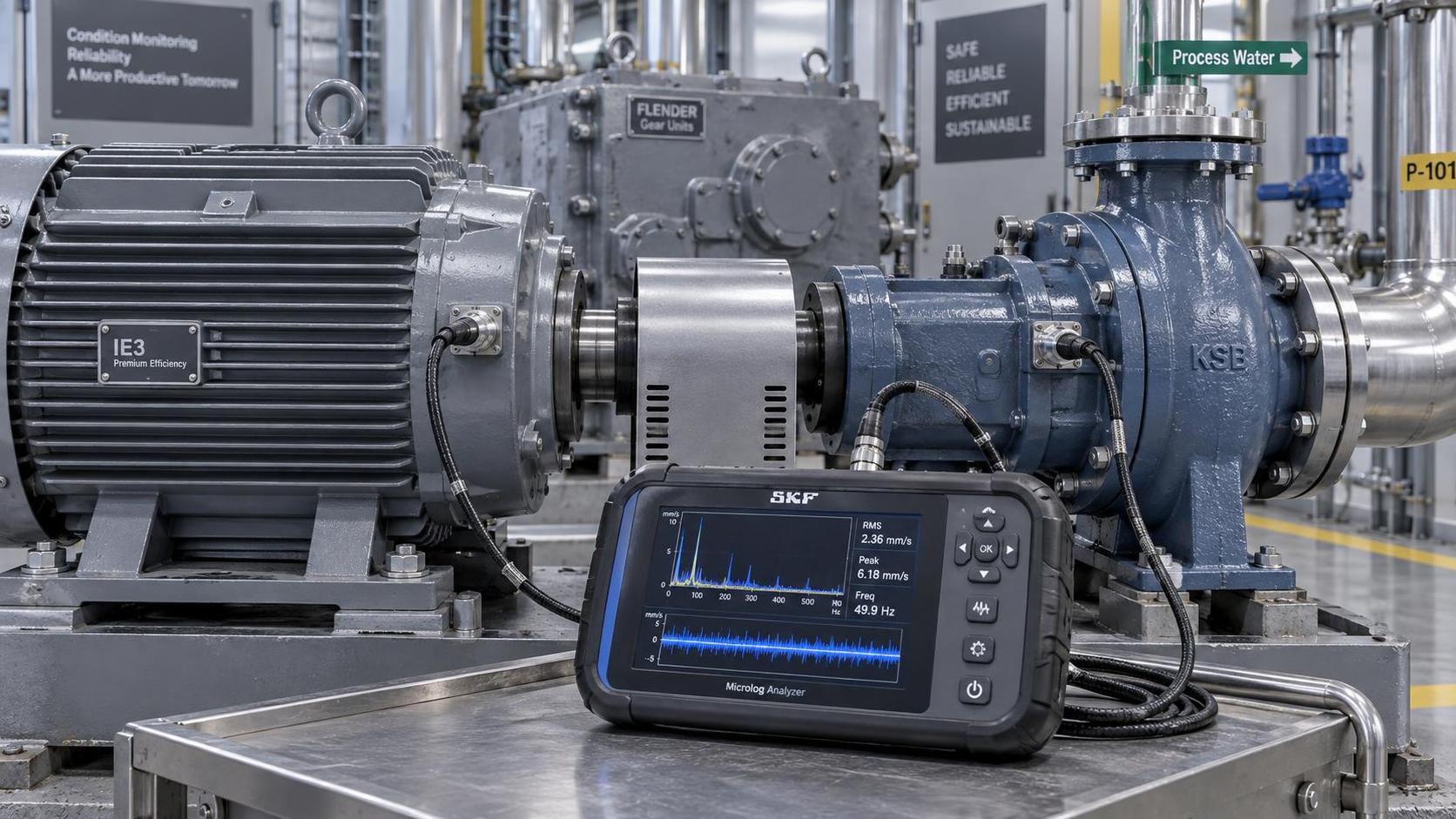
How to Validate Industrial Application Scenarios Before Procurement
Author
Date Published
Reading Time

Before committing capital to critical equipment, procurement teams must confirm that a solution performs under real operating conditions—not just on paper. Understanding how to validate industrial application scenarios before final procurement decision means testing the fit between a product’s stated capability and the constraints of a specific site: duty cycle, ambient conditions, process media, safety obligations, interfaces, maintainability, and failure consequences.
This distinction matters because industrial procurement failures rarely result from a component being universally “bad.” More often, the item was suitable for a different operating envelope. A pressure transmitter may meet its published accuracy specification yet drift when exposed to vibration and temperature cycling. A switchgear assembly may carry the required nominal rating but be inappropriate for the available fault level, installation altitude, or maintenance arrangement. A corrosion-resistant alloy may be technically credible until the actual chloride concentration, cleaning chemicals, or crevice geometry are considered.
The practical question before procurement is therefore not, “Does this product meet the specification?” It is, “Can this solution reliably perform its required function in this exact application for the intended service life?”
Paper qualification and scenario validation are not the same exercise
Most industrial buying processes begin with document review. Teams compare data sheets, drawings, certificates, inspection reports, references, and commercial terms. This is necessary, particularly where regulatory requirements, project specifications, or approved-vendor rules apply. But document review is a qualification method, not full application validation.
A data sheet confirms what the manufacturer declares under defined test conditions. A certificate confirms that a product, process, or management system has been assessed against a stated standard or scope. Neither automatically proves fitness for every installation.
Scenario validation goes further. It examines the interaction between equipment and operating reality. That includes transient loads rather than nominal loads alone; local environmental exposure rather than general climate classification; upstream and downstream system behavior rather than an isolated component rating; and field maintenance practices rather than theoretical service intervals.
The comparison is important because teams sometimes treat one form of evidence as a substitute for another. A successful FAT does not replace a site integration test. A well-known reference installation does not prove suitability if the process chemistry, grid quality, ambient temperature, or operating philosophy differs. Conversely, demanding a full pilot for a mature, standardized item can add cost and delay without materially improving the decision.
Start with the operating envelope, not the supplier’s catalogue
Validation becomes unreliable when the application is described in broad terms such as “outdoor,” “chemical service,” “high temperature,” or “continuous operation.” These descriptions are too general to distinguish between viable alternatives. A usable application definition identifies the boundaries within which the equipment must function and the consequences if it does not.
For mechanical equipment, this may include flow variation, solids content, suction conditions, start-stop frequency, vibration, alignment tolerances, cleaning methods, and expected wear mechanisms. For electrical equipment, it may include voltage tolerance, fault duty, harmonics, ingress exposure, altitude, switching frequency, earthing system, cable entry arrangement, and available maintenance isolation. For instrumentation, relevant conditions often include pressure pulsation, electromagnetic interference, impulse line behavior, sensor fouling, calibration access, response-time needs, and cybersecurity requirements where devices connect to control networks.
Environmental statements also require discipline. “IP-rated enclosure” is not a complete outdoor-use assessment. Rain, wind-driven dust, solar loading, condensation, salt spray, corrosive emissions, washdown, rodent exposure, and ultraviolet ageing can create very different risks. The same applies to material selection: a nominal stainless-steel grade is not a corrosion assessment without considering temperature, concentration, oxygen availability, deposits, galvanic contact, and cleaning regime.

A strong validation file separates normal operating conditions from credible abnormal conditions. Normal conditions determine routine performance. Abnormal conditions often determine equipment survival and recovery time. Examples include pump dead-heading, temporary loss of cooling, emergency generator transfer, voltage dips, blocked filters, rapid temperature change, accidental chemical over-concentration, or loss of instrument air. Not every abnormal event must be designed out, but each should be acknowledged and assigned a response: tolerate, alarm, trip, bypass, isolate, repair, or replace.
Compare alternatives by failure consequence, not purchase price alone
The depth of validation should be proportionate to risk. A low-cost item that is easy to replace and has no meaningful safety, environmental, or production consequence may require only a concise technical review and incoming inspection plan. A seemingly modest component located in a high-pressure line, emergency shutdown loop, fire protection system, hazardous area, or single-point process bottleneck deserves far greater scrutiny.
One useful comparison is between the cost of validation and the cost of being wrong. The cost of being wrong is not limited to replacement purchase price. It may include shutdown labor, production loss, environmental remediation, contractual penalties, engineering rework, access equipment, spare inventory, regulatory reporting, and reputational damage. In EPC work, an unsuitable item discovered late can also trigger cascading impacts on cable schedules, structural supports, control narratives, piping layouts, commissioning sequences, and handover dates.
This is why the lowest compliant bid can be a misleading category. “Compliant” may mean that a supplier answered every line of a requisition, while key assumptions were buried in exclusions, qualification notes, or interpretation differences. A bid that appears more expensive may include testing, spares, documentation, local support, compatible accessories, or a more conservative material and design basis. The correct comparison is delivered application risk, not headline equipment price.
Interrogate the interfaces where failures usually emerge
Industrial equipment rarely fails in isolation. Many procurement disputes are actually interface failures: the supplied item operated as designed, but the surrounding system did not provide the conditions assumed by that design.
Mechanical interfaces include flange standards, bolt materials, nozzle loads, baseplate stiffness, pipe strain, drainage, lifting access, lubrication arrangements, and allowable vibration. Electrical interfaces extend beyond voltage and frequency to protection coordination, short-circuit withstand, control voltage, communications protocol, cable termination space, and electromagnetic compatibility. Digital systems introduce another layer: data ownership, network architecture, firmware management, remote-access controls, time synchronization, and compatibility with existing automation platforms.
Interface validation should be evidence-based. Rather than asking a supplier for a general confirmation of compatibility, provide marked drawings, load cases, wiring diagrams, process and instrumentation diagrams, control narratives, hazardous-area classifications where relevant, and environmental design data. Require the response to identify assumptions explicitly. A simple statement such as “compatible with existing system” has limited value unless it is tied to versions, protocols, responsibilities, and test boundaries.
Responsibilities must also be visible. If a packaged skid includes a motor, variable-speed drive, local panel, instruments, and PLC logic, who owns functional performance when a process trip occurs? The motor vendor, drive vendor, skid assembler, controls integrator, or site contractor may each have a legitimate but narrow answer. Validation should close those gaps before purchase order release, not during commissioning.
Use standards correctly: as a baseline, not a blanket assurance
Standards and certifications are essential tools, especially in international sourcing, but they must be interpreted within their actual scope. CE marking, for example, is a conformity framework applicable to certain product categories placed on the European Economic Area market; it is not a universal quality label. UL certification can be highly relevant to products and applications within its scope, but buyers should confirm the applicable listing, recognition, installation conditions, and local authority requirements. ISO 9001 demonstrates a quality-management system framework; it does not certify that a particular product will meet a project’s functional duty.
The same principle applies to material certificates, ingress-protection ratings, explosion-protection markings, calibration certificates, and test reports. Each can be highly valuable. Each answers a defined question. None removes the need to verify that the product configuration, installation method, and operating condition match the conditions under which that evidence is valid.
For safety-critical or regulated applications, the procurement record should trace each mandatory requirement to objective evidence: applicable code or standard, equipment tag or model, revision-controlled document, acceptance criterion, and responsible reviewer. This protects the buyer from an all-too-common problem in global supply chains: documentation that is genuine but attached to a different configuration, manufacturing batch, market version, or certification scope.
Choose the right proof method for the uncertainty
Not all uncertainty can be resolved by asking for more documents. The proof method should match the source of doubt.
If uncertainty concerns dimensional fit, a certified drawing review, 3D model coordination, or sample check may be sufficient. If the concern is control logic, interlocks, alarm behavior, or communications, FAT with agreed test scripts is usually more informative. If the concern is environmental durability, the buyer may need test evidence that reflects the relevant exposure, an installed reference in a comparable environment, or a defined protective design. If the concern is process performance under variable feed conditions, a pilot or extended site trial may be justified.
A representative reference deserves careful evaluation. Ask whether the reference operates at comparable throughput, pressure, temperature, chemistry, duty cycle, maintenance regime, and regulatory conditions. Determine whether the equipment is the same model and revision, not merely the same product family. Also ask what went wrong during early operation. A supplier’s willingness to discuss modifications, service events, and lessons learned is often more valuable than a polished reference list.
For custom systems, acceptance criteria should be measurable before testing starts. Terms such as “stable,” “efficient,” or “user-friendly” invite disagreement. Better criteria define capacity range, accuracy or repeatability, energy consumption under stated conditions, alarm response, leakage limit, noise threshold, availability target, or recovery time after a specified disturbance. Tests should record actual conditions, instruments used, deviations, and unresolved punch-list items.
Do not confuse commissioning success with lifecycle suitability
Commissioning is often the first moment when all interfaces operate together, but it is a short observation window. Equipment can pass SAT and still prove unsuitable over months of cycling, contamination, corrosion, thermal expansion, operator use, or deferred maintenance.
This is especially relevant when comparing a higher-capital solution designed for robust service against a lower-cost alternative with tighter operating limits. The lower-cost option may work at start-up, but its economic case changes if it requires frequent recalibration, specialized consumables, more shutdowns, or imported spares with long lead times. Lifecycle validation should therefore examine wear parts, recommended inspection intervals, field repairability, diagnostic capability, spare-part interchangeability, obsolescence exposure, and availability of competent service support.
Warranty terms deserve the same scrutiny. A warranty may exclude damage from poor installation, process contamination, voltage quality, corrosion, vibration, or operation outside stated limits—the very mechanisms most likely to arise in a difficult application. The commercial value of the warranty depends on whether responsibility for those conditions has been clearly allocated and controlled.
A practical decision gate before final release
Before a final procurement decision, the technical and commercial record should support a clear yes-or-no judgment on five points:
- Can the proposed configuration meet required performance across the defined operating envelope, including relevant transients?
- Is compliance evidence applicable to the exact product, destination market, and installation context?
- Have mechanical, electrical, controls, process, and maintenance interfaces been reviewed with documented assumptions?
- Are remaining uncertainties understood, assigned, and reduced through inspection, FAT, SAT, pilot operation, spare strategy, or contractual safeguards?
- Does the lifecycle exposure remain acceptable when downtime, maintenance, serviceability, and supply continuity are considered alongside initial price?
If any answer rests on an untested assumption, that assumption should be visible in the decision record. It may still be reasonable to proceed, but it should be a conscious risk decision rather than an accidental omission.
The discipline behind how to validate industrial application scenarios before final procurement decision is not about making every purchase slow or bureaucratic. It is about applying the right level of evidence before a product becomes embedded in an operating asset. In industrial infrastructure, the most expensive procurement error is often not selecting an inferior product. It is approving an apparently compliant solution without proving that it belongs in the conditions where it will actually be asked to work.
Technical Specifications
- How to Select Electronic Hotel Key Card Locks for Guest Rooms and Staff AreasAuthor :Safety Compliance Lead
- How to Select Lab Instruments for Reliable Chemical Analysis WorkflowsAuthor :Precision Metrology Expert
- How to Size a UPS for Server Rooms: Load, Runtime, and Redundancy FactorsAuthor :Grid Infrastructure Analyst
Expert Insights

Chief Security Architect
Dr. Thorne specializes in the intersection of structural engineering and digital resilience. He has advised three G7 governments on industrial infrastructure security.
Related Analysis
- Sep 17, 2026How to Select Electronic Hotel Key Card Locks for Guest Rooms and Staff AreasAuthor :Safety Compliance Lead
- Sep 16, 2026How to Select Lab Instruments for Reliable Chemical Analysis WorkflowsAuthor :Precision Metrology Expert
- Sep 15, 2026How to Size a UPS for Server Rooms: Load, Runtime, and Redundancy FactorsAuthor :Grid Infrastructure Analyst
Core Sector // 01
Security & Safety
- What to Check When Sourcing Vibration Meters Wholesale for Industrial MaintenanceAuthor :Precision Metrology Expert

- How to Select Process Control Instruments for Accuracy, Safety, and UptimeAuthor :Precision Metrology Expert

- What Should Standards Compliance Analysis Training Cover Before an Audit?Author :Precision Metrology Expert

- Why Do Pressure Instruments Fail in High-Vibration Sites?Author :Precision Metrology Expert

- Is FM Software Integration Needed for Overseas Instrument Maintenance?Author :Precision Metrology Expert

- What Are the Differences Between Lab and Field Testing Equipment?Author :Precision Metrology Expert

- Is Independent Testing Necessary for Critical Safety Components?Author :Precision Metrology Expert

- How to Validate Industrial Application Scenarios Before ProcurementAuthor :Precision Metrology Expert