Choosing a Modular Desalination Plant: Capacity, Feedwater and Site Needs
Author
Date Published
Reading Time
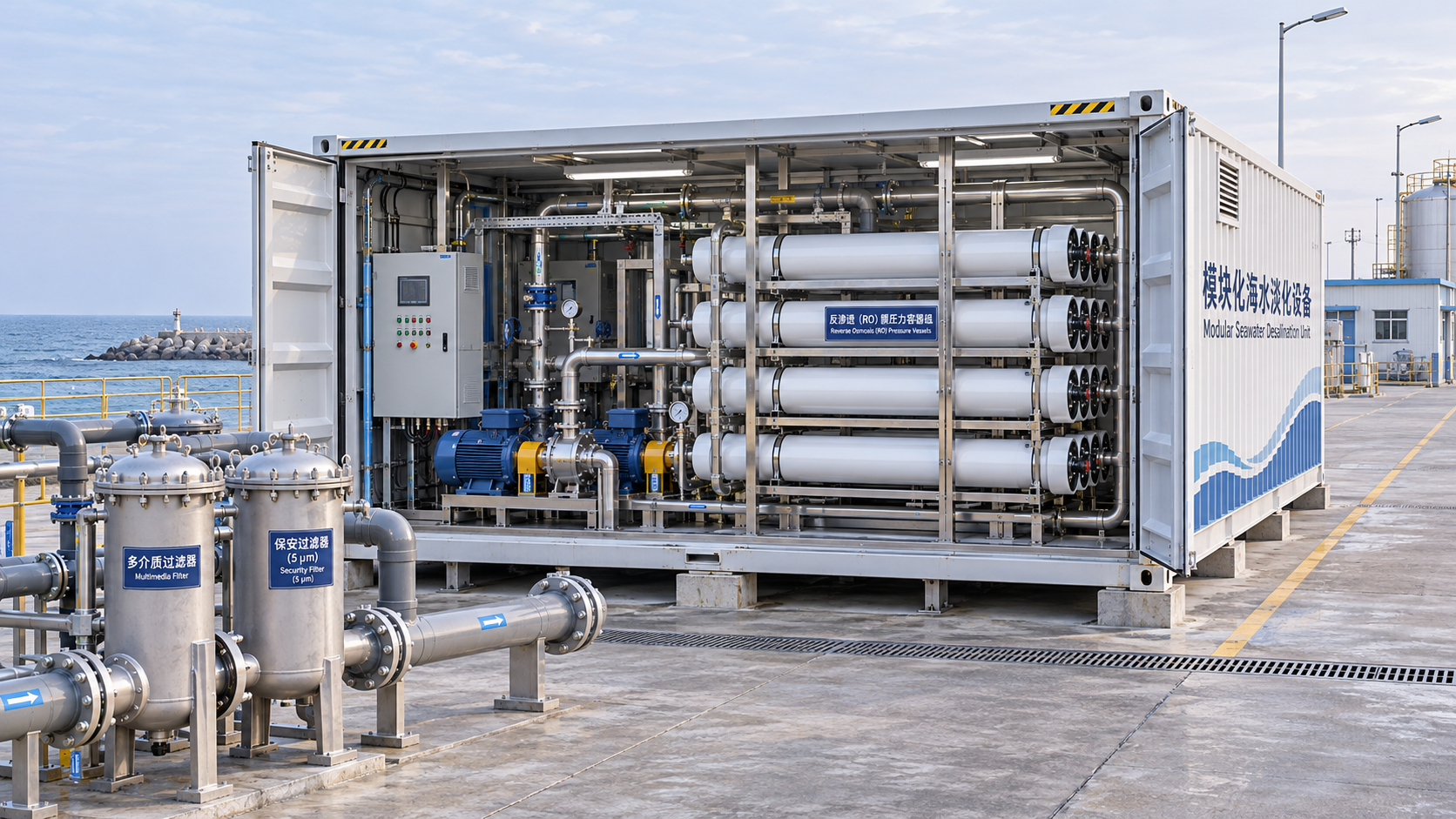
Selecting a modular desalination plant requires more than matching a supplier’s stated output to a daily water demand. Feedwater variability, pretreatment, energy, and site constraints all affect performance and cost.
For technical evaluators, the strongest choice is the design that reliably delivers the required water quality under the site’s worst credible operating conditions.
Compare capacity guarantees, feedwater limits, treatment stages, utilities, and discharge arrangements as one integrated system. A nominal production figure alone cannot establish whether a plant is suitable.
Start With Guaranteed Capacity, Not Container Size
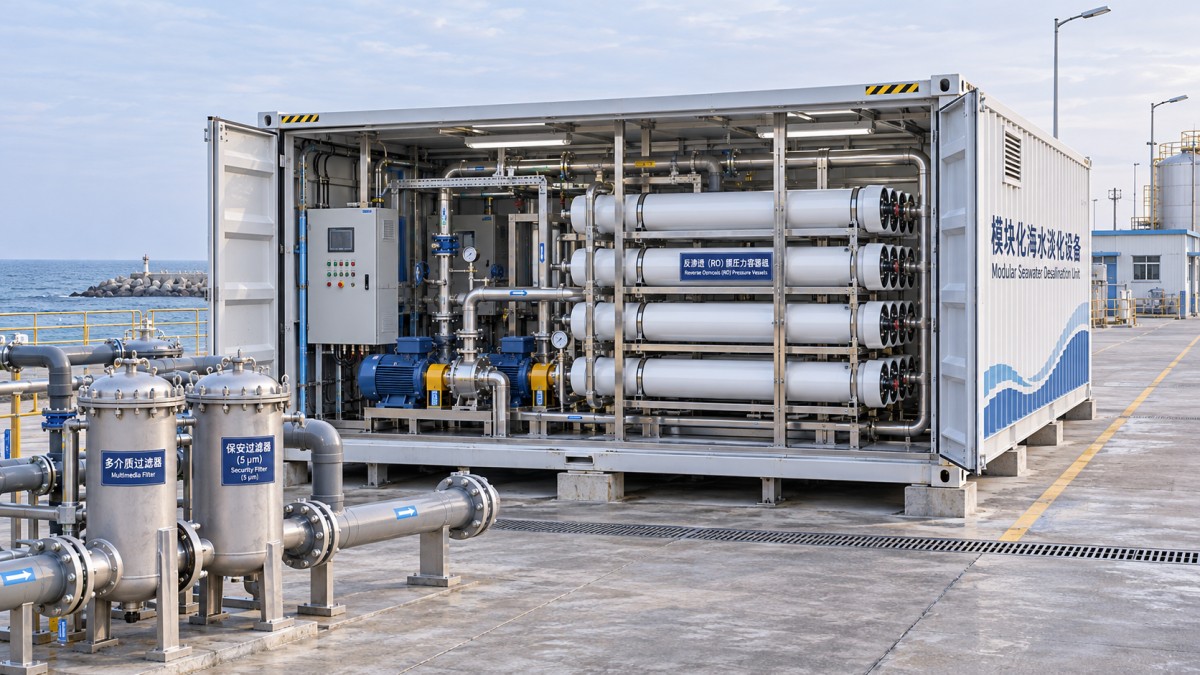
Define capacity as the volume of compliant product water available at the point of use over a specified period, rather than membrane output under ideal conditions.
Distinguish average daily demand from peak demand, seasonal changes, and minimum continuous supply. Include foreseeable expansions, but avoid purchasing excessive installed capacity without an operational reason.
For example, a facility requiring 1,000 cubic meters per day of usable water may need greater gross production if cleaning, storage losses, or downstream polishing consume water.
State whether the capacity guarantee applies to continuous operation, a 24-hour average, or a longer period. Ask suppliers to identify allowances for downtime and maintenance.
Temperature matters because colder water generally passes through reverse osmosis membranes less readily at the same pressure. A plant rated in warm conditions may produce less in winter.
Ask each bidder to calculate production at the lowest expected feedwater temperature and the highest relevant salinity, with realistic membrane aging and fouling allowances.
These conditions need not occur simultaneously if evidence shows they cannot. Document the selected design combinations so suppliers quote against the same operating envelope.
Decide How Much Redundancy the Process Needs
Multiple trains can improve turndown and allow maintenance while part of the plant operates. However, shared pumps, controls, power supplies, or pretreatment can remain single points of failure.
Specify the required water output during maintenance or a credible equipment failure. Then identify which components need standby capacity and which can be supported by storage.
For instance, two trains each sized for half the peak demand do not provide full production if one train is offline. Storage may bridge short outages.
Check whether adding future modules also requires larger intake equipment, pretreatment, electrical distribution, brine disposal capacity, or civil works. Reserve these interfaces early in design.
How Feedwater Determines the Treatment Design
Feedwater analysis is the foundation of a defensible selection. Seawater, brackish groundwater, surface water, and industrial effluent present different salinity, fouling, and treatment challenges.
Collect representative samples across seasons and operating conditions, using an accredited laboratory where practical. A single favorable sample can conceal the conditions that govern reliability.
For reverse osmosis, assess total dissolved solids, conductivity, temperature, pH, alkalinity, hardness, silica, iron, manganese, and other constituents relevant to scaling or membrane compatibility.
Where applicable, characterize turbidity, suspended solids, organic matter, biological activity, oil, and contaminants associated with industrial discharges. Ask suppliers which parameters could limit their guarantees.
Provide evidence of variability: rainfall events, algal blooms, tidal influence, well drawdown, production changes, and nearby discharges may all alter water quality or intake availability.
Confirm sampling locations and methods. Water drawn from an open intake, a beach well, and a storage tank may require different pretreatment despite sharing a source.
Compare Recovery Against Scaling and Disposal Limits
Recovery is the proportion of feedwater converted to product water. Higher recovery reduces intake volume per unit of product but concentrates salts and potential foulants.
At 40% recovery, producing 1,000 cubic meters per day requires approximately 2,500 cubic meters per day of feedwater and generates roughly 1,500 cubic meters of concentrate.
This simplified balance excludes cleaning flows and other losses. Actual recovery must reflect water chemistry, membrane limits, pretreatment performance, and permitted concentrate disposal routes.
Ask bidders to provide water balances at normal and limiting conditions, including backwash, cleaning, start-up discharge, and any bypass or reject streams relevant to the site.
A higher recovery proposal is valuable only if suppliers demonstrate acceptable scaling risk, stable operation, and a feasible outlet for the more concentrated reject stream.
What Pretreatment and Product-Water Quality Require
Pretreatment protects the membranes and is often the decisive difference between a dependable installation and one with frequent cleaning or premature membrane replacement.
Depending on the source, the treatment train may include screening, media filtration, ultrafiltration, cartridge filters, chemical dosing, or combinations selected for specific contaminants.
Ask suppliers to explain their selection against measured feedwater data and excursions, not simply list standard equipment. Clarify how the system responds when pretreatment limits are exceeded.
Request design criteria for membrane feed quality, monitoring locations, backwash requirements, chemical consumption, and the expected frequency and duration of cleaning under stated conditions.
Oil contamination, high organic loading, or difficult industrial effluent may require specialist treatment before conventional desalination. Establish compatibility with membrane materials and cleaning chemicals.
Specify product-water quality at its actual point of use. A conductivity target alone may be insufficient for drinking water, boiler feed, process water, or sensitive manufacturing applications.
Relevant requirements may include hardness, silica, boron, chloride, microbial quality, pH, and corrosion characteristics. Identify applicable local regulations and process specifications before requesting quotations.
Some applications need a second membrane pass, ion exchange, disinfection, remineralization, or pH adjustment. Include these stages in the scope, footprint, utilities, and cost comparison.
For potable applications, determine the governing drinking-water requirements with the responsible local authority. Confirm sampling, monitoring, and operating responsibilities before commissioning and routine supply.
Can the Site Support the Complete Plant?
A containerized package may simplify transport and assembly, but a working installation also depends on intake structures, pipework, power, chemical storage, drainage, and operator access.
Map the complete process boundary from feedwater source to product delivery and concentrate disposal. Assign responsibility for every connection, civil work, permit, and commissioning activity.
Check transport limits, lifting equipment, foundation loads, ground conditions, flood levels, and space for opening doors or removing pumps and membrane pressure vessels.
Allow access for consumable deliveries, cleaning equipment, safe chemical handling, and emergency response. A compact layout that obstructs maintenance can increase downtime throughout the asset’s life.
Confirm ambient temperature, humidity, corrosion exposure, wind, and seismic requirements. Outdoor installations may need ventilation, heating, insulation, protective coatings, or enclosed electrical equipment.
Verify Power and Control Interfaces
Review available voltage, frequency, fault levels, earthing, power quality, and starting capacity. Ask suppliers to distinguish peak electrical demand from average operating consumption.
Request specific energy consumption in kilowatt-hours per cubic meter of compliant product water, with clear boundaries covering intake, pretreatment, desalination, and post-treatment where applicable.
Compare energy figures only at equivalent feedwater conditions, recovery, product quality, and operating load. Identify whether figures exclude distribution pumping, standby loads, or ancillary equipment.
Where power is unreliable, assess restart behavior, surge protection, backup power, and minimum stable load. Confirm whether product storage can cover interruptions without compromising process continuity.
Define communication protocols, cybersecurity responsibilities, alarm routing, remote access arrangements, and integration with existing control systems. Establish who owns operating data and supports software updates.
Resolve Concentrate Disposal Before Committing
Brine or concentrate disposal can determine project feasibility. Options depend on location and regulation and may include permitted marine discharge, sewer discharge, or further treatment.
Assess discharge volume, salinity, temperature, chemical residues, and variability against receiving-system capacity and permit conditions. Obtain site-specific advice on environmental assessment and monitoring obligations.
Where disposal capacity is constrained, compare pretreatment changes, alternative recovery rates, and additional concentration technologies. Include their energy use, residual solids handling, and operating complexity.
How to Compare Modular Desalination Plant Proposals
Issue a common technical basis to all bidders: feedwater analyses, design scenarios, required product quality, capacity, operating hours, site conditions, utilities, and discharge constraints.
Require a process flow diagram and a mass balance, followed by an equipment list identifying duty and standby units. Make scope exclusions visible.
Request guaranteed output and quality at defined feedwater and ambient conditions, along with recovery, energy consumption, availability assumptions, and the procedures used to verify performance.
Review each guarantee alongside its exclusions. For example, an availability commitment may exclude planned maintenance, upstream water interruptions, or consumable replacement, changing its practical meaning.
Evaluate lifecycle cost using a consistent operating profile. Include electricity, chemicals, membranes, filters, labor, maintenance, monitoring, disposal, transport, civil works, and expected replacement intervals.
Document the assumptions behind each cost estimate, including electricity tariffs and supplier consumption rates. Test how the ranking changes when energy prices or feedwater conditions vary.
Assess service support as carefully as equipment price. Confirm spare-parts lead times, local technical coverage, remote support, operator training, and access to replacement membranes and controls.
Ask for references involving comparable water sources and operating conditions. Verify what the supplier delivered, how performance was measured, and whether the referenced plant is still operating.
What Should Happen Before Acceptance?
Agree on factory and site acceptance procedures before purchase. Factory testing can verify assembly and controls, while site testing demonstrates performance with actual water and utilities.
Define test duration, sampling methods, instrument accuracy, stabilization time, and the operating conditions under which capacity, quality, recovery, and energy guarantees will be assessed.
If actual feedwater differs from the agreed test basis, establish a documented correction method or alternative test condition. Avoid accepting unqualified production claims without measured context.
Require operating manuals, maintenance schedules, as-built drawings, chemical handling instructions, instrument calibration records, spare-parts lists, and training for the personnel responsible for the plant.
The best selection is the plant whose guaranteed performance matches the site’s real constraints and whose complete operating costs and responsibilities are clear.
Start with demand and feedwater evidence, then test treatment, utilities, redundancy, and disposal together. That sequence turns competing modular proposals into a practical engineering decision.
Expert Insights

Chief Security Architect
Dr. Thorne specializes in the intersection of structural engineering and digital resilience. He has advised three G7 governments on industrial infrastructure security.
Related Analysis
- Nov 22, 2026McKinsey: India Needs Up to $400 Billion to Meet Steel Capacity Growth GoalAuthor :
- Nov 22, 2026Choosing Geotextile Fabric for Landfill Drainage and Liner ProtectionAuthor :Environmental Engineering Director
- Nov 21, 2026Japan's Steel Exports Could Fall to Lowest Level Since 1999 in 2026Author :
Core Sector // 01
Security & Safety
- Choosing Neutralization Equipment for Industrial Wastewater TreatmentAuthor :Environmental Engineering Director

- Choosing a Modular Desalination Plant: Capacity, Feedwater and Site NeedsAuthor :Environmental Engineering Director

- Ductile Iron Pipe Bedding: What to Check Before Lowering PipeAuthor :Environmental Engineering Director

- Buying Fiberglass Water Tanks Wholesale: Compare Quotes and Delivery CostsAuthor :Environmental Engineering Director

- How to Select Industrial pH Meters for Continuous Wastewater Process ControlAuthor :Environmental Engineering Director

- How to Size a Rinse Fill Cap Machine for Your Bottle Format and Target OutputAuthor :Environmental Engineering Director

- How to Size a Heavy-Duty Submersible Sewage Pump for High-Solids Lift StationsAuthor :Environmental Engineering Director

- How to Size a Wafer Butterfly Valve for HVAC Chilled-Water and Heating LoopsAuthor :Environmental Engineering Director