Choosing Geotextile Fabric for Landfill Drainage and Liner Protection
Author
Date Published
Reading Time
Choosing Geotextile Fabric for Landfill Drainage and Liner Protection
Selecting geotextile fabric for landfill drainage and liner protection requires more than matching a material to a specification. Technical evaluators must consider filtration performance, puncture resistance, chemical compatibility, and long-term behavior under site-specific loads. An unsuitable fabric can restrict leachate flow or leave geomembranes vulnerable to damage. This guide examines the key selection criteria, relevant test methods, and design considerations to help project teams compare materials and support a reliable landfill containment system.
Start with the layer’s job, not its mass
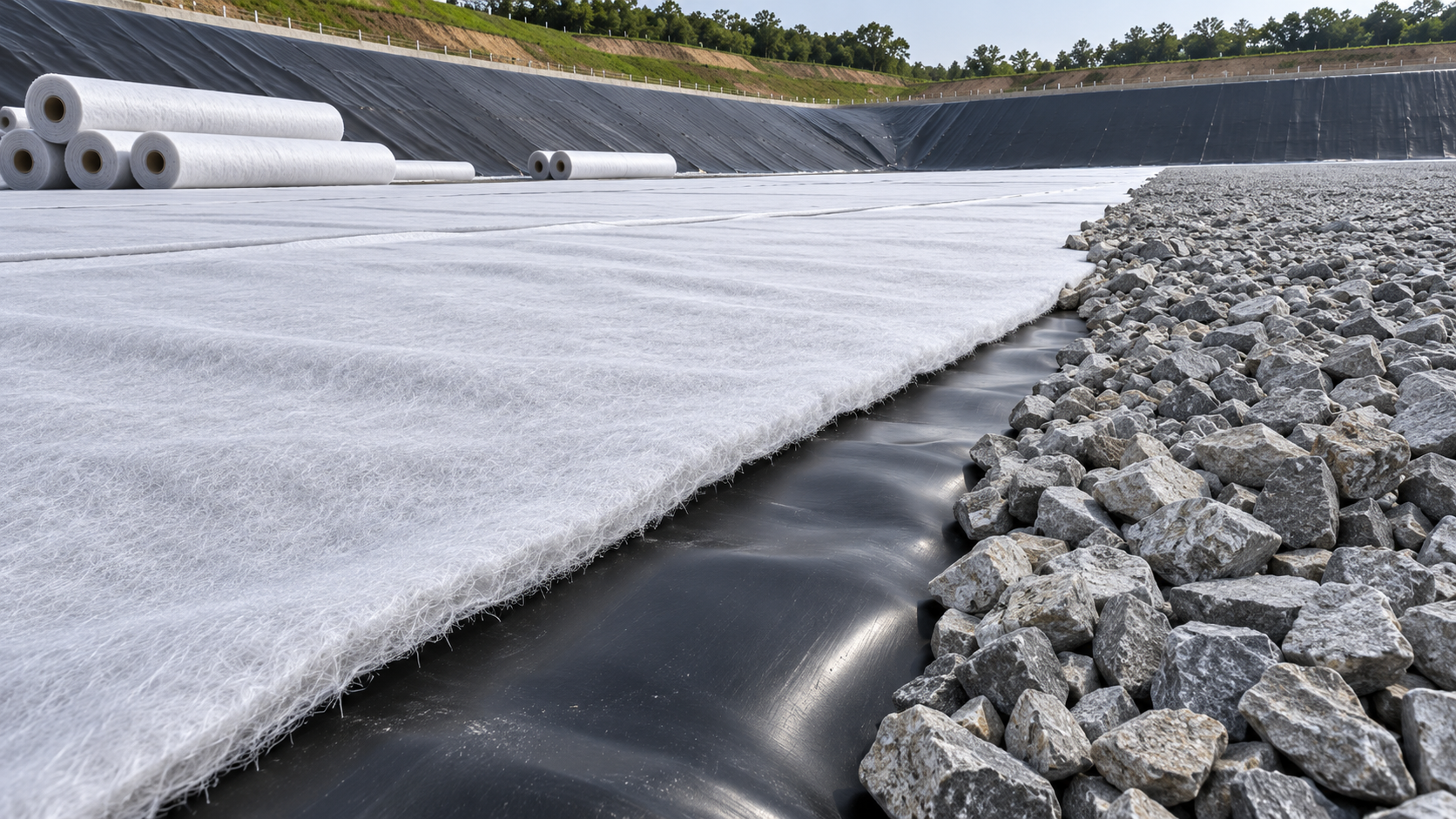
A landfill geotextile may act as a filter, a separator, a protective cushion, or a combination of these. The location determines which properties deserve priority. A fabric between waste and a drainage aggregate, for example, may need to retain mobile particles while allowing leachate to enter the drainage layer. A fabric placed immediately above a geomembrane may instead be selected primarily to reduce damage from overlying aggregate and construction activity.
Those functions overlap, but they are not interchangeable. A fabric that performs well in an index puncture test is not automatically an adequate filter. Equally, a high initial water flow rate does not establish that the material will protect a liner under long-term loading. Before comparing products, mark the proposed geotextile position on the containment-system section and identify the materials immediately above and below it.
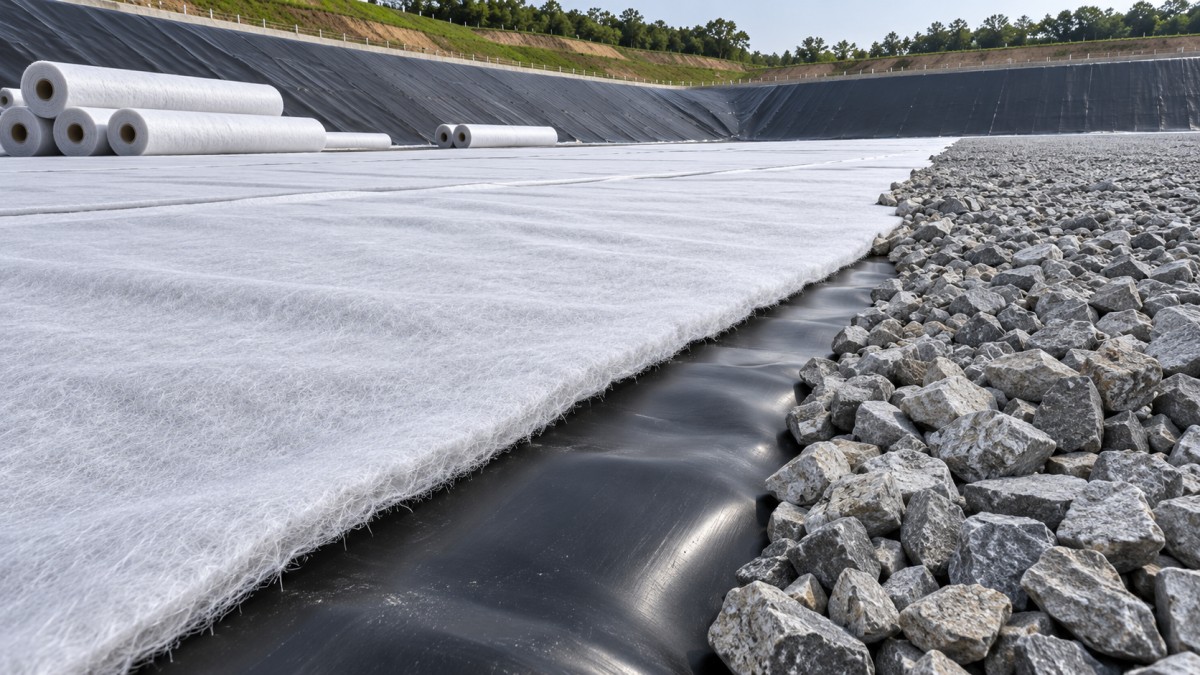
The distinction also matters for drainage geocomposites, where a geotextile is attached to a drainage core. In that arrangement, the fabric filters water entering the core; the core provides the principal in-plane flow path. Their combined performance must be checked under the expected confining pressure and hydraulic gradient, rather than inferred from the fabric’s water flow rating alone.
Filter performance begins with the adjoining material
The filter has two competing tasks: retain enough of the adjacent soil or waste-derived fines to prevent migration, while remaining open enough for liquid to pass. Selecting an apparent opening size without understanding the adjoining material can fail either test. Openings that are too large may allow excessive particle movement; an excessively tight structure may be more susceptible to blinding or clogging.
Ask for the particle-size distribution and characteristics of the material in contact with the fabric. A broadly graded soil, a fine-grained cover soil, and heterogeneous waste can present very different filtration challenges. Conventional soil-retention criteria may be useful for a defined soil, but waste is variable and may produce suspended solids or deposits that a simple grading curve does not capture.
For comparisons, ASTM D4751 measures apparent opening size, while ASTM D4491 addresses water permeability characteristics of geotextiles using permittivity. These are useful index tests, not a prediction of field service life. Check the test conditions and whether reported values are minimum average roll values or another statistical basis; numbers presented on different bases should not be compared as if they were equivalent.
Consider clogging before specifying a flow rate
Landfill leachate may contain suspended particles and support biological growth or chemical precipitates. A clean-fabric permittivity result cannot account for all of those mechanisms. Where clogging is a significant concern, the design team should consider project-specific testing with representative materials and liquids, alongside the expected operating conditions. ASTM D5101, the gradient ratio test, can help assess soil–geotextile system behavior under its defined conditions; its applicability to a particular waste or leachate scenario needs careful review.
Drainage design should also consider the consequences of reduced capacity. Access to collection pipes, cleaning provisions, allowable leachate head and the ability to inspect or maintain the system may be as consequential as the initial fabric selection.
Assess liner protection as a system
When aggregate bears against a geomembrane, individual particles can create localized indentations. The protection layer must moderate those contact stresses throughout construction and the design life, including under the overburden expected as the landfill is filled. Aggregate angularity, particle size and grading matter, as do geomembrane thickness, subgrade support and the applied load.
A heavier nonwoven geotextile may provide more cushioning than a lighter product of similar construction, but mass per unit area is a screening parameter, not proof of adequate protection. Fiber type, structure, thickness under load and the shape of the contacting aggregate all affect performance. A supplier’s generic recommendation should therefore be checked against the actual cross-section.
Index tests can narrow the field. ASTM D6241 measures static puncture strength using a prescribed probe, and ASTM D4833 measures index puncture resistance by another method. Neither reproduces every field contact condition. Where liner integrity is critical, a project-specific protection assessment or performance test using representative aggregate, geomembrane, support and loading is more informative than ranking candidates by puncture value alone. The designer should define the acceptance criterion and loading duration before testing.
Installation loading deserves separate attention. A design based only on final waste depth may overlook construction equipment, aggregate placement or localized trafficking. The contractor’s placement method and minimum cover over the liner should align with the approved construction-quality plan and the materials actually delivered.
Compare fabric structures against the application
Nonwoven geotextiles are often considered where cushioning and filtration are required. Their fiber structure can provide thickness and multiple flow paths, although performance varies substantially by product. Woven geotextiles may be attractive where tensile strength and dimensional stability are important, but their filtration and protection suitability must still be demonstrated for the proposed interface. Neither construction is universally preferable.
Polypropylene and polyester are both used in geotextiles, but polymer choice should follow the anticipated chemical and thermal exposure, not habit. Review the expected leachate chemistry, possible variations over time, and contact with adjacent materials. Resistance depends on the polymer, formulation and exposure conditions; a statement that a fabric is “chemically resistant” is not a substitute for relevant evidence. Where conditions are uncertain or aggressive, seek compatibility information or testing appropriate to the project and design life.
Ultraviolet exposure is another practical distinction between laboratory properties and site performance. Geotextiles intended to be covered can deteriorate if rolls or installed panels remain exposed longer than permitted. Confirm storage and cover requirements with the manufacturer, and incorporate them into the construction sequence rather than leaving them as a site-side assumption.
Use test results to eliminate uncertainty, not create false precision
A useful submittal package links each reported property to a design function. The following checks help distinguish a defensible comparison from a collection of unrelated data sheets:
- Filtration: Confirm opening size and permittivity test methods, reporting basis, and compatibility with the adjoining soil or waste-derived material.
- Protection: Review puncture and thickness data as screening information, then check whether a representative protection assessment is required.
- Mechanical survivability: Examine tensile and tear properties relevant to handling, placement, slopes and expected construction stresses.
- Durability: Check the polymer, anticipated chemical exposure, temperature and permissible UV exposure against the project conditions.
- Drainage composites: Request in-plane transmissivity data at relevant normal stresses, hydraulic gradients and boundary conditions, including the effects of fabric intrusion where applicable.
ASTM D4595 provides a wide-width tensile test method, while ASTM D4716 addresses in-plane flow capacity of geosynthetics. These methods answer different questions. A tensile result does not establish slope stability, and a transmissivity result obtained under one set of boundaries and loads should not be treated as a universal drainage capacity. Confirm the applicable edition, units and any project-specified departures from the test method.
For projects using European specifications, relevant EN and ISO methods and the applicable product standard may differ from ASTM-based documentation. Do not assume a result from one method can be substituted directly for another. The governing permit, design documents and local requirements determine what evidence is acceptable.
Check interfaces and constructability before approval
Even a suitable fabric can underperform if the system details are unresolved. On slopes, the interface between geotextile and geomembrane may influence stability. Friction should be evaluated for the actual materials and conditions, including textured or smooth geomembrane surfaces and potential wetting. A stronger fabric does not automatically correct an inadequate interface or anchorage design.
Review panel layout, overlap or seam requirements, anchor trenches and the sequence for placing drainage aggregate. These details depend on slope, wind exposure, loading and the approved design. Wrinkles, displaced overlaps, contamination and damage from equipment can compromise the intended separation or protection. The construction-quality plan should specify inspection, repair and acceptance procedures before installation begins.
Procurement checks matter too. Confirm roll dimensions, product identification, lot traceability, test documentation and delivery timing. If a proposed substitute differs in polymer, structure or manufacturing source, reassess the affected design functions rather than accepting it solely because its mass and tensile strength appear comparable. Independent conformance testing may be appropriate where required by the specification or quality plan.
A disciplined review, consistent with Global Industrial Core’s focus on infrastructure sourcing, brings the design, testing and delivery evidence together. Before approving geotextile fabric for landfill work, ask the designer and supplier to resolve the same questions against the actual section: what must the layer do, what conditions will it see, and which test results demonstrate that it can do the job? Where the answer depends on representative testing or local approval, make that a condition of the selection rather than an assumption deferred to construction.
Expert Insights

Chief Security Architect
Dr. Thorne specializes in the intersection of structural engineering and digital resilience. He has advised three G7 governments on industrial infrastructure security.
Related Analysis
- Nov 22, 2026McKinsey: India Needs Up to $400 Billion to Meet Steel Capacity Growth GoalAuthor :
- Nov 22, 2026Choosing Geotextile Fabric for Landfill Drainage and Liner ProtectionAuthor :Environmental Engineering Director
- Nov 21, 2026Japan's Steel Exports Could Fall to Lowest Level Since 1999 in 2026Author :
Core Sector // 01
Security & Safety
- Choosing Geotextile Fabric for Landfill Drainage and Liner ProtectionAuthor :Environmental Engineering Director

- How to Select a Twin Shaft Shredder for Bulky Waste, Scrap Metal, and PlasticsAuthor :Environmental Engineering Director

- How to Choose a Twin Shaft Shredder for Tires: Torque, Throughput, and Knife DesignAuthor :Environmental Engineering Director

- Selecting Waste Recycling Equipment by Waste Stream, Throughput, and Contamination LevelAuthor :Environmental Engineering Director

- How to Choose Waste Sorting Equipment for Recycling Plants by Material Stream and CapacityAuthor :Environmental Engineering Director

- Scrap Metal Baler Buying Guide: Horizontal vs Vertical, Capacity, Power, and OutputAuthor :Environmental Engineering Director

- What Is Industrial Ecology and How Does It Improve Resource Efficiency in Manufacturing?Author :Environmental Engineering Director

- Pet Bottle Washing Line Problems: Common Causes of Flake Contamination and How to Fix ThemAuthor :Environmental Engineering Director