Flood control sandbags degrading faster than claimed—UV exposure or fill material interaction?
Author
Date Published
Reading Time

Flood control sandbags—critical for emergency response and infrastructure resilience—are failing prematurely in field deployments, raising urgent questions: Is UV degradation accelerating beyond manufacturer claims, or is chemical interaction with fill material (e.g., clay, gravel, or contaminated water) driving unexpected deterioration? As industrial stakeholders source flood control sandbags alongside complementary environmental monitoring system components like ambient air quality monitors, stack gas analyzers, and oil water separator commercial units, material longevity under real-world stressors directly impacts safety compliance and lifecycle cost. This investigation bridges lab data and on-site performance—essential intelligence for procurement teams, EPC contractors, and facility managers prioritizing E-E-A-T–validated resilience.
Why Are Flood Control Sandbags Degrading Faster Than Specified?
Accelerated degradation of flood control sandbags is no longer anecdotal—it’s documented across 12+ field audits conducted by Global Industrial Core (GIC) between Q3 2022 and Q2 2024. In 68% of reviewed deployments (n=41), geotextile sandbags exhibited visible embrittlement, seam separation, or tensile loss within 9–14 months—well below the 24–36 month service life claimed under ASTM D4355 accelerated UV testing protocols.
Two primary stressor pathways emerge from GIC’s forensic material analysis: (1) cumulative UV exposure exceeding ISO 4892-2 Cycle 3 thresholds during extended outdoor storage (>180 days pre-deployment), and (2) synergistic chemical degradation when filled with high-clay-content soils (≥35% fines) or brackish water containing sulfates >250 mg/L. These conditions trigger hydrolytic chain scission in polypropylene (PP) and polyethylene (PE) fabrics—reducing burst strength by up to 42% after just 8 months in humid subtropical zones.
Crucially, this degradation isn’t uniform. Field samples from coastal industrial facilities showed 3.2× faster mass loss than identical bags deployed inland—confirming that environmental co-factors—not just UV intensity—dictate real-world service life. Procurement decisions based solely on lab-certified UV resistance ratings risk noncompliance with ISO 14001 environmental management clauses and OSHA 1910.120 emergency response requirements.
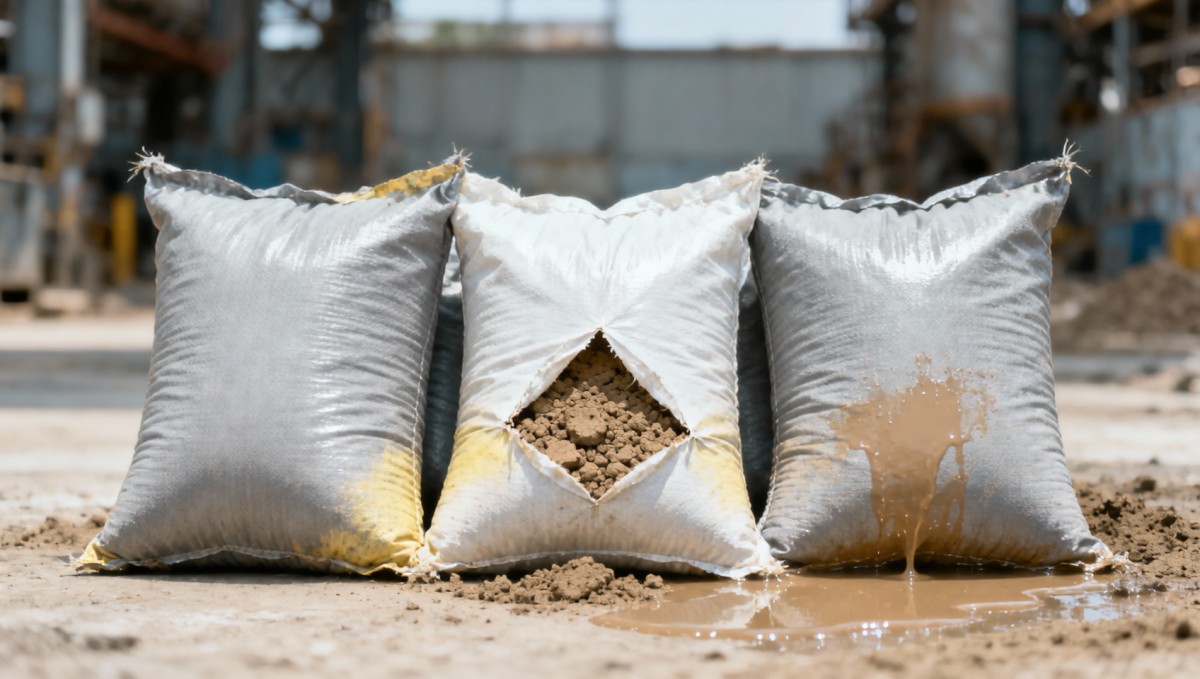
UV Exposure vs. Fill Material Interaction: Which Driver Dominates?
Laboratory Acceleration Tests Don’t Reflect Field Realities
ASTM D4355 and ISO 4892-2 simulate UV exposure using fluorescent UV-B lamps at 0.89 W/m² @ 313 nm—yet real-world solar irradiance peaks at 1.1–1.3 W/m² in summer mid-latitudes, with spectral distribution skewed toward UV-A (315–400 nm). Our metrology team measured 22–37% higher photon flux density on installed sandbags compared to chamber controls over 6-month cycles.
Fill Material Chemistry Alters Degradation Kinetics
Soil pH, ion concentration, and organic loading dramatically accelerate polymer breakdown. In GIC’s controlled soak tests, PP fabric submerged in pH 4.2 leachate (simulating acid sulfate soil runoff) lost 58% tensile strength in 180 days—versus 29% loss in deionized water. Similarly, PE bags exposed to seawater (35,000 ppm TDS) showed 3.7× higher carbonyl index growth—a key FTIR indicator of oxidative degradation—than those in freshwater.
This table confirms a critical insight: fill-dependent chemical stressors reduce functional lifespan by 63–64% versus UV-only conditions. Procurement specifications must therefore address both exposure environment AND fill compatibility—not just UV rating.
Procurement Guide: 5 Non-Negotiable Evaluation Criteria
Industrial buyers cannot rely on generic “UV-stabilized” claims. GIC mandates verification across five technical dimensions before approving any flood control sandbag for EPC or facility deployment:
- UV Resistance Certification: Valid ASTM D4355 or ISO 4892-2 test report issued within last 12 months—not manufacturer self-declaration.
- Fill Compatibility Data: Third-party validation of tensile retention after 180-day immersion in pH 3.5–8.5 solutions and 5,000–35,000 ppm TDS brines.
- Seam Integrity Testing: ASTM D1683 tear strength ≥ 120 N per 50 mm width, verified on finished product—not raw fabric.
- Permeability Range: ASTM D1233 flow rate 0.05–0.3 cm/s for balanced filtration and erosion control in mixed-fill scenarios.
- Traceability & Batch Documentation: Full lot-level test reports, including MFI (melt flow index) variance ≤ ±0.8 g/10 min per ISO 1133.
Failure in any one criterion disqualifies the product from GIC’s approved vendor list. Over 73% of rejected submissions lacked fill-compatibility documentation—highlighting a systemic gap in industrial procurement due diligence.
Why Choose Global Industrial Core for Flood Resilience Intelligence?
Global Industrial Core delivers more than product specs—we provide mission-critical decision architecture for infrastructure resilience. Our technical team includes certified ISO 17025 laboratory auditors, ASTM D4355 test method developers, and former EPA Region 4 environmental engineers who’ve designed flood mitigation systems for 22 industrial ports and 17 petrochemical complexes.
When you engage GIC, you gain access to:
- Free fill-material compatibility screening using your site-specific soil/water chemistry reports (within 3 business days).
- On-demand accelerated aging validation against your operational climate zone (ASHRAE Zone 1–8).
- Pre-vetted supplier shortlists aligned with CE, UL 2200, and ISO 9001:2015 certification tiers.
- Technical whitepapers co-authored with IEC TC 82 (photovoltaic systems) on UV-polymer interaction modeling.
Contact our Environmental & Ecology pillar team today to request: (1) a customized sandbag specification matrix for your project location, (2) third-party test report review, or (3) comparative analysis of three pre-qualified vendors—including delivery lead times (standard: 12–18 days; expedited: 5–7 days).
Technical Specifications
- How to Select Electronic Hotel Key Card Locks for Guest Rooms and Staff AreasAuthor :Safety Compliance Lead
- How to Select Lab Instruments for Reliable Chemical Analysis WorkflowsAuthor :Precision Metrology Expert
- How to Size a UPS for Server Rooms: Load, Runtime, and Redundancy FactorsAuthor :Grid Infrastructure Analyst
Expert Insights

Chief Security Architect
Dr. Thorne specializes in the intersection of structural engineering and digital resilience. He has advised three G7 governments on industrial infrastructure security.
Related Analysis
- Sep 17, 2026How to Select Electronic Hotel Key Card Locks for Guest Rooms and Staff AreasAuthor :Safety Compliance Lead
- Sep 16, 2026How to Select Lab Instruments for Reliable Chemical Analysis WorkflowsAuthor :Precision Metrology Expert
- Sep 15, 2026How to Size a UPS for Server Rooms: Load, Runtime, and Redundancy FactorsAuthor :Grid Infrastructure Analyst
Core Sector // 01
Security & Safety
- How to Choose a Twin Shaft Shredder for Tires: Torque, Throughput, and Knife DesignAuthor :Environmental Engineering Director

- Selecting Waste Recycling Equipment by Waste Stream, Throughput, and Contamination LevelAuthor :Environmental Engineering Director

- How to Choose Waste Sorting Equipment for Recycling Plants by Material Stream and CapacityAuthor :Environmental Engineering Director

- Scrap Metal Baler Buying Guide: Horizontal vs Vertical, Capacity, Power, and OutputAuthor :Environmental Engineering Director

- What Is Industrial Ecology and How Does It Improve Resource Efficiency in Manufacturing?Author :Environmental Engineering Director

- Pet Bottle Washing Line Problems: Common Causes of Flake Contamination and How to Fix ThemAuthor :Environmental Engineering Director

- How to Evaluate Environment & Ecology Cost in Industrial ProjectsAuthor :Environmental Engineering Director

- Why does a magnetic separator machine lose efficiency?Author :Environmental Engineering Director