Selecting Spherical Roller Bearings for Mining: Load, Contamination, and Service Life
Author
Date Published
Reading Time
Selecting Spherical Roller Bearings for Mining: Load, Contamination, and Service Life
Selecting spherical roller bearings for mining requires more than matching bore diameter, outside diameter, and catalogue load rating. In a mine, bearing performance is shaped by shock loads, shaft deflection, airborne dust, water ingress, imperfect mounting conditions, lubricant condition, and the practical difficulty of reaching the housing during a shutdown. A bearing that is technically interchangeable with an existing unit may still be the wrong choice if its internal clearance, seal arrangement, lubrication path, or cage design does not suit the duty.
For technical evaluators, the central question is not simply “Which bearing fits?” It is “Which bearing-and-housing system can maintain adequate operating clearance and lubricant film for the required service interval under this machine’s real loads and contamination exposure?” That distinction matters on crushers, screens, conveyors, feeders, mills, stackers, reclaimers, and slurry-related processing equipment, where an unplanned bearing event can stop a larger production chain.
Spherical roller bearings are widely specified because their two rows of rollers and spherical raceway allow them to carry high radial loads, accommodate moderate axial loads in either direction, and tolerate angular misalignment. Those strengths are valuable in mining, but they do not eliminate the need for disciplined selection. The application still determines whether the bearing is adequately sized, properly mounted, protected from contaminants, and realistically maintainable.
Start with the load spectrum, not the nominal load
Mining equipment rarely experiences a smooth, constant load. A conveyor pulley may operate for long periods at comparatively stable load, then encounter belt mistracking, a seized idler, material buildup, or a loaded restart. A jaw crusher, cone crusher, vibrating screen, or apron feeder can impose repeated dynamic loads, impact, vibration, and load reversals that are poorly represented by a single average value.
The bearing calculation should therefore begin with the machine duty cycle. Gather radial load, axial load, speed, temperature, expected operating hours, start-stop frequency, shock events, and any known overload condition. Where load data are estimated rather than measured, document the assumptions. A life calculation is only as credible as the load model behind it.
Dynamic load rating helps compare a bearing’s fatigue-life capacity, but it is not a direct promise of in-service life. Bearing life can be substantially shortened by contamination, inadequate lubrication, excessive preload, mounting errors, or vibration damage while equipment is stationary. Static load rating also deserves attention where large standing loads, shock loading, or slow oscillation may create permanent indentation risk in raceways.
Axial load is often underestimated. Spherical roller bearings can support axial forces, but their axial capacity and friction behavior depend on bearing geometry, operating clearance, load direction, and lubrication. A process change that increases belt tension, material pressure, or thermal movement can shift the axial demand beyond what an existing bearing arrangement was designed to absorb. When axial location is critical, the entire locating and non-locating arrangement must be reviewed rather than treating the bearing as an isolated component.
Misalignment is an allowance, not an invitation
One reason spherical roller bearings are selected for rugged equipment is their ability to accommodate angular misalignment between shaft and housing. That capability is useful where long shafts deflect, fabricated structures settle, or housing bores cannot remain perfectly aligned under load. Yet it should not be used to excuse poor installation practice or distorted housings.
Persistent misalignment increases internal friction and can alter load distribution across the rollers. On a hot, heavily loaded bearing, the resulting temperature rise may reduce grease consistency or accelerate oil degradation. Check shaft seat runout, housing bore geometry, support rigidity, and the effects of thermal growth. If the root cause is structural movement or a worn housing, installing a larger bearing may only delay the next failure.
Contamination control usually decides the service interval
Abrasive mineral fines are unforgiving. Once particles enter the lubricant film, they can create denting, surface distress, abrasive wear, and increased vibration. Water introduces a different set of problems: it can displace lubricant, support corrosion, and reduce the protective properties of grease or oil. In wet processing areas, washdown and slurry splash may be more significant than airborne dust; in dry crushing and conveying areas, fine particulate intrusion is often the dominant concern.
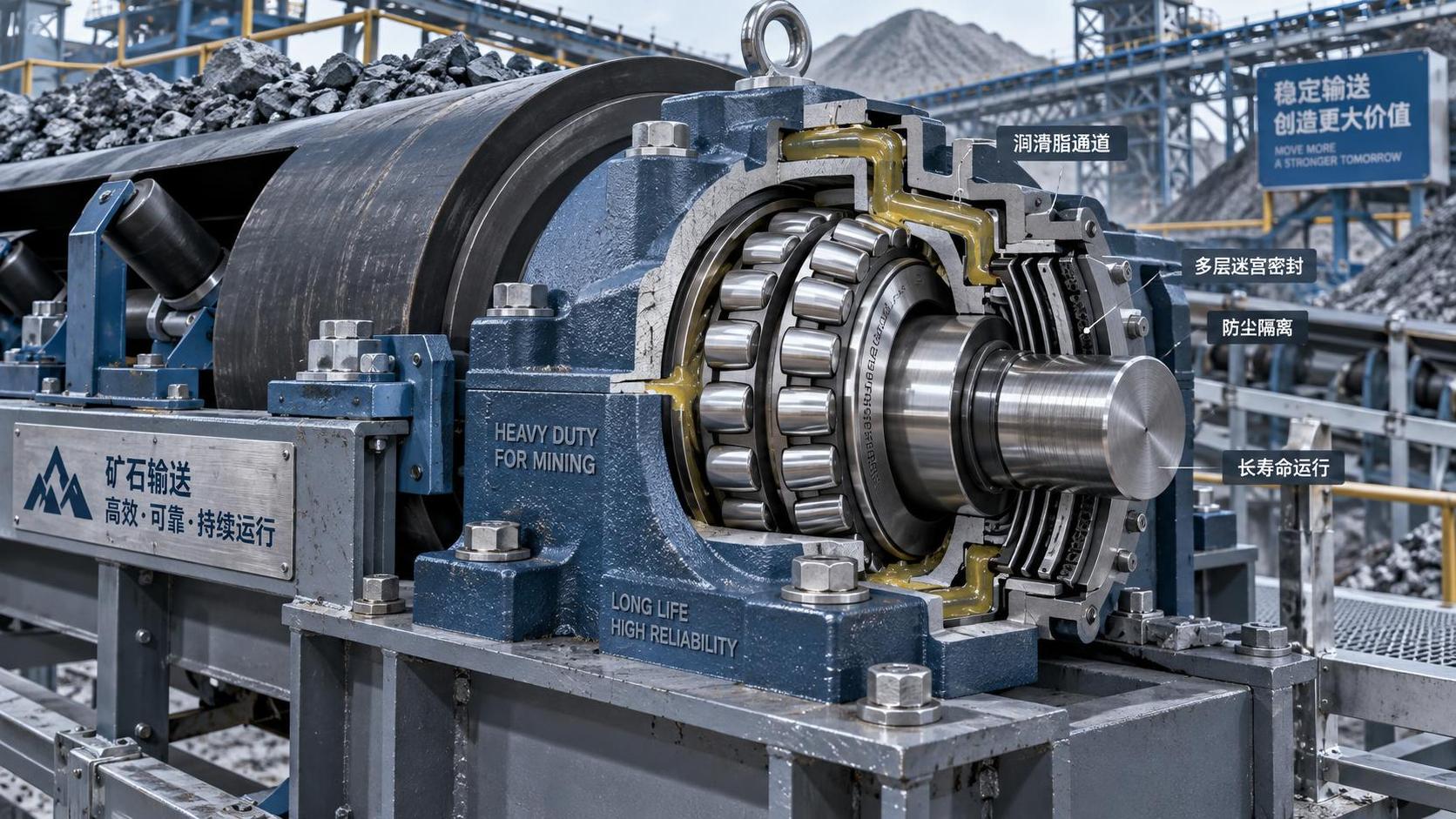
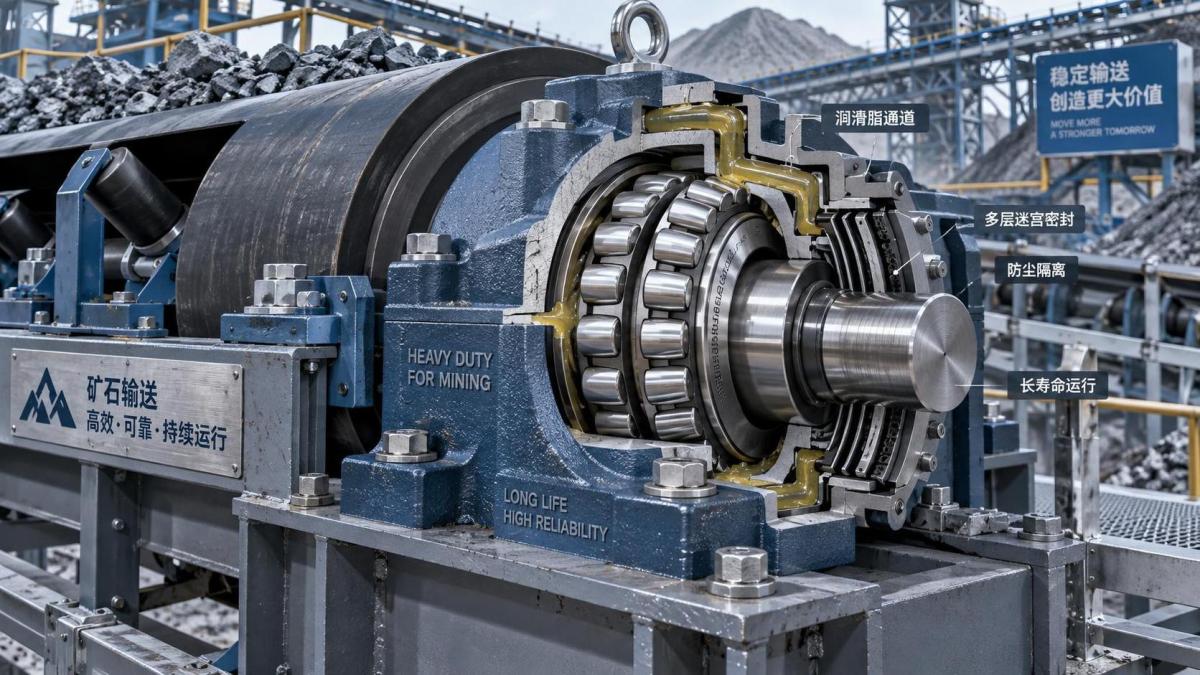
For this reason, selecting spherical roller bearings for mining should include the seals, housing, relubrication points, and grease-purging approach from the start. A high-capacity bearing inside a poorly protected plummer block is not a robust solution. Conversely, a well-designed sealing arrangement can materially improve bearing conditions even when the machine operates in a severe environment.
Seal choice should reflect the contamination mechanism rather than a generic “heavy-duty” label. Contact seals can offer strong exclusion but may add friction. Non-contact labyrinth arrangements can work well where shaft speed, alignment, and grease purge are appropriate, but their effectiveness depends on the housing design and maintenance discipline. In especially severe locations, layered protection may be justified: external deflectors or flingers, a labyrinth path, a compatible grease purge, and a properly maintained housing seal.
The bearing itself must also be specified with the lubricant strategy in mind. A centralized grease system, manual lubrication route, or oil-based arrangement each creates different requirements for relubrication frequency, lubricant cleanliness, flow, and access. It is unwise to specify a nominal grease type without checking temperature range, base-oil viscosity, thickener compatibility, extreme-pressure additive requirements, and the possibility of mixing with the grease already used on site.
Internal clearance and fits deserve a formal review
Internal clearance is one of the most consequential variables in a mining bearing selection. The radial internal clearance measured before mounting is not the same as the operating clearance after the bearing is fitted to the shaft, installed in the housing, heated by operation, and loaded in service. An interference fit on the inner ring reduces clearance. Differential thermal expansion between shaft and housing can change it again.
Too little operating clearance raises friction and heat, potentially leading to smearing, lubricant breakdown, or premature damage. Too much clearance can contribute to uneven load distribution, vibration, and reduced guidance. The appropriate clearance class cannot be selected from shaft diameter alone. It must be evaluated against fit tolerances, mounting method, temperature differential, speed, load, and the bearing manufacturer’s guidance for that bearing series.
This is especially important when using tapered-bore bearings mounted on adapters or withdrawal sleeves. The mounting process changes internal clearance, and the final result depends on the drive-up procedure or clearance reduction measurement. A maintenance instruction that only says “tighten the sleeve” leaves too much room for variation. The documented method should specify measurement points, acceptable reduction, tooling, cleanliness controls, and inspection responsibilities.
Service life is a system outcome
A target operating life is useful for comparison, inventory planning, and design review, but it should not be mistaken for a fixed replacement interval. In mining, a bearing may be removed because of rising vibration, seal damage, cage distress, lubrication contamination, or a planned overhaul long before classical rolling-contact fatigue becomes the limiting mechanism. The actual service life depends on the entire operating system.
Technical evaluators should ask suppliers and internal stakeholders for evidence that supports the intended duty: dimensional drawings, load and speed limits, clearance guidance, cage material and design information, lubrication recommendations, mounting instructions, traceability requirements, and relevant inspection documentation. If a replacement bearing is proposed as an equivalent, verify more than the basic designation. Differences in roller geometry, internal design, heat treatment approach, tolerance class, seal capability, or recommended mounting practice may affect performance.
Condition monitoring makes this evaluation more practical. Temperature trending can identify a developing friction or lubrication issue, though a single temperature reading is rarely diagnostic by itself. Vibration analysis may reveal bearing damage, looseness, imbalance, misalignment, or gear-related faults, depending on the machine. Grease inspection and used-oil analysis can provide early evidence of particle ingress or water contamination. The best monitoring method is the one that maintenance teams can apply consistently and interpret alongside process conditions.
Do not specify around a failure without examining it
When a bearing fails early, the removed component is valuable evidence. Record the bearing designation, installation date, machine position, lubricant, estimated hours, running temperature, shaft and housing measurements, and photographs before cleaning the parts. Raceway marks, roller condition, cage damage, discoloration, and corrosion patterns can help distinguish between overload, contamination, inadequate lubrication, electrical damage, incorrect fit, and mounting-related problems. The interpretation should remain cautious, but replacing a failed bearing without preserving this information often turns repeat failure into a mystery.
A practical decision route for mining applications
A defensible selection process connects machine design with site reality. Define the duty and load spectrum, then confirm shaft diameter, housing arrangement, speed, axial-force direction, expected misalignment, and ambient or process temperatures. Review the contamination route before choosing seals and lubricant. Establish mounting fits and operating clearance before releasing a bearing designation. Finally, confirm that the team can install, lubricate, inspect, and replace the arrangement with the access and tools available on site.
For critical assets, procurement should also consider supply continuity and documentation quality. A technically suitable bearing is of limited value if lead time, traceability, storage practices, or access to installation guidance create unacceptable risk. The lowest unit price can become expensive when it introduces uncertain equivalency into a crusher or conveyor position that has limited redundancy.
Global Industrial Core approaches mechanical-component evaluation in this wider infrastructure context: the bearing, lubricant, seals, housing, monitoring approach, and maintenance process should be assessed as one reliability chain. For EPC teams and facility managers, that means turning a catalogue selection into a documented engineering decision—one that can be reviewed against project specifications, applicable standards, operating conditions, and the consequences of downtime.
Before finalizing spherical roller bearings for mining, validate the proposed arrangement against actual load assumptions and contamination exposure, not just the previous purchase order. Where service history is poor or the equipment is production-critical, involve the bearing manufacturer, machine OEM where relevant, and site reliability personnel early enough to review fits, sealing, lubrication, and installation method together. That is usually where avoidable bearing failures are prevented.
Technical Specifications
- How to Select Electronic Hotel Key Card Locks for Guest Rooms and Staff AreasAuthor :Safety Compliance Lead
- How to Select Lab Instruments for Reliable Chemical Analysis WorkflowsAuthor :Precision Metrology Expert
- How to Size a UPS for Server Rooms: Load, Runtime, and Redundancy FactorsAuthor :Grid Infrastructure Analyst
Expert Insights

Chief Security Architect
Dr. Thorne specializes in the intersection of structural engineering and digital resilience. He has advised three G7 governments on industrial infrastructure security.
Related Analysis
- Sep 17, 2026How to Select Electronic Hotel Key Card Locks for Guest Rooms and Staff AreasAuthor :Safety Compliance Lead
- Sep 16, 2026How to Select Lab Instruments for Reliable Chemical Analysis WorkflowsAuthor :Precision Metrology Expert
- Sep 15, 2026How to Size a UPS for Server Rooms: Load, Runtime, and Redundancy FactorsAuthor :Grid Infrastructure Analyst
Core Sector // 01
Security & Safety
- Selecting Low-Friction Pneumatic Seals for High-Cycle, Low-Pressure CylindersAuthor :Heavy Industry Strategist

- Selecting Spherical Roller Bearings for Mining: Load, Contamination, and Service LifeAuthor :Heavy Industry Strategist

- Do Deep Groove Ball Bearings Need Special Seals in Coastal Humidity?Author :Heavy Industry Strategist

- How to Select Anti Vibration Rubber Shock Absorbers for Machinery and EquipmentAuthor :Heavy Industry Strategist

- When to Specify Induction Hardened Slewing Ring Bearings for Heavy-Duty EquipmentAuthor :Heavy Industry Strategist

- How to Evaluate Weather Resistant EPDM Extrusion for Outdoor Sealing ApplicationsAuthor :Heavy Industry Strategist

- Bearing and Seal Lead Times Stretch to 22 WeeksAuthor :Heavy Industry Strategist

- Angular Contact Ball Bearings Explained: Contact Angle, Load Capacity, and Common UsesAuthor :Heavy Industry Strategist