How to Select Anti Vibration Rubber Shock Absorbers for Machinery and Equipment
A common situation in plants, workshops, and equipment rooms is that a machine technically works, but it never feels stable in operation. There may be persistent vibration through the frame, noise transferring into the floor, bolts loosening earlier than expected, or nearby instruments giving unreliable readings. In many cases, the issue is not the machine alone. It is the interface between the machine and its mounting system, and that is where anti vibration rubber shock absorbers become a serious selection decision rather than a minor accessory.
If you are comparing options for new equipment, retrofitting older machinery, or trying to stop repeat maintenance problems, the challenge is usually the same: not every rubber mount behaves the same under load, motion, heat, fluids, or installation constraints. A good choice protects equipment and improves operating stability. A poor choice can hide the problem for a short time and then create a different one. The practical goal is to match the absorber to the actual operating conditions, not just to the machine weight on a catalog page.
Why the wrong choice creates ongoing problems
People often start looking for anti vibration rubber shock absorbers only after vibration has already become visible in day-to-day operation. That usually means the consequences are no longer theoretical. Operators may notice more noise during startup or shutdown. Maintenance teams may find cracked brackets, fatigued fasteners, or accelerated wear in connected components. In precision environments, even moderate vibration can affect alignment, repeatability, and measurement consistency.
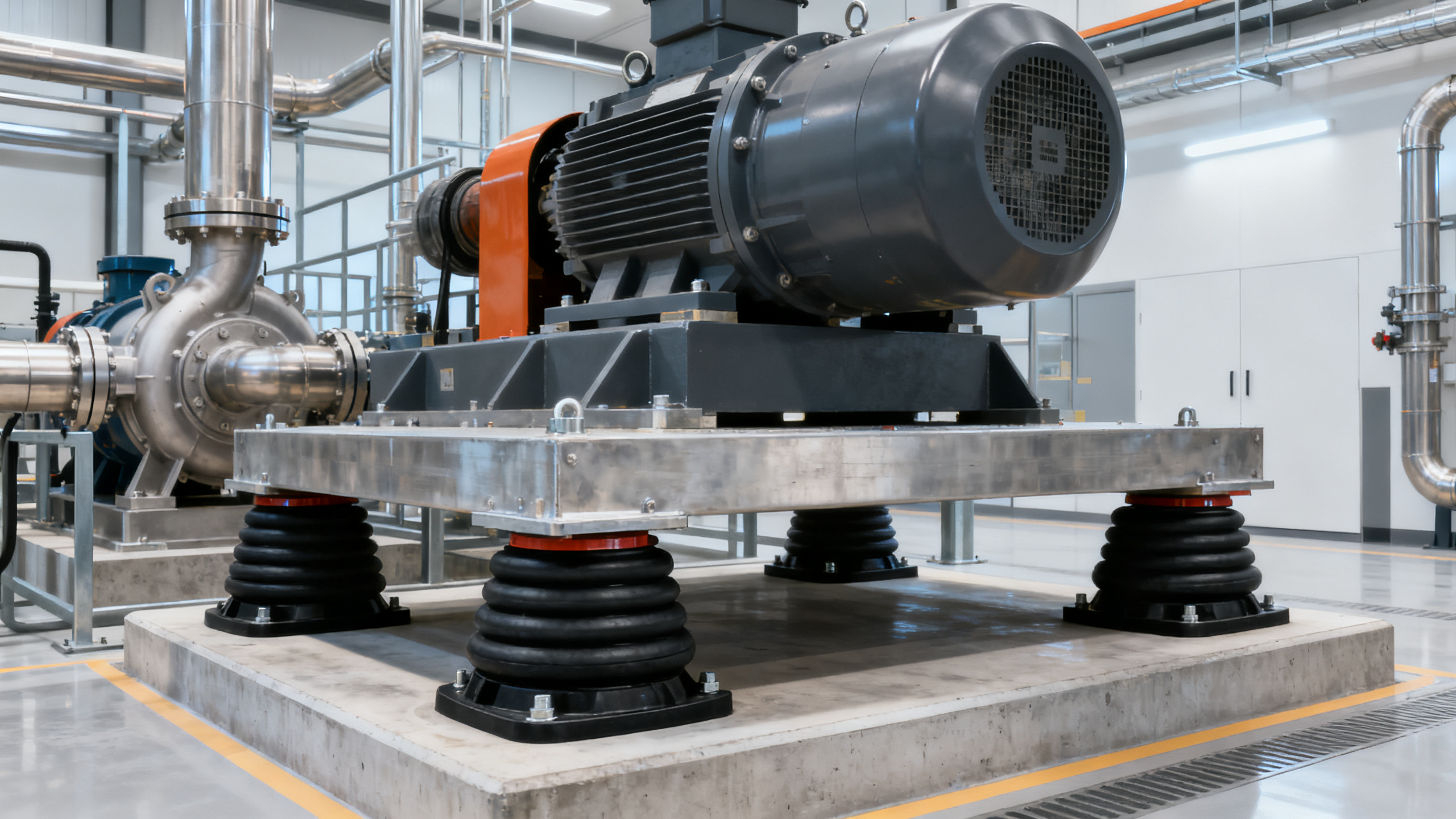
Another complication is that vibration problems rarely stay isolated. A pump, compressor, fan, generator, HVAC unit, conveyor drive, or packaged industrial system can transmit motion into support frames, piping, cable trays, housings, and nearby equipment. This is why selection should not focus only on “soft enough” or “strong enough.” The mount has to support the machine safely while controlling the specific type of motion the machine creates.
Procurement teams also run into a familiar problem during sourcing: several products appear similar in shape and basic dimensions, but their rubber compound, stiffness, mounting style, fatigue behavior, and environmental resistance are not equivalent. That is where many selection mistakes begin.
Start with the real operating condition, not the product photo
A practical review begins by describing the machine in use, not by browsing mount styles. Before comparing anti vibration rubber shock absorbers, clarify a few basics. What is the equipment type? Is the load static, dynamic, or impact-heavy? Does the machine run at a constant speed, cycle on and off, or pass through multiple operating ranges? Is the main concern vibration isolation, shock protection, structural support, or a mix of all three?
This step matters because similar-looking machinery can place very different demands on a mount. A small enclosure with intermittent vibration may tolerate a simpler rubber isolator. A skid-mounted unit with rotating mass, off-center loading, and continuous duty may require tighter control over compression, shear, and restraint. If the machine experiences startup torque, stopping shock, or uneven load distribution, those factors should be included early rather than treated as installation details later.
It also helps to separate the source of the problem. If vibration is mainly generated by rotating imbalance, you are dealing with one kind of selection logic. If the equipment is exposed to external shocks, transport loads, or structural movement, the absorber needs to handle a different kind of stress. The right product is usually the one designed for the dominant motion pattern.
Key selection criteria for anti vibration rubber shock absorbers
Once the operating condition is clear, the selection process becomes more disciplined. The following criteria are the ones that usually decide whether a mount will perform well over time.
1. Load capacity and load distribution
The first check is not just total machine weight, but how that weight is shared across mounting points. Many problems come from assuming an even load when the actual center of gravity is offset. If one corner carries more weight, a mount set chosen only by total mass can be overloaded at one position and underloaded at another. That leads to uneven compression, poor isolation, and premature failure.
When reviewing supplier information, look for rated load ranges under realistic mounting conditions. It is also useful to know whether the mount is intended primarily for compression, shear, or combined loading. A product that works well in one orientation may not behave the same way in another.
2. Excitation frequency and isolation target
One of the most important but often overlooked factors is the relationship between the machine’s operating frequency and the natural behavior of the mount. If those values are too close, the system can amplify vibration instead of reducing it. This is why a mount that feels firm and secure by hand is not automatically the right answer for rotating or reciprocating machinery.
For selection, the practical question is simple: what vibration are you trying to isolate, and at what operating speed does it occur most of the time? Without that answer, it is difficult to compare absorber stiffness in a meaningful way.
3. Deflection and stability
Rubber shock absorbers need enough deflection to isolate vibration, but not so much that the machine becomes unstable, misaligned, or difficult to restrain. In industrial settings, this balance matters a lot. Too stiff, and vibration passes through. Too soft, and the equipment may rock, shift, or place stress on connected piping, ducting, or electrical runs.
Selection should therefore consider both isolation and positional control. Machines with tall centers of gravity or directional forces often need mounts that provide restraint as well as damping.
4. Environmental resistance
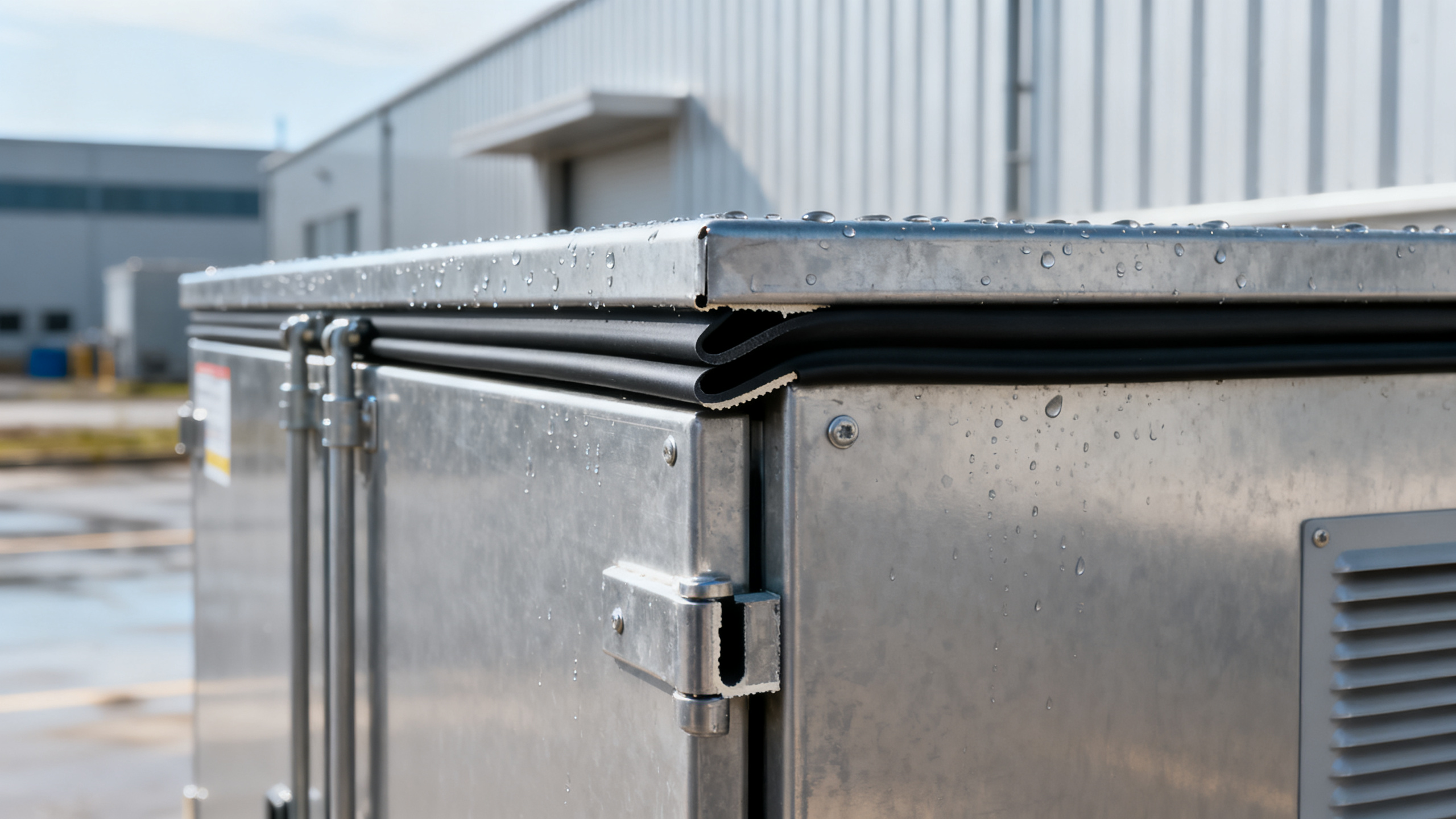
Rubber compounds do not all respond the same way to oils, chemicals, ozone, moisture, ultraviolet exposure, or elevated temperatures. A mount that performs well indoors in a clean utility room may degrade much faster in outdoor equipment, washdown areas, process zones, or engine-related applications.
If the equipment will be exposed to lubricants, solvents, weather, or sustained heat, ask for compound suitability rather than assuming “rubber” is a single material category. This is one of the easiest places to avoid hidden lifecycle problems during sourcing.
5. Mounting geometry and installation space
Even a technically correct absorber can become the wrong choice if the installation geometry is awkward. Clearance, bolt pattern, thread orientation, access for maintenance, and available installation height all affect the result. In retrofit projects, limited space often pushes teams toward a compact mount, but that should not come at the expense of load handling or vibration performance.
It is worth checking whether the selected part allows clean installation without forcing the mount into unintended preload, tilt, or side stress. Rubber components are sensitive to how they are installed, and poor mounting practice can distort performance from the start.
Common selection mistakes that lead to poor results
One frequent mistake is choosing only by load rating. Load matters, but it is only one piece of the decision. Two mounts with similar load capacity can perform very differently because of stiffness, compound behavior, or intended motion mode.
Another mistake is treating noise reduction and vibration isolation as identical goals. They are related, but not the same. A mount may reduce some audible effects without adequately isolating structural vibration. For equipment near sensitive instruments or occupied work areas, that difference becomes important.
A third issue is ignoring connected systems. Even if the anti vibration rubber shock absorbers are selected well, rigid piping, conduit, cable, or duct connections can still transmit vibration and make the absorber appear ineffective. In practice, mount selection and system integration should be reviewed together.
There is also a tendency to overspecify hardness because a firmer mount feels safer. In reality, excessive stiffness often defeats the purpose of vibration isolation. The better question is whether the mount controls the equipment safely while still allowing the right amount of controlled movement.
A practical decision process for buyers and technical evaluators
- Define the machine condition clearly. Record equipment type, operating mode, approximate weight, support points, speed range, and whether the main concern is vibration, shock, or both.
- Identify the dominant risk. Decide whether the bigger issue is transmitted vibration, machine instability, impact loading, environmental degradation, or installation constraints. This prevents a generic part search.
- Check actual load per mounting point. Do not assume equal distribution unless the equipment layout truly supports that assumption. Offset centers of gravity change everything.
- Review motion direction. Determine whether the absorber will mainly see compression, shear, tension restraint, or combined loading. The absorber style should match that reality.
- Screen materials for the environment. Confirm compatibility with heat, oil, water, weather, chemicals, and outdoor exposure where relevant.
- Verify installation details before ordering. Confirm height, footprint, thread size, clearances, and whether nearby connections allow the mount to do its job.
- Ask for technical documentation that supports selection. When sourcing through industrial channels, it helps to prioritize suppliers that provide usable load, deflection, and material guidance rather than only basic catalog images and dimensions.
For organizations using a technical sourcing workflow, this is where a research-driven platform such as Global Industrial Core can be useful as part of the decision path. The value is not in treating one product as universally correct, but in comparing mechanical components through engineering criteria, application fit, and documentation quality before a purchasing decision is locked in.
Which absorber style tends to fit which application
While final selection depends on actual specifications, some broad patterns are useful. Simple cylindrical or bobbin-style rubber mounts are often considered where compact size, moderate isolation, and straightforward installation are priorities. They can work well for smaller machinery, enclosures, light industrial assemblies, and general equipment support.
Conical or more geometrically controlled mounts may suit applications where combined directional loads and better stability are needed. These are often reviewed for equipment that sees both vibration and movement in more than one axis. Sandwich mounts and plate-style configurations can be considered where height constraints or broader support surfaces matter.
For heavier-duty systems, especially where shock events, repeated cycling, or harsher environmental conditions are part of the operating profile, the selection process should be stricter. In those cases, comparing only shape and dimensions is rarely enough. Load behavior, compound properties, and intended duty cycle become much more important than appearance.
How to avoid repeat replacement and recurring vibration complaints
Once a suitable anti vibration rubber shock absorber is selected, the next step is making sure the installation and follow-up checks support that decision. Many repeat issues are not caused by the absorber design itself but by the way the assembly is put into service.
After installation, check whether the machine sits level, whether compression is reasonably consistent across mount points, and whether connected components are forcing the machine out of neutral position. Watch for signs of side-loading, twisting, or excessive restriction from rigid attachments. If vibration is still being transmitted, review the full mounting system rather than replacing the rubber component immediately with a harder version.
It also helps to build a simple inspection habit into maintenance routines. Look for cracking, permanent set, swelling, surface degradation, loose fasteners, and changes in machine alignment. Rubber mounts are often quiet components, so they get ignored until the surrounding equipment starts showing symptoms. Catching deterioration early is usually easier than diagnosing a full vibration problem later.
Frequently Asked Questions
How do I know whether I need vibration isolation or shock absorption?
Start by looking at the operating condition. If the machine creates ongoing motion during normal running, vibration isolation is usually the main concern. If the equipment is exposed to sudden impacts, transport loads, or intermittent heavy jolts, shock absorption becomes more important. Some applications need both, but one is usually the dominant requirement.
Can I select anti vibration rubber shock absorbers based only on machine weight?
No. Total weight is only the starting point. You also need to know how that load is distributed, what kind of vibration or shock is present, how the mount will be oriented, and what environmental conditions it will face. Weight alone does not tell you whether the absorber will isolate effectively or remain stable in service.
Is softer rubber always better for vibration reduction?
Not necessarily. Softer mounts may improve isolation in some cases, but they can also create too much movement, poor alignment, or instability. The correct choice is the one that balances isolation, support, and control for the specific machine.
Why do new mounts sometimes fail to solve the problem?
Common reasons include incorrect load assumptions, unsuitable stiffness, poor environmental compatibility, side-loading during installation, and rigid connected systems that continue to transmit vibration. The mount should be evaluated as part of the full equipment setup.
What should I ask a supplier before buying?
Ask for load range, deflection guidance, intended loading mode, material suitability for the environment, dimensional details, and any application notes relevant to your machine type. Useful technical documentation is often a better indicator of fit than a broad product list.
Conclusion
Selecting anti vibration rubber shock absorbers is usually easier once the decision is framed around real operating conditions instead of general product categories. The important questions are straightforward: what motion is present, how is the load carried, what environment will the mount live in, and how much controlled movement can the machine tolerate? When those answers are clear, comparing options becomes more disciplined and far less guess-based.
For buyers, engineers, and maintenance teams, the most reliable path is to treat the absorber as a functional part of the machine system, not as a simple accessory. A careful review of load, frequency, deflection, material resistance, and installation geometry will do more to prevent repeat vibration problems than choosing the most familiar part style on the shelf.