How to Choose Corrosion-Resistant Deep Groove Bearings for Coastal Sites
Author
Date Published
Reading Time
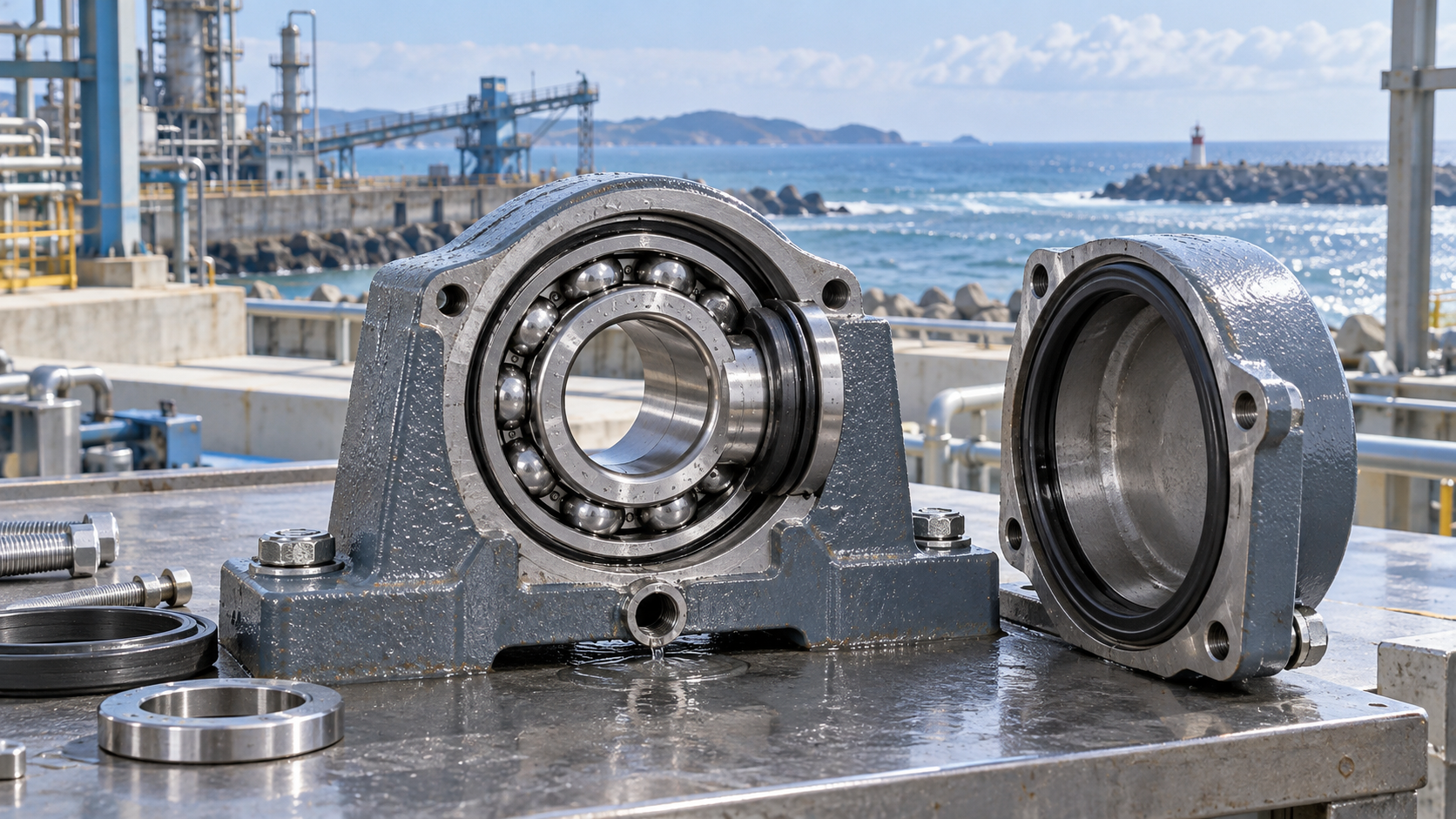
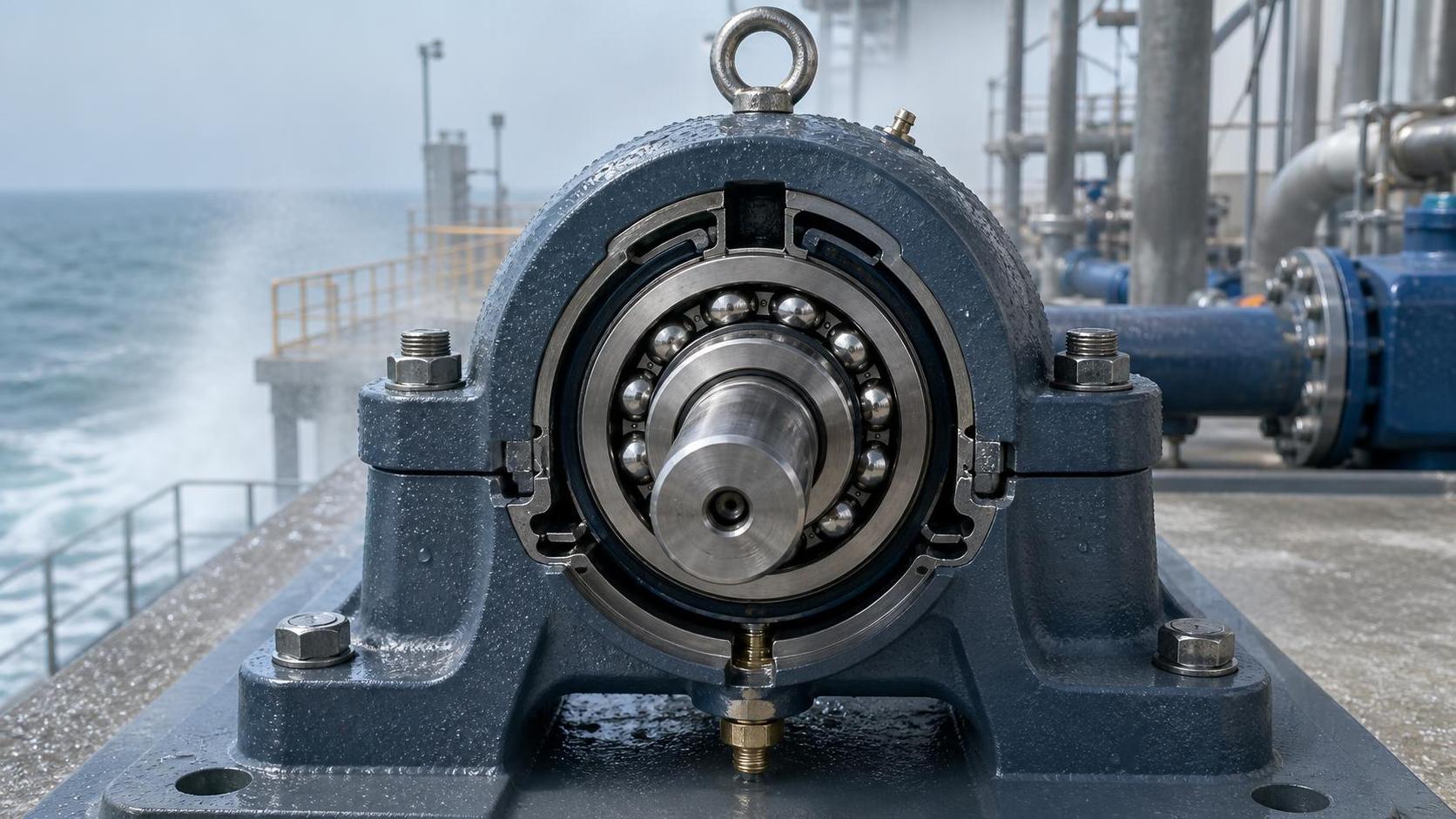
Choose corrosion-resistant deep groove ball bearings for coastal sites by matching the complete bearing arrangement to the actual salt and moisture exposure. Ring material matters, but so do seal performance, grease behavior, shaft condition, housing drainage, and periods of inactivity. A stainless bearing with poor water exclusion can fail earlier than a conventional bearing operating inside an effectively protected housing.
Start with the required load capacity and speed, then identify where salt water can reach the assembly. Select materials and barriers that address those entry paths, and require evidence relevant to the proposed configuration. A stainless-steel description or a salt-spray test result alone does not establish service life in coastal infrastructure.
Define the exposure at the bearing location
Distance from the shoreline is an incomplete selection criterion. An enclosed fan motor near the sea faces different conditions from an exposed conveyor roller, even when both occupy the same site. The useful distinction is whether the bearing encounters airborne salt, direct spray, retained water, or condensation inside its housing.
Record exposure during operation and shutdown. A warm housing draws in humid air as it cools, and repeated temperature cycles can leave moisture inside an otherwise sheltered assembly. Equipment that runs intermittently also leaves rolling contacts stationary for long periods, allowing localized corrosion where moisture persists.
Separate these conditions in the specification:
- Salt-laden air without direct wetting: housing protection and effective bearing seals may provide sufficient separation from the environment, subject to condensation control.
- Wind-driven spray or frequent washdown: water exclusion needs attention at bearing seals, shaft entries, housing joints, and covers. Cleaning chemicals introduce a separate compatibility requirement.
- Standing water or occasional immersion: ordinary sealed deep groove bearings should not be assumed suitable. The arrangement needs explicit validation for immersion, or redesign to keep water away from the bearing.
Include sand and dust in this assessment. Abrasive particles damage seal lips and shaft surfaces, opening paths for saline moisture even when the original seal design was adequate.
Choose the bearing material without losing mechanical capacity
Conventional bearing steel provides useful hardness and rolling-contact fatigue performance, but exposed surfaces are vulnerable to corrosion. It remains a possible choice where the housing reliably excludes contamination and maintenance access supports the required lubrication regime. Its suitability rests on that protection remaining effective throughout service.
Hardened martensitic stainless steels offer improved corrosion resistance while retaining the hardness needed for raceways. However, chloride exposure can still produce pitting, particularly where salt deposits stay wet or moisture becomes trapped. The term “stainless” does not establish resistance to seawater.
Austenitic stainless steels commonly used for marine structures cannot automatically replace hardened bearing steels in demanding rolling contacts. Their corrosion behavior is only one part of the comparison; hardness, load rating, wear resistance, and available bearing construction also matter.
Compare the published dynamic and static load ratings of each candidate. Identical dimensions do not guarantee identical capacity. Review cage material, seals, and retaining components as well: corrosion resistance claimed for the rings does not necessarily describe every part of the assembly.
Coatings require similar care. Establish which surfaces receive the coating, whether rolling contact is permitted on those surfaces, and how coating thickness affects dimensions and fits. Protection on external ring surfaces does not establish protection inside the raceways.
Build a continuous barrier against water ingress
Metal shields provide limited protection against contaminants and generally impose little friction. They leave a clearance path and should not be treated as water barriers for exposed coastal locations. Contact seals provide stronger exclusion, with additional friction and temperature effects that must be included in the speed assessment.
Seal suffixes vary between bearing suppliers. Obtain the actual seal description rather than assuming that similar suffixes indicate equivalent construction. Relevant details include lip contact, seal material, permissible temperature, lubricant compatibility, and any demonstrated resistance to the expected water exposure.
A bearing seal also cannot compensate for a housing that channels water toward it. Use external deflectors or labyrinth arrangements where appropriate, and provide drainage that prevents accumulation around the bearing. The effectiveness of a labyrinth depends on its geometry, shaft speed, orientation, and exposure; a stationary shaft receives no centrifugal assistance.
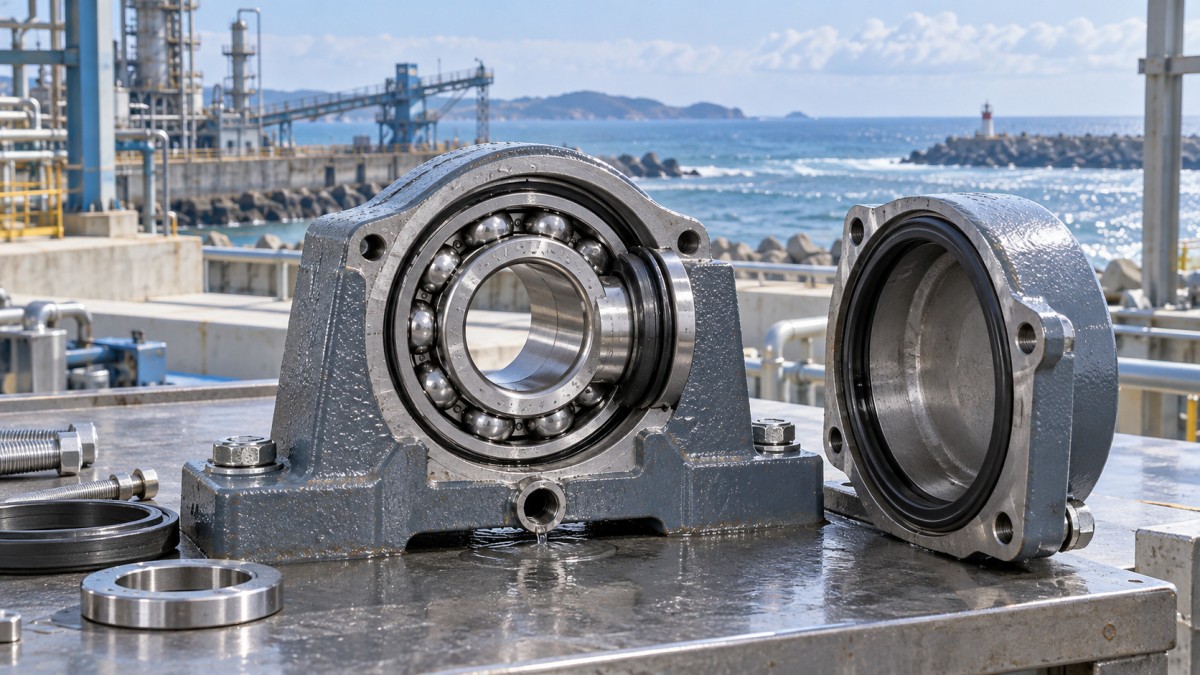
The shaft sealing surface deserves particular attention. Corrosion, scoring, or an unsuitable finish beneath an external seal lip compromises exclusion. A corrosion-resistant bearing installed on a rusting shaft can therefore remain vulnerable. Account for shaft protection, housing joints, and fasteners when assessing the complete arrangement.
Do not transfer an enclosure ingress-protection rating to an individual bearing. Any claimed resistance needs to identify the tested assembly and exposure conditions. High-pressure cleaning directed at a seal is also a different challenge from ordinary rain or airborne spray.
Match grease and operating conditions together
For coastal service, grease must lubricate the rolling contacts while tolerating the moisture exposure that remains after sealing. Relevant properties include water washout resistance, corrosion protection, consistency, base-oil viscosity, and compatibility with seals. No single property resolves all of these requirements.
Choose base-oil viscosity using bearing size, speed, load, and operating temperature. Increasing viscosity solely to resist water can increase friction and operating temperature, especially at higher speeds. Excess grease similarly causes churning; filling every available space is not a universal corrosion-control measure.
Water washout and corrosion performance describe different behavior. Grease that stays in place under water exposure does not necessarily prevent rust in contaminated rolling contacts. Review both forms of evidence, together with any limitations involving salt water or the intended temperature range.
For relubricatable housings, establish a replenishment route and a controlled outlet for displaced grease. Excessive pressure can damage seals or push grease into adjacent equipment. Mixing greases requires compatibility assessment because changes in consistency or oil release can undermine lubrication even when both products perform well separately.
Factory-filled sealed bearings need a different maintenance assumption. Their suitability depends on the retained grease and seals surviving the intended duty. Where repeated contamination is expected, replacement access or an externally protected, relubricatable arrangement deserves consideration.
Verify capacity, speed, and fits after selecting protection
Corrosion resistance does not remove the need for a mechanical calculation. Confirm radial load, axial load, shock loading, speed, and required operating life using data for the selected bearing. Deep groove ball bearings accommodate combined loading within their design limits, but substantial thrust or misalignment can justify a different bearing arrangement.
Calculated fatigue life assumes defined loading and lubrication conditions. It does not predict the time before chloride pitting or water ingress causes failure. Keep the mechanical life calculation and environmental suitability assessment separate so that a favorable calculation does not conceal an unresolved exposure problem.
Seals and grease affect permissible speed and heat generation. Use the rating applicable to the actual sealed configuration, rather than a higher speed shown for an open version. At low loads and high speeds, also confirm the minimum load requirement specified for the bearing.
Internal clearance must account for interference fits and operating temperatures. A tight fit reduces clearance, while temperature differences between shaft and housing alter it further. Choosing additional clearance without calculation can introduce noise or poor load distribution; choosing too little can cause overheating. Confirm shaft and housing tolerances alongside the bearing designation.
Interpret corrosion tests by what they actually demonstrate
A salt-spray test helps compare materials or protective treatments under specified conditions. Its duration cannot be converted directly into years of coastal service. Continuous laboratory exposure differs from daily drying, salt accumulation, grease movement, mechanical loading, and shutdown condensation.
Request the test method, specimen preparation, exposure conditions, and acceptance criteria. Establish whether the test covered bare material, a coated ring, a complete stationary bearing, or a rotating assembly. These configurations answer different questions. A visually clean outer ring says little about lubricant condition or hidden raceway damage.
Useful evidence connects the test to the proposed failure mechanism. For suspected seal leakage, an assembly test involving rotation and representative water exposure is more informative than a material coupon test. For chloride pitting, alloy identification and corrosion results remain relevant even when seals provide the primary barrier.
Where operating consequences justify application testing, define acceptance before testing begins. Assessments can include starting torque, running temperature, vibration, grease contamination, and internal corrosion after disassembly. Include representative shutdown periods if condensation or stationary exposure is part of the duty. Testing a continuously running bearing alone leaves that condition unresolved.
Turn the selection into a usable specification
The purchase description should preserve the engineering choices that control performance. Record the complete bearing designation, ring and rolling-element materials, cage construction, seal design, internal clearance, lubricant, and load and speed requirements. Define any required corrosion evidence by configuration and acceptance criteria, rather than using an unsupported phrase such as “marine grade.”
Also capture the installation conditions on which the selection relies: shaft fit, housing fit, external sealing, drainage, and permitted cleaning exposure. A substitution with the same bore and outside diameter needs review if it changes capacity, seals, grease, or material. Dimensional interchangeability alone is insufficient.
Storage and installation can undo an otherwise sound selection. Keep protective packaging intact until installation, prevent condensation during storage, and avoid washing out the factory lubricant. Apply mounting force through the ring receiving the interference fit; transmitting that force through the balls can damage the rolling contacts before operation begins.
After commissioning, record baseline temperature and vibration under a known operating condition. If deterioration appears, retain the bearing, grease, and seals for examination. Rust deposits, abrasive wear, and raceway indentations point toward different corrective actions. Replacing the bearing with a more corrosion-resistant grade will not resolve a persistent ingress path or mounting defect.
Technical Specifications
- US Commerce Opens Changed Circumstances Review of Mexican Heavy-Walled Rectangular Welded Carbon Steel PipeAuthor :Heavy Industry Strategist
- Selecting Flexible Copper Busbars for Switchgear: Current Rating and Bend RadiusAuthor :Grid Infrastructure Analyst
- Outdoor Vacuum Circuit Breaker Selection: Voltage, Fault Duty, and Site ConditionsAuthor :Grid Infrastructure Analyst
Expert Insights

Chief Security Architect
Dr. Thorne specializes in the intersection of structural engineering and digital resilience. He has advised three G7 governments on industrial infrastructure security.
Related Analysis
- Oct 26, 2026US Commerce Opens Changed Circumstances Review of Mexican Heavy-Walled Rectangular Welded Carbon Steel PipeAuthor :Heavy Industry Strategist
- Oct 26, 2026Selecting Flexible Copper Busbars for Switchgear: Current Rating and Bend RadiusAuthor :Grid Infrastructure Analyst
- Oct 25, 2026Outdoor Vacuum Circuit Breaker Selection: Voltage, Fault Duty, and Site ConditionsAuthor :Grid Infrastructure Analyst
Core Sector // 01
Security & Safety
- How to Choose Corrosion-Resistant Deep Groove Bearings for Coastal SitesAuthor :Heavy Industry Strategist

- How to Select Flange Gaskets for Pressure, Temperature, and Media CompatibilityAuthor :Heavy Industry Strategist

- Selecting High-Temperature Gaskets for Steam, Flanges, and Thermal CyclingAuthor :Heavy Industry Strategist

- Selecting Low-Friction Pneumatic Seals for High-Cycle, Low-Pressure CylindersAuthor :Heavy Industry Strategist

- Selecting Spherical Roller Bearings for Mining: Load, Contamination, and Service LifeAuthor :Heavy Industry Strategist

- Do Deep Groove Ball Bearings Need Special Seals in Coastal Humidity?Author :Heavy Industry Strategist

- How to Select Anti Vibration Rubber Shock Absorbers for Machinery and EquipmentAuthor :Heavy Industry Strategist

- When to Specify Induction Hardened Slewing Ring Bearings for Heavy-Duty EquipmentAuthor :Heavy Industry Strategist