Why sand casting iron parts fail dimensional checks
Author
Date Published
Reading Time
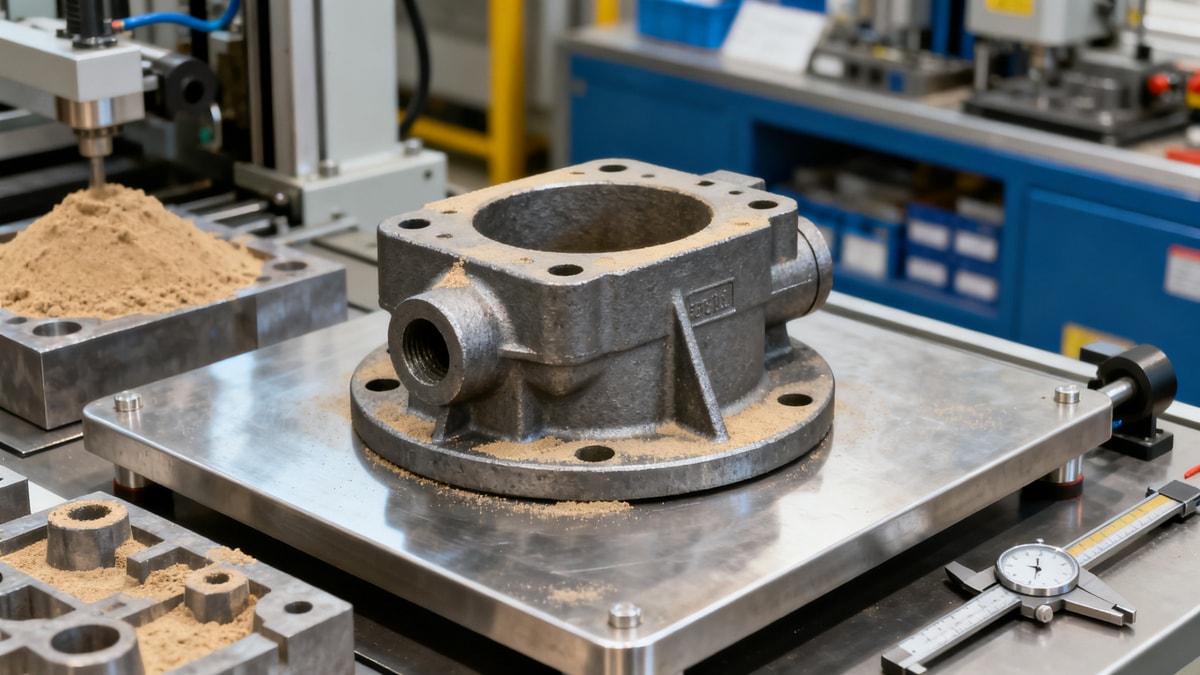
When sand casting iron parts fail dimensional checks, the root cause is rarely a single defect. For quality control and safety teams, even minor deviations can trigger assembly issues, performance risks, and costly rework. This article examines the most common process, tooling, and material factors behind dimensional failure, helping industrial buyers and inspectors identify risks earlier and improve casting consistency.
Why do sand casting iron parts often fail dimensional checks even when the mold looks correct?
A visually acceptable mold does not guarantee acceptable dimensions. In practice, sand casting iron parts can pass a basic appearance review and still fail inspection because dimensional accuracy depends on the entire casting system, not only on cavity shape. Pattern allowances, core placement, mold hardness, pouring temperature, metal shrinkage, shakeout timing, and machining stock all interact. A small shift in one stage can amplify into a measurable deviation in the finished part.
For quality control teams, this is why dimensional nonconformance should be investigated as a process chain issue. A bore centerline may drift because of core movement. Flange thickness may vary because of mold wall erosion. Overall length may miss tolerance because the shrinkage allowance was calculated for one iron grade but the actual chemistry changed solidification behavior. Safety managers should pay special attention when these parts are used in load-bearing housings, valve bodies, pump casings, brackets, or enclosures, where dimensional error can become a fit, sealing, or stress problem later in service.
The main lesson is simple: dimensional failure in sand casting iron parts usually reflects variation control weaknesses, not a single isolated defect.
Which dimensional problems appear most often in sand casting iron parts?
The most common failures are not always dramatic. Many are subtle enough to escape casual review but serious enough to cause rejection at incoming inspection or during assembly. Quality personnel should watch for several recurring patterns.
- Overall length, width, or height outside tolerance because of incorrect shrinkage allowance or uneven cooling.
- Wall thickness variation caused by mold wear, poor sand compaction, or core shift.
- Hole location error due to core misalignment or inadequate core print support.
- Flatness and parallelism problems caused by residual stress, distortion, or nonuniform section cooling.
- Parting line mismatch from cope and drag misalignment.
- Machining allowance shortage, leaving insufficient material to recover dimensions later.
These issues matter because dimensional checks are not only about geometry. They are an early warning of casting process capability. If sand casting iron parts repeatedly drift on datum features, hole spacing, or sealing surfaces, the supplier may also be struggling with repeatability in chemistry, feeding, or mold control.
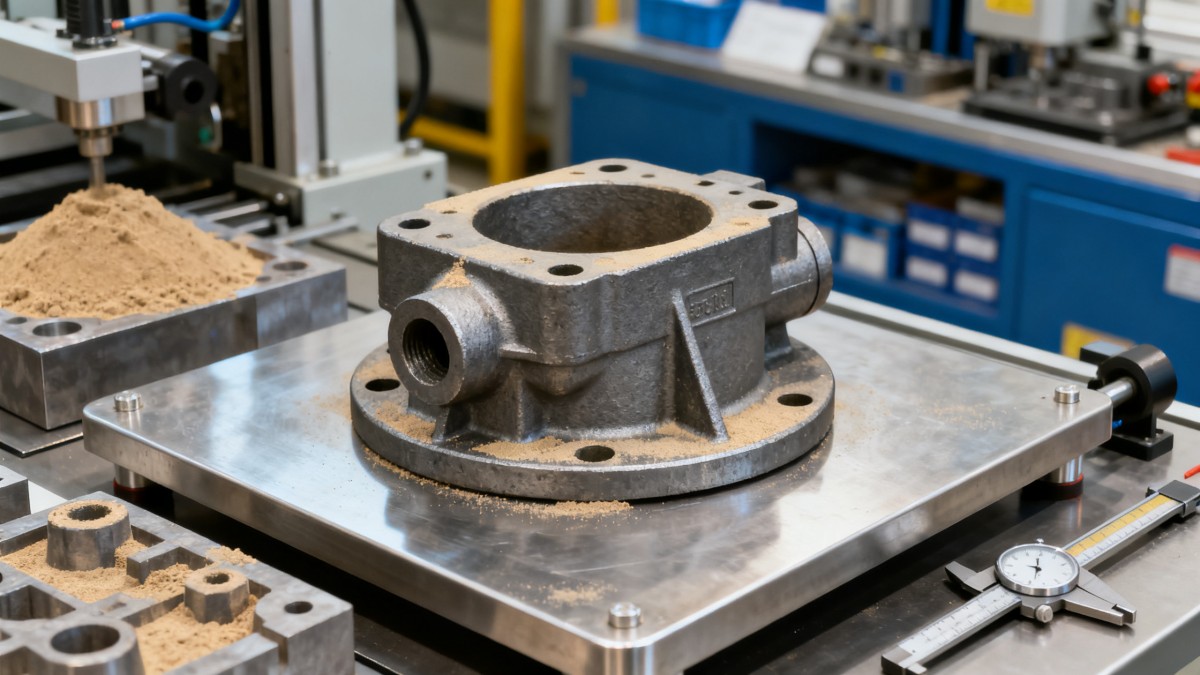
What process factors should inspectors check first when sand casting iron parts fail?
Inspectors should begin with the factors that most directly influence repeatability. The first is pattern and tooling condition. Worn patterns, damaged core boxes, and loose locating features can gradually create dimensional drift across production lots. If failures are increasing over time rather than appearing randomly, tooling wear is a likely contributor.
The second factor is mold and core stability. Sand properties such as moisture, grain distribution, binder content, compactability, and strength affect cavity retention. If the mold face deforms during closing or pouring, the final dimensions will move. Core shift is especially important in sand casting iron parts with internal passages, ports, or mounting holes. Even a slight movement can put features out of position and create wall imbalance that later affects pressure integrity or structural performance.
The third area is pouring and solidification control. Pouring temperature that is too high may increase mold erosion and dimensional instability. Temperature that is too low may cause misruns or incomplete fill, changing edge definition and feature size. Gating and risering design also matter because uneven feeding can produce localized shrinkage or distortion that appears as dimensional failure rather than as a classic visible defect.
Finally, review cooling and handling. Premature shakeout, rough knockout, or improper stacking after casting can warp sections before measurement. In many foundries, dimensional problems emerge not at the mold, but during post-casting handling and stress relief control.
How do material behavior and shrinkage make sand casting iron parts difficult to control?
Iron castings are not dimensionally neutral materials. Gray iron, ductile iron, and other iron grades behave differently during solidification and cooling. Their carbon content, silicon level, inoculation practice, and section thickness influence expansion, contraction, and graphite formation. As a result, a shrinkage rule that works for one part may not transfer cleanly to another.
This is one reason sand casting iron parts require process-specific dimensional planning. Thin sections cool faster than heavy bosses. Mixed section geometry can create internal stress, causing bowing or movement after shakeout. A housing with ribs, pads, and deep cavities may distort because the part does not cool uniformly. If the foundry applies a standard pattern allowance without validating actual thermal behavior, dimensional checks may fail even when the operation appears stable.
For QC and safety teams, material review should include melt chemistry records, inoculation practice, iron grade consistency, and any change in raw material source. A chemistry adjustment intended to improve machinability or hardness can unintentionally alter dimensional performance. This is especially relevant for components that must align with seals, shafts, covers, or bolted interfaces.
What are the most common inspection and measurement mistakes during dimensional checks?
Not every failed dimensional check means the casting itself is wrong. Sometimes the measurement method is the problem. Sand casting iron parts often have rough surfaces, draft angles, flash, parting mismatch, and variable datum accessibility. If the inspection plan does not define datums clearly, different inspectors may obtain different results from the same part.
A common mistake is measuring as-cast features with a machining-based mindset. Cast surfaces are less precise, so the inspection method must match the drawing intent. Another frequent error is ignoring temperature stabilization before measurement. Large iron castings can retain heat or expand and contract with ambient changes, affecting checks on long spans or tight positional tolerances.
Quality teams should also review fixture design, gauge repeatability, coordinate measuring machine strategy, and sampling logic. If the drawing tolerances are unrealistic for the selected casting process, the problem may lie in specification transfer rather than foundry execution. In other words, dimensional failure in sand casting iron parts can arise from poor tolerance allocation between casting and machining stages.
Quick reference table for dimensional failure diagnosis
How can buyers, QC teams, and safety managers reduce dimensional risk before production approval?
The best time to prevent dimensional rejection is before full-rate production starts. For sand casting iron parts, pre-production validation should include a practical review of tolerance feasibility, not just a drawing signoff. Buyers and quality teams should confirm which features are critical-to-fit, critical-to-function, and critical-to-safety. Not every dimension needs the same control method, and forcing unnecessary tight tolerances can raise cost without improving operational performance.
It is also wise to request a documented control plan covering pattern maintenance, core setting verification, melt records, first article inspection, and ongoing capability checks. If the part contains internal geometry, ask how the supplier controls core position and verifies wall thickness. If machining will recover final dimensions, ensure enough stock is specified and consistently delivered.
For safety-sensitive applications, dimensional review should connect directly to service risk. A casting that is slightly off on a nonfunctional boss may be acceptable, but the same deviation on a pressure face, mounting plane, or bearing seat may create failure pathways later. This is why sand casting iron parts for infrastructure, process plants, utilities, and heavy equipment require tighter cross-functional review between sourcing, QC, engineering, and safety stakeholders.
What misconceptions lead companies to underestimate dimensional failure in sand casting iron parts?
One misconception is that dimension problems can always be corrected in machining. In reality, machining cannot fully recover a casting with major core shift, insufficient stock, warped geometry, or misplaced datums. Another misconception is that repeat defects always come from operator error. While operator practice matters, recurring dimensional issues often signal weak process design, unstable sand control, or outdated tooling.
A third mistake is evaluating foundries only on unit price. Lower-cost suppliers may quote aggressively while carrying higher hidden costs in scrap, delayed delivery, inspection burden, and field risk. For industrial buyers, the real benchmark is total dimensional capability across lots, not the lowest initial piece price. Sand casting iron parts that meet the drawing once but drift in later batches still create procurement and safety problems.
There is also a tendency to separate quality from safety. In heavy industry, dimensional nonconformance is often an upstream safety issue. Poor fit can create leakage, vibration, uneven bolt loading, accelerated wear, or installation workarounds. Quality managers and safety managers should therefore treat repeated dimensional failure as a reliability warning, not just a paperwork concern.
What should you ask a supplier when dimensional checks keep failing?
If dimensional rejection persists, the next discussion should go beyond asking for sorting or replacement. Start by requesting evidence of root-cause analysis linked to the specific feature that failed. Ask whether the issue is tied to pattern wear, core location, shrinkage assumptions, mold assembly, pouring practice, or post-casting distortion. Then ask what process control has been changed and how effectiveness will be verified in the next run.
It is also useful to confirm how the supplier defines datums for internal inspection, how often gauges are validated, and whether first-off approval is required after tooling adjustment. For sand casting iron parts supplied into regulated or high-consequence environments, request records that connect dimensional checks with material traceability, heat treatment if applicable, and final release criteria. This creates stronger confidence that the corrective action is systemic rather than temporary.
If you need to confirm a concrete path forward, prioritize these questions: Which dimensions are truly critical? What process variable has the strongest correlation with drift? What capability data supports the supplier’s claim? How much machining stock is available? What lot validation method will be used before shipment? Those answers usually reveal whether the supplier can reliably control sand casting iron parts or is only reacting after failures occur.
Technical Specifications
Expert Insights

Chief Security Architect
Dr. Thorne specializes in the intersection of structural engineering and digital resilience. He has advised three G7 governments on industrial infrastructure security.
Related Analysis
- May 04, 2026When Components & Metals bulk order pricing stops being cheaperAuthor :Heavy Industry Strategist
- May 04, 2026What makes an Instruments & Measurement supplier dependableAuthor :Precision Metrology Expert
- May 04, 2026How to assess an Environment & Ecology exporter by documentationAuthor :Environmental Engineering Director
Core Sector // 01
Security & Safety
- When Components & Metals bulk order pricing stops being cheaperAuthor :Heavy Industry Strategist

- What a Components & Metals manufacturer should prove firstAuthor :Heavy Industry Strategist

- How metallurgical engineering manufacturers improve consistencyAuthor :Heavy Industry Strategist

- Why Components & Metals specs break sourcing plansAuthor :Heavy Industry Strategist

- How to vet a closed die forging parts supplier fastAuthor :Heavy Industry Strategist

- Closed die forging parts or casting parts for high loads?Author :Heavy Industry Strategist

- Industrial metallurgy choices that affect part lifespanAuthor :Heavy Industry Strategist

- Why investment casting manufacturer quotes vary so muchAuthor :Heavy Industry Strategist