When Components & Metals bulk order pricing stops being cheaper
Author
Date Published
Reading Time
For finance approvers, the assumption that larger volumes always cut costs can be dangerously misleading. In Components & Metals bulk order decisions, price breaks may disappear once logistics, storage, compliance, scrap risk, and cash-flow pressure are fully accounted for. This article examines when bulk purchasing stops delivering savings and how to evaluate the true total cost before approving high-value industrial procurement.
In industrial buying, especially across mechanical components, fabricated metal parts, raw metal stock, fasteners, housings, tubing, and precision-machined items, the unit price shown on a quotation is only the visible layer of cost. The real financial exposure often emerges 30, 90, or 180 days later, when inventory is aging, engineering revisions arrive, or imported material requires additional certification checks.
For organizations managing EPC projects, plant maintenance, OEM production, or infrastructure upgrades, a Components & Metals bulk order can still be the right move. But finance teams need a disciplined approval framework. The key question is not whether the supplier gives a 4% or 8% volume discount. The key question is whether the full landed and usable cost per accepted unit remains lower after all downstream variables are included.
Why bulk order pricing loses its advantage in industrial procurement
The first warning sign appears when purchase volume rises faster than actual consumption. If a facility uses 8,000 stainless fasteners per quarter but approves a 40,000-piece order to secure a lower unit price, the buyer may lock in 12 to 15 months of stock. That sounds efficient until carrying costs, bin management, quality inspections, and obsolescence are added to the cost model.
In metals procurement, the problem becomes even more pronounced. Sheet, bar, coil, castings, and forgings are sensitive to grade traceability, corrosion exposure, storage conditions, and processing waste. A discounted Components & Metals bulk order may stop being cheaper when only 85% to 92% of the received material ends up in accepted production use.
1. Inventory carrying costs quietly absorb the discount
Finance teams often calculate purchase savings but underestimate inventory holding cost. In many industrial environments, annual carrying cost lands in a practical range of 15% to 30% of inventory value when warehousing, insurance, internal handling, cycle counting, shrinkage, and capital cost are considered together. A 7% unit-price discount can disappear quickly if material sits for 9 months instead of 6 weeks.
This risk is highest for slow-moving MRO parts, project-based metal stock, and custom-machined components with non-transferable specifications. The longer the storage period, the greater the chance that engineering requirements, coating standards, or dimensional tolerances will change before all units are consumed.
Typical carrying-cost triggers
- Inventory coverage exceeding 120 days for standard components
- Inventory coverage exceeding 60 to 90 days for engineered-to-order metal items
- Higher internal inspection frequency for regulated or safety-related parts
- Additional packaging, racking, or humidity control for corrosion-sensitive materials
2. Logistics and packaging costs scale nonlinearly
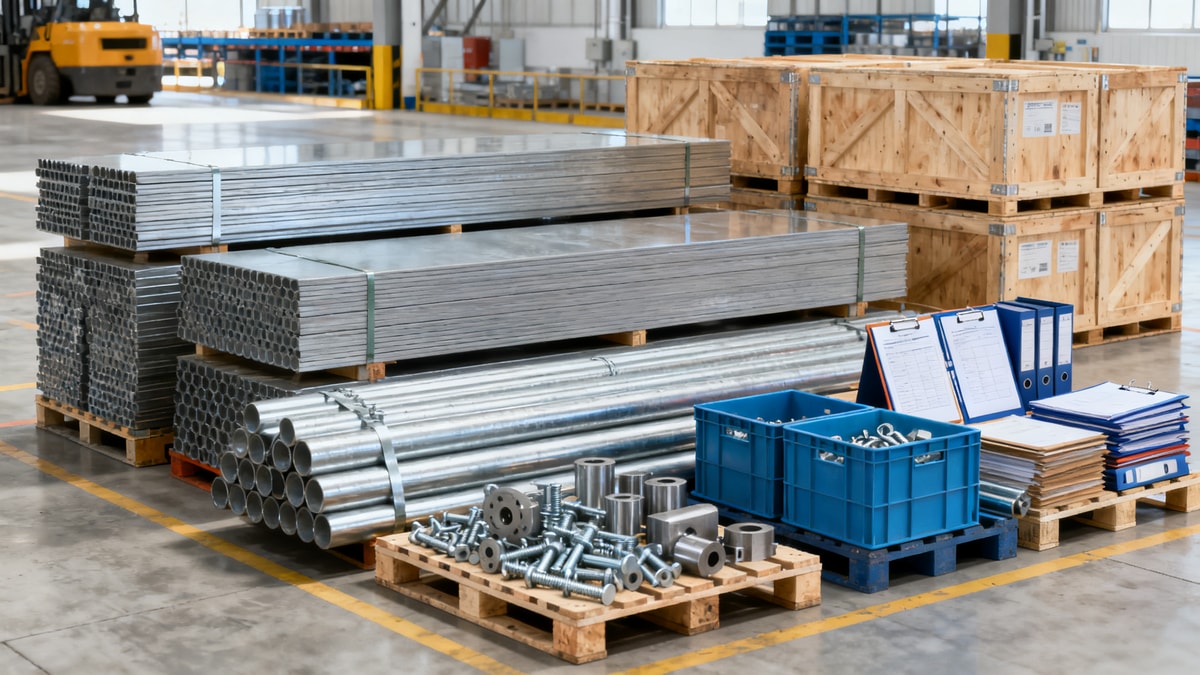
Bulk buying does not always reduce freight cost per usable unit. Once shipment weight crosses pallet, container, or route thresholds, transportation economics change. A Components & Metals bulk order may require export crating, moisture barriers, fumigation-compliant wooden packaging, or split delivery arrangements. Each step adds cost that is rarely visible in the supplier’s headline price.
For imported metals or mixed component loads, the logistics profile can worsen further. Larger shipments can increase customs review probability, unloading complexity, and receiving congestion. A 20-ton shipment delayed by even 7 to 10 days may trigger project sequencing issues or temporary material substitutions that carry their own cost premium.
The table below shows common points at which bulk pricing stops producing net savings for industrial buyers.
For finance approvers, the main lesson is simple: the cheapest quote line is not the lowest cost position. Once stock duration, usable yield, and freight complexity cross practical thresholds, bulk savings narrow quickly and may turn negative.
The hidden cost drivers behind a Components & Metals bulk order
Industrial procurement decisions are often approved on three visible figures: unit price, total order value, and lead time. But a sound approval should also test at least six hidden cost drivers. These are especially relevant for fabricated parts, specialty alloys, coated components, and tolerance-critical assemblies used in plant, utility, transport, and heavy-equipment settings.
Compliance and traceability costs
When a Components & Metals bulk order includes safety-relevant or regulated materials, every batch may require mill test reports, dimensional inspection records, coating verification, or country-of-origin documentation. If the order is split across multiple heats, lots, or subcontracted finishing operations, document control can become a material cost center.
The burden is heavier in projects where CE, UL, ISO-aligned procedures, customer-specific QA plans, or third-party witnessing are involved. Even if the supplier does not charge much more upfront, internal quality teams may spend 4 to 12 extra labor hours per shipment validating paperwork and nonconformance risk.
Scrap, cut loss, and process waste
For metal stock, the approved volume should reflect usable output, not just purchased weight. A large buy of plate or bar can look attractive until nesting loss, saw-cut kerf, trim waste, and rejected sections reduce actual yield. In many practical settings, utilization varies by geometry and process, often from 88% to 97% for stable production and lower for prototype-heavy or revision-prone work.
This matters because finance may approve based on cost per kilogram, meter, or piece, while production lives with cost per usable assembly. If 10% more material must be purchased than the BOM implies, the bulk discount must first recover that loss before any savings are real.
Cash-flow pressure and working-capital drag
A lower unit price is often funded by a larger immediate cash commitment. For finance leaders, that creates an opportunity-cost question. Would the same capital generate more value if allocated to short-lead items, outage-critical spares, or supplier diversification? A Components & Metals bulk order that ties up cash for 120 to 180 days may weaken purchasing flexibility across the rest of the procurement portfolio.
This is especially important in volatile commodity periods. If steel, aluminum, copper, nickel, or alloy surcharges move unexpectedly, a large inventory position can either protect margins or trap capital in stock acquired at the wrong point in the cycle. Finance approval should therefore test price risk and liquidity impact together, not separately.
A practical six-point hidden-cost checklist
- Expected inventory days on hand after receipt
- Usable yield percentage after cutting, machining, and inspection
- Extra QA or compliance labor per lot
- Storage and preservation requirements over 30, 60, and 90 days
- Probability of engineering revision before full consumption
- Cash conversion impact versus staged or scheduled releases
How finance approvers should evaluate total cost before approving volume buys
A reliable decision model for a Components & Metals bulk order should move beyond supplier discount ladders. The approval framework should compare at least three purchase scenarios: immediate bulk buy, staggered releases against a pricing agreement, and smaller recurring orders with safety stock support. This comparison often reveals that the best financial outcome is neither the smallest order nor the largest one.
Build a landed-and-usable cost model
Instead of using quoted unit price alone, finance should calculate landed-and-usable cost per accepted unit. This means adding freight, duties where applicable, packaging, receiving labor, quality inspection, scrap allowance, storage, and capital cost. If the order is for metal stock, the model should also include process yield assumptions and offcut recovery value where relevant.
A useful internal rule is to test three cases: base case, moderate-risk case, and adverse case. For example, compare usable yield at 96%, 92%, and 88%, or inventory coverage at 45, 90, and 150 days. If the savings survive all three cases, the large order is more likely to be financially sound.
The table below outlines a practical comparison approach that finance teams can use during approval reviews.
In many industrial categories, blanket orders with 30-day, 60-day, or milestone-based releases deliver the strongest balance between price control and financial discipline. They preserve supply continuity without forcing the buyer to absorb all inventory risk on day one.
Use threshold-based approval rules
Finance approvers benefit from simple thresholds. For instance, require additional review when inventory coverage exceeds 90 days, when engineering revision cycles are shorter than 6 months, when projected scrap exceeds 5%, or when a single order consumes more than a defined share of monthly procurement budget. Thresholds create consistency and reduce approval decisions based on quote appearance alone.
Another practical rule is to separate standard catalog items from custom or specification-sensitive items. A Components & Metals bulk order for universal fasteners or standard carbon steel stock may be supportable at 120-day coverage. The same coverage for custom brackets, coated parts, or special-alloy components may be too aggressive unless there is locked demand and stable engineering documentation.
Common mistakes that lead to false savings
Even experienced procurement and finance teams repeat a few predictable errors. These errors usually appear when project urgency, supplier pressure, or annual budget timing makes the discount feel too attractive to question. Recognizing these patterns can prevent high-value purchasing mistakes before they reach approval stage.
Confusing purchase price with total cost
The most common error is treating quoted price as the decision metric. In practice, a 6% lower purchase price can become a 3% higher total cost after receiving labor, inspection overhead, scrap, and storage are included. This is particularly true when orders combine components and raw metals with different handling and traceability requirements.
Overbuying against uncertain demand
Forecast accuracy matters. If actual demand can vary by plus or minus 20%, then a large order based on best-case consumption may create excess inventory almost immediately. For capital projects, maintenance shutdowns, and phased installations, release schedules often shift. Finance should ask whether demand is committed, likely, or merely expected.
Ignoring lot variability and quality risk
A large Components & Metals bulk order can amplify the financial effect of one quality issue. If a dimensional deviation, hardness mismatch, coating defect, or material certificate discrepancy affects a major lot, the exposure is far greater than in smaller staged purchases. Bigger orders can reduce frequency of transactions, but they can also concentrate risk into fewer receipts.
Questions finance should ask before final approval
- What percentage of this order will be consumed within 60 days, 90 days, and 180 days?
- What is the expected usable yield after processing and inspection?
- Are there any pending engineering changes, alternate material reviews, or coating revisions?
- Can the supplier hold stock and release in stages under the same commercial terms?
- What internal labor is required for receiving, certification review, and periodic inventory control?
A smarter purchasing approach for components and metals
The strongest procurement strategy is often a hybrid model. Rather than treating every Components & Metals bulk order the same, segment purchases into three groups: stable high-run items, variable-demand standard items, and custom or revision-sensitive items. Each group should have a different approval logic and stock policy.
Stable, high-consumption items may justify larger commitments when demand is proven across 2 to 4 quarters. Variable-demand items often perform better under blanket agreements with scheduled releases. Custom or compliance-heavy items should usually be bought in tighter quantities unless the project timeline, documentation, and use case are fully locked.
What this means for finance-led approvals
A disciplined approval process protects more than cost. It supports working-capital control, operational resilience, and supplier accountability. For finance approvers, the goal is not to reject volume buying. It is to approve only those orders where price, consumption timing, compliance burden, and risk profile are aligned.
Global Industrial Core supports industrial decision-makers with structured sourcing insight across components, metallurgy, compliance, and operational procurement risk. If your team is evaluating a high-value order and needs a clearer framework for true cost comparison, now is the right time to review the numbers before the purchase order is issued.
For buyers, plant operators, EPC contractors, and finance leaders facing complex industrial sourcing decisions, a better question is not “How much is the discount?” but “How much of the order will still be value-creating after 90 or 180 days?” To assess your next Components & Metals bulk order with greater confidence, contact us to discuss your sourcing scenario, request a tailored evaluation framework, or learn more solutions for industrial procurement planning.
Technical Specifications
Expert Insights

Chief Security Architect
Dr. Thorne specializes in the intersection of structural engineering and digital resilience. He has advised three G7 governments on industrial infrastructure security.
Related Analysis
- May 04, 2026When Components & Metals bulk order pricing stops being cheaperAuthor :Heavy Industry Strategist
- May 04, 2026What makes an Instruments & Measurement supplier dependableAuthor :Precision Metrology Expert
- May 04, 2026How to assess an Environment & Ecology exporter by documentationAuthor :Environmental Engineering Director
Core Sector // 01
Security & Safety
- When Components & Metals bulk order pricing stops being cheaperAuthor :Heavy Industry Strategist

- What a Components & Metals manufacturer should prove firstAuthor :Heavy Industry Strategist

- How metallurgical engineering manufacturers improve consistencyAuthor :Heavy Industry Strategist

- Why Components & Metals specs break sourcing plansAuthor :Heavy Industry Strategist

- How to vet a closed die forging parts supplier fastAuthor :Heavy Industry Strategist

- Closed die forging parts or casting parts for high loads?Author :Heavy Industry Strategist

- Industrial metallurgy choices that affect part lifespanAuthor :Heavy Industry Strategist

- Why investment casting manufacturer quotes vary so muchAuthor :Heavy Industry Strategist