A Pen Reveals China's Flexible Manufacturing Revolution
Author
Date Published
Reading Time
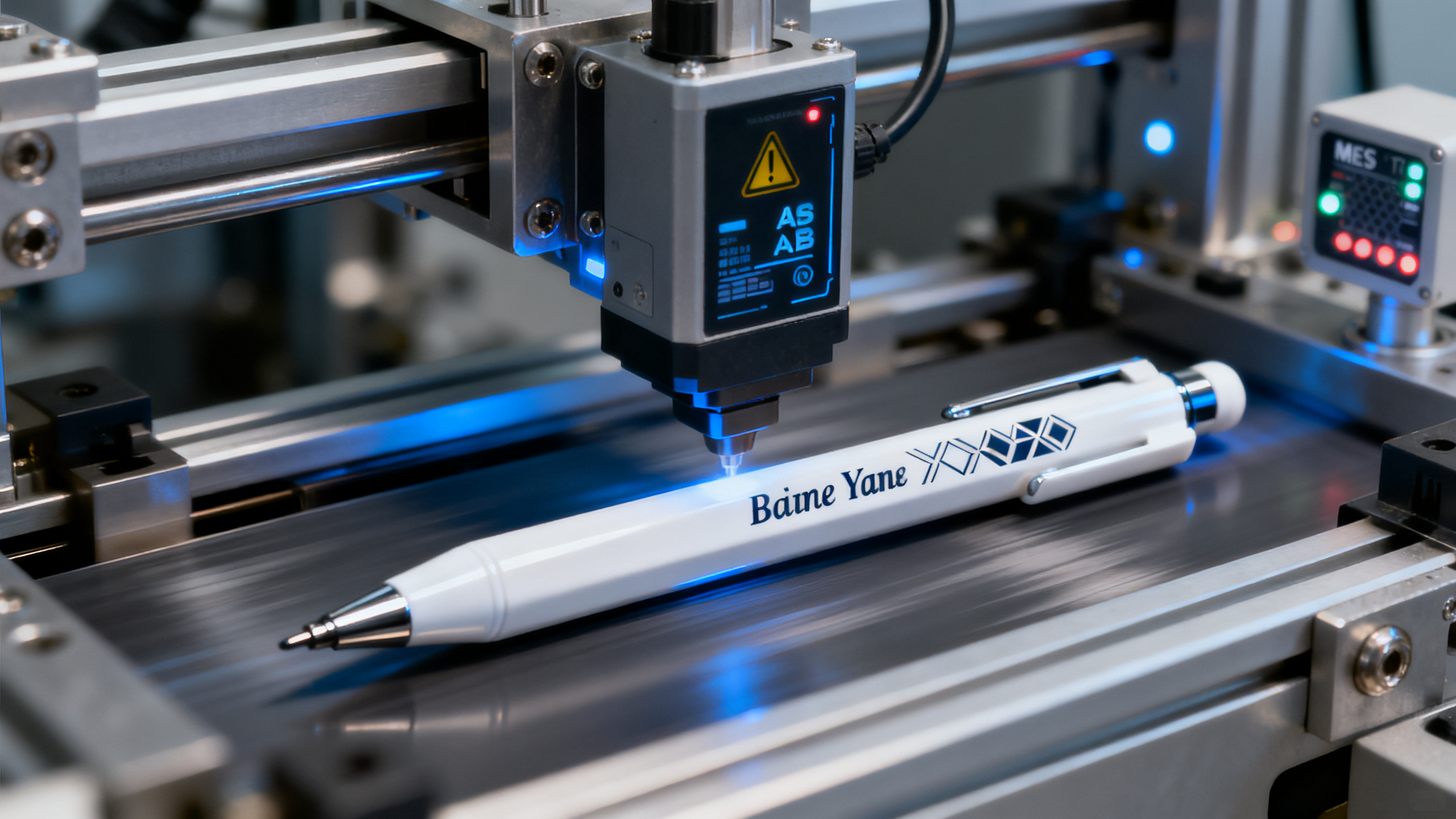
On May 11, 2026, a deep-dive industry report highlighted that Chinese stationery manufacturers have achieved true single-piece customization for ballpoint pens—enabling on-demand printing of names, patterns, and personalized messages, with delivery within 48 hours. This development signals emerging implications for export-oriented small-batch manufacturing sectors, including industrial signage, instrument nameplates, and safety warning labels.
Event Overview
On May 11, 2026, an industry report confirmed that Chinese pen manufacturing facilities have implemented flexible production capable of single-unit customization: real-time digital printing of personalized text and graphics on ballpoint pens, supported by modular production lines, MES+IoT scheduling systems, and compact digital printing units. Delivery time has been reduced to 48 hours. The model is now being replicated in adjacent B2B labeling segments—specifically industrial nameplates, instrumentation铭牌 (translated as 'instrument nameplates'), and safety warning labels—to meet overseas demand for low-volume, high-variety, and rapidly delivered orders.
Industries Affected
Direct Export Trading Companies
These firms face shifting buyer expectations: overseas clients increasingly request short-run, customized items without MOQ penalties or extended lead times. The pen case demonstrates that such capabilities are now operationally viable—not just conceptual—within China’s light industrial base. Impact includes pressure to revise quoting logic, revise lead-time guarantees, and re-evaluate supplier qualification criteria beyond cost and scale.
Raw Material Procurement Enterprises
Suppliers of substrates (e.g., ABS/PP pen barrels), specialty inks, and printable films may see rising demand for smaller-lot, higher-specification variants—especially those compatible with on-the-fly digital printing and rapid curing. Impact centers on inventory planning: traditional bulk procurement models may misalign with the new just-in-sequence material flow enabled by MES+IoT integration.
Contract Manufacturing & OEM Factories
Factories serving international brands across non-pen categories—including electronics enclosures, medical device housings, and HVAC components—may encounter requests to extend similar personalization capabilities (e.g., batch-specific serials, customer logos, compliance markings) to their own product lines. Impact manifests in equipment evaluation cycles, operator upskilling needs, and validation requirements for traceable micro-batch output.
Supply Chain Service Providers
Logistics and fulfillment partners supporting cross-border e-commerce or B2B micro-fulfillment will need to accommodate tighter order-to-shipment windows and greater SKU fragmentation per shipment. Impact includes revised warehouse slotting logic, increased label-handling complexity, and potential need for localized print-on-demand handoff points near port zones.
What Relevant Companies or Practitioners Should Focus On
Monitor early adoption signals in adjacent verticals
Track pilot deployments beyond stationery—particularly in instrument nameplates and safety labels—where regulatory traceability and low-volume flexibility coexist. Early commercial use cases (e.g., CE-marked custom labels for EU lab equipment distributors) offer realistic benchmarks for capability scaling.
Evaluate MES+IoT readiness—not just automation
Current flexible pen production relies less on full robotic lines and more on tightly coordinated modular stations with real-time data exchange. Firms should assess whether their existing MES supports dynamic job routing, IoT-enabled machine status feedback, and digital print queue synchronization—not merely dashboard reporting.
Assess digital printing unit integration feasibility
Micro-digital printing units used in this application operate at sub-50mm print width, support variable-data RIP engines, and integrate directly into conveyor-based assembly. Procurement teams should benchmark compatibility with common substrate types (e.g., curved plastic, anodized aluminum) before assuming plug-and-play deployment.
Prepare for upstream communication shifts
As customization moves closer to point-of-sale, brand owners may shift from static artwork files to API-driven metadata feeds (e.g., JSON payloads containing name, language, logo ID). Engineering and QA teams should begin reviewing internal workflows for handling dynamic input validation and version-controlled print asset management.
Editorial Perspective / Industry Observation
Observably, this pen case is not primarily about stationery—it is a visible proxy for a broader recalibration in how Chinese contract manufacturing interprets ‘low-volume, high-mix’ demand. Analysis shows the enabling technologies (modular lines, lightweight MES+IoT, embedded digital printing) are now sufficiently mature, affordable, and interoperable to move beyond pilot labs into revenue-generating production. From an industry perspective, it functions less as a finished outcome and more as a leading indicator: one suggesting that responsiveness—not just scale—is becoming a baseline operational expectation for globally competitive suppliers. Continued attention is warranted because scalability beyond visual customization (e.g., functional variations like voltage ratings or material grades) remains unconfirmed in public reports.
Conclusion: This development reflects an operational inflection—not a technological breakthrough—in China’s manufacturing responsiveness. It underscores a shift toward treating variability as a managed process rather than a constraint. Currently, it is best understood as an early-stage capability demonstration with clear replication pathways in adjacent precision-labeling domains, rather than a wholesale transformation of mass production logic.
Source: Industry deep-dive report published May 11, 2026. Note: Deployment scope beyond stationery—particularly in regulated sectors such as medical or industrial instrumentation—remains under observation and is not yet publicly verified.
Technical Specifications
- Air Handling Unit Supplier Checklist: Performance Data, Lead Times, and SupportAuthor :Environmental Engineering Director
- Buying Fiberglass Water Tanks Wholesale: Compare Quotes and Delivery CostsAuthor :Environmental Engineering Director
- Choosing an XLPE Power Cable Supplier: Test Reports, Traceability, and Lead TimesAuthor :Grid Infrastructure Analyst
Expert Insights

Chief Security Architect
Dr. Thorne specializes in the intersection of structural engineering and digital resilience. He has advised three G7 governments on industrial infrastructure security.
Related Analysis
- Oct 19, 2026Air Handling Unit Supplier Checklist: Performance Data, Lead Times, and SupportAuthor :Environmental Engineering Director
- Oct 18, 2026Buying Fiberglass Water Tanks Wholesale: Compare Quotes and Delivery CostsAuthor :Environmental Engineering Director
- Oct 17, 2026Choosing an XLPE Power Cable Supplier: Test Reports, Traceability, and Lead TimesAuthor :Grid Infrastructure Analyst
Core Sector // 01
Security & Safety
- How to Build an Equipment Budget for EPC Projects Without Underestimating Lifecycle CostsAuthor :Safety Compliance Lead

- Selecting EPC Procurement Support Tools to Reduce Vendor and Delivery DelaysAuthor :Safety Compliance Lead

- How to Select an Access Control Management System for Multi-Site FacilitiesAuthor :Safety Compliance Lead

- How to Select Electronic Hotel Key Card Locks for Guest Rooms and Staff AreasAuthor :Safety Compliance Lead

- How to Evaluate a Hotel Key Card Lock Supplier for Multi-Property RolloutsAuthor :Safety Compliance Lead

- Pre-Contract Audit Checklist for Verified Production Safety and Environmental ComplianceAuthor :Safety Compliance Lead

- How Can Distributors Build Procurement-Oriented Industrial Content That Drives RFQs?Author :Safety Compliance Lead

- EU Mandates EN 50131-1:2026 for Security SystemsAuthor :Safety Compliance Lead