RTD PT100 Sensors Explained: Accuracy Classes, Wiring Options, and Temperature Range
Author
Date Published
Reading Time

RTD PT100 sensors are a benchmark for precision temperature measurement in industrial systems, but selecting the right model requires more than knowing the basics.
This guide explains accuracy classes, wiring options, and temperature range considerations for better technical comparison, compliance review, and application fit.
Across process plants, power assets, HVAC networks, and machinery, rtd pt100 sensors remain a trusted option where stability and repeatability matter.
What are RTD PT100 sensors and why are they widely used?
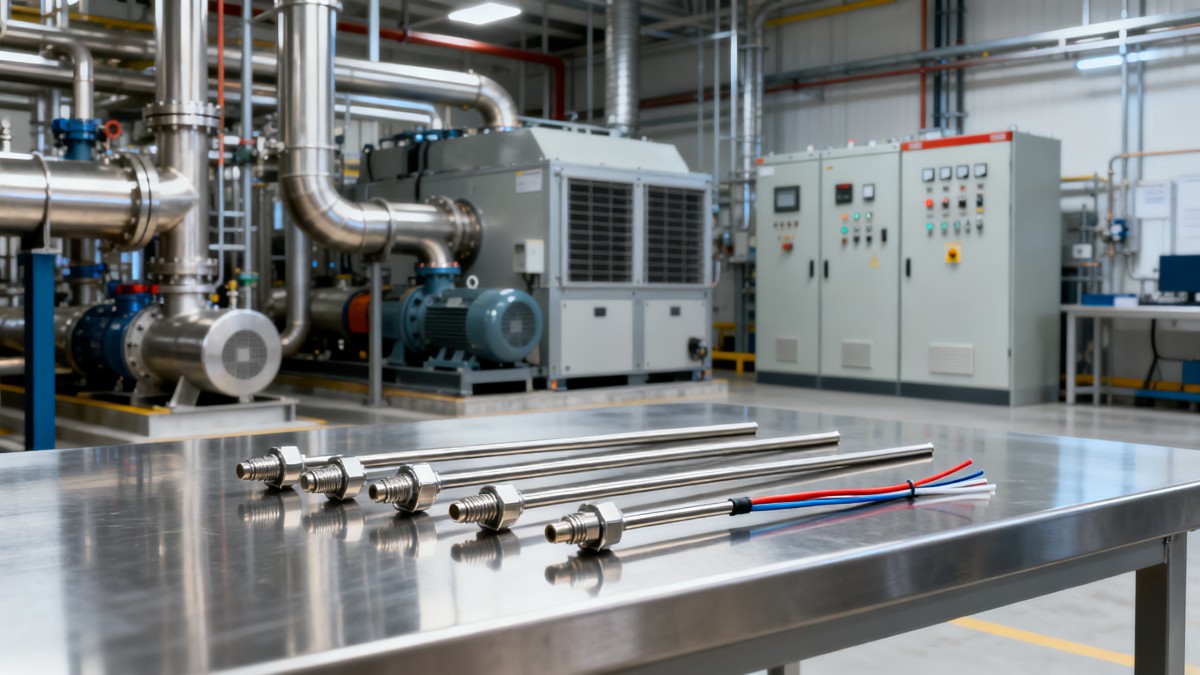
RTD PT100 sensors are resistance temperature detectors built with platinum elements.
The “PT” refers to platinum, and “100” means 100 ohms at 0°C.
As temperature changes, resistance changes in a predictable and nearly linear way.
That predictable behavior makes rtd pt100 sensors suitable for control loops, data logging, and safety-critical monitoring.
Compared with thermocouples, PT100 devices usually offer better accuracy and long-term stability in moderate temperature ranges.
They are common in reactors, pipelines, compressors, transformer systems, food equipment, and environmental monitoring stations.
Industrial users also value their compatibility with transmitters, PLC input cards, and standardized calibration procedures.
Where do they fit best?
- Continuous process temperature measurement
- Equipment protection in motors and bearings
- Energy systems requiring stable readings
- Clean processes needing repeatable calibration
- Building automation and utility distribution
How do accuracy classes for RTD PT100 sensors work?
Accuracy class defines the allowable deviation from true temperature under a recognized standard.
For rtd pt100 sensors, IEC 60751 is the reference most engineers check first.
Common classes include Class B, Class A, and higher-precision options such as Class AA.
A tighter class reduces measurement uncertainty, but cost and installation sensitivity usually increase.
What do the classes mean in practice?
Class B is widely used for general industrial service where reliable performance matters more than laboratory-level precision.
Class A fits tighter process control, energy balancing, and regulated applications with stricter reporting requirements.
Class AA supports higher-accuracy duties, often in pharmaceutical, metrology, or advanced test environments.
However, sensor class alone does not guarantee system accuracy.
Transmitter tolerance, lead resistance, immersion depth, thermal lag, and calibration quality also affect final results.
Which wiring option is best: 2-wire, 3-wire, or 4-wire?
Wiring choice strongly affects the real-world accuracy of rtd pt100 sensors.
The main issue is lead resistance, especially over long cable runs.
2-wire RTD PT100 sensors
A 2-wire circuit is simple and low cost.
But the resistance of the wires adds directly to the sensor reading.
This method works best for short runs and lower-accuracy applications.
3-wire RTD PT100 sensors
3-wire designs are the industrial standard in many plants.
The extra lead allows compensation for wire resistance, assuming lead lengths are closely matched.
This gives a strong balance between accuracy, simplicity, and installation cost.
4-wire RTD PT100 sensors
4-wire circuits provide the highest measurement accuracy.
They nearly eliminate lead resistance error by separating current and voltage measurement paths.
They are ideal for calibration benches, long cable distances, and critical measurement systems.
What temperature range should be considered for RTD PT100 sensors?
Many standard rtd pt100 sensors operate from about -200°C to 600°C, sometimes higher with specialized construction.
Still, the usable range depends on sheath material, insulation, probe design, and surrounding media.
A published element range is not the same as reliable field operating range.
Why does range selection matter?
Running near the upper limit can shorten sensor life and increase drift.
At very low temperatures, mechanical stress and moisture sealing become more important.
Fast cycling between hot and cold conditions can also fatigue the sensing assembly.
Useful range checks before selection
- Normal operating temperature, not only peak temperature
- Exposure duration at extremes
- Pressure, vibration, and chemical compatibility
- Need for thermowell or direct immersion
- Required response time and immersion length
How can RTD PT100 sensors be compared for industrial applications?
A useful comparison goes beyond element type.
For industrial use, rtd pt100 sensors should be reviewed as a full measurement assembly.
Key comparison points
- Accuracy class under IEC 60751
- 2-wire, 3-wire, or 4-wire configuration
- Probe diameter and response time
- Mineral insulated or wire-wound construction
- Sheath material, such as 316 stainless steel
- Ingress protection, vibration resistance, and approvals
- Calibration documentation and traceability
In harsh sites, environmental sealing and mechanical durability may matter more than the highest nominal accuracy.
In utility, power, and process infrastructure, compliance with CE, UL, ISO, and site specifications often drives the final decision.
What mistakes are common when selecting RTD PT100 sensors?
One common mistake is choosing by price only.
A low-cost probe may create larger lifecycle costs through drift, downtime, or poor compatibility.
Another mistake is assuming all PT100 probes perform the same if the resistance curve is standardized.
In reality, construction quality, sealing, and lead termination strongly affect field performance.
A third issue is ignoring the complete signal chain.
Even high-grade rtd pt100 sensors can underperform if paired with poor transmitters or incorrect wiring.
How should the final selection be made?
Start with the required measurement uncertainty and operating temperature window.
Then confirm wiring method, probe construction, sheath material, mounting style, and certification needs.
For many industrial systems, 3-wire rtd pt100 sensors with Class A or Class B elements provide the best balance.
For higher assurance, request calibration records, tolerance data, and environmental performance details before approval.
RTD PT100 sensors deliver strong value when selection is based on application reality rather than catalog shorthand.
Use a structured checklist, compare total measurement chain performance, and verify compliance before deployment.
That approach reduces risk, improves measurement consistency, and supports resilient industrial operations over the long term.
Technical Specifications
- How to Select Electronic Hotel Key Card Locks for Guest Rooms and Staff AreasAuthor :Safety Compliance Lead
- How to Select Lab Instruments for Reliable Chemical Analysis WorkflowsAuthor :Precision Metrology Expert
- How to Size a UPS for Server Rooms: Load, Runtime, and Redundancy FactorsAuthor :Grid Infrastructure Analyst
Expert Insights

Chief Security Architect
Dr. Thorne specializes in the intersection of structural engineering and digital resilience. He has advised three G7 governments on industrial infrastructure security.
Related Analysis
- Sep 17, 2026How to Select Electronic Hotel Key Card Locks for Guest Rooms and Staff AreasAuthor :Safety Compliance Lead
- Sep 16, 2026How to Select Lab Instruments for Reliable Chemical Analysis WorkflowsAuthor :Precision Metrology Expert
- Sep 15, 2026How to Size a UPS for Server Rooms: Load, Runtime, and Redundancy FactorsAuthor :Grid Infrastructure Analyst
Core Sector // 01
Security & Safety
- What to Check When Sourcing Vibration Meters Wholesale for Industrial MaintenanceAuthor :Precision Metrology Expert

- How to Select Process Control Instruments for Accuracy, Safety, and UptimeAuthor :Precision Metrology Expert

- What Should Standards Compliance Analysis Training Cover Before an Audit?Author :Precision Metrology Expert

- Why Do Pressure Instruments Fail in High-Vibration Sites?Author :Precision Metrology Expert

- Is FM Software Integration Needed for Overseas Instrument Maintenance?Author :Precision Metrology Expert

- What Are the Differences Between Lab and Field Testing Equipment?Author :Precision Metrology Expert

- Is Independent Testing Necessary for Critical Safety Components?Author :Precision Metrology Expert

- How to Validate Industrial Application Scenarios Before ProcurementAuthor :Precision Metrology Expert