Choosing Ambient Air Monitoring Equipment: Pollutants, Range and Accuracy
Author
Date Published
Reading Time
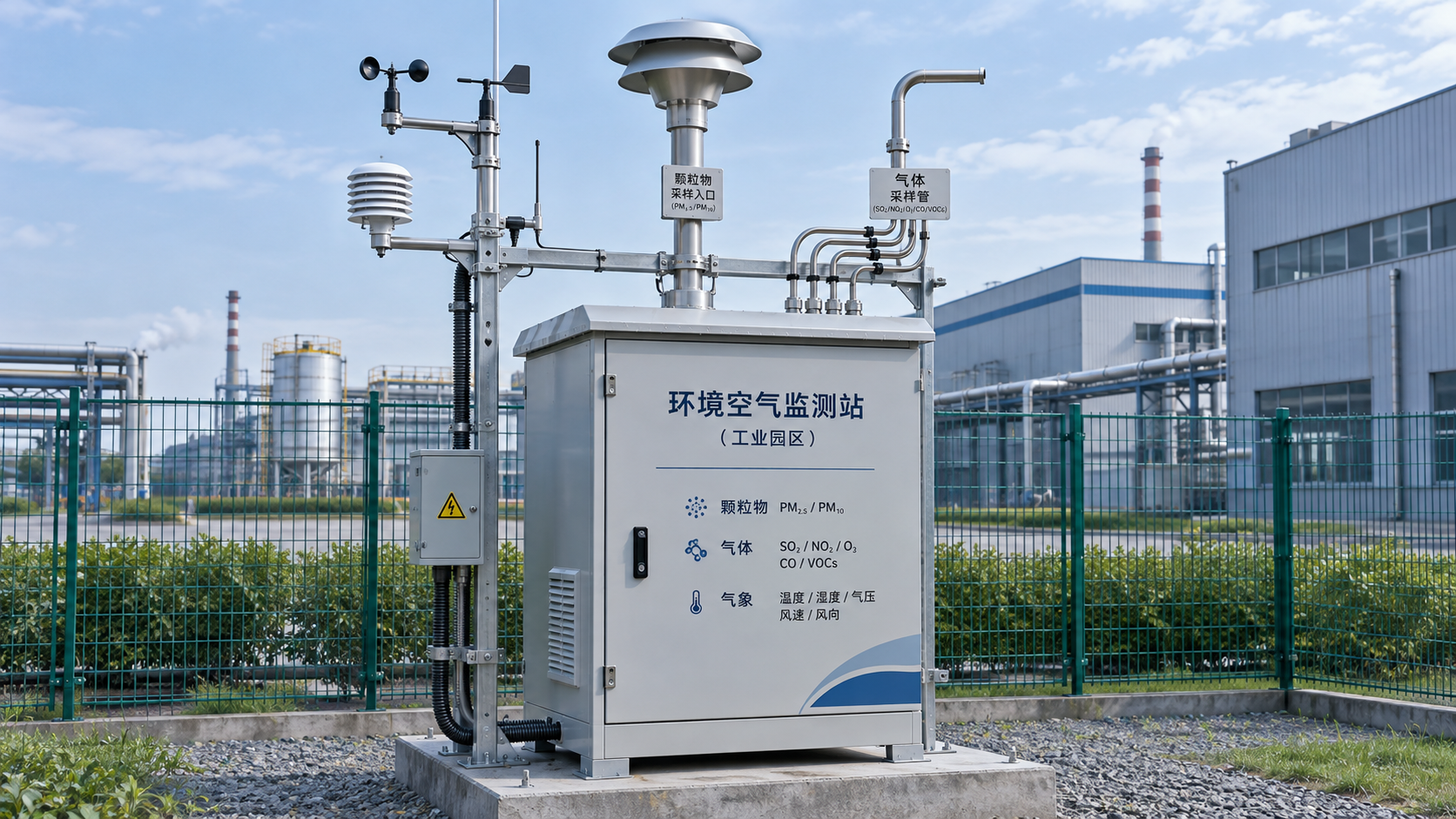
Choose ambient air monitoring equipment by matching the pollutant and measurement objective to the instrument’s range, detection capability, uncertainty, and approved method. A monitor suited to identifying changes near an industrial boundary is not necessarily suitable for demonstrating compliance with an ambient air quality limit.
The decisive question is whether the complete measurement system can produce defensible data at the concentrations, averaging times, and environmental conditions that matter. Sensor specifications alone do not establish that performance: sampling, calibration, siting, maintenance, and data validation are equally important.
Start with the decision the measurement must support
Define the pollutant, location, averaging period, and intended use before comparing instruments. A compliance station, a source-investigation network, and a community screening project can measure the same pollutant yet require different equipment and quality controls.
- Regulatory assessment: Identify the applicable jurisdiction, pollutant standard, averaging period, and accepted measurement methods. An instrument’s general conformity claims are not a substitute for method approval for the intended use.
- Background and trend monitoring: Prioritize low-concentration performance, long-term stability, calibration traceability, and consistency across the historical record.
- Industrial boundary screening: Consider response time, wind information, siting, and potential peak concentrations. Measurements can indicate a pattern that merits investigation, but concentration alone does not necessarily identify the source.
- Network mapping: Evaluate unit-to-unit agreement, communications, power, maintenance capacity, and field correction as well as the price of each node.
Write a measurement objective in operational terms: for example, whether the system must resolve hourly changes in nitrogen dioxide near a boundary or provide a data record for comparison with a specified daily particulate limit. That statement determines which performance characteristics are essential and which are secondary.
Match ambient air monitoring equipment to the pollutant
Different pollutants require different measurement principles. A device described as an “air quality monitor” may measure only a subset directly, calculate a composite index, or estimate one parameter from another; inspect the actual analytes and outputs.
For particulate matter, confirm whether the requirement is a mass concentration for a defined size fraction or a particle count by size. These are different measurands; converting between them requires assumptions about particle properties that may not hold at the site.
Evaluate range, detection limit, and accuracy together
A wide measurement range is useful only if the instrument can also resolve concentrations near the decision threshold. Request performance information for the selected range and averaging time, rather than relying on a single headline accuracy figure.
Range and low-end performance
Set the lower end around the lowest concentration that must be distinguished from zero or background. Set the upper end high enough to capture credible peaks without saturation, including episodes associated with nearby operations. If both background levels and short peaks matter, check whether automatic range switching preserves data continuity and calibration.
Detection limit, quantification limit, resolution, and noise are not interchangeable. Resolution is the smallest displayed increment; a device displaying fine increments can still have substantial noise or uncertainty. Ask how detection and quantification limits were determined, including the averaging interval and test conditions.
Accuracy and uncertainty at the decision point
An accuracy statement expressed as a percentage of full scale can imply a large error at low concentrations. For illustration, an error limit of ±2% of a 1,000 ppb full-scale range is ±20 ppb; that specification alone would not demonstrate adequate performance for distinguishing a 10 ppb change. This is an arithmetic example, not a claim about a particular instrument.
Distinguish percentage of reading from percentage of full scale, and check whether the specification includes an additive term. Review repeatability, zero and span drift, linearity, response time, and environmental effects. Where a formal uncertainty estimate is required, assess the complete uncertainty budget rather than adding specification claims without understanding their definitions or correlations.
Time resolution and data completeness
A fast display update does not guarantee a fast physical response. Inlet tubing, filters, sample flow, sensor response, and internal averaging can delay or smooth a short plume. Compare the complete system response with the event duration and the averaging period used for reporting.
Also define the minimum acceptable data capture and the rules for valid averages under the applicable program. Frequent calibration, filter changes, power interruptions, and communications failures can reduce usable data even when the analyzer meets its laboratory specification.
Test the complete sampling system against site conditions
Ambient air does not reach an analyzer unchanged by default. The inlet, manifold, tubing, sample conditioning, and enclosure can introduce losses or artifacts, so their materials and geometry must be compatible with the target pollutant and the selected method.
- Reactive gases: Long sample lines, unsuitable surfaces, moisture, and contamination can alter the sample before analysis. Specify compatible materials, residence time, and maintenance procedures.
- Particles: Inlet design, flow rate, and size-selective components affect the measured fraction. Heated or conditioned sampling can also change volatile particle mass; use the configuration required by the measurement method.
- Temperature and humidity: Check the operating limits of the analyzer and supporting equipment, then assess performance throughout the enclosure’s expected conditions—not just outdoor air temperature.
- Power and communications: Define outage recovery, local data storage, time synchronization, cybersecurity requirements, and remote access before installation.
- Siting: Consider representativeness, inlet height, nearby obstructions, local emissions, and safe access. Regulatory networks may impose specific siting requirements.
In a hypothetical humid industrial boundary application, an optical particulate sensor may be attractive for dense coverage. If humidity changes the particle response, however, an uncorrected rise in reported mass could be mistaken for an emissions event. A defensible design would assess humidity effects through suitable field comparison and retain meteorological data for interpretation.
Set the calibration and validation requirements before purchase
Calibration aligns an instrument’s response with known inputs; validation tests whether the resulting measurements meet the intended performance criteria. Neither a factory certificate nor a one-time field check guarantees stable performance over the equipment’s operating life.
For gas analyzers, specify zero and span checks, calibration gas traceability, regulator and dilution-system requirements, and acceptance limits appropriate to the program. For particle instruments, identify the required flow checks, leak checks, reference materials or comparison procedures, and inlet maintenance. Confirm who will perform each task and how the results will be recorded.
For indicative sensors, request a plan for collocation with a suitable reference or approved method under representative conditions. The plan should address seasonal or operating changes, independent evaluation of any correction model, performance after deployment, and the conditions under which a correction is no longer valid. A correction developed at one location should not be assumed transferable to another.
Data handling belongs in the same evaluation. Retain raw and processed values where practical, calibration records, instrument status flags, maintenance events, and a documented audit trail for edits or invalidation. Check that exports preserve units, timestamps, averaging definitions, and uncertainty or quality flags needed for analysis.
Compare conformity claims with the intended compliance route
Standards and approvals are method- and jurisdiction-specific. For example, the United States Environmental Protection Agency maintains federal reference and equivalent method designations for applicable ambient monitoring methods; a designation should be checked against the instrument configuration and intended pollutant. In Europe, relevant EN standards and national implementation requirements can govern particular measurements and demonstration procedures.
Ask for the actual designation, test reports, applicable configuration, and any conditions of approval. A CE marking, an ISO management-system certificate, or compliance with an electrical safety standard does not by itself establish that an instrument is approved for regulatory ambient pollutant measurement.
Make the final choice with a documented trade-off
Use a requirement matrix that separates mandatory conditions from preferences. Reject a system that cannot meet a required method, detection capability, operating condition, or data-quality objective before scoring convenience features.
Compare lifecycle resources as well as acquisition cost: calibration gases, filters, laboratory analysis, replacement sensors, field visits, data management, and downtime all affect the usable record. The strongest selection is the one whose documented performance and support plan remain adequate at the actual decision threshold—not simply the instrument with the broadest range or the most reported parameters.
Technical Specifications
Expert Insights

Chief Security Architect
Dr. Thorne specializes in the intersection of structural engineering and digital resilience. He has advised three G7 governments on industrial infrastructure security.
Related Analysis
Core Sector // 01
Security & Safety
- Choosing Ambient Air Monitoring Equipment: Pollutants, Range and AccuracyAuthor :Precision Metrology Expert

- Surface Roughness Tester Price: What Drives the Cost of a Purchase?Author :Precision Metrology Expert

- Choosing Temperature Transmitters: Sensor Inputs, Accuracy and OutputsAuthor :Precision Metrology Expert

- FCC Votes to Bar All China-Based Labs From Testing Electronics for US MarketAuthor :Precision Metrology Expert

- Choosing Contact Temperature Instruments: Accuracy, Range, and Response TimeAuthor :Precision Metrology Expert

- How to Validate Third-Party Flow Meter Vibration Data for Humid ClimatesAuthor :Precision Metrology Expert

- Are IEC Standards and ATEX Mandatory for Overseas Pressure Instruments?Author :Precision Metrology Expert

- How to Verify ATEX Pressure Transmitters for Overseas Oil and Gas SitesAuthor :Precision Metrology Expert