Global Industrial Water Quality Monitor IC Shortage Worsens
Author
Date Published
Reading Time
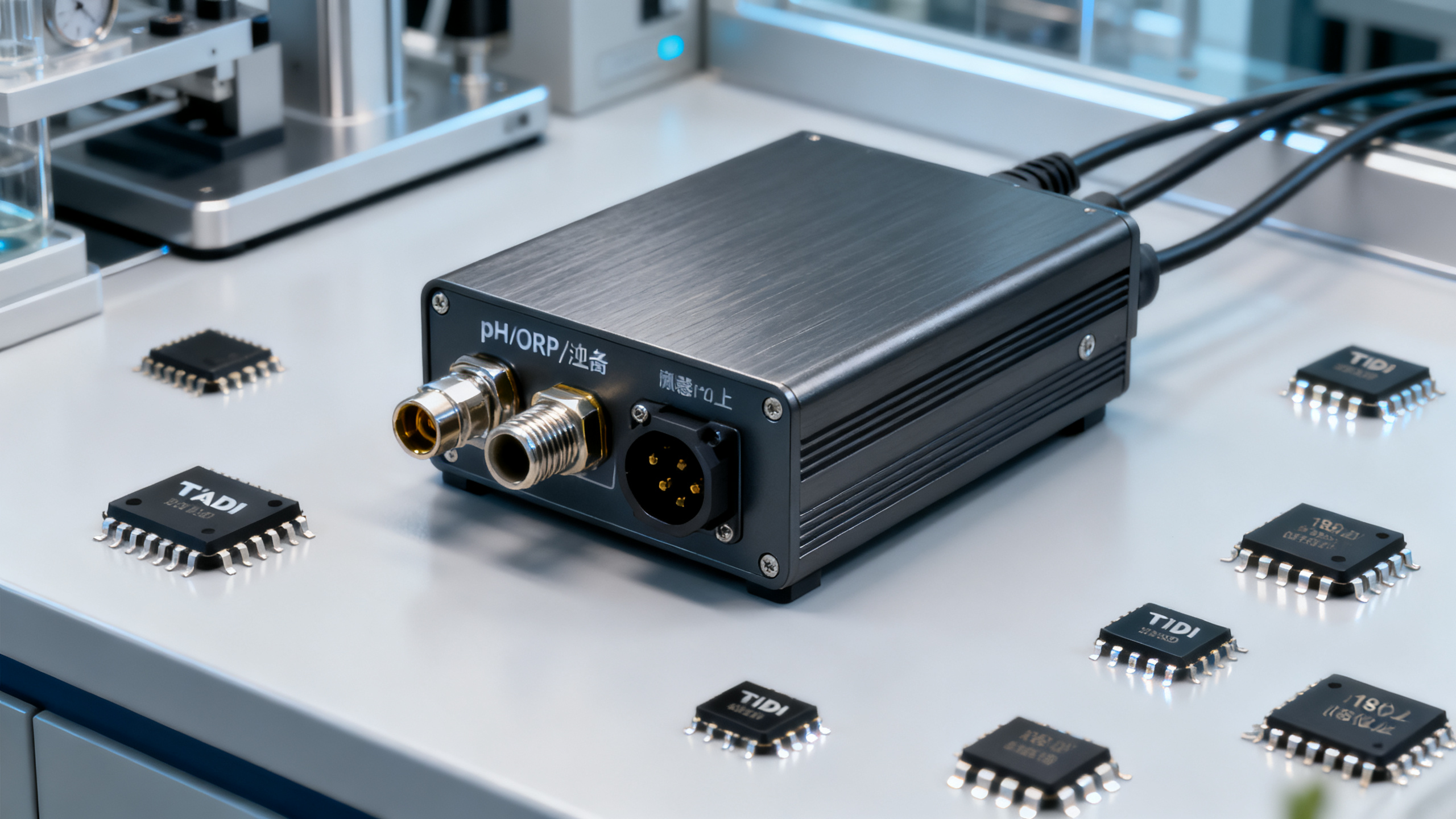
On May 8, 2026, Texas Instruments (TI) and Analog Devices, Inc. (ADI) jointly announced supply adjustments to key analog and data-conversion components — including suspension of general-purpose ADC shipments and extension of lead times for industrial-grade LDOs and high-precision op-amps (≥18-bit) to 32 weeks. This development directly impacts manufacturers of industrial water quality monitoring instruments (e.g., pH, ORP, turbidity, and free chlorine analyzers), particularly those reliant on China-based OEM/ODM production. The incident signals acute strain in the industrial analog semiconductor supply chain and warrants close attention from instrument makers, system integrators, and export-focused distributors.
Event Overview
On May 8, 2026, TI and ADI issued a joint public notice stating that, due to surging demand from defense and new-energy vehicle sectors, they would immediately suspend shipments of general-purpose analog-to-digital converter (ADC) chips. Additionally, lead times for industrial-grade low-dropout regulators (LDOs) and precision operational amplifiers with resolution of 18 bits or higher were uniformly extended to 32 weeks. This adjustment is effective as of the announcement date and applies globally to non-military, non-automotive commercial allocations.
Industries Affected by Segment
Instrument Manufacturing Firms (OEM/ODM)
These firms — especially those producing industrial water quality monitors in China — rely heavily on TI and ADI’s ADCs, LDOs, and precision op-amps for signal conditioning, sensor interface, and power management. Suspension of ADC supply halts new design validation and volume ramp-up; extended LDO/op-amp lead times constrain final assembly. Impact manifests as delayed NPI (new product introduction), reduced quarterly output capacity, and increased risk of missed export delivery windows.
Export-Oriented Distributors & Channel Partners
Distributors serving water instrumentation customers face inventory depletion of critical analog components and rising allocation pressure from TI/ADI. With no near-term replenishment for suspended ADC SKUs, channel partners cannot fulfill pending orders for monitor subassemblies or repair kits. Revenue recognition delays and customer contract renegotiations are emerging concerns, especially for Q3 2026 shipments.
System Integrators & Water Utility Solution Providers
Integrators bundling certified water quality monitors into larger SCADA or IoT-enabled infrastructure projects may encounter schedule slippage when core devices fail to meet delivery commitments. Longer component lead times translate directly into extended project timelines — particularly for municipal or industrial wastewater compliance deployments where hardware certification cycles are fixed and inflexible.
What Enterprises and Practitioners Should Monitor and Do Now
Track official allocation policies and exception request pathways
TI and ADI have not published criteria for qualifying for priority allocation. Enterprises should proactively engage regional field application engineering (FAE) teams to understand whether industrial water monitoring applications may be eligible for limited exceptions — especially if tied to regulated environmental compliance use cases.
Reassess bill-of-materials (BOM) alternatives for non-suspended components
While general-purpose ADCs are suspended, certain automotive- or industrial-qualified variants remain available (though subject to longer lead times). Engineering teams should audit current BOMs for pin-compatible or functionally equivalent parts from TI/ADI’s active portfolios — prioritizing those with confirmed availability over 16-week horizons.
Validate and document component substitution impact on metrological performance
Replacing an 18-bit op-amp with a 16-bit alternative — even if electrically functional — may affect measurement accuracy, linearity, and long-term drift in pH/ORP circuits. Any substitution must undergo full recalibration and traceable verification per ISO/IEC 17025 or relevant regional calibration standards before deployment.
Adjust procurement planning and customer communication timelines
With confirmed 32-week lead times for key LDOs and op-amps, procurement teams should revise safety stock targets and align internal production schedules accordingly. Concurrently, sales and project management teams should update delivery forecasts for all water monitor SKUs scheduled for Q3 2026 shipment — especially export orders bound for EU, ASEAN, and Middle East markets where regulatory conformity timelines are binding.
Editorial Perspective / Industry Observation
Observably, this event is less a transient shortage and more a structural reallocation signal: TI and ADI are deprioritizing broad commercial analog segments in favor of higher-margin, mission-critical end markets. Analysis shows that the 32-week lead time reflects not just backlog but deliberate capacity gating — consistent with observed fab utilization shifts toward AEC-Q200 and MIL-STD-883 qualified lots. From an industry perspective, this marks a pivot point where industrial instrumentation suppliers must treat analog component sourcing as a strategic, not tactical, function. Current developments are better understood as a policy-driven constraint than a temporary logistics bottleneck — meaning mitigation requires technical agility (e.g., BOM redesign), not just supply-chain negotiation.
Conclusion: This supply adjustment underscores growing competition for high-reliability analog ICs across defense, automotive, and industrial domains. For water quality monitoring equipment manufacturers, it confirms that component availability — not just design capability — now governs scalability and market responsiveness. It is more accurate to interpret this development as an early indicator of sustained analog IC allocation discipline, rather than an isolated disruption requiring short-term workarounds alone.
Source: Joint public notice issued by Texas Instruments and Analog Devices, Inc. on May 8, 2026. No third-party or secondary sources were used. Ongoing monitoring is recommended for any updates to TI/ADI’s allocation frameworks or qualification pathways for industrial water monitoring applications.
Technical Specifications
- How to Select an Emissions Monitoring System Analyzer for Compliance ReportingAuthor :Precision Metrology Expert
- How to Select an Access Control Management System for Multi-Site FacilitiesAuthor :Safety Compliance Lead
- Portable Gas Monitor Calibration: How Often Is It Needed for Safe Confined-Space Work?Author :Precision Metrology Expert
Expert Insights

Chief Security Architect
Dr. Thorne specializes in the intersection of structural engineering and digital resilience. He has advised three G7 governments on industrial infrastructure security.
Related Analysis
- Sep 21, 2026How to Select an Emissions Monitoring System Analyzer for Compliance ReportingAuthor :Precision Metrology Expert
- Sep 20, 2026How to Select an Access Control Management System for Multi-Site FacilitiesAuthor :Safety Compliance Lead
- Sep 19, 2026Portable Gas Monitor Calibration: How Often Is It Needed for Safe Confined-Space Work?Author :Precision Metrology Expert
Core Sector // 01
Security & Safety
- How to Size a Wafer Butterfly Valve for HVAC Chilled-Water and Heating LoopsAuthor :Environmental Engineering Director

- How Pressure Class and Joint Design Affect Long-Term Performance of Ductile Iron Pipes in Drainage InfrastructureAuthor :Environmental Engineering Director

- How Ductile Iron Pipe Joints Affect Installation Reliability and Leak ControlAuthor :Environmental Engineering Director

- How to Size Effluent Treatment Equipment for Variable Industrial Wastewater LoadsAuthor :Environmental Engineering Director

- US Battery Push Raises New Entry Rules for SuppliersAuthor :Environmental Engineering Director

- EU EMC Rule Tightens for Water Treatment ExportsAuthor :Environmental Engineering Director

- EU REACH Restriction Targets PFAS Water Treatment ImportsAuthor :Environmental Engineering Director

- EU Mandates EN 14113:2026 for Water Treatment ExportsAuthor :Environmental Engineering Director