Commercial UV Water Sterilizer vs Filtration: Which System Fits Your Facility?
Author
Date Published
Reading Time
Why the Right Choice Depends on Operating Conditions
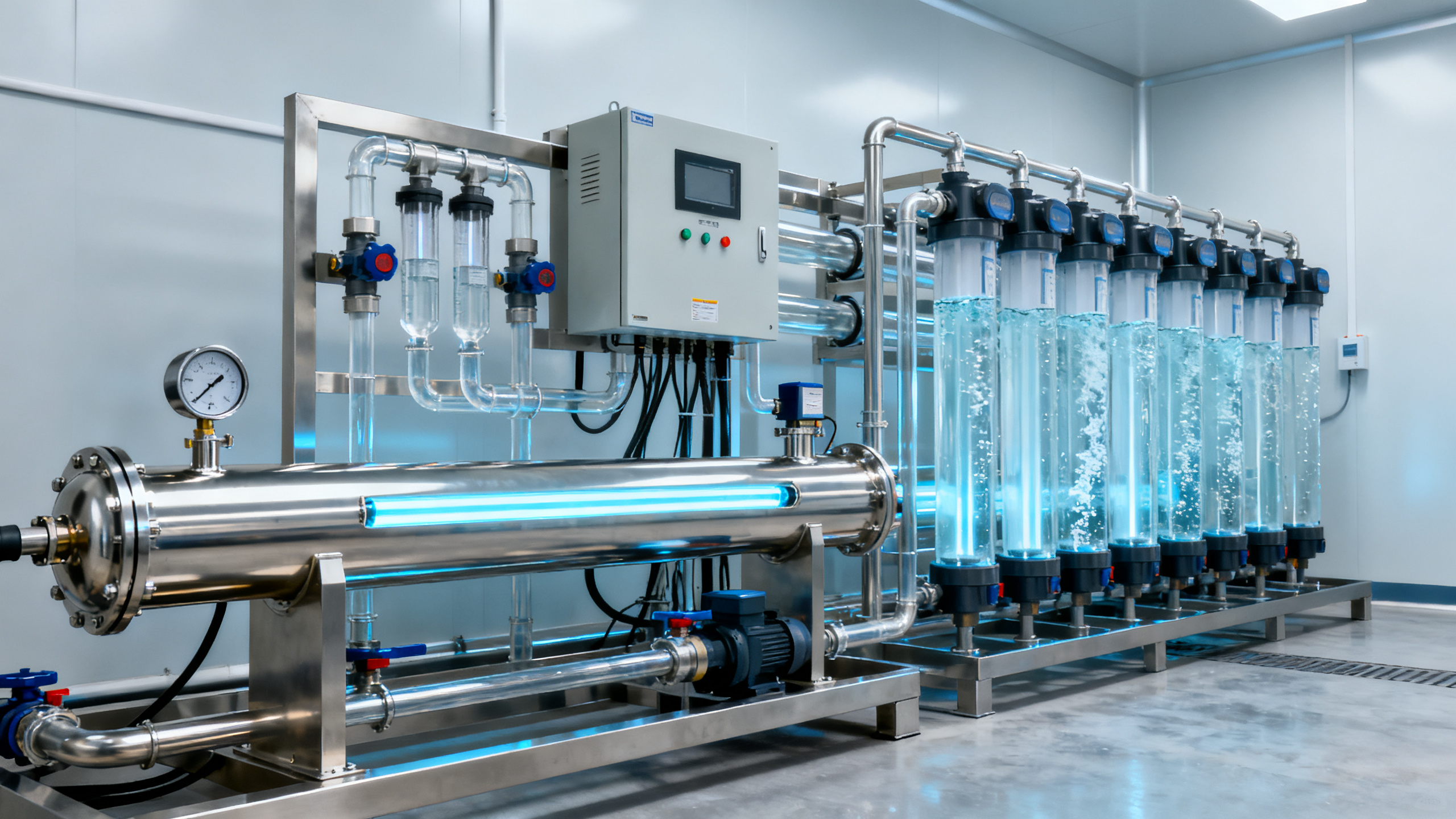
Choosing a commercial UV water sterilizer over filtration, or combining both, is rarely a simple equipment comparison.
In industrial settings, water quality decisions affect compliance exposure, process stability, asset protection, and maintenance planning at the same time.
That is why the better question is not which technology is superior in theory.
The practical question is which system fits the facility’s actual risk profile, water source, and operational duty cycle.
A commercial UV water sterilizer targets microorganisms by disrupting DNA, while filtration removes suspended solids, sediment, and selected contaminants.
Those functions overlap less than many teams assume.
In real projects reviewed across industrial infrastructure platforms such as Global Industrial Core, the mismatch usually comes from ignoring site conditions.
Water clarity, flow variation, temperature, fouling load, and validation requirements often matter more than brochure claims.
Different Facilities Create Different Water Risks
Two facilities may both need clean water, yet their treatment priorities can be completely different.
A food processing line may focus on microbial control and audit readiness.
A metalworking plant may care more about particulates, scale, and equipment wear.
A commercial building loop may need stable disinfection without chemicals and without disrupting occupancy.
This is where a commercial UV water sterilizer becomes highly relevant in some environments and insufficient on its own in others.
UV performs best when water has low turbidity and consistent transmittance.
Filtration performs best when the main threat is physical contamination, membrane protection, or downstream process sensitivity.
More often than not, facilities are not choosing one technology against the other.
They are deciding where each function belongs in the treatment train.
A quick comparison before looking at scenarios
Where UV Makes More Sense Than Filtration Alone
In high-contact water applications, microbial control can outweigh sediment concerns.
That is common in beverage preparation, rinse water, hospitality systems, healthcare support utilities, and some packaged process skids.
Here, a commercial UV water sterilizer is often chosen because it provides disinfection without chemical residuals.
That matters when taste, odor, corrosion impact, or downstream compatibility are under close control.
The key judgment point is not simply whether microbes are a concern.
It is whether the incoming water is clear enough for UV energy to reach the target organisms consistently.
If the source already passes through reliable prefiltration, UV can become the final safeguard that stabilizes microbial quality.
In these conditions, replacing UV with filtration alone would leave a gap.
Particles may be reduced, yet bacteria can still remain viable.
When Filtration Carries More Weight in Daily Operations
Other facilities face a very different challenge.
Their water may contain rust, silt, hardness-related debris, carbon fines, or process particles that interfere with valves, nozzles, membranes, and heat exchange surfaces.
In those cases, filtration addresses the immediate cause of downtime more directly than a commercial UV water sterilizer.
This pattern appears in cooling systems, pretreatment lines, washdown utilities, and plants using variable municipal or mixed-source water.
The decision becomes even clearer when flow rates swing sharply during shifts.
UV dose depends on exposure time and lamp performance.
If hydraulic conditions fluctuate without proper design margin, disinfection reliability can become harder to verify.
Filtration still needs correct sizing, but it is often easier to align with physical contaminant loads and equipment protection goals.
Typical situations where filtration leads the decision
- Pretreatment ahead of reverse osmosis, softening, or fine membrane systems
- Facilities with recurring clogging in spray nozzles or control valves
- Sites using older piping networks that release scale or corrosion particles
- Operations where visible solids create product quality or housekeeping problems
In Many Industrial Environments, the Real Answer Is a Combined Train
The strongest water strategy often combines both methods rather than forcing a single-system decision.
Filtration handles the physical load first.
A commercial UV water sterilizer then acts on the reduced and clarified stream.
This sequence is especially effective where audit pressure, hygiene assurance, and equipment life all matter together.
That includes pharmaceutical support systems, electronics rinsing, premium food processing, and engineered building utilities with low tolerance for biological growth.
The value of a combined train is not only treatment performance.
It also improves predictability.
When solids are reduced upstream, UV sleeves foul more slowly, dose stability improves, and maintenance intervals become easier to plan.
That is a practical lifecycle advantage, not just a technical one.
What Usually Gets Misjudged Before Installation
The most common mistake is treating clean-looking water as UV-ready water.
Visual clarity does not confirm UV transmittance, biological load, or scaling potential on quartz sleeves.
Another frequent error is assuming micron ratings answer every water quality problem.
A filter may capture particles effectively while doing little against microbial regrowth downstream.
Cost analysis is also often too narrow.
A lower purchase price can be offset by sleeve cleaning labor, cartridge replacement frequency, pressure loss, or production interruption during service windows.
Standards and documentation deserve equal attention.
Facilities operating under CE, UL, ISO, or internal validation frameworks usually need traceable performance data, not just nominal specifications.
That is why technical reviews in heavy industry increasingly favor verified operating evidence over isolated catalog values.
How to Match the System to the Facility Instead of the Catalog
A better selection process starts with a short list of site-specific checks.
These checks usually reveal whether a commercial UV water sterilizer, filtration system, or combined layout is the right fit.
- Confirm source water variability across seasons, shifts, and backup supply changes
- Identify the dominant risk: microorganisms, particulates, scale, organics, or membrane fouling
- Map where water touches product, personnel, critical equipment, or closed-loop utilities
- Check required documentation, validation, and certification expectations before procurement
- Estimate maintenance access, spare strategy, lamp replacement, and filter service intervals
In practice, these points prevent overbuying in low-risk areas and underdesigning in critical ones.
They also help compare suppliers on operating resilience rather than headline efficiency alone.
A Practical Way to Decide the Next Step
A commercial UV water sterilizer is the stronger option when microbial control is central and pretreatment already supports UV performance.
Filtration is the stronger lead option when solids, fouling, and equipment protection define daily operating risk.
Many facilities, however, will get the best result by combining both in the correct sequence.
The useful next step is to document actual water conditions, confirm critical control points, and compare lifecycle demands rather than initial hardware cost alone.
Once those conditions are clear, the choice between a commercial UV water sterilizer and filtration stops being abstract.
It becomes a disciplined facility decision tied to compliance, reliability, and long-term operational control.
Technical Specifications
- How to Select Electronic Hotel Key Card Locks for Guest Rooms and Staff AreasAuthor :Safety Compliance Lead
- How to Select Lab Instruments for Reliable Chemical Analysis WorkflowsAuthor :Precision Metrology Expert
- How to Size a UPS for Server Rooms: Load, Runtime, and Redundancy FactorsAuthor :Grid Infrastructure Analyst
Expert Insights

Chief Security Architect
Dr. Thorne specializes in the intersection of structural engineering and digital resilience. He has advised three G7 governments on industrial infrastructure security.
Related Analysis
- Sep 17, 2026How to Select Electronic Hotel Key Card Locks for Guest Rooms and Staff AreasAuthor :Safety Compliance Lead
- Sep 16, 2026How to Select Lab Instruments for Reliable Chemical Analysis WorkflowsAuthor :Precision Metrology Expert
- Sep 15, 2026How to Size a UPS for Server Rooms: Load, Runtime, and Redundancy FactorsAuthor :Grid Infrastructure Analyst
Core Sector // 01
Security & Safety
- How to Size a Wafer Butterfly Valve for HVAC Chilled-Water and Heating LoopsAuthor :Environmental Engineering Director

- How Pressure Class and Joint Design Affect Long-Term Performance of Ductile Iron Pipes in Drainage InfrastructureAuthor :Environmental Engineering Director

- How Ductile Iron Pipe Joints Affect Installation Reliability and Leak ControlAuthor :Environmental Engineering Director

- How to Size Effluent Treatment Equipment for Variable Industrial Wastewater LoadsAuthor :Environmental Engineering Director

- US Battery Push Raises New Entry Rules for SuppliersAuthor :Environmental Engineering Director

- EU EMC Rule Tightens for Water Treatment ExportsAuthor :Environmental Engineering Director

- EU REACH Restriction Targets PFAS Water Treatment ImportsAuthor :Environmental Engineering Director

- EU Mandates EN 14113:2026 for Water Treatment ExportsAuthor :Environmental Engineering Director