Commercial UV Water Sterilizer vs Chlorination: Which Fits Your Facility Better?
Author
Date Published
Reading Time
Choosing between a commercial UV water sterilizer and chlorination is not just a treatment decision. It shapes compliance readiness, maintenance effort, water quality stability, and how resilient a facility stays under daily pressure.
In industrial and commercial settings, the better option is rarely the one with the lowest purchase price. It is the one that matches flow demand, contamination risk, staffing capacity, and validation requirements without creating hidden operating problems later.
For infrastructure-focused operations, this decision also touches broader priorities that Global Industrial Core often highlights: safety, measurement accuracy, environmental control, and long-term system reliability. A good fit should support all four, not just disinfection on paper.
Start with what each method actually does
A commercial UV water sterilizer uses ultraviolet light to inactivate microorganisms as water passes through a chamber. It works fast, adds no chemical taste, and performs best when water clarity is tightly controlled.
Chlorination adds a chemical disinfectant that continues working through storage tanks, piping, and downstream distribution. That residual effect is useful, but it also introduces dosing control, byproducts, and handling requirements.
The practical question is simple: do you need immediate in-line treatment, ongoing residual protection, or a combination of both?
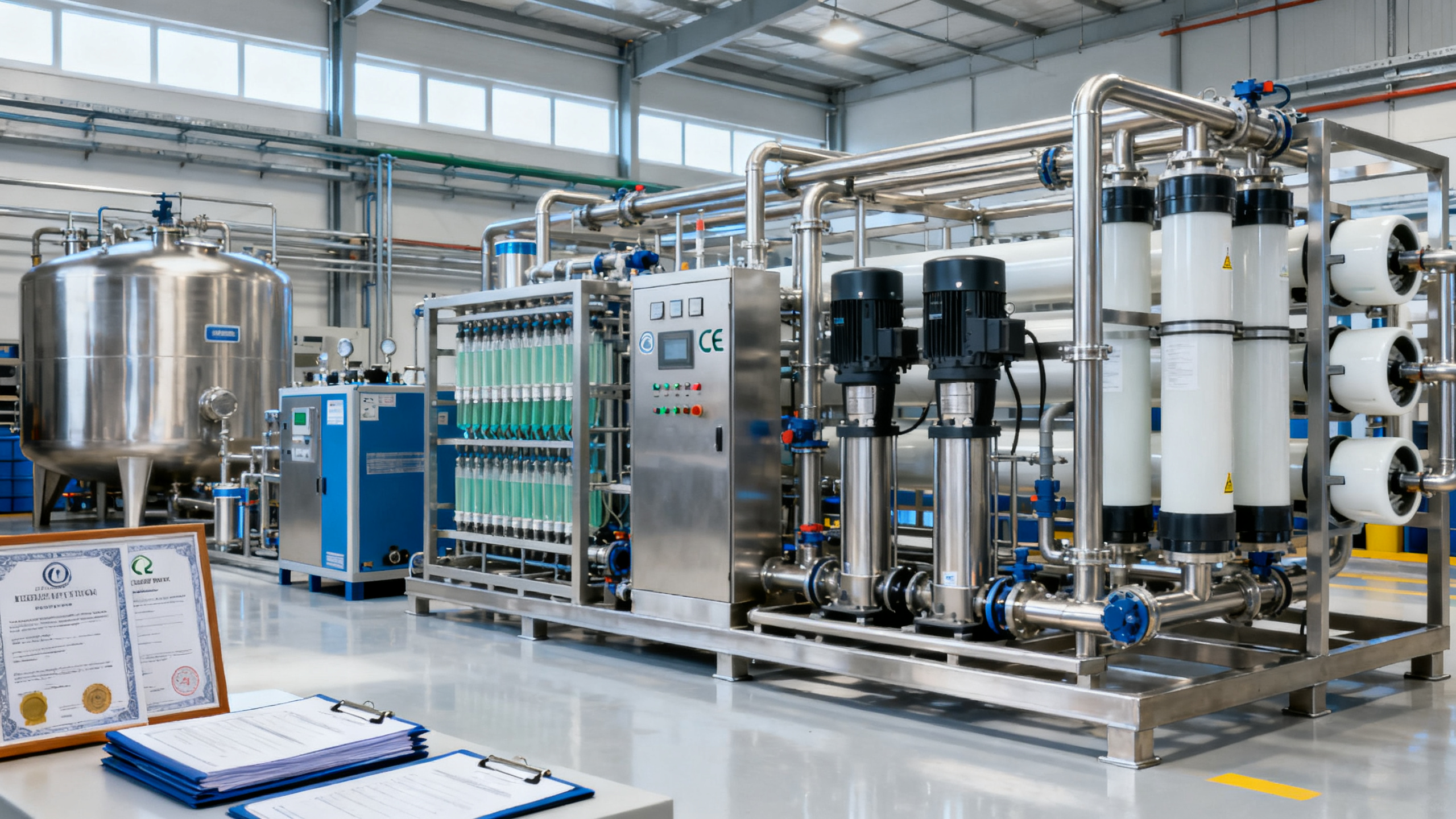
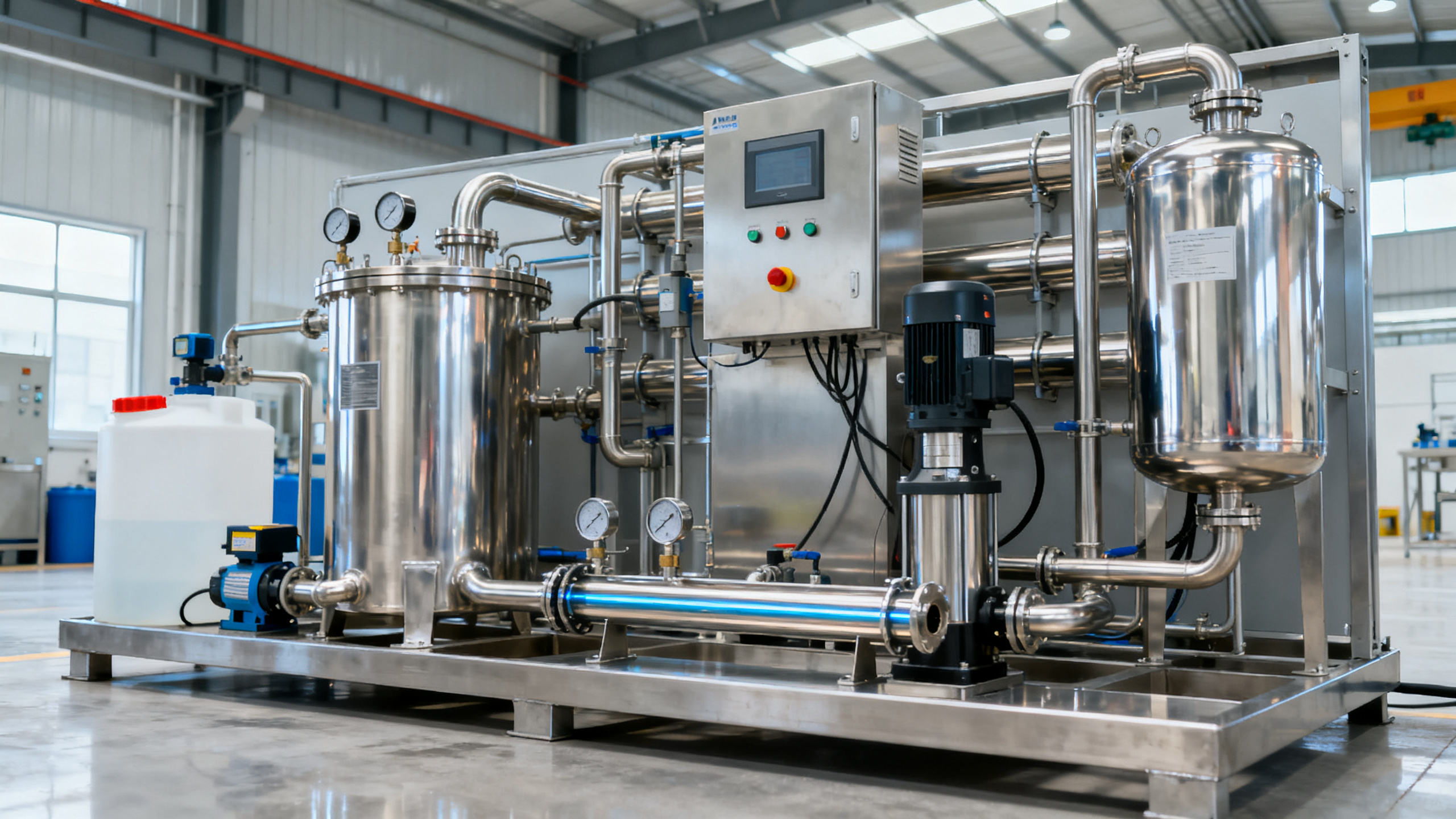
[Image 01: Commercial UV water sterilizer installed on an industrial water treatment skid beside chemical dosing equipment]
That single question usually narrows the field faster than any brochure claim. It also helps avoid a common mistake: selecting a treatment method before mapping the real contamination pathway.
Six decision points that usually determine the better fit
- Choose a commercial UV water sterilizer when water is used immediately after treatment, quality must stay unchanged, and there is strong control over turbidity, scaling, and suspended solids.
- Lean toward chlorination when treated water sits in tanks, travels long pipe runs, or faces recontamination risk after the treatment point because residual protection matters more there.
- Check maintenance reality, not theory. UV needs lamp, sleeve, and sensor care; chlorination needs dosing calibration, chemical storage discipline, and frequent residual verification.
- Review compliance documentation early. A commercial UV water sterilizer often needs dose validation data, while chlorination systems usually need stronger chemical handling and discharge records.
- Compare lifecycle cost instead of equipment cost alone. Lower capex can be offset later by chemical consumption, corrosion impact, labor hours, or downtime from poor process control.
- Match the disinfection method to failure tolerance. If power instability is common, UV needs backup planning; if dosing drift is likely, chlorination may create inconsistent water quality.
Where a commercial UV water sterilizer usually wins
A commercial UV water sterilizer is often the stronger choice when water taste, odor, or chemistry must remain unchanged. That matters in food processing support systems, rinse applications, high-purity pretreatment trains, and premium commercial buildings.
It also fits sites that want cleaner environmental reporting. There is no bulk disinfectant to transport, store, or neutralize, and no chlorinated byproduct discussion if the upstream water is properly conditioned.
Still, UV is not a shortcut. If the incoming water has unstable turbidity, iron fouling, manganese, or hardness scaling, performance can drop quietly. That is why monitoring and pretreatment matter as much as the UV chamber itself.
Best-fit conditions for UV
A good UV installation usually has stable flow, low suspended solids, predictable maintenance intervals, and reliable power. It also has enough instrumentation to confirm that design dose is still being delivered.
This is where GIC-style evaluation becomes useful. Looking at disinfection in isolation misses the bigger system picture, especially when instrumentation, electrical reliability, and environmental performance are tightly linked.
Where chlorination often makes more sense
Chlorination usually makes more sense when water must remain protected after treatment. Facilities with storage tanks, cooling networks, long internal distribution loops, or intermittent consumption often benefit from that residual barrier.
It is also a practical choice when source water conditions vary and microbial control must continue beyond a single contact point. In many legacy systems, chlorination integrates more easily than adding a new UV train.
The tradeoff is operational complexity. Overdosing can affect taste, odor, equipment life, and discharge quality. Underdosing creates a false sense of security, especially when manual testing is inconsistent.
Best-fit conditions for chlorination
Chlorination performs best where chemical management is mature, residual testing is routine, and the site can handle worker safety controls, ventilation, storage separation, and emergency response planning.
That is why the decision is not simply UV versus chlorine. In many facilities, it is really about whether operational discipline is stronger around mechanical systems or chemical systems.
A side-by-side view for faster selection
What often gets overlooked during evaluation
One common blind spot is upstream water variability. A commercial UV water sterilizer may look ideal in design documents, then underperform because seasonal source water changes reduce UV transmittance.
Another is downstream system condition. Chlorination may be selected for safety margin, but old piping, dead legs, and poor tank turnover can still undermine microbial control and increase chemical demand.
Instrumentation is another major factor. Without dependable sensors, alarms, and routine verification, both methods can fail quietly. In high-consequence facilities, that is not a technical detail. It is a governance issue.
Practical checks before approval
- Confirm real water conditions across seasons, not one sample date. UV transmittance, hardness, iron, and turbidity trends can change the viability of a commercial UV water sterilizer.
- Map where contamination can re-enter the system. If there are tanks, long loops, or idle branches, chlorination or a hybrid design may be safer.
- Audit available maintenance skills before buying. The best technical option can become the worst operational option if upkeep routines are unrealistic for the site.
- Check electrical and control resilience. UV systems need stable power, while chemical dosing systems need dependable interlocks, calibration routines, and alarm response discipline.
- Review material compatibility with the full water chemistry. Chlorination can accelerate corrosion in some systems, while UV performance drops when sleeves foul too quickly.
- Ask for validation records, not just claims. Dose data, sensor logic, certification status, and service intervals are more useful than generic performance brochures.
When a hybrid approach is the smarter answer
In some facilities, the best answer is not choosing only one method. A commercial UV water sterilizer can handle primary in-line disinfection, while low-level chlorination protects storage or downstream distribution.
This approach often appears in larger campuses, process-support utilities, and infrastructure where water quality sensitivity and network protection both matter. It can reduce chemical load without giving up residual defense.
The key is clear control logic. Hybrid systems work well when each stage has a defined job, measurable performance limits, and maintenance ownership that is easy to enforce.
A straightforward way to make the final call
If water is used quickly, quality must remain unchanged, and pretreatment is reliable, a commercial UV water sterilizer is often the cleaner and more efficient fit. If water sits, travels, or risks recontamination, chlorination usually has the advantage.
If both conditions exist, a combined design deserves serious consideration. That is especially true in operations where compliance, uptime, and environmental accountability all carry equal weight.
The most reliable next step is to compare the two options against actual site data: flow pattern, storage time, pipe layout, water quality trends, maintenance resources, and monitoring capability. Once those six points are clear, the right choice becomes much easier to defend.
For industrial infrastructure, good disinfection selection is never just about killing microbes. It is about building a water treatment strategy that stays safe, measurable, compliant, and dependable long after installation.
Technical Specifications
- How to Select Electronic Hotel Key Card Locks for Guest Rooms and Staff AreasAuthor :Safety Compliance Lead
- How to Select Lab Instruments for Reliable Chemical Analysis WorkflowsAuthor :Precision Metrology Expert
- How to Size a UPS for Server Rooms: Load, Runtime, and Redundancy FactorsAuthor :Grid Infrastructure Analyst
Expert Insights

Chief Security Architect
Dr. Thorne specializes in the intersection of structural engineering and digital resilience. He has advised three G7 governments on industrial infrastructure security.
Related Analysis
- Sep 17, 2026How to Select Electronic Hotel Key Card Locks for Guest Rooms and Staff AreasAuthor :Safety Compliance Lead
- Sep 16, 2026How to Select Lab Instruments for Reliable Chemical Analysis WorkflowsAuthor :Precision Metrology Expert
- Sep 15, 2026How to Size a UPS for Server Rooms: Load, Runtime, and Redundancy FactorsAuthor :Grid Infrastructure Analyst
Core Sector // 01
Security & Safety
- How to Size a Wafer Butterfly Valve for HVAC Chilled-Water and Heating LoopsAuthor :Environmental Engineering Director

- How Pressure Class and Joint Design Affect Long-Term Performance of Ductile Iron Pipes in Drainage InfrastructureAuthor :Environmental Engineering Director

- How Ductile Iron Pipe Joints Affect Installation Reliability and Leak ControlAuthor :Environmental Engineering Director

- How to Size Effluent Treatment Equipment for Variable Industrial Wastewater LoadsAuthor :Environmental Engineering Director

- US Battery Push Raises New Entry Rules for SuppliersAuthor :Environmental Engineering Director

- EU EMC Rule Tightens for Water Treatment ExportsAuthor :Environmental Engineering Director

- EU REACH Restriction Targets PFAS Water Treatment ImportsAuthor :Environmental Engineering Director

- EU Mandates EN 14113:2026 for Water Treatment ExportsAuthor :Environmental Engineering Director