How to Select a Twin Shaft Shredder for Bulky Waste, Scrap Metal, and Plastics
Author
Date Published
Reading Time
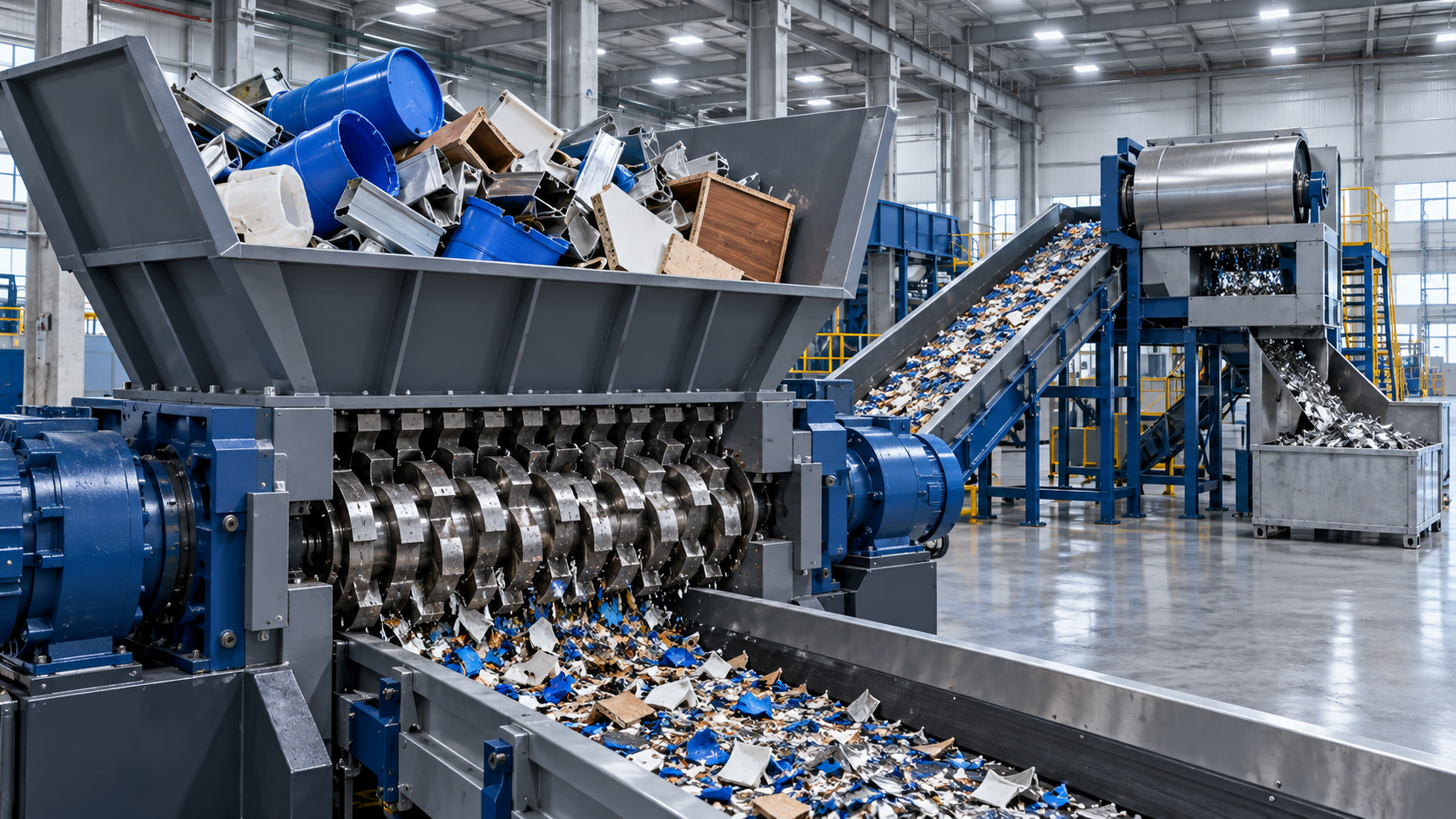
A twin shaft shredder machine is often selected at the point where a recycling line meets its least predictable materials: overfilled municipal bulky waste, mixed metal offcuts, rigid plastics with embedded inserts, or production rejects that do not arrive in neat, uniform batches. On paper, the decision may appear to be about tonnes per hour. In practice, throughput is only the visible outcome of a much broader engineering match between the machine, the feedstock, the operating environment, and the next stage of processing.
For technical evaluators, the central question is not simply, “Which shredder is bigger?” It is: “Which shredder will continue to produce an acceptable output when the material mix changes, contamination appears, and uptime matters?” A poor fit can lead to frequent reversals, cutter damage, excessive fines, unstable conveyor loading, or costly manual intervention. A well-specified system reduces material reliably while fitting the realities of the plant around it.
Begin with the material stream, not the brochure capacity
Every twin-shaft application starts with a material definition. “Bulky waste,” “scrap metal,” and “plastics” are useful commercial categories, but they are not sufficiently precise for equipment specification. The same nominal waste stream can behave very differently depending on density, shape, wall thickness, contamination, moisture, and the presence of reinforced or composite materials.
For example, bulky waste may contain mattresses, furniture, timber, appliances, textiles, carpets, and occasional metal frames. A scrap stream may range from light-gauge sheet and aluminium profiles to steel drums, mixed turnings, cable bundles, or automotive components. Plastics can include hollow HDPE containers, rigid PP crates, thick-walled purgings, films, pipes, pallets, and glass-fibre-reinforced parts. Each group imposes different demands on cutter geometry, shaft torque, screening, and discharge control.
Before requesting a proposal, compile representative information from the actual operating stream:
- Typical and maximum item dimensions, including awkward or oversized pieces.
- Expected material composition by volume and by mass.
- Maximum metal thickness, hardness, and likely tramp-metal content.
- Presence of wire, fabric, foam, rubber, sand, glass, moisture, or soil.
- Batch-fed versus continuous-fed operation.
- Required output size and whether size consistency is critical downstream.
- Annual operating hours, shift pattern, and permitted downtime windows.
This exercise may seem basic, yet it prevents one of the most common specification errors: selecting from a “standard application list” without identifying the worst credible feed condition. A shredder should be evaluated against the material that creates the highest operational risk, not only against the cleanest samples.
Torque, speed, and cutting action: understand what the shafts are being asked to do
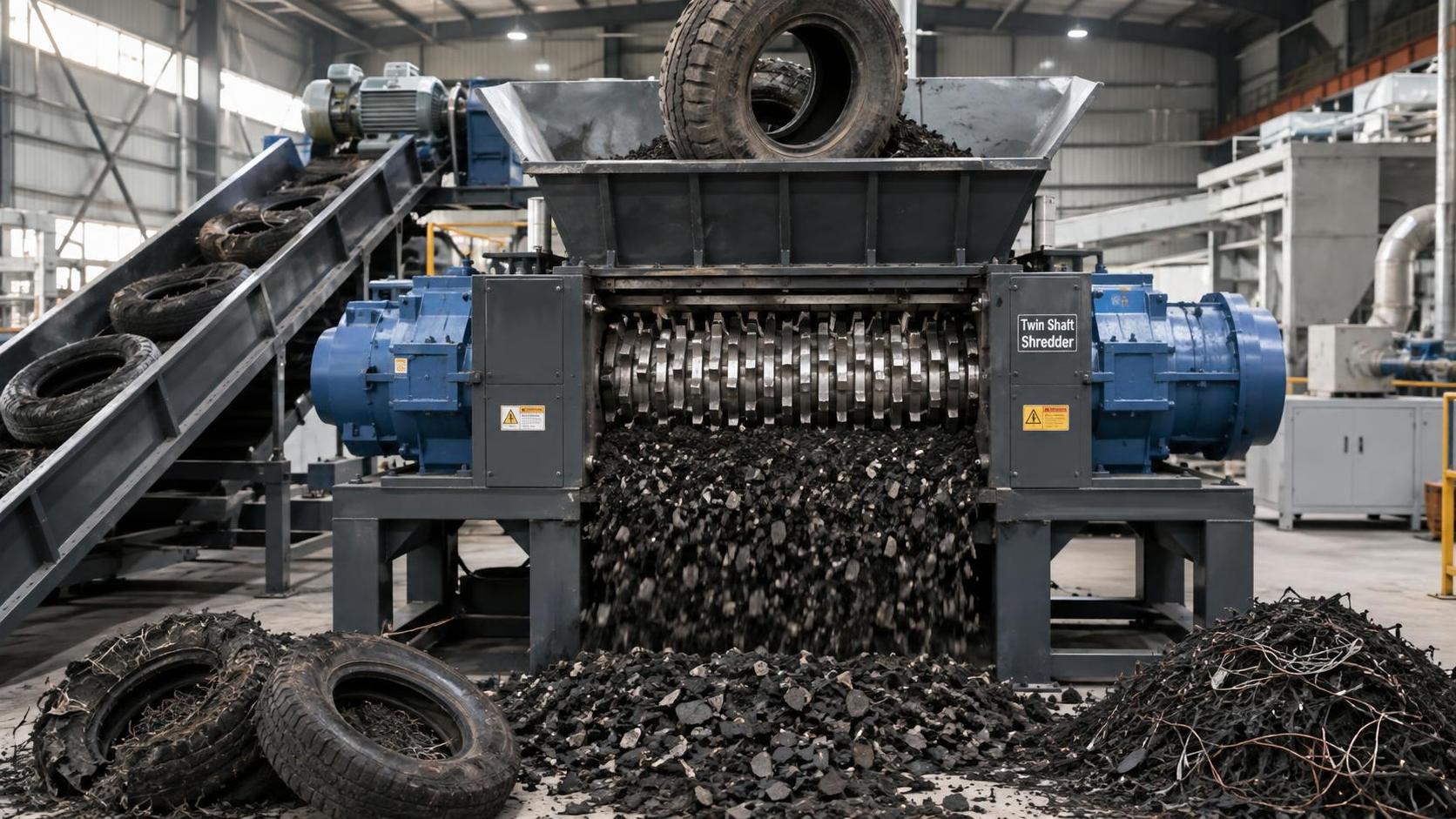
A twin shaft shredder machine uses two counter-rotating shafts fitted with intermeshing cutters. Rather than relying primarily on high-speed impact, it tears, shears, pulls, and crushes material at relatively low rotational speed. This operating principle is especially useful for bulky, tough, or heterogeneous waste because it can accept irregular feed shapes and generate high cutting forces.
High torque is important when materials resist deformation: thick plastics, steel-bearing waste, compact furniture assemblies, cable bundles, and dense scrap are typical examples. But “high torque” on its own is not a complete selection criterion. Evaluators should ask how torque is delivered, how the drive responds to overload, and whether the machine can reverse automatically when a non-shreddable or poorly oriented item enters the chamber.
Drive design also affects maintenance and operating behavior. Hydraulic drives can offer strong overload protection and independent shaft control, while electromechanical systems may provide efficiency and precise control in suitable applications. Neither arrangement is universally superior. The right choice depends on material severity, required responsiveness, energy strategy, service capability, and the plant’s preference for hydraulic or electrical maintenance disciplines.
Speed should be considered alongside torque. A slow-speed, high-torque configuration generally favors controlled reduction of tough mixed feedstocks and may reduce the risk of spark generation compared with high-speed fragmentation. However, shaft speed, cutter profile, and feed arrangement must work together. Increasing speed without considering discharge capacity or downstream equipment can simply move the bottleneck rather than improve useful production.
Cutter configuration determines more than output size
The cutter stack is the practical heart of the shredder. Shaft spacing, cutter thickness, hook shape, tip design, number of teeth, and spacer arrangement influence how material is gripped and broken apart. These details determine not only the nominal particle size, but also the machine’s ability to pull in difficult feed and resist wear.
Wide cutters with fewer hooks are often associated with coarse primary reduction and robust handling of large, mixed items. Narrower cutters can produce a smaller, more controlled fraction, but they may be less tolerant of certain contamination levels or may increase the number of cutting events required per tonne. Aggressive hooks can improve engagement with bulky plastics, textiles, and wood-containing waste, while different profiles may be needed to avoid wrapping or bridging in film, cable, and fibrous material.
For metal-bearing streams, cutter material and heat treatment deserve close scrutiny. Wear resistance, toughness, and the ability to withstand shock loading must be balanced. A cutter that is extremely hard but insufficiently tough may be vulnerable in impact-prone scrap applications. Ask suppliers how cutters are built, how they are protected from overload, whether they can be refurbished, and how replacement is managed. Cutter life cannot be credibly judged from a generic estimate; it depends heavily on feedstock and operating discipline.
Match the machine to the process role
A shredder is rarely a standalone answer. Its selected configuration should reflect what happens before and after it. In a bulky waste line, the twin-shaft unit may be a primary shredder feeding magnetic separation, screening, air classification, or refuse-derived fuel preparation. In a metal recycling operation, it may open and reduce scrap before sorting and further size reduction. In plastics recycling, it may serve as a pre-shredder that prepares material for a granulator, wash line, or densification process.
This process role changes the acceptable output. A primary shredder does not necessarily need a highly uniform particle size; it needs a reduction level that allows the next machine to work efficiently. Chasing a fine fraction in a primary twin-shaft stage can increase power demand, wear, and residence time without improving final recovery. Conversely, overly coarse output can overload a granulator, impair magnetic separation, or create unstable feeding in downstream conveyors.
Consider the full material path: loading device, hopper geometry, shredder chamber, discharge conveyor, separation equipment, and storage. If a loader drops long, heavy items into a shallow hopper, bridging may occur regardless of shredder torque. If discharge conveyors are undersized, material can build up beneath the shafts and cause recirculation or jams. System integration is where many otherwise sound machine selections lose their value.
Throughput claims need a boundary condition
Capacity figures are useful only when their test conditions are clear. A stated throughput may assume a specific material density, feed presentation, cutter set, output size, and operator feeding pattern. It may not represent the same performance on wet furniture, tangled wire, thick plastic lumps, or mixed demolition-derived waste.
When comparing offers, request a capacity basis in writing. The proposal should identify the tested or assumed feedstock, bulk density, maximum piece size, desired output, and the anticipated proportion of non-shreddable contaminants. It should also distinguish between peak throughput and sustained average throughput. In real plants, sustained performance matters more because it determines labor planning, downstream sizing, and annual processed tonnage.
If possible, arrange a material trial using representative samples, including difficult but normal items. A carefully prepared sample made up only of easy material can create false confidence. The goal is not to force a failure; it is to observe how the equipment handles variation, reverses under load, discharges material, and recovers after an interruption.
Safety and compliance should be designed into the evaluation
Shredding equipment combines high torque, rotating components, noise, dust, sharp materials, and unpredictable feed behavior. Safety review should therefore extend beyond a statement that a machine is “CE compliant.” Technical teams should verify the applicable machinery safety requirements for the installation region and assess the actual safeguarding concept.
Key questions include access control around the hopper and discharge, emergency-stop placement, lockout/tagout provisions, interlocked guards, safe cleaning procedures, and protection against unexpected restart. For metal-containing waste or dusty plastic streams, evaluate fire detection, suppression interfaces, and the potential for hot fragments or ignition sources within the wider line. Electrical panels, control systems, and sensors should align with the site’s environmental conditions, including dust, moisture, temperature, and washdown exposure where relevant.
For global procurement, documentation quality is itself a useful signal. Drawings, operating manuals, electrical schematics, risk assessments, spare-parts lists, and declaration documents should be available early enough for engineering review. Global Industrial Core recommends treating compliance evidence as an evaluation input, not paperwork collected after the technical decision is already made.
Maintenance access is a capacity issue in disguise
A shredder may look productive during a demonstration but become burdensome if cutter changes, chamber cleaning, or drive service require excessive disassembly. In abrasive, mixed, or metal-bearing applications, wear is not an exception; it is part of normal operation. The design should make that reality manageable.
Inspect access to the cutting chamber, shafts, hydraulic or gearbox components, bearings, and wear parts. Determine whether the cutter assembly can be removed safely, what lifting equipment is required, and whether routine inspections can be performed without dismantling guards or conveyors. Also ask which spares should be held on site and what information the controls provide about overload events, operating hours, direction reversals, and maintenance intervals.
Remote diagnostics can be valuable, especially for multi-site operators, but they do not replace maintainable mechanical design. The best operational data is still difficult to use if a technician cannot safely reach the component that needs attention.
A practical decision framework for technical evaluators
Shortlist equipment only after establishing a weighted evaluation matrix. The weighting should reflect the plant’s actual risk profile. A facility processing clean, homogeneous plastic rejects may place greater emphasis on output consistency and ease of cleaning. A transfer station handling unpredictable bulky waste may give more weight to chamber size, torque reserve, overload recovery, and robust construction. A metal recycler may prioritize cutter durability, shock-load behavior, and protection of downstream separation equipment.
A useful final review should include five questions:
- Can the shredder process the hardest expected material, not merely the average material?
- Does its cutter and drive configuration support the required output and downstream process?
- Are capacity assumptions transparent and validated against representative feedstock?
- Can the machine be safely maintained within the site’s labor, lifting, and shutdown constraints?
- Does the supplier provide the technical documentation, service pathway, and spare-parts clarity needed for long-term operation?
Selecting a twin shaft shredder machine is ultimately an exercise in reducing uncertainty. The right unit is not necessarily the one with the largest published capacity or the most aggressive specification sheet. It is the machine whose cutting system, torque behavior, controls, safety design, and maintenance arrangement are genuinely aligned with the material stream and the process that follows. When that alignment is established early, the shredder becomes a stable foundation for recovery performance rather than a recurring source of disruption.
Technical Specifications
- How to Select a Twin Shaft Shredder for Bulky Waste, Scrap Metal, and PlasticsAuthor :Environmental Engineering Director
- Selecting EPC Procurement Support Tools to Reduce Vendor and Delivery DelaysAuthor :Safety Compliance Lead
- How to Evaluate a Precision Measurement Equipment Manufacturer for Critical TolerancesAuthor :Precision Metrology Expert
Expert Insights

Chief Security Architect
Dr. Thorne specializes in the intersection of structural engineering and digital resilience. He has advised three G7 governments on industrial infrastructure security.
Related Analysis
- Sep 28, 2026How to Select a Twin Shaft Shredder for Bulky Waste, Scrap Metal, and PlasticsAuthor :Environmental Engineering Director
- Sep 27, 2026Selecting EPC Procurement Support Tools to Reduce Vendor and Delivery DelaysAuthor :Safety Compliance Lead
- Sep 26, 2026How to Evaluate a Precision Measurement Equipment Manufacturer for Critical TolerancesAuthor :Precision Metrology Expert
Core Sector // 01
Security & Safety
- How to Select a Twin Shaft Shredder for Bulky Waste, Scrap Metal, and PlasticsAuthor :Environmental Engineering Director

- How to Choose a Twin Shaft Shredder for Tires: Torque, Throughput, and Knife DesignAuthor :Environmental Engineering Director

- Selecting Waste Recycling Equipment by Waste Stream, Throughput, and Contamination LevelAuthor :Environmental Engineering Director

- How to Choose Waste Sorting Equipment for Recycling Plants by Material Stream and CapacityAuthor :Environmental Engineering Director

- Scrap Metal Baler Buying Guide: Horizontal vs Vertical, Capacity, Power, and OutputAuthor :Environmental Engineering Director

- What Is Industrial Ecology and How Does It Improve Resource Efficiency in Manufacturing?Author :Environmental Engineering Director

- Pet Bottle Washing Line Problems: Common Causes of Flake Contamination and How to Fix ThemAuthor :Environmental Engineering Director

- How to Evaluate Environment & Ecology Cost in Industrial ProjectsAuthor :Environmental Engineering Director