How to Choose a Twin Shaft Shredder for Tires: Torque, Throughput, and Knife Design
Author
Date Published
Reading Time
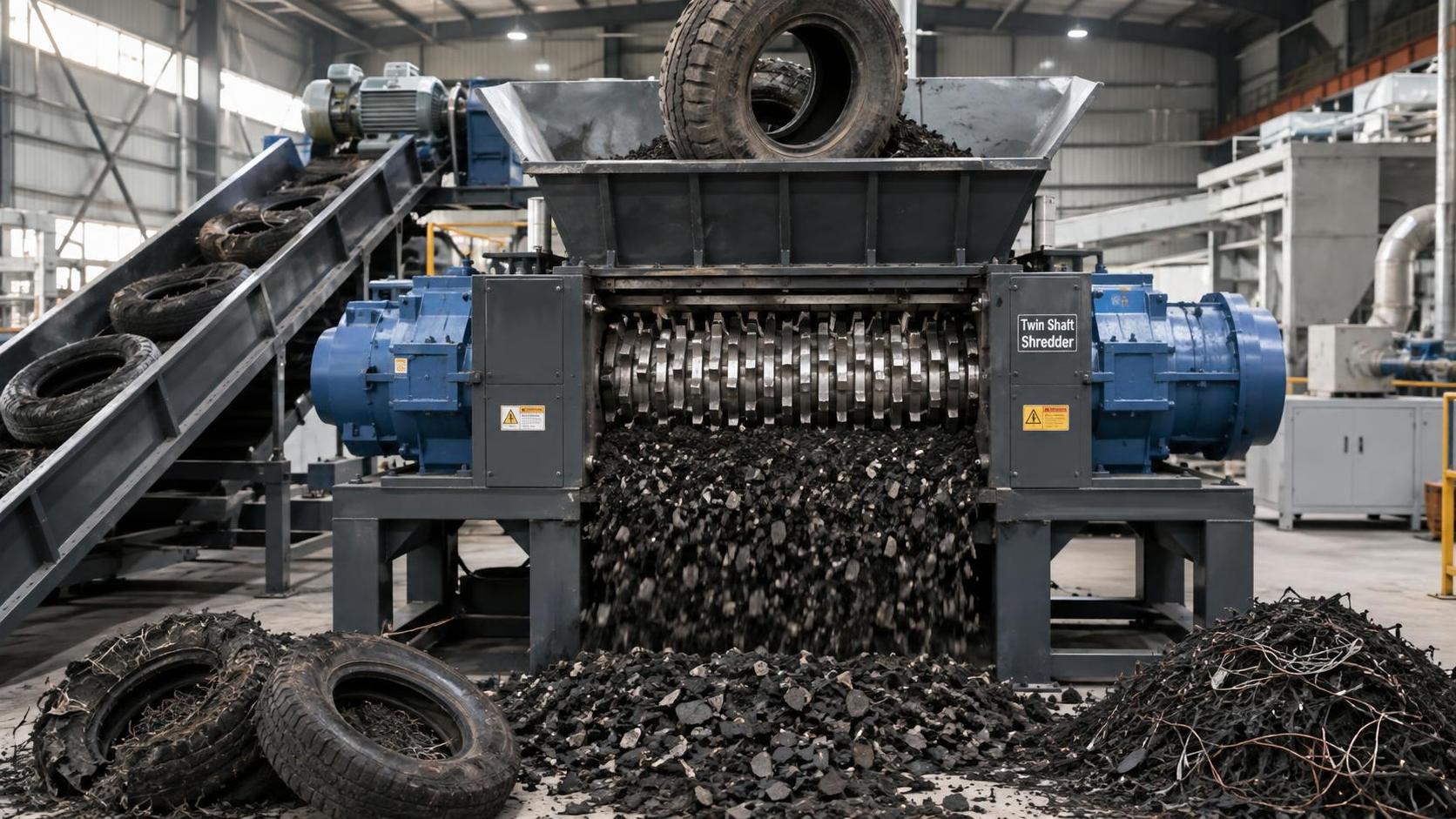
How to Choose a Twin Shaft Shredder for Tires: Torque, Throughput, and Knife Design
Selecting a twin shaft shredder for tire processing requires more than comparing motor ratings. Technical evaluators must assess available torque, real-world throughput, knife geometry, tire feed conditions, and downstream size requirements to ensure reliable operation.
The correct machine is the one that maintains controlled cutting performance across passenger tires, truck tires, off-road tires, and mixed tire streams. A high nominal capacity is irrelevant if the shredder stalls, produces inconsistent pieces, or requires excessive knife maintenance.
Start With the Tire Stream and the Required Output
Before comparing a twin shaft shredder for tire models, define the incoming material and the next processing stage. Tire dimensions, construction, contamination, bead content, and feed consistency directly determine the appropriate shredder configuration.
Passenger car tires are generally easier to process than truck, agricultural, mining, or earthmoving tires. Larger tires contain more steel reinforcement, thicker sidewalls, heavier beads, and greater rubber mass, increasing the torque demand substantially.
Technical evaluators should request a representative feed specification rather than using a broad term such as “waste tires.” The specification should identify tire diameter, width, weight range, rim removal status, moisture, debris, and estimated steel content.
The desired output is equally important. Primary shredding may only require rough strips or chips suitable for transport, while downstream granulation, steel liberation, pyrolysis, or tire-derived fuel production requires tighter and more repeatable sizing.
A twin-shaft machine is commonly selected as the primary reduction stage because it delivers high torque at low rotor speed. It tears and shears bulky tires while limiting dust, heat generation, and uncontrolled material ejection.
However, a primary shredder should not automatically be expected to produce final granulate. Trying to force a coarse machine to achieve overly small output can reduce capacity, accelerate knife wear, and create more frequent operational interruptions.
Specify the required nominal output range, acceptable oversize percentage, and expected downstream acceptance limit. These three parameters help suppliers propose an appropriate knife width, hook profile, screen arrangement, and secondary processing configuration.
Feed preparation should also be evaluated. Whole tires may be fed by conveyor, wheel loader, grab crane, or manual placement. Each method affects surge loading, tire orientation, safety guarding, and the likelihood of bridging above the cutting chamber.
Evaluate Usable Torque, Not Motor Power Alone
Torque is usually the first technical constraint in tire shredding. Tires resist cutting through elastic rubber, textile plies, thick steel belts, and bead bundles, so the shredder must sustain high torque without damaging drivetrain components.
Motor power indicates the rate at which energy can be delivered, but it does not by itself show whether the rotor can break a difficult tire. Gear reduction, hydraulic pressure, drive control, and rotor speed determine actual cutting torque.
For this reason, two machines with identical motor ratings can perform very differently. A machine with a properly sized gearbox and low rotor speed may deliver stronger cutting force than a faster system with insufficient reduction.
Ask suppliers to state peak shaft torque, continuous operating torque, rotor speed, gearbox service factor, and overload protection method. These values should be supplied for the proposed tire stream, not only for general solid-waste applications.
Peak torque matters when a knife encounters a steel bead or several compressed tires. Continuous torque matters during normal operation, where the machine must process material steadily without relying on repeated overload cycles.
Hydraulic twin-shaft shredders can offer robust overload protection and automatic shaft reversal. Electric-drive systems can provide high efficiency and precise control, but their gearbox, coupling, and control architecture must be engineered for shock loads.
Reverse logic is not a minor control feature. It determines whether the shredder clears difficult material automatically or requires operator intervention. Review the reversal trigger, reverse duration, restart sequence, and the number of permitted cycles.
Frequent reversing often signals a mismatch between material, knife design, and available torque. During site trials, record reverse events per tonne, motor loading, and time lost to clearing, rather than accepting a short visual demonstration.
Torque requirements should include a margin for tire variability. A line designed only for typical passenger tires may fail when occasional truck tires, double tires, steel-heavy casings, or improperly prepared feed enter the system.
Calculate Throughput From Operating Conditions
Published throughput figures should be treated as reference conditions, not guaranteed production rates. Actual tonnes per hour depend on tire type, feeding method, knife configuration, output size, uptime, operator practice, and downstream equipment availability.
A supplier may quote capacity based on loosely fed passenger tires with a coarse cutter arrangement. That figure can decline materially when the same shredder receives truck tires, compressed bales, mixed sizes, or a smaller output specification.
Define throughput in terms of net saleable or processable output per operating hour. This is more useful than gross feed rate because it accounts for jams, reversing, maintenance, screen cleaning, steel handling, and planned downtime.
For procurement comparisons, request at least three capacity cases: expected average feed, worst credible feed, and maximum design feed. Each case should state tire mix, target particle size, loading method, and assumed operating availability.
Availability is often the overlooked variable. A shredder rated at five tonnes per hour but operating at sixty percent availability may process less material per shift than a lower-rated machine with stable feeding and easier maintenance.
Calculate annual processing capacity from realistic scheduled hours, planned maintenance, unscheduled stoppages, and changeover time. Avoid basing financial justification on nameplate throughput multiplied by every calendar operating hour.
Feed equipment can become the actual bottleneck. A shredder needs a consistent supply that does not overwhelm the cutting chamber. Conveyor speed control, hopper geometry, infeed sensors, and loader discipline all influence achievable throughput.
Downstream conveyors, magnetic separators, secondary shredders, and granulators must also match the primary machine’s discharge pattern. A primary shredder that creates intermittent surges can overload an otherwise correctly sized downstream line.
During acceptance testing, agree on a timed trial using representative tires. Measure weighed input, output size distribution, electrical consumption, reverse cycles, stoppages, and knife condition. A formal test protocol creates a defensible procurement record.
Match Knife Geometry to the Reduction Duty
Knife design governs how a twin-shaft shredder grips, tears, shears, and releases tire material. It is one of the most consequential choices because it affects output size, throughput, energy demand, wear rate, and maintenance cost.
Wide knives generally produce larger strips or chips and allow higher throughput. Narrow knives create smaller pieces, but they increase the number of cutting interfaces, reduce open chamber volume, and often raise the torque needed for each tire.
Hook geometry controls material engagement. Aggressive hooks pull tires into the rotor effectively, especially when whole tires are fed loosely. Excessively aggressive profiles can increase shock loading and may complicate discharge of tough steel-reinforced fragments.
Knife thickness should be selected with the output specification, tire type, and secondary process in mind. Do not choose narrow cutters merely because they offer a smaller nominal piece size in a supplier brochure.
Counter-knives, spacers, combs, and shaft cleaning elements deserve the same scrutiny as rotary knives. These parts control cutting clearance and prevent long wire-containing strips from wrapping around shafts or passing through unprocessed.
Ask whether knives are manufactured from through-hardened alloy steel, surface-hardened steel, or another specified grade. Material selection must balance edge hardness against toughness, because tire bead impacts can chip overly brittle cutting edges.
Replaceable knife inserts can reduce maintenance cost when only worn edges require renewal. Fully replaceable discs may be more practical where damage is severe or where maintenance teams need rapid component exchange rather than reconditioning.
Knife maintenance should be evaluated as a lifecycle process. Clarify whether knives can be rotated, rebuilt, hardfaced, resharpened, or replaced individually, and determine how each option affects cutting clearance and output quality.
Request estimated knife life for the stated tire mix, but require the supplier to define the basis. Knife life varies widely with tire construction, contaminants, feed practices, operator response to overloads, and the chosen output size.
Consider Rotor, Chamber, and Screen Design Together
Rotor diameter, shaft spacing, cutting chamber volume, and discharge design work together with the knife profile. A large chamber can accept bulky tires more easily, while shaft spacing determines how effectively material is pinched and sheared.
Larger rotors can provide greater leverage and tooth engagement, but they also increase machine mass, inertia, drivetrain demand, and replacement cost. The preferred rotor size should reflect tire dimensions instead of being treated as a universal quality indicator.
Many primary tire shredders operate without a sizing screen, allowing material to exit once it passes through the cutting zone. This supports high throughput but produces variable pieces that may require a secondary shredder.
Where screens are used, evaluate their accessibility and blockage risk. Steel wire, long rubber strips, and fabric can accumulate around restrictive screens, reducing effective capacity and increasing maintenance exposure for operators.
Output control can also be achieved through cutter width, cutter count, shaft speed, and downstream classification. A staged approach is frequently more reliable than requiring a single twin-shaft shredder to deliver a tightly controlled final fraction.
Inspect the chamber for dead zones where tires can bridge or where wire can wrap. Good access doors, cleaning points, and guarded maintenance positions reduce the time and safety risk associated with routine material removal.
Assess Energy Use, Reliability, and Lifecycle Cost
Energy consumption should be measured per tonne of processed tire material, not only as installed kilowatts. A higher-power shredder can deliver lower energy per tonne when it avoids repeated stalls, reversals, and inefficient partial cutting cycles.
Request electrical consumption data from representative tire trials and distinguish between idle power, average operating power, and peak demand. Peak demand affects site electrical infrastructure, while average consumption shapes the recurring operating budget.
Drivetrain reliability is central to lifecycle value. Gearboxes, hydraulic pumps, couplings, bearings, seals, and shaft assemblies should be assessed for load ratings, service access, spare-part lead times, and documented maintenance intervals.
Bearings are particularly important because tire shredding creates shock loads, dust, wire contamination, and vibration. Review bearing protection, lubrication arrangements, temperature monitoring, and whether replacement requires major dismantling of the shredder frame.
Maintenance access should be physically reviewed during a factory acceptance test or reference-site visit. A machine may appear simple in drawings yet require extensive disassembly, lifting equipment, or hazardous confined access for routine knife replacement.
Include wear parts, labor, planned downtime, energy, and spare inventory in the total cost of ownership model. The lowest purchase price can become costly when cutter life is short or critical drivetrain parts have long delivery times.
For global projects, verify local technical support, remote diagnostics, commissioning capability, and spare-part stocking. A tire recycling line can lose substantial revenue when a proprietary knife, gearbox component, or control module is unavailable.
Verify Safety, Controls, and Compliance Requirements
Tire shredding presents entanglement, ejection, noise, dust, fire, and maintenance hazards. Equipment selection must therefore include a documented review of guarding, emergency stops, lockout points, control reliability, and safe cleaning procedures.
Ask for the applicable machine safety standards and declarations of conformity, including CE requirements where relevant. For international facilities, align the machine package with local electrical codes, occupational safety rules, and site-specific risk assessments.
Emergency-stop circuits should safely remove hazardous motion and prevent unexpected restart. Verify whether the machine uses safety-rated relays or programmable safety controls, and confirm how upstream and downstream equipment are integrated into the safety circuit.
Fire protection deserves attention because shredded rubber can retain heat and create fuel-rich dust. Depending on the process, specify temperature monitoring, spark detection, suppression interfaces, dust extraction, and isolation from other combustible material streams.
Controls should record practical operating data. Useful information includes motor load, hydraulic pressure, shaft direction, reverse events, runtime, alarms, maintenance hours, and emergency-stop status. These records support troubleshooting and performance verification.
Remote monitoring can improve support, but it should be reviewed within the facility’s cybersecurity requirements. Confirm user access levels, network architecture, data ownership, and the supplier’s process for remote intervention and software updates.
Build a Procurement Specification That Suppliers Can Answer
A clear specification reduces the risk of receiving incomparable proposals. Start with annual tonnage, operating schedule, tire categories, maximum tire dimensions, prohibited feed materials, target output size, and expected downstream processing steps.
Then define minimum technical information required from every bidder. This should include motor rating, shaft speed, continuous and peak torque, knife dimensions, knife material, estimated wear life, throughput assumptions, power consumption, and installed auxiliaries.
Require suppliers to identify exclusions explicitly. Common exclusions include infeed conveyors, discharge conveyors, magnets, dust extraction, electrical installation, foundations, crane access, commissioning, training, spare parts, and performance testing materials.
Performance guarantees should be linked to defined feedstock and operating conditions. A guarantee without a controlled test material, output requirement, availability basis, and acceptance method leaves too much room for conflicting interpretation after delivery.
Reference checks are valuable when they match the intended duty. Ask existing users about tire mix, actual tonnes per hour, knife replacement frequency, unplanned downtime, supplier response time, and whether output matched downstream process requirements.
Do not evaluate a twin shaft shredder for tire processing in isolation. The best selection is a line-level decision that balances feed handling, primary reduction, steel separation, secondary sizing, safety systems, and maintenance resources.
Final Selection Guidance
The right twin shaft shredder for tire applications is not necessarily the largest machine or the one with the highest motor rating. It is the machine whose torque, cutter design, chamber geometry, and controls match the real tire stream.
Technical evaluators should prioritize verified continuous torque, representative throughput testing, knife lifecycle data, maintainability, and safety integration. These factors predict operational reliability more accurately than headline capacity or purchase price alone.
Specify the incoming tires and required output first, then compare suppliers using measurable operating conditions. This approach produces a defensible selection, protects downstream equipment, and improves the long-term economics of tire recycling operations.
Technical Specifications
- How to Select Electronic Hotel Key Card Locks for Guest Rooms and Staff AreasAuthor :Safety Compliance Lead
- How to Select Lab Instruments for Reliable Chemical Analysis WorkflowsAuthor :Precision Metrology Expert
- How to Size a UPS for Server Rooms: Load, Runtime, and Redundancy FactorsAuthor :Grid Infrastructure Analyst
Expert Insights

Chief Security Architect
Dr. Thorne specializes in the intersection of structural engineering and digital resilience. He has advised three G7 governments on industrial infrastructure security.
Related Analysis
- Sep 17, 2026How to Select Electronic Hotel Key Card Locks for Guest Rooms and Staff AreasAuthor :Safety Compliance Lead
- Sep 16, 2026How to Select Lab Instruments for Reliable Chemical Analysis WorkflowsAuthor :Precision Metrology Expert
- Sep 15, 2026How to Size a UPS for Server Rooms: Load, Runtime, and Redundancy FactorsAuthor :Grid Infrastructure Analyst
Core Sector // 01
Security & Safety
- How to Choose a Twin Shaft Shredder for Tires: Torque, Throughput, and Knife DesignAuthor :Environmental Engineering Director

- Selecting Waste Recycling Equipment by Waste Stream, Throughput, and Contamination LevelAuthor :Environmental Engineering Director

- How to Choose Waste Sorting Equipment for Recycling Plants by Material Stream and CapacityAuthor :Environmental Engineering Director

- Scrap Metal Baler Buying Guide: Horizontal vs Vertical, Capacity, Power, and OutputAuthor :Environmental Engineering Director

- What Is Industrial Ecology and How Does It Improve Resource Efficiency in Manufacturing?Author :Environmental Engineering Director

- Pet Bottle Washing Line Problems: Common Causes of Flake Contamination and How to Fix ThemAuthor :Environmental Engineering Director

- How to Evaluate Environment & Ecology Cost in Industrial ProjectsAuthor :Environmental Engineering Director

- Why does a magnetic separator machine lose efficiency?Author :Environmental Engineering Director