Industrial Metal Properties: Strength, Corrosion Resistance and Applications
Author
Date Published
Reading Time
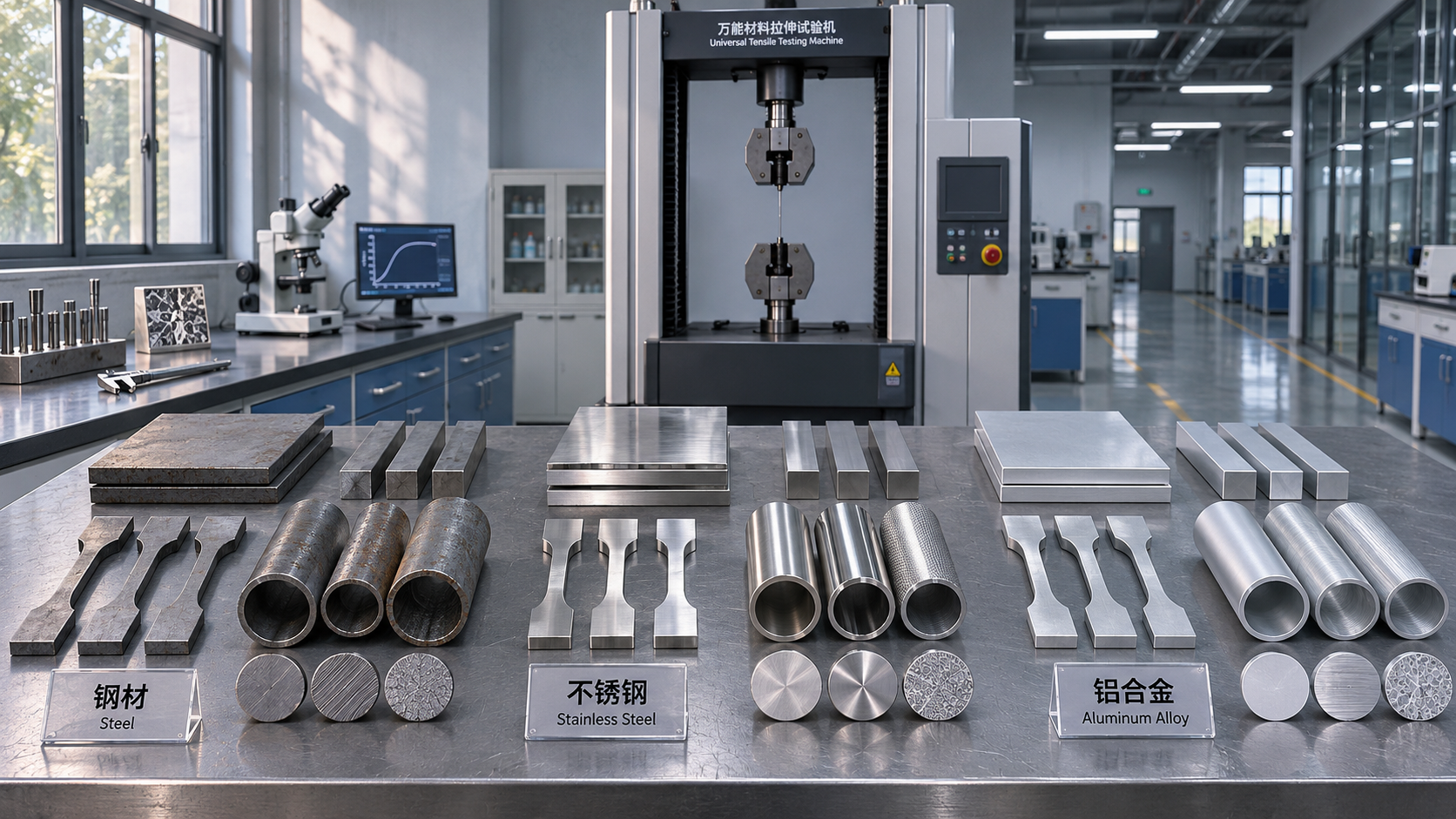
Industrial metal selection starts with the required performance of the finished component under its actual load and environment. Yield strength, corrosion resistance and operating temperature must be considered together: a strong alloy can fail prematurely at a chloride-exposed crevice, while a corrosion-resistant material can deform if its stiffness or elevated-temperature strength is inadequate. The relevant properties also change with alloy grade, product form, heat treatment and welding.
For a defensible comparison, define the service conditions before comparing material data sheets. Record the load type, temperature range, contact media and expected fabrication route, then compare properties for the same product form and condition. A value measured on a heat-treated plate is not automatically representative of a welded casting or a cold-formed tube made from the same alloy family.
Strength values describe different failure limits
Yield strength indicates the stress at which a material begins to undergo a specified amount of permanent deformation. It is often relevant where a shaft, bracket or pressure boundary must retain its shape after loading. Ultimate tensile strength is the maximum engineering stress reached in a tensile test; it does not establish the load a component can safely carry. A design that allows little permanent distortion is often governed by yield rather than ultimate strength.
Stiffness is a separate property. Two steels with substantially different yield strengths have similar elastic moduli, so replacing a lower-strength steel with a higher-strength grade will not greatly reduce elastic deflection if the geometry stays the same. A thicker section or a different shape may be needed to control movement. Aluminum has a lower elastic modulus than steel, making deflection and buckling especially relevant when comparing structures of similar dimensions.
Strength data also need a temperature and direction. Properties measured at room temperature do not establish performance during sustained hot service. At sufficiently high temperature, creep—gradual deformation under load—can govern design even when the applied stress is below the short-term yield strength. At low temperature, some metals lose toughness and become more susceptible to brittle fracture; the transition depends on grade, thickness, processing and loading conditions.
Fatigue introduces a different limit. A component subjected to repeated vibration, pressure cycling or reversing loads can crack at a local stress concentration even when the nominal stress is below yield. Weld toes, keyways, threads, surface damage and corrosion pits all affect fatigue performance. A polished test specimen cannot represent every finished part, so fatigue data must be interpreted alongside joint geometry and surface condition.
Comparing common industrial metal families
The table summarizes tendencies rather than design allowables. Each family contains grades with substantially different properties; the specified condition and service environment control the final comparison.
Within stainless steels, austenitic, ferritic, martensitic and duplex grades behave differently. For example, an austenitic grade selected for corrosion resistance and formability is not interchangeable with a martensitic grade selected for hardness. Likewise, “aluminum” does not identify whether a component has been strengthened by work hardening or heat treatment, or whether a subsequent weld will reduce strength locally.
Corrosion resistance belongs to an alloy–environment pair
General corrosion removes material over a relatively broad area. Where the rate is sufficiently predictable, it can be addressed through material thickness, protection and inspection. Localized corrosion is harder to manage by adding thickness alone: a pit or crevice can penetrate a wall while most of the surface appears sound. Deposits under gaskets, stagnant pockets and tight overlaps are common locations for differences in local chemistry to develop.
Stainless steel illustrates the distinction. Its corrosion resistance relies on a passive surface film, but chloride concentration, temperature, acidity, oxygen availability and crevice geometry influence whether that film remains protective. A grade suitable for clean, flowing water is not automatically suitable beneath deposits in warm, chloride-containing water. Drainage, cleaning access and avoidance of stagnant pockets can be as consequential as changing the alloy.
Galvanic corrosion requires an electrical connection between dissimilar metals and an electrolyte that connects their surfaces. The less noble metal can corrode preferentially. Risk depends on the particular materials, electrolyte and exposed area ratio; a small anodic area connected to a large cathodic area is a concerning arrangement. Electrical isolation and suitable joint design can interrupt the corrosion cell, but an insulating washer alone may be insufficient if a wet fastener still bridges the metals.
Stress corrosion cracking combines a susceptible material, tensile stress and a specific environment. Residual stresses from forming or welding can contribute even when external loads appear modest. The relevant combination must be evaluated for the alloy and medium; resistance to uniform corrosion does not establish resistance to cracking. Hydrogen exposure presents another distinct concern because certain high-strength steels can be vulnerable to hydrogen-assisted cracking under appropriate conditions.
Fabrication changes the material being evaluated
A drawing that names only an alloy family leaves too much open. Product form, temper or heat-treatment condition, thickness and applicable material specification affect the properties delivered. A forged part, plate and casting of similar nominal chemistry can have different grain structures, defect populations and specified mechanical requirements.
Welding adds a fusion zone and a heat-affected zone, each with properties that can differ from the base metal. In heat-treatable aluminum, welding can reduce local strength relative to the parent material. In some stainless steels, an unsuitable thermal cycle or filler choice can impair corrosion resistance or toughness. Welding procedures, filler selection and any required post-weld treatment therefore belong in the material assessment, especially when the joint lies in a highly stressed or corrosive region.
Cold forming raises strength through work hardening in many metals, but it also consumes ductility and introduces residual stress. The resulting condition matters when a formed tube is later expanded, welded or exposed to a cracking environment. Machining has its own consequences: sharp transitions and poor surface finish can raise local fatigue sensitivity, while contamination from fabrication tools can compromise the appearance or local corrosion behavior of stainless surfaces.
Surface protection is part of the system. A coating can make carbon steel suitable for an environment that would otherwise attack it, provided the surface preparation, application, edge coverage and maintenance regime fit the exposure. Coating damage at a flange, weld or support changes the local condition; the bare substrate and the damaged area must be considered when assessing service life.
Turning material properties into an application decision
Pressure-containing piping
For a pipe carrying a process fluid, start with pressure, temperature and fluid composition, including contaminants and expected cleaning chemicals. Consider startup, shutdown and stagnant conditions as well as normal flow. Strength at the design temperature establishes one part of the assessment; internal corrosion, external exposure, erosion at changes in direction and weld performance establish others. The governing construction code and material specification determine the applicable design rules and allowable stresses.
A stainless grade may suit a clean process stream yet be vulnerable at a gasket crevice when chlorides accumulate. Conversely, carbon steel with an appropriate corrosion allowance and protective system may be suitable for a different fluid. The choice turns on documented exposure and inspection access, rather than on a generic ranking of metals.
Rotating shafts and structural members
A shaft requires sufficient strength against combined bending and torsion, but fatigue often controls around shoulders, keyways and threaded ends. Hardness can improve wear resistance at a bearing or seal surface; excessive hardness or an unsuitable heat treatment can also affect toughness and cracking susceptibility. Specify the required properties and inspection locations for the finished section, including any surface treatment.
For a long frame member, deflection and buckling may govern before material yield. A higher-strength steel can permit a smaller cross-section only if stiffness, stability, connections and fatigue remain acceptable. An aluminum alternative reduces weight, but the section geometry and welded-joint strength need separate evaluation.
Heat exchangers and electrical components
Thermal conductivity matters in a heat exchanger, yet tube wall thickness, fouling, fluid velocity and corrosion also influence performance. Copper alloys can offer useful conductivity, while a stainless or nickel alloy may be selected for a particular fluid. Compatibility must be considered on both sides of the tube, including deposits and cleaning conditions.
For conductors and terminals, electrical conductivity competes with mechanical strength, contact pressure and corrosion behavior. Aluminum connections require attention to surface oxide, joint design and thermal expansion. A material with adequate bulk conductivity can still produce an unreliable connection if the interface is poorly controlled.
Reading specifications and test evidence
Use material standards to define the grade, permitted composition, delivery condition, dimensions and required tests. Construction standards or codes address the design and fabrication of the equipment; a material specification alone does not establish that a complete component is fit for service. Identify the applicable edition and any project-specific requirements in the purchase and engineering documents.
Test reports should be traceable to the supplied material and relevant to the specified product form and condition. Tensile results, impact results where required, chemical analysis and heat-treatment records answer different questions. A passing tensile result does not demonstrate corrosion resistance in a particular process fluid, and a composition report does not establish the toughness of a weld.
Where published corrosion data do not represent the actual chemistry or temperature, laboratory testing or a controlled exposure trial can reduce uncertainty. The test should reproduce the conditions that drive the suspected mechanism, including crevices, welds, deposits or cyclic exposure where relevant. Acceptance criteria and inspection methods need to be agreed before testing so that the result can support a material decision.
Expert Insights

Chief Security Architect
Dr. Thorne specializes in the intersection of structural engineering and digital resilience. He has advised three G7 governments on industrial infrastructure security.
Related Analysis
- Nov 22, 2026McKinsey: India Needs Up to $400 Billion to Meet Steel Capacity Growth GoalAuthor :
- Nov 22, 2026Choosing Geotextile Fabric for Landfill Drainage and Liner ProtectionAuthor :Environmental Engineering Director
- Nov 21, 2026Japan's Steel Exports Could Fall to Lowest Level Since 1999 in 2026Author :
Core Sector // 01
Security & Safety
- Industrial Metal Properties: Strength, Corrosion Resistance and ApplicationsAuthor :Heavy Industry Strategist

- US Commerce Opens Changed Circumstances Review of Mexican Heavy-Walled Rectangular Welded Carbon Steel PipeAuthor :Heavy Industry Strategist

- What Specifications Matter for High-Temperature Steel Furnace Linings?Author :Heavy Industry Strategist

- How to Specify Steel Heavy-Duty Corner Guards for Loading Bays and High-Traffic AreasAuthor :Heavy Industry Strategist

- Selecting Non-Ferrous Metal Plates for Corrosion, Weight, and Formability RequirementsAuthor :Heavy Industry Strategist

- Stainless Steel Welded Tube Applications: Matching Tube Supply to Fabrication NeedsAuthor :Heavy Industry Strategist

- What Maintenance Do Furnace Components Need After 18 Months?Author :Heavy Industry Strategist

- How to Assess Metal Materials for Thermal Cycling in Power BoilersAuthor :Heavy Industry Strategist