How to Specify Steel Heavy-Duty Corner Guards for Loading Bays and High-Traffic Areas
Author
Date Published
Reading Time
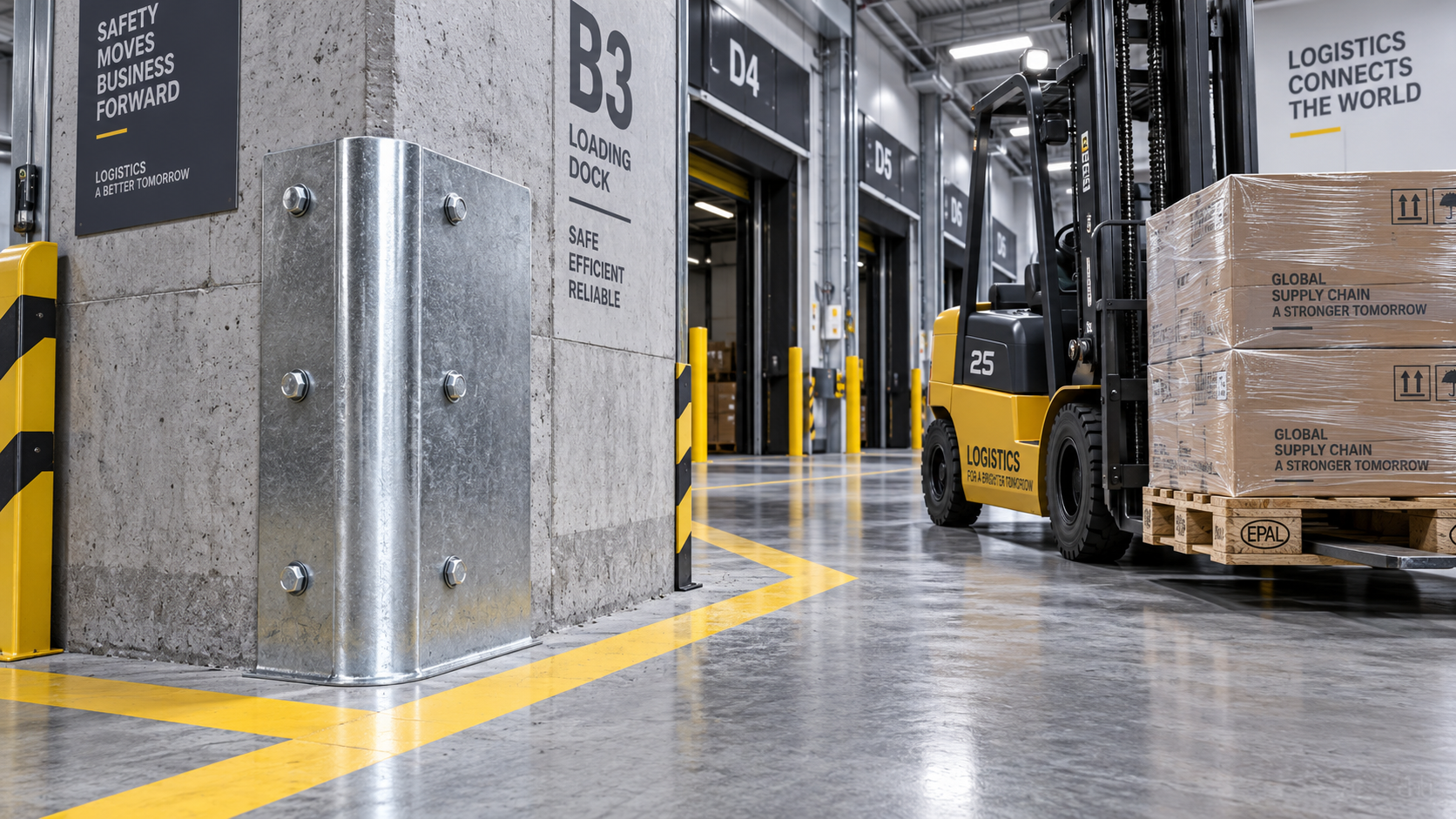
At a loading bay, corner damage rarely begins with a dramatic collision. More often, it starts with a pallet truck cutting a turn too tightly, a reversing forklift clipping a dock opening, or a delivery vehicle brushing a wall during a busy shift. Over time, chipped masonry, crushed drywall, exposed concrete edges, and bent trims become more than cosmetic defects. They can interrupt operations, create snag points, weaken wall finishes, and turn a minor maintenance issue into a recurring repair cost.
For project managers, specifying steel heavy duty corner guards is therefore not a simple finishing decision. The guard has to suit the impact pattern, wall construction, vehicle movement, exposure conditions, maintenance strategy, and safety expectations of the facility. A product that appears substantial in a catalogue may still fail early if it is fixed into a weak substrate, too short for the strike zone, or made from a steel grade unsuitable for washdown and coastal air.
The most reliable specification begins with a clear view of what is actually hitting the corner—and how often. This guide sets out a practical framework for selecting steel corner protection in loading bays, warehouses, manufacturing plants, service corridors, parking structures, and other high-traffic industrial areas.
Start with the impact event, not the catalogue description
“Heavy duty” has no universal engineering meaning. A corner guard intended to resist occasional trolley contact is a different product from one positioned beside a dock leveller where forklifts and roll cages pass all day. Before selecting thickness, profile, or finish, identify the credible impact events at each location.
Walk the route with operations personnel where possible. Review turning radii, door clearances, rack positions, queuing areas, and the direction from which vehicles approach. A corner on the outside edge of a dock door may receive broad glancing contact from vehicle bodies, while an internal corridor corner may take concentrated impacts from forklift counterweights or pallet overhangs. These events transfer force differently and can demand different guard geometries.
- Light rolling contact: hand trolleys, carts, wheeled bins, and pedestrian traffic.
- Repeated medium impact: pallet jacks, roll cages, electric pallet trucks, and mobile equipment.
- High-energy industrial impact: forklifts, reach trucks, dock equipment, reversing vehicles, and material-handling loads.
- Environmental degradation: water, de-icing salts, cleaning chemicals, food-processing washdown, dust, or coastal exposure.
Where the risk is high-energy vehicle contact, a wall-mounted corner guard should not be treated as a substitute for a freestanding bollard, barrier rail, rack-end protector, or dock protection system. Steel guards protect the corner face and edge; they do not automatically protect the wall structure from a serious vehicle strike. The specification should state this limitation clearly so that the design team does not assign one component a job it cannot safely perform.
Define the protection zone in three dimensions
A common procurement mistake is to choose a robust guard but protect too little of the corner. The result is familiar: the guard survives while the wall just above, below, or beside it begins to fail. The required protection zone should be based on the equipment fleet, not on a standard product length alone.
Map the likely contact height. Forklift forks, load edges, pallet corners, vehicle bumpers, and cart handles do not all strike at the same elevation. In loading bays, the highest-risk area may begin close to floor level and extend well beyond the height of a conventional wall trim. Consider whether impacts occur during lifting, turning, or reversing. If pallets are carried at elevated height, a taller installation—or a complementary wall protection panel—may be needed.
Length also matters horizontally. A narrow angle guard protects the arris but leaves adjacent wall faces vulnerable to oblique impacts. Wider wings distribute loads across a larger area and give a better visual target for drivers. However, excessively wide profiles can reduce clearances, interfere with shutters or doors, and create a projection hazard in narrow routes. The best profile is one that provides enough coverage without compromising circulation.
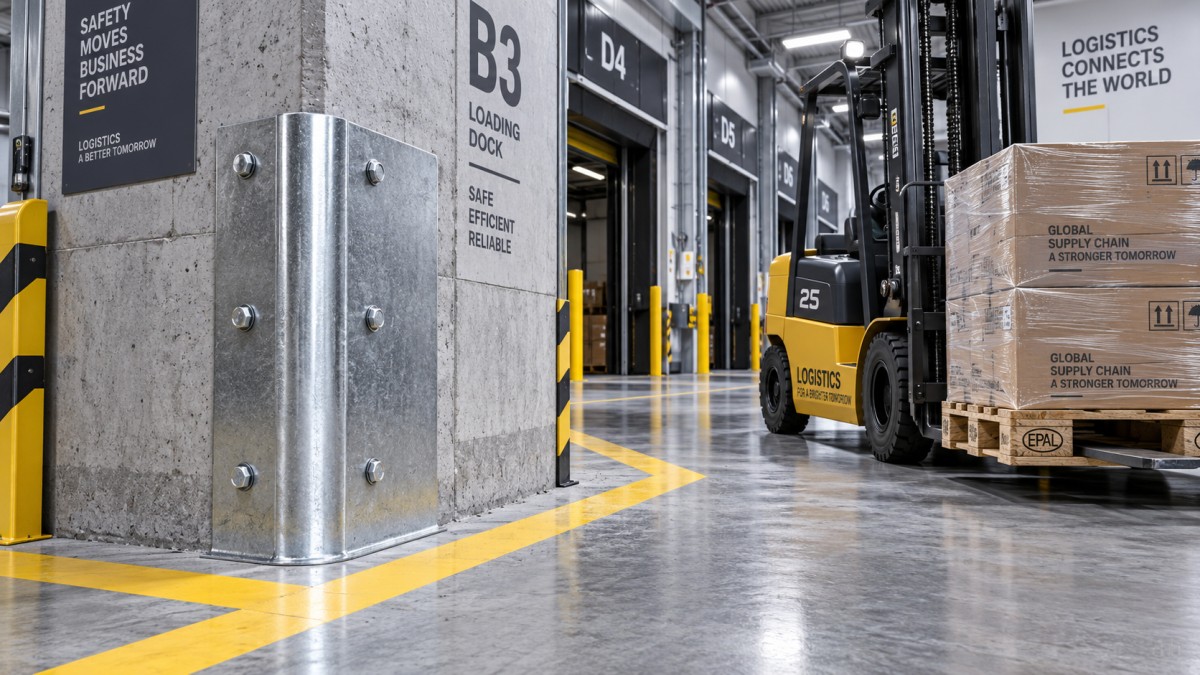
Steel grade and finish: choose for the environment, not appearance
Steel remains a practical choice for demanding corners because it combines stiffness, abrasion resistance, and repairability. Yet “steel” is only the starting point. Material selection should reflect the actual corrosion and hygiene environment.
Carbon steel with a coating can be appropriate for protected interiors, but every drilled hole, cut edge, and impact scratch becomes a possible corrosion initiation point. Stainless steel offers improved resistance in many wet or hygienic settings, but it is not immune to staining, chloride attack, or contamination from carbon-steel tooling. Project documents should define the finish, fabrication quality, and handling expectations rather than simply writing “stainless steel” as a catch-all requirement.
If the guard will be visible to visitors, reflectivity and finish consistency may matter. In operational zones, though, a highly polished surface can reveal scratches quickly and may create glare. Brushed, textured, galvanized, or coated finishes can be more practical depending on the location and cleaning regime.
Thickness is important—but section shape and anchorage often decide performance
It is tempting to compare guards only by sheet thickness. Thickness contributes to dent resistance, but performance is also influenced by return depth, folded edges, corner radius, stiffening features, spacing from the wall, and the ability of the fixing system to transfer load into the substrate.
A sharply formed right-angle section may fit a crisp architectural corner, but a rounded outer radius can better deflect glancing contact and reduce the chance of a load catching on the edge. Return flanges increase stability and spread impact forces. For repeated industrial contact, formed or fabricated sections with substantial returns are generally more dependable than thin decorative angle trims.
Ask suppliers to provide drawings that show the full cross-section, not only the face dimensions. The drawing should identify metal thickness, internal corner dimensions, external radius, return flanges, fixing-hole locations, and any welded components. If the guard is described as “reinforced,” request an explanation of where the reinforcement sits and how it affects the installed condition.
The substrate is part of the system
A strong corner guard fixed into a weak wall will simply pull fasteners out, deform the finish, or transfer damage to the surrounding structure. The specification needs to distinguish among reinforced concrete, solid masonry, hollow block, metal stud partitions, insulated panels, and precast elements. Each substrate requires a different fixing approach.
Concrete and sound masonry can usually accept mechanical anchors when edge distances, embedment, and substrate condition are properly assessed. Hollow block may require specialist anchors, resin systems, backing plates, or local strengthening. Lightweight stud walls deserve particular caution: a steel guard exposed to vehicle contact may need blocking, structural framing, or a separate floor-fixed protection measure rather than direct attachment to board alone.
Where fixings are exposed, use fasteners compatible with the guard material and environment. Dissimilar metals can contribute to galvanic corrosion when moisture is present. Fixing heads should be recessed or arranged so they do not become snag points, while still remaining inspectable and serviceable. Adhesive-only installation is rarely appropriate for high-impact loading-bay use unless it is part of a proven engineered system and the supplier confirms its suitability for the exact substrate and service conditions.
Write a performance-led specification
A vague line item such as “provide heavy-duty steel corner protectors” invites inconsistent bids and difficult substitutions. A better specification gives suppliers room to propose suitable products while making the operational requirement unambiguous.
For each corner type, define the location, protected height, wing dimensions or minimum coverage, material and finish, substrate, fixing method, and intended impact exposure. State whether the installation is internal, external, wet, hygienic, corrosive, or UV-exposed. Include colour or visibility requirements where guards are also intended to support route awareness. If a barrier, bollard, or dock bumper is required in addition to the guard, show the relationship on drawings rather than leaving it to site interpretation.
It is also useful to require submittals that include product drawings, material declarations, coating information where relevant, anchor data, installation instructions, maintenance guidance, and evidence of suitability for the declared application. This does not mean demanding generic claims of indestructibility. It means creating a traceable basis for evaluating whether the proposed product is appropriate.
Questions to ask during technical review
- Which vehicle types and load-handling equipment are expected to contact this location?
- Does the guard cover the full observed strike height and likely angle of approach?
- Can the specified wall or column safely receive the proposed anchors and impact loads?
- Will water, washdown residue, or debris collect behind or beneath the installation?
- Are the steel grade, coating, fasteners, and site environment compatible?
- Will the guard reduce door, shutter, aisle, or emergency egress clearance?
- Is a wall-mounted guard sufficient, or should independent vehicle protection be added?
Do not overlook installation tolerances and corner geometry
Real buildings are rarely perfectly square. Columns may have chamfers, masonry corners may be uneven, and wall finishes may vary in depth. Ordering a rigid 90-degree steel angle for every location without survey verification can lead to gaps, rocking, distorted fixings, or field modifications that damage protective coatings.
For renovation projects, survey representative corners before release. Record angle variation, wall flatness, base details, skirting, service penetrations, door frames, and existing damage. Some locations may need custom fabrication, packers, sealant detailing, or different wing sizes. At floor level, ensure the guard does not bridge over an uneven slab in a way that leaves a sharp, unsupported edge exposed to impact.
Installation quality deserves a hold point in the project plan. Check alignment, fastener spacing, torque where applicable, coating damage, edge treatment, clearances, and cleanability. In wet areas, sealing may be needed to prevent trapped moisture or contaminant build-up, but sealant should not be used to disguise a poorly fitting guard or compensate for inadequate anchorage.
Balance acquisition cost against the cost of interruption
The lowest-cost guard can become expensive if it requires repeated replacement, creates corrosion maintenance, or fails during a busy operational period. Equally, overspecifying stainless steel and custom fabrication for every low-risk internal corner may not be a responsible use of project budget. The aim is proportionate protection.
Assess lifecycle cost through the likely frequency of contact, cost of wall repair, downtime needed for access, safety implications, cleaning demands, and expected asset life. In a high-throughput loading bay, a durable system that can be inspected and repaired locally may have a stronger business case than a visually neat but lightly built trim. In an office-adjacent service corridor, the priority may be a profile that manages cart damage while remaining unobtrusive and easy to clean.
For large sites, create a corner-protection schedule rather than selecting one guard type everywhere. Categorise locations by impact severity and environment, then assign appropriate protection levels. This gives procurement teams clearer quantities, makes substitutions easier to assess, and prevents critical dock corners from receiving the same treatment as low-risk internal junctions.
A practical final check before approval
Steel heavy duty corner guards perform best when they are specified as part of an operational protection strategy, not as an afterthought once walls are already being damaged. Before approving a submittal, confirm that the guard matches the real traffic pattern, covers the impact zone, suits the substrate, and can survive the environmental conditions around it. Verify that it will not obstruct movement or create a new hazard, and make sure stronger independent protection is used wherever vehicle energy exceeds what a wall-mounted corner guard can reasonably manage.
That disciplined approach gives project teams something more valuable than a line item: a defensible, maintainable decision that protects the building fabric while keeping loading and material-handling operations moving.
Technical Specifications
- Air Handling Unit Supplier Checklist: Performance Data, Lead Times, and SupportAuthor :Environmental Engineering Director
- Buying Fiberglass Water Tanks Wholesale: Compare Quotes and Delivery CostsAuthor :Environmental Engineering Director
- Choosing an XLPE Power Cable Supplier: Test Reports, Traceability, and Lead TimesAuthor :Grid Infrastructure Analyst
Expert Insights

Chief Security Architect
Dr. Thorne specializes in the intersection of structural engineering and digital resilience. He has advised three G7 governments on industrial infrastructure security.
Related Analysis
- Oct 19, 2026Air Handling Unit Supplier Checklist: Performance Data, Lead Times, and SupportAuthor :Environmental Engineering Director
- Oct 18, 2026Buying Fiberglass Water Tanks Wholesale: Compare Quotes and Delivery CostsAuthor :Environmental Engineering Director
- Oct 17, 2026Choosing an XLPE Power Cable Supplier: Test Reports, Traceability, and Lead TimesAuthor :Grid Infrastructure Analyst
Core Sector // 01
Security & Safety
- How to Specify Steel Heavy-Duty Corner Guards for Loading Bays and High-Traffic AreasAuthor :Heavy Industry Strategist

- Selecting Non-Ferrous Metal Plates for Corrosion, Weight, and Formability RequirementsAuthor :Heavy Industry Strategist

- Stainless Steel Welded Tube Applications: Matching Tube Supply to Fabrication NeedsAuthor :Heavy Industry Strategist

- What Maintenance Do Furnace Components Need After 18 Months?Author :Heavy Industry Strategist

- How to Assess Metal Materials for Thermal Cycling in Power BoilersAuthor :Heavy Industry Strategist

- How to Evaluate Aluminum Extrusion Suppliers for Tight-Tolerance Components?Author :Heavy Industry Strategist

- How to Evaluate a Weld Neck Flange Manufacturer for High-Pressure Pipe ProjectsAuthor :Heavy Industry Strategist

- EU REACH Ban Hits Cr(VI)-Coated Steel ImportsAuthor :Heavy Industry Strategist
-Coated Steel Imports")