INMETRO Updates Fire Pump Set Certification: IEC 60034-30-2 Enforcement Effective May 2026
Author
Date Published
Reading Time
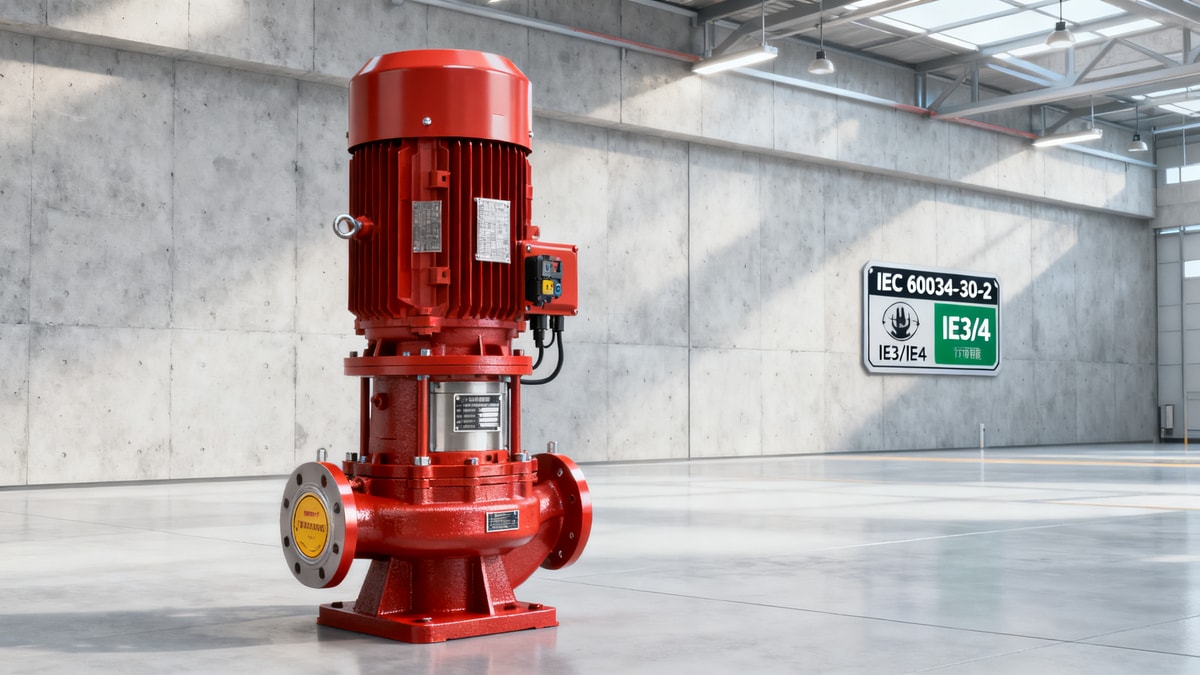
On May 2, 2026, Brazil’s National Institute of Metrology, Quality and Technology (INMETRO) updated Annex to Portaria INMETRO No. 189/2025, extending mandatory energy efficiency requirements under IEC 60034-30-2:2023 to fire pump sets. This change directly impacts manufacturers, exporters, and importers of fire pump equipment supplying the Brazilian market — particularly those based in China and other major exporting countries.
Event Overview
Effective May 2, 2026, INMETRO revised the technical annex of Portaria INMETRO No. 189/2025 to include fire pump sets under the scope of IEC 60034-30-2:2023. Under the update, all electric motors integrated into fire pump sets imported into Brazil must meet IE3 or IE4 efficiency classes. Compliance requires submission of an energy efficiency test report issued by an INMETRO-recognized laboratory.
Which Subsectors Are Affected
Direct Exporting Enterprises
Companies exporting fire pump sets from China (and other non-Brazilian jurisdictions) to Brazil are required to revalidate motor efficiency for each model line. Since prior certifications may not cover IEC 60034-30-2:2023 testing protocols, full retesting is necessary — triggering both cost and timeline implications.
Motor Component Suppliers
Suppliers of standardized or custom-built motors used in fire pump assemblies face revised procurement specifications. Buyers now require IE3/IE4-rated motors with traceable test documentation, shifting sourcing criteria and potentially narrowing qualified vendor pools.
Fire Pump System Integrators & Manufacturers
Integrators assembling complete fire pump sets (e.g., diesel-driven units with electric jockey pumps, or electric-only systems) must verify motor compliance at the component level and ensure final assembly documentation reflects IEC 60034-30-2 alignment. This adds verification steps to quality control and certification workflows.
Logistics & Certification Service Providers
Third-party testing labs, INMETRO-accredited conformity assessment bodies, and customs brokers handling fire pump imports will see increased demand for energy efficiency validation support. Lead times for lab testing and report issuance are expected to rise, affecting overall shipment planning.
What Relevant Enterprises or Practitioners Should Focus On
Monitor official updates to Portaria INMETRO No. 189/2025 implementation guidance
While the regulatory amendment took effect on May 2, 2026, transitional provisions — such as grace periods for existing stock or grandfathering of previously certified models — have not been publicly confirmed. Enterprises should track INMETRO’s official notices and consult accredited certification bodies for interpretation.
Prioritize retesting for high-volume or flagship fire pump models
Given projected BOM cost increases of 3.2%–5.8% and extended lead times of 10–14 days per test cycle, companies should sequence retesting based on export volume, customer contracts, and shelf-life of current certifications — rather than applying blanket revalidation across all SKUs.
Distinguish between regulatory signal and enforceable requirement
This update formalizes a technical requirement but does not yet specify enforcement mechanisms (e.g., port-of-entry verification frequency, penalties for noncompliance). From industry perspective, it signals tightening alignment with global efficiency norms — not immediate customs detention risk — though readiness remains operationally urgent.
Update supplier agreements and internal technical documentation
Procurement terms with motor suppliers should now explicitly reference IEC 60034-30-2:2023 compliance and reporting obligations. Internal engineering files, BOMs, and export declaration templates must reflect updated efficiency class labeling and test report references.
Editorial Observation / Industry Perspective
Observably, this revision reflects Brazil’s broader policy shift toward harmonizing energy efficiency standards for industrial equipment with IEC benchmarks — particularly for safety-critical applications like fire protection systems. Analysis shows that while the rule change itself is narrow in scope (limited to fire pump sets), its inclusion of IEC 60034-30-2:2023 suggests future expansion to other pump categories or rotating machinery under INMETRO’s OCP (Organismo de Conformidade de Produtos) framework. It is better understood as a regulatory signal — one that underscores the growing linkage between energy performance and market access in Latin American regulated sectors — rather than a standalone compliance endpoint.
Current attention should focus less on whether the rule applies, and more on how quickly firms can align motor sourcing, testing capacity, and documentation practices without disrupting order fulfillment timelines for the Brazilian market.
Conclusion
This update marks a procedural tightening in Brazil’s fire pump market access regime — not a fundamental shift in product safety expectations, but a material addition to technical compliance prerequisites. For affected enterprises, the change reinforces that energy efficiency is no longer a voluntary differentiator in regulated infrastructure equipment; it is now a baseline eligibility criterion. The most pragmatic interpretation is that this is an operational calibration point — requiring focused, model-level action — rather than a strategic inflection demanding broad portfolio redesign.
Source Disclosure
Main source: Official amendment to Annex of Portaria INMETRO No. 189/2025, published by the Brazilian National Institute of Metrology, Quality and Technology (INMETRO), effective May 2, 2026.
Note: Transitional arrangements, enforcement timelines, and model-specific grandfathering provisions remain unconfirmed and require ongoing monitoring.
Technical Specifications
- India BIS Draft IS 17832:2026 Sets Noise & Dust Limits for Waste CrushersAuthor :Environmental Engineering Director
- Korea MFDS Mandates Korean UI & KOSHA OEL Database for Industrial Water AnalyzersAuthor :Precision Metrology Expert
- Indonesia BPOM Mandates PM0.1 Efficiency & CADR Decay Labeling for Industrial Air PurifiersAuthor :Environmental Engineering Director
Expert Insights

Chief Security Architect
Dr. Thorne specializes in the intersection of structural engineering and digital resilience. He has advised three G7 governments on industrial infrastructure security.
Related Analysis
- May 03, 2026India BIS Draft IS 17832:2026 Sets Noise & Dust Limits for Waste CrushersAuthor :Environmental Engineering Director
- May 03, 2026Korea MFDS Mandates Korean UI & KOSHA OEL Database for Industrial Water AnalyzersAuthor :Precision Metrology Expert
- May 03, 2026Indonesia BPOM Mandates PM0.1 Efficiency & CADR Decay Labeling for Industrial Air PurifiersAuthor :Environmental Engineering Director
Core Sector // 01
Security & Safety
- INMETRO Updates Fire Pump Set Certification: IEC 60034-30-2 Enforcement Effective May 2026Author :Safety Compliance Lead

- Marine Oil Spill Boom Choices That Backfire in Rough WaterAuthor :Safety Compliance Lead

- Flood Control Sandbags: When Size Choice Affects Deployment SpeedAuthor :Safety Compliance Lead

- JIS T 8201-2026 Enforces New Low-Temp Impact Test for Fire Respirator MasksAuthor :Safety Compliance Lead

- Dry chemical fire extinguishers and clean-up costs after dischargeAuthor :Safety Compliance Lead

- CO2 fire extinguishers wholesale: refill logistics often overlookedAuthor :Safety Compliance Lead

- Fire hydrant valves: signs the material grade is not enoughAuthor :Safety Compliance Lead

- Why fire hose reel cabinets fail early in humid locationsAuthor :Safety Compliance Lead