India BIS Draft IS 17832:2026 Sets Noise & Dust Limits for Waste Crushers
Author
Date Published
Reading Time
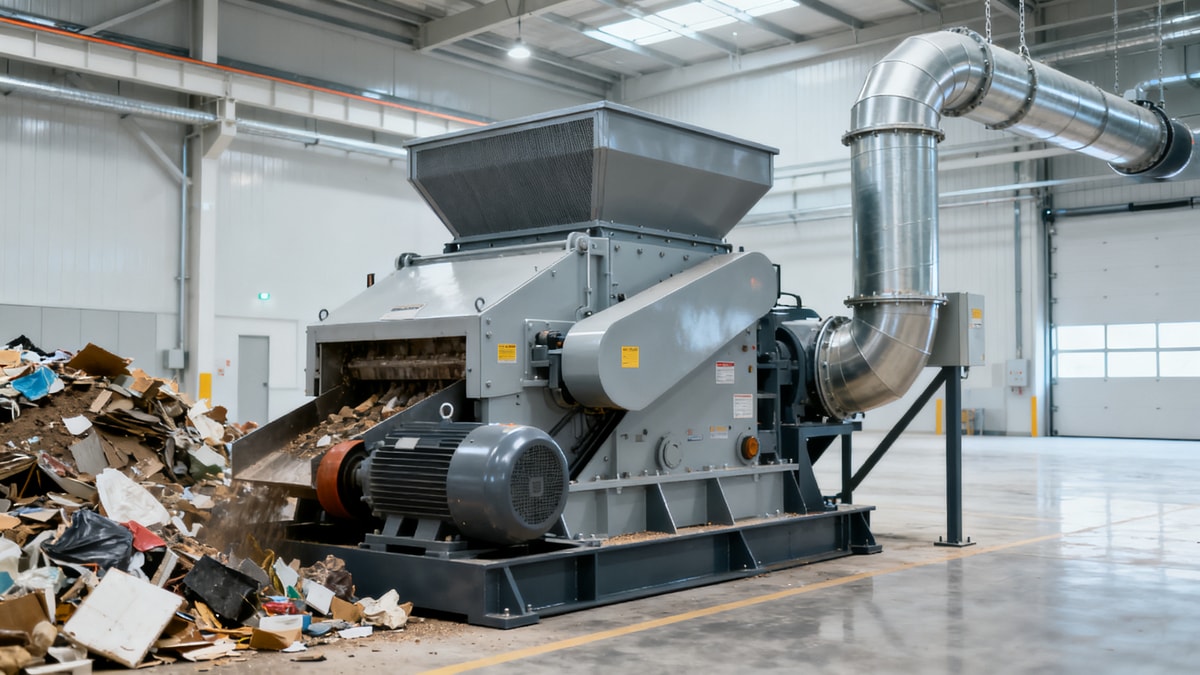
On May 1, 2026, the Bureau of Indian Standards (BIS) released the draft standard IS 17832:2026 — Safety and Environmental Requirements for Industrial Solid Waste Crushers — for public consultation. The draft proposes mandatory dual-control certification for all imported industrial waste crushing equipment, requiring compliance with noise emission ≤85 dB(A) at 1 m distance and airborne dust emission ≤0.5 mg/m³. This development is especially relevant for manufacturers, exporters, and distributors of solid waste processing equipment targeting the Indian market.
Event Overview
The Bureau of Indian Standards (BIS) published the draft IS 17832:2026 on May 1, 2026. The document specifies safety and environmental requirements for industrial solid waste crushing equipment, with two enforceable limits: sound pressure level not exceeding 85 dB(A) measured at 1 meter from the equipment, and dust emission not exceeding 0.5 mg/m³ under defined test conditions. Certification must be issued by a BIS-recognized laboratory. Public comments are accepted until June 15, 2026. The standard is expected to enter into force in Q4 2026.
Impact on Specific Industry Segments
Direct Exporters (Especially from China)
Exporters supplying industrial crushers to India will face new pre-market compliance obligations. Non-compliant units may be denied BIS registration or customs clearance post-implementation. Impact manifests primarily in extended lead times (due to mandatory third-party testing), increased certification costs, and potential redesign requirements for legacy models lacking integrated noise suppression or dust containment systems.
Equipment Manufacturers (OEMs and Tier-2 Suppliers)
Manufacturers must verify whether their current product lines meet both acoustic and particulate emission thresholds under standardized test protocols. Since the draft references specific measurement methods (not detailed in the source), OEMs may need to engage BIS-recognized labs early for gap analysis. Impact includes revised technical documentation, possible retrofitting of enclosures or filtration systems, and updated labeling to reflect certified performance values.
Distribution and Aftermarket Service Providers
Distributors handling multiple crusher brands will need to validate certification status for each SKU before import or resale. Post-implementation, inventory without valid BIS-recognized test reports may become unsellable. Impact includes heightened documentation tracking, coordination with overseas suppliers for updated compliance evidence, and potential delays in after-sales part approvals if replacement components affect noise or dust profiles.
What Relevant Enterprises or Practitioners Should Focus On — And How to Respond Now
Monitor official BIS updates and final standard language
The current version is a draft; final parameters (e.g., test conditions, tolerances, exemptions for retrofit units) may change before Q4 2026 issuance. Stakeholders should subscribe to BIS notifications and review the final text upon publication — not rely solely on the May 1 draft.
Identify and engage BIS-recognized testing laboratories now
Since only BIS-recognized labs can issue valid reports, Chinese and other foreign manufacturers should begin mapping accredited labs — particularly those with capacity for simultaneous noise and dust testing — ahead of the June 15 feedback deadline. Early engagement helps avoid bottlenecks once demand surges.
Review product specifications against the two hard metrics — not general claims
Marketing statements such as “low-noise design” or “dust-controlled operation” are insufficient. Compliance hinges exclusively on verified results: ≤85 dB(A) at 1 m and ≤0.5 mg/m³ dust concentration. Companies should audit existing test data to determine whether retesting under BIS-aligned protocols is needed.
Assess supply chain readiness for documentation handover
Importers and distributors will require full test reports, technical files, and declarations of conformity from suppliers. Current procurement contracts may lack clauses covering these deliverables. Updating supplier agreements and internal documentation workflows now reduces implementation risk later this year.
Editorial Perspective / Industry Observation
Observably, IS 17832:2026 signals India’s tightening regulatory alignment with global environmental performance expectations for industrial machinery — particularly in sectors handling urban and industrial waste. Analysis shows this is not merely a procedural update but a structural shift toward outcome-based certification: it moves beyond mechanical safety to measurable operational emissions. From an industry perspective, it more closely resembles an emerging compliance signal than an already-enforced requirement — its impact remains contingent on finalization, enforcement rigor, and lab capacity scaling. Continuous monitoring is warranted because the dual-metric framework could set precedent for future standards covering shredders, grinders, or sorting equipment.
Conclusion
This draft standard marks a concrete step toward formalizing environmental performance as a non-negotiable entry condition for industrial waste crushing equipment in India. Its significance lies less in immediate enforcement and more in establishing clear, quantifiable benchmarks that reshape product development timelines, certification pathways, and cross-border technical cooperation. Currently, it is best understood as a preparatory milestone — one requiring targeted technical and logistical readiness, not wholesale strategic redirection.
Information Source
Main source: Bureau of Indian Standards (BIS), Draft IS 17832:2026, published May 1, 2026. Public consultation period ends June 15, 2026. Final implementation timing and exact test methodology remain subject to official confirmation and are under ongoing observation.
Technical Specifications
- India BIS Draft IS 17832:2026 Sets Noise & Dust Limits for Waste CrushersAuthor :Environmental Engineering Director
- Korea MFDS Mandates Korean UI & KOSHA OEL Database for Industrial Water AnalyzersAuthor :Precision Metrology Expert
- Indonesia BPOM Mandates PM0.1 Efficiency & CADR Decay Labeling for Industrial Air PurifiersAuthor :Environmental Engineering Director
Expert Insights

Chief Security Architect
Dr. Thorne specializes in the intersection of structural engineering and digital resilience. He has advised three G7 governments on industrial infrastructure security.
Related Analysis
- May 03, 2026India BIS Draft IS 17832:2026 Sets Noise & Dust Limits for Waste CrushersAuthor :Environmental Engineering Director
- May 03, 2026Korea MFDS Mandates Korean UI & KOSHA OEL Database for Industrial Water AnalyzersAuthor :Precision Metrology Expert
- May 03, 2026Indonesia BPOM Mandates PM0.1 Efficiency & CADR Decay Labeling for Industrial Air PurifiersAuthor :Environmental Engineering Director
Core Sector // 01
Security & Safety
- India BIS Draft IS 17832:2026 Sets Noise & Dust Limits for Waste CrushersAuthor :Environmental Engineering Director

- Eddy Current Separator Performance Drops With the Wrong Feed MixAuthor :Environmental Engineering Director

- Magnetic Separator Machine Buying Traps in Mixed Scrap LinesAuthor :Environmental Engineering Director

- When a Vibrating Screen Separator Starts Losing AccuracyAuthor :Environmental Engineering Director

- Copper Wire Granulator Output Depends on More Than Blade SpeedAuthor :Environmental Engineering Director

- Medical Waste Incinerator Compliance Risks Often Missed EarlyAuthor :Environmental Engineering Director

- Compost Turner Machine Size: Bigger Is Not Always BetterAuthor :Environmental Engineering Director

- What to Check Before Buying Smokeless Incinerators WholesaleAuthor :Environmental Engineering Director