Global Industrial Laser Distance Meter Price Index Up 9.3% Weekly
Author
Date Published
Reading Time
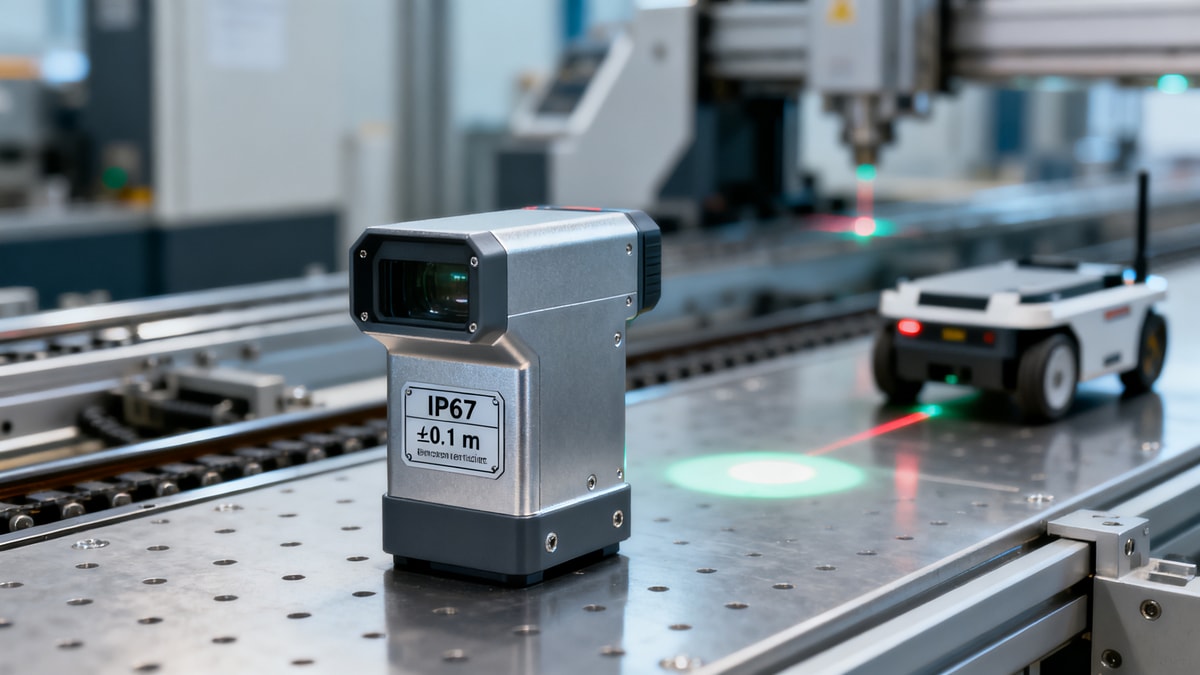
Global industrial laser distance meters (±0.1 mm accuracy, IP67-rated) saw a 9.3% weekly increase in FOB price to $2,140/unit, as reported in the Global Industrial Optics Price Watch dated May 2, 2026. This surge—driven by constrained supply of critical laser modules from Zeiss (Germany) and Keyence (Japan)—has extended average lead times to 14–18 weeks. Manufacturers in precision metrology, automated guided vehicle (AGV) integration, construction surveying, and industrial robotics should monitor implications for procurement cycles, system integration timelines, and export compliance.
Event Overview
According to the Global Industrial Optics Price Watch published on May 2, 2026, the global FOB average price of industrial-grade laser distance meters—defined as devices with ±0.1 mm accuracy and IP67 ingress protection—rose 9.3% week-on-week to $2,140 per unit. Concurrently, delivery lead times widened to 14–18 weeks. The report attributes this shift to reduced output capacity of core laser modules at Carl Zeiss AG (Germany) and Keyence Corporation (Japan). Chinese optical measurement equipment manufacturers are accelerating adoption of domestically sourced laser sources, subject to successful certification under IEC 60825-1:2024 for laser safety compliance prior to export.
Impact on Specific Industry Segments
Direct Trading Enterprises
Trading firms importing or exporting industrial laser distance meters face immediate margin compression and contractual risk due to sudden price volatility and extended lead times. Exposure is highest for those operating on fixed-price contracts with tight delivery windows or serving markets requiring rapid fulfillment (e.g., OEMs in semiconductor tooling).
Raw Material & Component Procurement Teams
Procurement units sourcing laser modules or integrated optical subassemblies are encountering tighter allocation, longer qualification cycles, and increased scrutiny of alternative suppliers’ compliance documentation—particularly IEC 60825-1:2024 certification status. Unverified domestic alternatives may delay final product validation.
Manufacturing & System Integration Firms
Companies integrating laser distance meters into larger systems—including AGVs, CNC coordinate measuring machines (CMMs), and structural monitoring platforms—are experiencing schedule slippage in pilot deployments and production ramp-ups. Design-for-manufacturability (DFM) reviews now require explicit verification of laser module availability and safety certification timelines.
Supply Chain & Logistics Service Providers
Third-party logistics and customs brokers supporting cross-border shipments of certified optical instruments must verify updated technical documentation (e.g., IEC 60825-1:2024 test reports) for export clearance—especially for shipments from China to EU or North American markets where regulatory enforcement has intensified.
What Stakeholders Should Monitor and Act On
Track official certification updates for domestic laser sources
Chinese manufacturers adopting local laser modules must confirm whether their chosen components have completed full IEC 60825-1:2024 testing—and whether test reports are issued by ILAC-accredited labs. Non-accredited reports may not be accepted by EU Notified Bodies or U.S. FDA/CDRH reviewers.
Reassess inventory buffers for high-precision optical subsystems
Given the 14–18 week lead time extension, companies with just-in-time (JIT) procurement models should evaluate minimum buffer stock levels for calibrated laser distance meter units or drop-in replacement modules—particularly for applications where recalibration downtime exceeds acceptable thresholds.
Verify contract terms for price adjustment and force majeure clauses
Buyers and sellers negotiating new supply agreements should explicitly define triggers for price re-negotiation (e.g., >5% weekly index change) and clarify whether extended lead times resulting from upstream component shortages qualify as force majeure under governing law (e.g., CISG or national commercial code).
Monitor regional certification harmonization developments
While IEC 60825-1:2024 is globally referenced, implementation timelines vary: the EU’s EN 60825-1:2024 transition deadline is set for Q4 2026; the U.S. FDA currently accepts 2014 edition reports but expects alignment with 2024 revision for Class 3R devices by mid-2027. Stakeholders should align internal compliance roadmaps accordingly.
Editorial Perspective / Industry Observation
Observably, this price surge is less an isolated market fluctuation and more a stress-test signal for optical supply chain resilience. The dependency on two Tier-1 suppliers for mission-critical laser modules—despite growing domestic capability—highlights persistent bottlenecks in high-reliability photonic component manufacturing. Analysis shows that while Chinese firms are progressing on source substitution, the IEC 60825-1:2024 certification barrier remains a pacing item—not merely a paperwork step, but a multi-month validation process involving beam profiling, exposure limit verification, and interlock testing. From an industry perspective, this episode functions primarily as an early-warning indicator: it reflects tightening capacity at the foundational layer of industrial photonics, rather than transient demand pressure.
Current more suitable understanding is that this is a structural inflection—not a cyclical blip. The 9.3% weekly jump signals a break in historical pricing stability, and the 14–18 week lead times suggest capacity constraints are unlikely to ease before Q3 2026, absent significant capital investment announcements from Zeiss or Keyence.
Conclusion: This development underscores how upstream optical component availability directly constrains downstream automation and precision engineering deployment. For stakeholders, the priority is not forecasting when prices will stabilize—but adjusting procurement cadence, validating alternative compliance pathways, and mapping certification dependencies across the value chain. Rational response centers on operational adaptability, not speculation on reversal timing.
Source: Global Industrial Optics Price Watch, May 2, 2026. Note: Certification status of specific domestic laser modules and timeline for Zeiss/Keyence capacity restoration remain under observation and are not confirmed in the source report.
Technical Specifications
- India BIS Draft IS 17832:2026 Sets Noise & Dust Limits for Waste CrushersAuthor :Environmental Engineering Director
- Korea MFDS Mandates Korean UI & KOSHA OEL Database for Industrial Water AnalyzersAuthor :Precision Metrology Expert
- Indonesia BPOM Mandates PM0.1 Efficiency & CADR Decay Labeling for Industrial Air PurifiersAuthor :Environmental Engineering Director
Expert Insights

Chief Security Architect
Dr. Thorne specializes in the intersection of structural engineering and digital resilience. He has advised three G7 governments on industrial infrastructure security.
Related Analysis
- May 03, 2026India BIS Draft IS 17832:2026 Sets Noise & Dust Limits for Waste CrushersAuthor :Environmental Engineering Director
- May 03, 2026Korea MFDS Mandates Korean UI & KOSHA OEL Database for Industrial Water AnalyzersAuthor :Precision Metrology Expert
- May 03, 2026Indonesia BPOM Mandates PM0.1 Efficiency & CADR Decay Labeling for Industrial Air PurifiersAuthor :Environmental Engineering Director
Core Sector // 01
Security & Safety
- Global Industrial Laser Distance Meter Price Index Up 9.3% WeeklyAuthor :Precision Metrology Expert

- Noise Monitoring Terminal Data Looks Normal, but Is It Trustworthy?Author :Precision Metrology Expert

- Stack Gas Analyzer Calibration Issues That Lead to Bad DecisionsAuthor :Precision Metrology Expert

- Portable Water Testing Kits: What Field Errors Skew Results?Author :Precision Metrology Expert

- Continuous Emission Monitoring CEMS: Data Gaps That Raise RiskAuthor :Precision Metrology Expert

- Gold Wash Plant Equipment That Cuts Recovery LossesAuthor :Precision Metrology Expert

- KC Certification Update: Industrial Laser Dust Meters Require Class II Div 2 Explosion-Proof HousingAuthor :Precision Metrology Expert

- ESMA Mandates EN 14181 QA/QC Level 3 for Industrial Water Sensors in UAEAuthor :Precision Metrology Expert