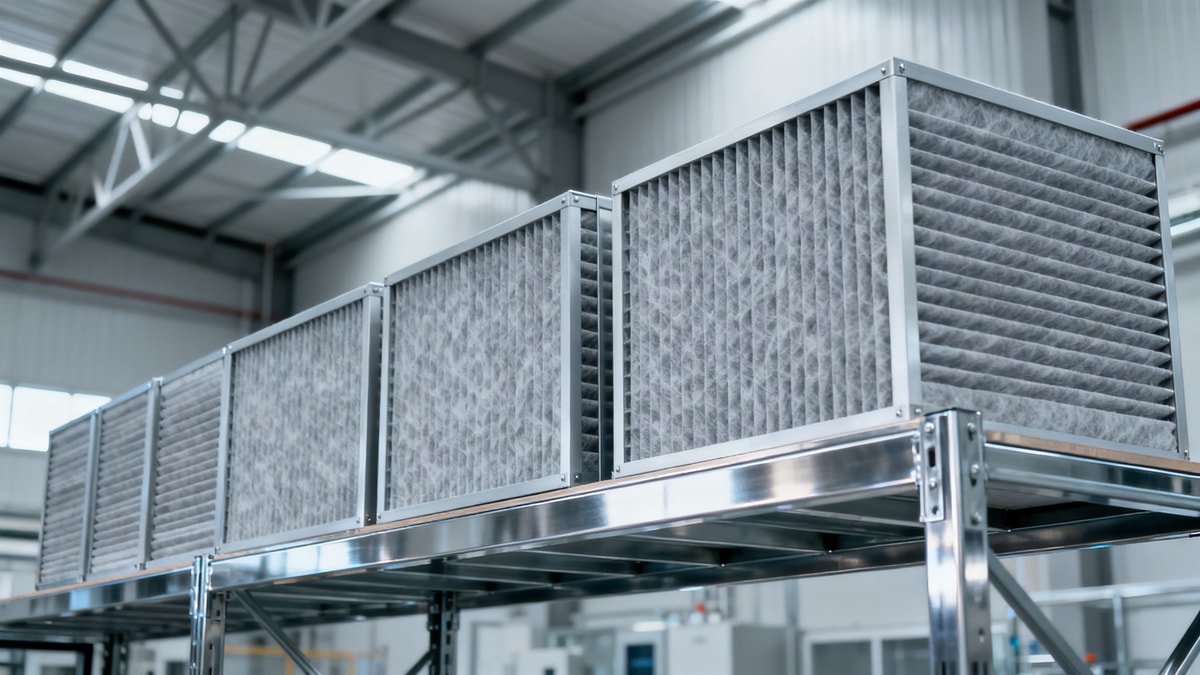
Global Industrial HEPA Filter Lead Times Extend to 24 Weeks
Author
Date Published
Reading Time

Global industrial-grade air filter lead times have extended to 22–24 weeks, according to the International Filtration Association’s (IFA) Global Filter Media Supply Chain Alert, released on May 1, 2026. This development stems from redirected production capacity for HEPA substrate base cloth — specifically polypropylene melt-blown fabric with PTFE lamination — toward military-grade chemical and biological protective equipment in the U.S., Japan, and South Korea. Manufacturers of industrial air filtration systems, especially those exporting to the EU, Middle East, and Southeast Asia, are now facing prolonged delivery cycles. The situation is prompting select high-end customers to initiate validation of domestically sourced alternative base cloths.
Event Overview
On May 1, 2026, the International Filtration Association (IFA) issued its Global Filter Media Supply Chain Alert, reporting that the global average lead time for industrial-grade HEPA filter base cloth — composed of polypropylene melt-blown material laminated with PTFE — has extended to 22–24 weeks. The cause cited is synchronized expansion of military orders for chemical and biological protective gear across the United States, Japan, and South Korea, resulting in reallocation of HEPA substrate production capacity away from civilian industrial applications.
Impact on Specific Industry Segments
Direct Exporters & Trading Firms
Export-oriented air filter manufacturers supplying the EU, Middle East, and Southeast Asia are experiencing delayed order fulfillment due to upstream material shortages. Impact manifests as contract renegotiation pressure, increased customer escalation, and potential loss of repeat business where delivery reliability is a contractual KPI.
Raw Material Procurement Teams
Procurement units responsible for sourcing HEPA base cloth face constrained supplier options and longer forecast horizons. The bottleneck is not in finished filters but at the substrate level — making traditional vendor qualification and dual-sourcing strategies less effective unless applied earlier in the supply chain.
Filter Manufacturing & Assembly Facilities
Industrial filter producers relying on imported HEPA base cloth are encountering production scheduling disruptions. Inventory buffers are depleting faster than replenishment, leading to batch delays and reduced throughput — particularly for Class H13–H14 filters used in cleanrooms, pharma, and semiconductor facilities.
Supply Chain & Logistics Service Providers
Third-party logistics and customs brokerage firms supporting cross-border filter shipments are observing increased documentation complexity and client queries related to force majeure clauses, shipment rescheduling, and origin-of-material traceability — especially for EU REACH and CE marking compliance where substrate composition is increasingly scrutinized.
What Relevant Enterprises or Practitioners Should Monitor and Do Now
Track official updates from national filtration associations and export control agencies
Analysis shows that military procurement shifts may trigger further export licensing reviews or quota adjustments — especially for dual-use filtration media. Monitoring statements from IFA, the U.S. Department of Commerce Bureau of Industry and Security (BIS), and Japan’s METI is advisable for early signals of policy tightening.
Validate alternative substrate suppliers — especially domestic or ASEAN-based ones — with priority on technical equivalence
Observably, some end users have already launched verification programs for non-Japanese/non-U.S. HEPA base cloth. Companies should prioritize testing for filtration efficiency (EN 1822-1:2019), airflow resistance, and hydrophobicity — rather than initiating full re-certification of finished filters unless required by end-market regulations.
Distinguish between short-term allocation constraints and structural capacity shifts
Current more appropriately reflects a near-term capacity reallocation, not permanent HEPA base cloth scarcity. From industry perspective, sustained extension beyond Q4 2026 would signal deeper industrial policy alignment — warranting reassessment of long-term material strategy.
Update customer communications proactively — focusing on transparency around root cause and mitigation timelines
Forward-looking manufacturers are revising delivery commitments with clear rationale (e.g., “HEPA substrate allocation shift per IFA May 2026 alert”) and providing rolling forecasts — reducing disputes and preserving trust, particularly with regulated-sector clients such as pharmaceutical or healthcare facility operators.
Editorial Perspective / Industry Observation
This alert is best understood as an early-stage supply chain signal — not yet a full-blown crisis, but one requiring active monitoring. Analysis shows it reflects a deliberate, government-coordinated reprioritization of critical filtration infrastructure toward national security applications, rather than generalized manufacturing disruption. Observably, the ripple effect is most acute at the interface between defense procurement policy and commercial industrial filtration standards — highlighting how dual-use materials can rapidly become constrained without broad market visibility. From industry angle, this underscores growing interdependence between geopolitical procurement trends and routine industrial operations — a dynamic likely to persist across other high-performance filter media categories in coming years.

Conclusion
This development does not indicate a collapse in global HEPA supply capacity, but rather a temporary reallocation driven by sovereign defense priorities. It serves as a reminder that industrial filtration — though often treated as a mature, stable segment — remains sensitive to macro-level policy decisions affecting dual-use materials. Current more appropriately reads as a supply planning inflection point, not a fundamental market shift — and warrants calibrated, evidence-based response over reactive procurement or strategic pivots.
Information Source
Main source: International Filtration Association (IFA), Global Filter Media Supply Chain Alert, issued May 1, 2026.
Points requiring ongoing observation: Further updates from IFA; national-level procurement announcements from U.S., Japanese, and South Korean defense ministries; and validation outcomes from Chinese manufacturers’ domestic base cloth trials.
Technical Specifications
- SASO Mandates Dual Energy Label for Industrial Transformers in Saudi Arabia from May 2026Author :Grid Infrastructure Analyst
- EN 61000-4-30:2026 Enforced: Class A Harmonic Traceability Mandatory for EU PQ AnalyzersAuthor :Precision Metrology Expert
- US DOE Level 3 Transformer Efficiency Standard Effective July 1, 2026Author :Grid Infrastructure Analyst
Expert Insights

Chief Security Architect
Dr. Thorne specializes in the intersection of structural engineering and digital resilience. He has advised three G7 governments on industrial infrastructure security.
Related Analysis
- May 06, 2026SASO Mandates Dual Energy Label for Industrial Transformers in Saudi Arabia from May 2026Author :Grid Infrastructure Analyst
- May 06, 2026EN 61000-4-30:2026 Enforced: Class A Harmonic Traceability Mandatory for EU PQ AnalyzersAuthor :Precision Metrology Expert
- May 06, 2026US DOE Level 3 Transformer Efficiency Standard Effective July 1, 2026Author :Grid Infrastructure Analyst
Core Sector // 01
Security & Safety
- Global Industrial HEPA Filter Lead Times Extend to 24 WeeksAuthor :Environmental Engineering Director

- Indonesia BPOM Accelerates Approval for Chinese Dust PurifiersAuthor :Environmental Engineering Director

- Global Industrial HEPA Filter Media Base Fabric Lead Times Extend to 24 WeeksAuthor :Environmental Engineering Director

- Indonesia BPOM Fast-Tracks Chinese Dust PurifiersAuthor :Environmental Engineering Director

- What drives hidden Environment & Ecology costs in dust controlAuthor :Environmental Engineering Director

- Indonesia BPOM Fast-Tracks Chinese Industrial Air PurifiersAuthor :Environmental Engineering Director

- Global Industrial Air Filter Lead Times Extend to 18–24 WeeksAuthor :Environmental Engineering Director

- Why Environment & Ecology Cost Estimates Miss Ongoing MaintenanceAuthor :Environmental Engineering Director