Electrostatic precipitator ESP vs baghouse in high temperature dust
Author
Date Published
Reading Time
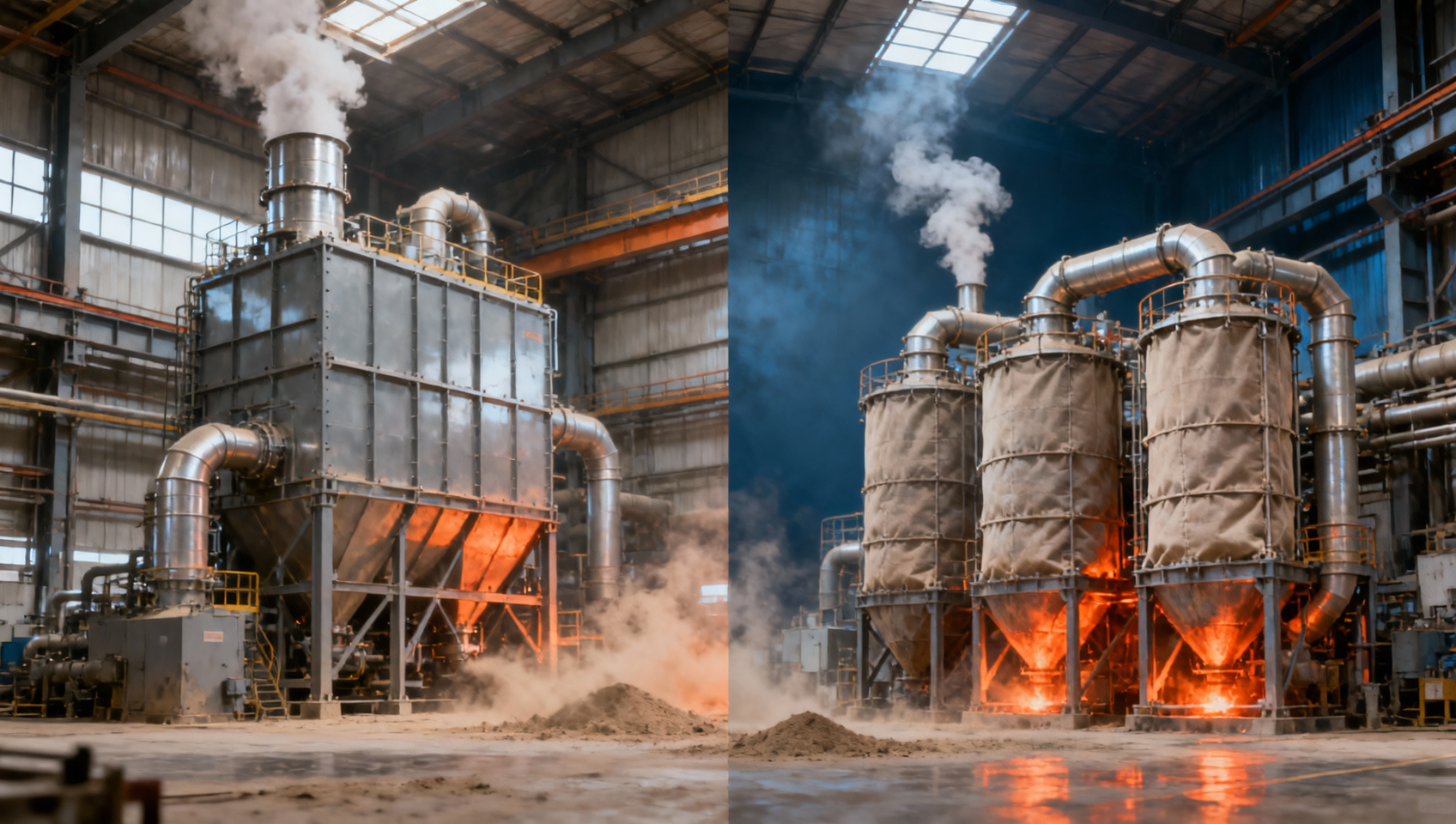
Choosing between an electrostatic precipitator ESP and a pulse jet baghouse for high-temperature dust control can determine compliance, uptime, and long-term operating cost. For EPC teams, plant operators, buyers, and decision-makers comparing an industrial dust collector, this guide explains how particle size, gas temperature, emissions targets, and maintenance demands influence the best-fit solution.
In heavy industry, dust collection is not a commodity purchase. It directly affects stack emissions, fan power, shutdown frequency, refractory life, worker safety, and the ability to run continuously under demanding thermal loads. A wrong selection can lock a facility into years of avoidable maintenance, unstable pressure drop, or costly retrofits.
High-temperature dust streams are especially complex because gas composition, particle resistivity, dew point, explosibility, and load fluctuations all interact. Cement kilns, sinter plants, biomass boilers, non-ferrous smelters, foundries, and waste heat recovery systems each present different operating windows, often from 160°C to above 350°C before conditioning.
For industrial buyers, the real question is not whether an ESP or baghouse is “better” in general. The right question is which technology is better for a specific duty point, emissions limit, maintenance model, and lifecycle budget. The sections below break down the decision in a practical B2B format.
How ESP and baghouse systems work under high-temperature dust conditions
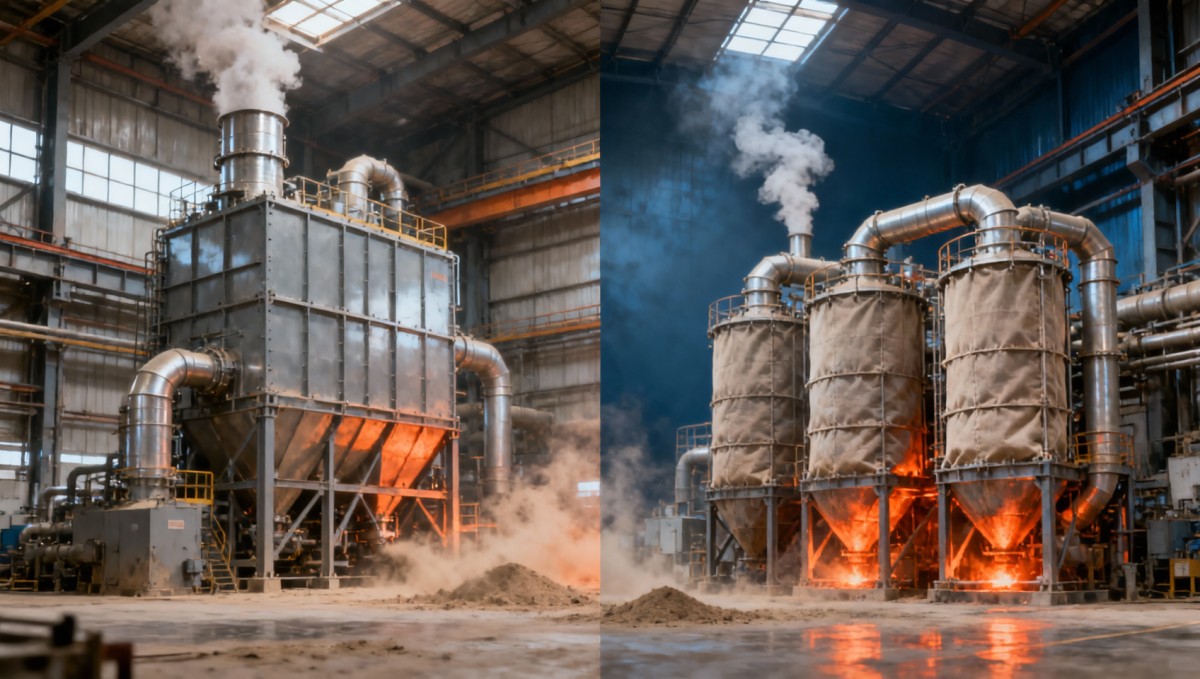
An electrostatic precipitator removes particles by electrically charging them and collecting them on grounded plates. Dust is then dislodged by rappers and falls into hoppers. In high-volume flue gas service, an ESP can handle large gas flow rates with relatively low pressure drop, often in the range of 100–250 Pa, which can reduce fan energy compared with fabric systems.
A pulse jet baghouse filters dust through bags made from heat-resistant media such as PPS, aramid, PTFE membrane laminates, glass fiber, or blended fabrics. Dust accumulates on the bag surface and periodic compressed air pulses clean the cake. In many industrial applications, operating pressure drop typically falls between 1000–1800 Pa, depending on air-to-cloth ratio, dust loading, and cleaning strategy.
For high-temperature duty, the thermal threshold is one of the first engineering filters. Standard polyester media is unsuitable for streams above about 130°C, while aramid may serve around 200°C and glass fiber can work in the 240–260°C range under controlled chemistry. ESP internals can tolerate higher gas temperatures, but collection performance becomes sensitive to particle resistivity and gas properties.
This means the two technologies solve the same emissions problem through very different physical mechanisms. ESP performance depends heavily on electrical conditions, particle charging behavior, and stable gas distribution. Baghouse performance depends more on media compatibility, filtration velocity, cleaning frequency, and the ability to avoid condensation, blinding, or bag degradation.
Core operating differences that affect selection
From a process engineering view, the most important differences usually include five variables: gas temperature, dust resistivity, outlet emission target, available pressure budget, and maintenance capability on site. If one of these is misread during FEED or tendering, total ownership cost can shift significantly within the first 12–24 months.
- ESPs are often favored when gas volumes are very large and pressure drop must stay low.
- Baghouses are commonly chosen when very low particulate emissions are required, especially below 20 mg/Nm³ and often below 10 mg/Nm³ with proper media and sealing.
- ESPs can be less attractive for highly variable dust chemistry or high-resistivity particles that reduce collection efficiency.
- Baghouses need tighter control of temperature excursions, acid dew point margin, and compressed air quality.
The comparison below summarizes the operational logic that procurement and engineering teams typically evaluate at the concept stage.
The key takeaway is that ESPs tend to win on low resistance and large gas handling, while baghouses tend to win on low emissions certainty and adaptability to strict particulate limits. The plant’s actual process envelope, not vendor preference alone, should drive the specification.
Selection criteria: temperature, particle size, emissions, and process variability
A practical selection starts with four engineering inputs: gas temperature profile, inlet dust concentration, particle size distribution, and target outlet emissions. These values are more useful than broad claims because both ESP and baghouse performance can shift significantly when operating conditions move even 10–20% away from design.
Temperature should be reviewed as a full range, not a single design point. For example, a normal operating condition of 210°C may seem suitable for a high-temperature baghouse, but startup excursions to 260°C, sudden air in-leakage, or upset chemistry can shorten bag life dramatically. On the ESP side, higher temperature may be mechanically acceptable yet still create collection instability if resistivity enters an unfavorable range.
Particle size also matters. Fine particles below 2.5 microns are often more challenging in any system, but baghouses generally maintain strong capture because filtration forms a dust cake barrier. ESPs can perform very well on many dusts, yet fine, high-resistivity particles may require larger collecting area, gas conditioning, or multi-field designs to hold emissions consistently.
Emissions targets are increasingly decisive. If a facility must reliably meet levels under 10 mg/Nm³, the baghouse often becomes the more straightforward route, especially when regulatory enforcement is strict and process variation is frequent. If the requirement is less aggressive and energy efficiency is a priority, an ESP may remain highly competitive.
Typical conditions that favor one technology over the other
Below is a simplified decision matrix used in early-stage evaluation. It does not replace pilot data or detailed process guarantees, but it helps narrow the shortlist before issuing RFQs.
For most EPC teams, these inputs should be checked against at least 6 practical design questions: minimum and maximum gas temperature, upset duration, inlet grain loading, dust chemistry, stack limit, and planned maintenance staffing. Missing any one of these can create a specification gap that only appears after commissioning.
Questions procurement teams should ask before tendering
- What is the normal, minimum, and peak temperature, and how long do excursions last?
- What outlet dust limit must be met at full load and partial load?
- How variable is the dust composition across seasons, fuel blends, or raw material changes?
- Is fan capacity sufficient for an additional 1000–1500 Pa if a baghouse is selected?
- Is the plant prepared for bag replacement cycles, compressed air maintenance, or HV transformer maintenance?
These questions turn a generic dust collector purchase into a more controlled engineering decision. They also help buyers compare quotations on equal technical grounds instead of being distracted by only initial capex.
Lifecycle cost, maintenance burden, and uptime impact
The initial purchase price tells only part of the story. In high-temperature dust service, lifecycle cost is driven by fan energy, compressed air demand, replacement parts, outage planning, and the financial cost of emissions non-compliance. A lower-capex system can become more expensive within 3–5 years if maintenance demand is underestimated.
ESPs often benefit from lower pressure drop, which can reduce electricity use on large induced-draft fans. However, they may require more sophisticated tuning, rapper maintenance, insulator care, transformer-rectifier support, and attention to gas flow distribution. If dust properties change with fuel or feedstock, performance drift can appear without obvious mechanical failure.
Baghouses bring a different cost profile. They usually consume more fan power and compressed air, and they require periodic bag inspections and planned replacement. Depending on media, chemistry, and operating discipline, bag life may range from about 18 months to 5 years. Poor temperature control, acid attack, or abrasive dust can shorten that interval significantly.
From an uptime perspective, many operators value baghouses for their predictable filtration behavior once the system is correctly sized and maintained. ESPs can deliver long service life, but in difficult dust conditions they may need more process-sensitive optimization to keep emissions stable through load changes and upset events.
Cost and maintenance comparison for industrial planning
The table below highlights common ownership considerations used in budgetary comparison. Actual cost depends on gas volume, materials, region, and compliance level, but the framework is useful when evaluating proposals.
The operational conclusion is straightforward: if your plant values low pressure drop above all else and process conditions are well understood, an ESP can be highly economical. If your plant faces changing fuels, tighter emissions, or less tolerance for performance drift, a baghouse often reduces compliance risk even with higher routine operating costs.
Frequent maintenance mistakes to avoid
- Selecting bag media by temperature alone and ignoring acid dew point, abrasion, or hydrolysis risk.
- Assuming ESP performance at nominal load will remain unchanged during fuel changes or lower-load operation.
- Undersizing hopper evacuation and causing dust re-entrainment in either system.
- Comparing only capex and ignoring 24-month operating cost, outage cost, and spare strategy.
For procurement leaders, this is why lifecycle evaluation should cover at least a 3-year horizon and preferably 5 years for large plants. The larger the gas flow, the more small efficiency differences compound into meaningful annual cost.
Application scenarios and procurement guidance for EPC and plant teams
Different industries prioritize different outcomes. Cement and lime plants often work with large gas volumes, abrasive dust, and high temperatures, making both ESP and baghouse options relevant depending on emissions limits and raw mill integration. Metallurgy and smelting operations may face finer particles, corrosive components, and greater process instability, which often pushes selection toward robust high-temperature filtration media.
For power and boiler-related applications, fuel type matters. Biomass ash, coal ash, mixed fuel streams, and waste-derived fuels all behave differently. A system that performs well on one ash chemistry may become difficult on another. That is why the procurement file should always include a fuel envelope or process variability statement, not just a single-point design basis.
EPC contractors also need to look beyond collector performance and consider package integration. Duct layout, expansion joints, bypass provisions, insulation, hopper heating, explosion isolation, access platforms, and instrumentation can materially affect reliability. A dust collector that is technically sound on paper can still underperform if the balance of plant is weak.
For enterprise decision-makers, the best procurement strategy is usually specification-led rather than quotation-led. Define the duty in measurable terms, request guarantee points, review spare philosophy, and verify what happens during startup, trip recovery, and partial-load operation.
A practical 5-step buying framework
- Confirm the process envelope: gas flow, temperature range, chemistry, dust loading, and upset conditions.
- Set the compliance target: stack limit, monitoring method, and acceptable margin during transient operation.
- Evaluate utilities and plant constraints: fan reserve, compressed air, footprint, shutdown windows, and access.
- Compare lifecycle factors: media replacement, electrical maintenance, energy use, spare parts, and operator skill level.
- Request documented guarantees and a commissioning plan covering at least the first 72 hours of stable operation.
Recommended RFQ checklist
A strong RFQ reduces technical ambiguity and improves bid comparability. The checklist below is useful for procurement teams working across multiple regions or with mixed vendor bases.
When this checklist is applied early, plant teams usually reduce change orders, clarify accountability, and speed up technical alignment between operations, engineering, and commercial stakeholders.
FAQ: common high-temperature dust collector questions
Is a baghouse always better for low emissions?
Not always, but often. If the target is below 10–20 mg/Nm³ and the process experiences variable dust conditions, a baghouse is usually the more direct path. However, an ESP may still be viable if gas chemistry is favorable, flow distribution is well engineered, and adequate collecting area is provided.
When does high temperature make ESP the safer choice?
ESP can become attractive when gas temperatures are continuously high and there is limited confidence in available filter media, or when excursions exceed the thermal margin of fabric systems. That said, “safer” should be judged against emissions reliability, not only temperature tolerance. Some plants install gas cooling or dilution specifically to enable a baghouse solution.
What is the biggest procurement mistake in ESP vs baghouse projects?
The most common mistake is evaluating the collector in isolation. Buyers focus on the vessel and ignore duct design, hopper discharge, insulation, controls, spare strategy, and startup logic. In practice, at least 20–30% of avoidable performance issues are linked to system integration rather than the core collector body alone.
How long does implementation usually take?
For retrofit projects, engineering and supply can range from about 12–28 weeks depending on scope, materials, and regional logistics. Installation duration may add another 1–4 weeks if shutdown access is available. Complex EPC packages involving structural changes, gas conditioning, or major duct rerouting usually need longer planning windows.
For facilities handling high-temperature dust, the ESP versus baghouse decision should be made through process data, emissions requirements, maintenance realities, and lifecycle economics rather than generic preference. ESP systems often make sense for very large flows and low pressure drop priorities, while baghouses often lead when particulate limits are tight and process variability is high.
If your team is comparing industrial dust collector options for a new project, retrofit, or compliance upgrade, a structured technical review will save time and reduce procurement risk. Global Industrial Core supports EPC contractors, operators, buyers, and decision-makers with practical industrial sourcing insight, specification guidance, and solution-oriented evaluation frameworks.
Contact us to discuss your operating conditions, obtain a tailored comparison, or explore more high-temperature dust control solutions aligned with your plant’s compliance and uptime goals.
Technical Specifications
- How to choose an organic fertilizer machine for wet raw materialsAuthor :Environmental Engineering Director
- What affects output stability in a hydraulic briquetting pressAuthor :Environmental Engineering Director
- Waste paper baler wholesale prices vary for reasons beyond tonnageAuthor :Environmental Engineering Director
Expert Insights

Chief Security Architect
Dr. Thorne specializes in the intersection of structural engineering and digital resilience. He has advised three G7 governments on industrial infrastructure security.
Related Analysis
- Apr 16, 2026How to choose an organic fertilizer machine for wet raw materialsAuthor :Environmental Engineering Director
- Apr 16, 2026What affects output stability in a hydraulic briquetting pressAuthor :Environmental Engineering Director
- Apr 16, 2026Waste paper baler wholesale prices vary for reasons beyond tonnageAuthor :Environmental Engineering Director
Core Sector // 01
Security & Safety
- Electrostatic precipitator ESP vs baghouse in high temperature dustAuthor :Environmental Engineering Director

- Commercial kitchen exhaust hood sizing mistakes that hurt captureAuthor :Environmental Engineering Director

- HVAC ozone generator use cases where odor control can backfireAuthor :Environmental Engineering Director

- Industrial humidifiers wholesale orders often miss water quality limitsAuthor :Environmental Engineering Director

- Commercial dehumidifiers that work in cold rooms need a closer lookAuthor :Environmental Engineering Director

- AHU handling units: where energy loss often starts in the design stageAuthor :Environmental Engineering Director

- Activated carbon air filter life span depends on more than airflowAuthor :Environmental Engineering Director

- Pocket air filters with low pressure drop are not always the best fitAuthor :Environmental Engineering Director