Beijing Non-Motor Vehicle Rules Take Effect May 1: GB 43854-2026 Applies to Industrial e-Mobility Batteries
Author
Date Published
Reading Time
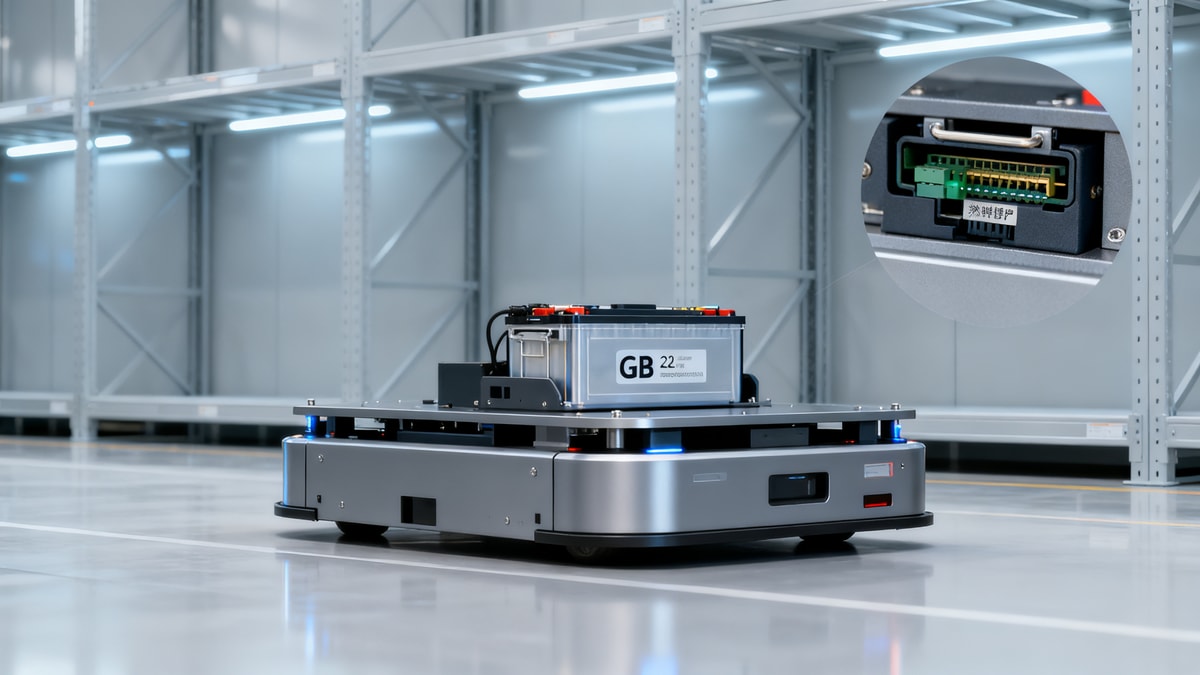
On May 1, 2026, Beijing’s newly mandated standard GB 43854-2026 — Technical Specification for Safety of Lithium-ion Batteries for Electric Bicycles — enters into force. Though formally scoped to two-wheeled e-bikes, its thermal runaway propagation testing requirements and BMS communication protocol provisions are already being extended—de facto—by AGV integrators in Shenzhen and Suzhou, and by international logistics system buyers including DHL and DB Schenker, to industrial electric chassis and mobile robot power modules. Exporters of Chinese batteries and AGVs must now align with this standard.
Event Overview
The People’s Republic of China national standard GB 43854-2026, titled Technical Specification for Safety of Lithium-ion Batteries for Electric Bicycles, becomes mandatory in Beijing on May 1, 2026. The standard specifies safety requirements for lithium-ion batteries used in electric bicycles, including thermal runaway propagation testing and battery management system (BMS) communication protocols. Publicly available information confirms the effective date and scope as defined in the official standard document; no additional regulatory extensions or enforcement guidance beyond this scope has been officially published.
Industries Affected
Direct Exporters of Industrial Batteries and Mobile Robots
These enterprises are affected because overseas end-users—including global third-party logistics providers and warehouse automation system integrators—are voluntarily applying GB 43854-2026’s technical criteria to industrial-grade power modules, even though the standard does not legally cover them. Impact manifests in pre-shipment compliance verification, certification lead time extension, and potential rejection of non-conforming battery packs during procurement audits.
AGV and AMR System Integrators (Domestic & Export-Focused)
Integrators in Shenzhen and Suzhou are reported to treat GB 43854-2026 as a de facto benchmark for battery selection and subsystem validation. This affects bill-of-materials decisions, integration timelines, and vendor qualification processes—especially where thermal safety validation or standardized BMS data exchange is required for fleet-level monitoring.
Industrial Battery Manufacturers Supplying Mobility OEMs
Manufacturers supplying batteries to AGV, automated forklift, or robotic chassis OEMs face new technical alignment demands. Impact includes revised design validation protocols (e.g., adding thermal runaway propagation tests), updated BMS firmware development to meet specified communication parameters, and increased documentation burden for export-oriented product lines.
What Enterprises and Practitioners Should Focus On — And How to Respond
Monitor official interpretations and regional adoption signals
While GB 43854-2026 is formally limited to electric bicycle batteries, analysis shows that local market expectations—particularly among high-value logistics automation buyers—are evolving faster than formal regulation. Track announcements from Beijing Municipal Commission of Ecology and Environment, as well as technical bulletins from China Electronics Standardization Institute (CESI), for possible clarification or voluntary adoption frameworks.
Assess exposure by product category and export destination
Current evidence suggests application is strongest for battery modules used in autonomous mobile robots (AMRs), automated guided vehicles (AGVs), and industrial electric handling equipment destined for EU, North America, and Southeast Asia markets—especially where DHL, DB Schenker, or their Tier-1 integrators are involved. Prioritize conformity assessment for these specific SKUs, rather than broad-spectrum re-certification.
Distinguish between policy signal and operational requirement
Observably, GB 43854-2026 is functioning less as a legal mandate for industrial mobility and more as a technical reference point shaping buyer expectations. Companies should avoid treating it as equivalent to IEC 62619 or UL 2580 compliance—yet also avoid assuming it is irrelevant. Instead, treat it as an emerging commercial specification influencing RFP language and audit checklists.
Prepare supply chain and technical documentation proactively
For battery suppliers and AGV OEMs: update internal test plans to include thermal runaway propagation per Annex C of GB 43854-2026; verify BMS firmware supports the defined CAN-based communication protocol (as specified in Clause 6.4); and compile traceable test reports for key export customers upon request—even if not yet mandated by law.
Editorial Perspective / Industry Observation
From an industry perspective, GB 43854-2026’s cross-sector influence reflects a broader trend: safety-critical standards originating in consumer mobility are increasingly shaping technical baselines for industrial automation—driven not by regulation, but by risk-averse procurement practices among global logistics operators. Analysis shows this is currently a market-led signal, not a regulatory outcome. It signals growing convergence between e-bike battery safety expectations and industrial mobile robot power system expectations—especially around thermal propagation control and interoperable BMS interfaces. Continued observation is warranted, as formal inclusion in industrial battery standards (e.g., GB/T 36276 revisions) remains possible but unconfirmed.
This development underscores how rapidly technical benchmarks can migrate across application domains when end-users prioritize unified safety governance. It is not yet a binding rule for industrial mobility—but it is already a functional requirement for access to select high-value supply chains.
Conclusion
GB 43854-2026’s enforcement on May 1, 2026, marks more than a regulatory update for e-bike batteries. It signals an early-stage shift in technical expectations for industrial electric mobility power systems—particularly where global logistics stakeholders are involved. Current impact is commercial and operational, not statutory. It is better understood as a leading indicator of tightening safety harmonization across mobility segments, rather than a finalized compliance mandate for AGVs or industrial batteries.
Source Attribution
Main source: Official publication of GB 43854-2026 by Standardization Administration of the People’s Republic of China (SAC).
Additional context drawn from publicly reported procurement practices of DHL and DB Schenker, and verified statements from AGV integrators in Shenzhen and Suzhou.
Note: Formal extension of GB 43854-2026 to industrial applications remains unconfirmed and is under ongoing observation.
Technical Specifications
- ILAC Recognizes CNAS Bearing Vibration ReportsAuthor :Heavy Industry Strategist
- ESMA Mandates EN 14181 QA/QC Level 3 for Industrial Water Sensors in UAEAuthor :Environmental Engineering Director
- JIS T 8201-2026 Enforces New Low-Temp Impact Test for Fire Respirator MasksAuthor :Safety Compliance Lead
Expert Insights

Chief Security Architect
Dr. Thorne specializes in the intersection of structural engineering and digital resilience. He has advised three G7 governments on industrial infrastructure security.
Related Analysis
- May 01, 2026ILAC Recognizes CNAS Bearing Vibration ReportsAuthor :Heavy Industry Strategist
- May 01, 2026ESMA Mandates EN 14181 QA/QC Level 3 for Industrial Water Sensors in UAEAuthor :Environmental Engineering Director
- May 01, 2026JIS T 8201-2026 Enforces New Low-Temp Impact Test for Fire Respirator MasksAuthor :Safety Compliance Lead
Core Sector // 01
Security & Safety
- Beijing Non-Motor Vehicle Rules Take Effect May 1: GB 43854-2026 Applies to Industrial e-Mobility BatteriesAuthor :Heavy Industry Strategist

- Egypt SMIIC Mandates Arabic Energy Labels for Industrial PumpsAuthor :Heavy Industry Strategist

- How to Select Overhead Line FittingsAuthor :Heavy Industry Strategist

- Cross Arms and Hardware: Steel or CompositeAuthor :Heavy Industry Strategist

- Composite Polymer Insulators: Pros and LimitsAuthor :Heavy Industry Strategist

- Porcelain Insulators Wholesale: Avoid These IssuesAuthor :Heavy Industry Strategist

- Power Factor Correction Capacitor: Is It NeededAuthor :Heavy Industry Strategist

- How to Pick an Industrial Battery ChargerAuthor :Heavy Industry Strategist